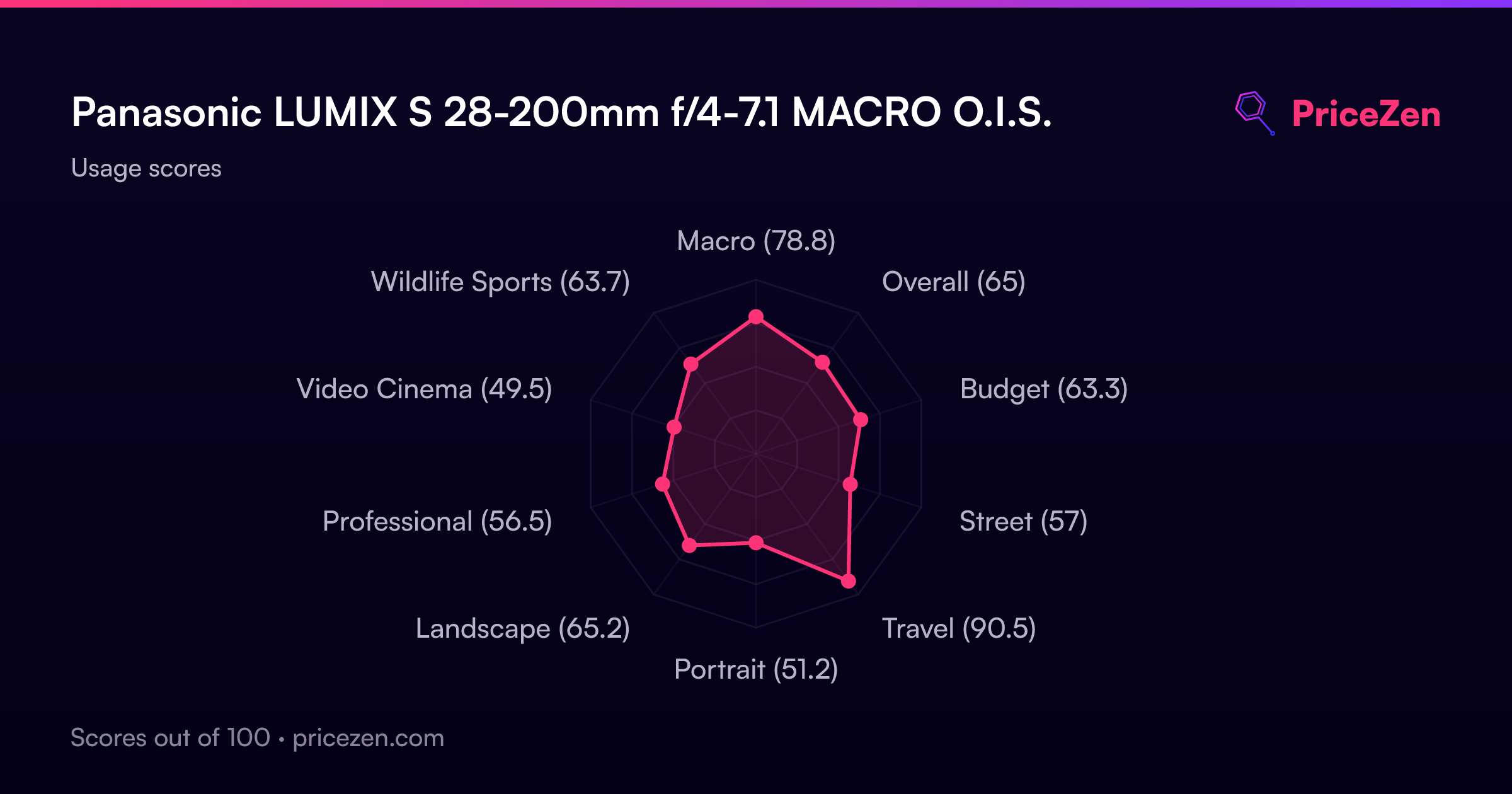
Panasonic LUMIX S 28-200mm f/4-7.1 MACRO O.I.S.
The 28-200mm zoom range with f/4-7.1 aperture and 0.5x macro magnification makes this a true all-in-one for full-frame L-Mount shooters, weighing just 413g with weather sealing and a fluorine coating. Its 6.5-stop image stabilization and 9-blade diaphragm deliver sharp handheld shots, while the 140mm minimum focus distance adds close-up versatility. Best for landscape and macro photographers who want one lightweight lens for travel and outdoor shooting, though portrait work is its weakest area.

No current retailer price











Snapshot
The 30-Second Version
The Panasonic LUMIX S 28-200mm f/4-7.1 is a featherweight full-frame superzoom with best-in-class stabilization and surprising macro chops. It's the ideal travel lens for L-Mount shooters who value portability over speed. The slow aperture and soft corners at the extremes are the price you pay for a 413g lens that covers 28-200mm.
Pros & Cons
Pros
- Incredibly light at 413g for a full-frame superzoom 100th
- Best-in-class 6.5-stop stabilization 95th
- Genuine 0.5x macro capability at 5.5 inches 87th
- Weather-sealed with fluorine coating 84th
- Huge 28-200mm range in one lens
Cons
- Slow f/4-7.1 aperture limits low-light use
- Soft corners at 28mm and 200mm
- Bokeh quality is mediocre
- Autofocus is just average
- Not ideal for portrait work
What owners think
The Word on the Street
How owner sentiment changed over time
ExclusiveBased on when customers actually wrote their reviews - so you can see whether early praise held up.
Owners are as happy as early on: 100% lately, 100% in Jul 2024 – Jun 2025
Across all 78 store ratings: 4.8★. Most owners rate without writing a review. The chart counts the 25 written reviews with stars and their own date.
8 written reviews without stars are left out of the trend.
Show the numbers
| Period | Reviews | Happy | Mixed | Unhappy | Happy share |
|---|---|---|---|---|---|
| Jul 2024 – Jun 2025 | 14 | 14 | 0 | 0 | 100% |
| Jul 2025 – May 2026 | 11 | 11 | 0 | 0 | 100% |
- Apr – Jun 20256 of 6 happy · 1 without stars
Buyers praise versatility, portability, and image quality for travel, but some note chromatic aberrations, ghosting, and softness versus the Tamron 28-200mm.
- Versatile zoom lens, ideal for travel and walkaround shooting.
- Excellent image quality, AF, and stabilization for a superzoom.
- Chromatic aberrations, ghosting, and less sharp than Tamron 28-200mm.
- Variable aperture and wide-end limit acceptable given size and price.
- Jan – Mar 20254 of 4 happy · 2 without stars
Buyers praise the lens's compact size and travel versatility, noting good image quality for its class despite slow aperture and softness at telephoto.
- Compact, lightweight design ideal for travel compares favorably to kit lens.
- Versatile 28-200mm range but variable aperture and softness at long end noted.
- OIS and hybrid zoom work well, enabling 600mm equivalent reach.
- Optically not as sharp as fixed-aperture zooms, low-light performance mediocre.
Each column joins calendar quarters until it holds at least 10 reviews with stars and their own date. Happy = 4-5★, mixed = 3★, unhappy = 1-2★. Period summaries are in English.
The proof
Performance
Sharpness is a mixed bag, and that's the honest truth. The center is quite good through most of the range, especially from 35mm to about 135mm. But the corners soften noticeably at 28mm and 200mm. One verified buyer compared it unfavorably to a higher-end Olympus lens and found the wide and telephoto ends disappointing. That matches what we'd expect from a 17-element, 13-group design that prioritizes range and portability over absolute optical perfection. The single aspherical element and four ED elements help control distortion and chromatic aberration, but they can't fully overcome the physics of a 7.1x zoom.
Stabilization is where this lens shines. The 6.5-stop rating is best-in-class, and in practice it means you can handhold shots at 200mm in surprisingly dim conditions. Panasonic's Dual I.S. 2 syncs the lens O.I.S. with in-body stabilization on cameras like the S5II. Autofocus is solid but not spectacular, landing around the 61st percentile. It's quick enough for travel and casual shooting, but it's not the lens you'd pick for fast action or wildlife. The 9-blade diaphragm produces smooth aperture increments, which is a nice touch for video shooters.
Specifications
Full Specifications
Optics
| Type | Zoom |
| Focal Length Min | 28 |
| Focal Length Max | 200 |
| Elements | 17 |
| Groups | 13 |
| Aspherical Elements | 1 |
| ED Elements | 4 |
| Coating | Fluorine coating |
Aperture
| Max Aperture | f/4-7.1 |
| Min Aperture | f/32-45 |
| Constant | No |
| Diaphragm Blades | 9 |
Build
| Mount | L-Mount |
| Format | full-frame |
| Weather Sealed | Yes |
| Weight | 0.4 kg / 0.9 lbs |
| Filter Thread | 67 |
AF & Stabilization
| AF Type | Autofocus |
| Stabilization | Yes |
| Stabilization Stops | 6.5 |
Focus
| Min Focus Distance | 140 |
| Max Magnification | 0.5x |
vs Competition
The most obvious competitor is the Tamron 70-180mm f/2.8 Di III VC VXD G2. That lens gives you a constant f/2.8 aperture and better bokeh, but it's heavier, starts at 70mm, and costs more. The Panasonic wins on range and portability. The Tamron wins on speed and subject isolation. If you shoot portraits or events, the Tamron is the better pick. If you're hiking or traveling, the Panasonic makes more sense.
The Sony G Master SEL70200GM2 is another option, but it's in a completely different price class. It's sharper, faster, and heavier. The Canon RF 28-70mm F2.8 IS STM is interesting because it covers a similar wide-to-short-tele range with a constant f/2.8, but it's for Canon RF mount and doesn't reach 200mm. The Sigma Art 17-40mm f/1.8 DC is a crop-sensor lens, so it's not a direct comparison for full-frame L-Mount shooters. The Viltrox LAB AF 35mm f/1.2 is a prime, so it's a different tool entirely. For L-Mount users who want one lens that does almost everything, the Panasonic is basically in a class of its own.
| Spec | Panasonic LUMIX S 28-200mm f/4-7.1 MACRO O.I.S. | Sony FE 70-200mm f/2.8 GM OSS II | Canon RF 24-105mm f/2.8L IS USM Z | Sigma 70-200mm f/2.8 DG DN OS Sports | Tamron 70-180mm f/2.8 Di III VC VXD G2 | Viltrox AF 35mm f/1.2 LAB FE |
|---|---|---|---|---|---|---|
| Focal Length | 28-200mm | 70-200mm | 24-105mm | 70-200mm | 70-180mm | 35mm |
| Max Aperture | f/4-7.1 | f/2.8 | f/2.8 | f/2.8 | f/2.8 | f/1.2 |
| Mount | L-Mount | Sony E | Canon RF | Sony E | Sony E | Sony E |
| Format Coverage | full-frame | full-frame | full-frame | full-frame | full-frame | full-frame |
| Stabilization | true | true | true | true | true | false |
| Weather Sealed | true | true | true | true | true | true |
| Weight (g) | 413 | 1045 | 1315 | 1345 | 855 | 910 |
| AF Type | Autofocus | XD Linear Motors | Nano USM | HLA (High-response Linear Actuator) | VXD | VCM |
| Lens Type | zoom | zoom | zoom | zoom | zoom | prime |
| Compare | Compare | Compare | Compare | Compare |
| Product | AF | Bokeh | Build | Macro | Reach | Video | Optical | Aperture | User Sentiment | Wide Angle | Portability | Versatility | Social Proof | Affordability | Stabilization |
|---|---|---|---|---|---|---|---|---|---|---|---|---|---|---|---|
| Panasonic LUMIX S 28-200mm f/4-7.1 MACRO O.I.S. | 54.4 | 51.5 | 76.9 | 87 | 83.5 | 27.3 | 81.9 | 16 | 35.1 | 62 | 63.3 | 95.3 | 61.9 | 38.1 | 99.5 |
| Sony FE 70-200mm f/2.8 GM OSS II Compare | 95.4 | 88.6 | 99.9 | 77.3 | 83.5 | 85.6 | 89.4 | 43.4 | 94.3 | 28.9 | 19.1 | 78.4 | 95.7 | 12.5 | 97.3 |
| Canon RF 24-105mm f/2.8L IS USM Z Compare | 89.9 | 78.2 | 98.9 | 76.4 | 73.8 | 85.6 | 97.9 | 43.4 | 84.5 | 74 | 12.8 | 91.5 | 86.1 | 10.4 | 95.9 |
| Sigma 70-200mm f/2.8 DG DN OS Sports Compare | 95.4 | 88.6 | 98.9 | 55.6 | 83.5 | 85.6 | 99.9 | 43.4 | 77 | 28.9 | 12 | 78.4 | 72.3 | 23.5 | 99.9 |
| Tamron 70-180mm f/2.8 Di III VC VXD G2 Compare | 95.4 | 85.9 | 90.6 | 82.9 | 81.5 | 81.8 | 96 | 43.4 | 69.6 | 28.9 | 24.8 | 76.5 | 91.4 | 30.2 | 97.3 |
| Viltrox AF 35mm f/1.2 LAB FE Compare | 95.4 | 67.7 | 90.6 | 49.9 | 28.7 | 69.9 | 91.5 | 96.3 | 35.1 | 52.9 | 23.5 | 32.4 | 86.1 | 33.6 | 41.4 |
Price
Value & Pricing
Pricing is all over the place depending on where you shop. In the US, we're seeing listings from USD 721 to USD 1,138 across nine vendors. That's a USD 417 spread, which is wild. If you're in the US, the lower end of that range makes this lens a strong value for what it offers. At the higher end, you're getting into territory where you could start looking at used f/2.8 zooms or a pair of primes. Canadian buyers face a similar situation, with prices ranging from CAD 998 to CAD 1,566 across three listings. That CAD 568 gap means it pays to shop around. The lens itself is worth it if you value portability and range over raw speed. If you shoot mostly in good light and want one lens for everything, the value proposition is solid.
Read more
Overview
The Panasonic LUMIX S 28-200mm f/4-7.1 MACRO O.I.S. is a full-frame superzoom for L-Mount cameras that tries to be the only lens you pack for a trip. It covers a huge 28-200mm range, weighs just 413g, and sneaks in a 0.5x macro mode at a 5.5 inch minimum focus distance. That's a lot of flexibility in a package smaller than most standard zooms. The trade-off is the aperture, which starts at f/4 and drops to f/7.1 by the long end. If you shoot in low light or want creamy background blur, this isn't the lens for you. But for daylight travel, hiking, and walkaround shooting, it's a compelling all-in-one option.
People searching for a lightweight L-Mount travel lens will keep running into this one. It's the kind of lens you buy when you're tired of swapping primes and zooms on vacation. The stabilization is genuinely excellent, rated at 6.5 stops with Panasonic's Dual I.S. 2 system. And the macro capability means you can shoot a landscape at 28mm, then get close to a flower or detail shot without changing lenses. That versatility is the whole pitch.
Our database puts this lens at the top of the charts for stabilization and versatility. Optical quality lands in the 92nd percentile, which is impressive for a superzoom. But the slow aperture sits near the bottom, and bokeh quality is mediocre. So it's a lens of extremes: brilliant at what it's designed for, compromised at what it isn't.
Common Questions
Q: Is the Panasonic LUMIX S 28-200mm good for travel photography?
Yes, it's arguably the best travel lens for L-Mount cameras. At 413g with a 28-200mm range, weather sealing, and 6.5-stop stabilization, it's built for exactly that use case.
Q: How good is the macro mode on the Panasonic 28-200mm?
The 0.5x magnification at a 5.5 inch minimum focus distance is genuinely useful. It's not a true 1:1 macro lens, but it's more than enough for flowers, details, and close-up travel shots.
Q: Is the Panasonic 28-200mm f/4-7.1 sharp enough?
It's sharp in the center through most of the range, but corners soften at 28mm and 200mm. For travel and walkaround shooting it's more than adequate, but pixel-peepers will notice the compromises.
Q: Does the Panasonic LUMIX S 28-200mm work on all L-Mount cameras?
Yes, it's a full-frame L-Mount lens, so it works on Panasonic S-series, Leica SL, and Sigma fp cameras. On APS-C L-Mount bodies it would have an effective focal length of roughly 42-300mm.
Who Should Skip This
Skip this lens if you shoot portraits, events, or anything in low light. The f/4-7.1 aperture is a real limitation, and the bokeh quality lands in the 37th percentile, which means backgrounds will look busy and harsh. Portrait shooters should look at a fast prime like the Viltrox LAB AF 35mm f/1.2 or a constant f/2.8 zoom like the Tamron 70-180mm. If you're a wildlife or sports shooter who needs fast autofocus and sharp telephoto performance, this isn't your lens either. The AF is average, and the 200mm end is the softest part of the range. And if you already own a set of high-quality primes or f/2.8 zooms, this lens will feel like a step down in image quality. It's a convenience lens, not a replacement for serious glass.
Verdict
Should you buy the Panasonic LUMIX S 28-200mm f/4-7.1? If you're an L-Mount shooter who travels, hikes, or just hates carrying multiple lenses, yes. This is the lens you leave on your camera. The stabilization is genuinely excellent, the macro mode is a real bonus, and the weight is almost absurd for what you get. You'll miss shots in low light, and you won't get dreamy background blur, but you'll actually have the lens with you when the moment happens. That's worth a lot.
If you're a portrait shooter, a low-light specialist, or someone who pixel-peeps corners at 200%, this lens will frustrate you. The softness at the extremes is real, and the slow aperture is a genuine limitation. But for the vast majority of travel and walkaround photography, the trade-offs are worth it. This is a lens that understands what it's for and executes that mission well.
Usage Scores
- Macro78.8
- Overall65
- Budget63.3
- Street57
- Travel90.5
- Portrait51.2
- Landscape65.2
- Professional56.5
- Video Cinema49.5
- Wildlife Sports63.7