ZOTAC GeForce RTX 3080 GAMING 10GB GDDR6X White
The Ampere-based RTX 3080 with 10GB of GDDR6X memory and a 1740 MHz boost clock delivers strong 4K gaming through DLSS and ray tracing support. Its white shroud and triple-fan IceStorm cooling offer a clean aesthetic and effective thermal management for full-tower builds. This refurbished card is best for 1440p-to-4K gamers seeking high frame rates without paying current-generation flagship prices.

No current retailer price


Snapshot
The 30-Second Version
The ZOTAC RTX 3080 Trinity OC posts a 25,003 PassMark score and ranks in the 96th percentile for features, making it a solid 1440p gaming card. But the 320W TDP lands it in the 33rd percentile for efficiency, and the 10GB VRAM ceiling is a real limitation. At CAD 720 refurbished, it's a decent value play if you can live with the power draw and aging architecture.
Pros & Cons
Pros
- 96th percentile feature set with DLSS, ray tracing, and AV1 encode 96th
- 92nd percentile thermal performance with triple-fan IceStorm 2.0 cooler 92nd
- 25,003 PassMark score delivers solid 1440p and 4K gaming 76th
- 10GB GDDR6X with 912 GB/s bandwidth handles texture-heavy games well 75th
- HDMI 2.1 and triple DisplayPort 1.4a support quad displays
Cons
- 33rd percentile efficiency with a 320W TDP that needs a 750W PSU
- 10GB VRAM limits future-proofing and AI workloads
- 318mm length and 2.5-slot design won't fit smaller cases
- LHR limiter caps ETH mining at roughly 43 MH/s
- Social proof is weak at the 12th percentile with only 4 reviews
The proof
Performance
The headline number is that 25,003 PassMark G3D score, which puts this ZOTAC in the 66th percentile for raster performance. In plain English, that means it's above average but not chart-topping. The 8704 CUDA cores and 1740 MHz boost clock deliver roughly 30.6 TFLOPS of FP32 compute, which is enough to push most modern titles past 60 fps at 1440p with settings cranked. The 10GB of GDDR6X memory on a 320-bit bus gives you 912 GB/s of bandwidth, so texture streaming stays smooth even in memory-hungry scenes. Ray tracing performance sits at the 74th percentile, which is respectable for an Ampere card, and the 48 RT cores handle most RT workloads without turning your framerate into a slideshow.
Where this card gets interesting is the feature set. It ranks in the 96th percentile overall for features, and that's not marketing fluff. You get DLSS support, which is still one of the best upscaling technologies out there, plus AV1 encode for streamers and content creators. The HDMI 2.1 port supports 4K at 60Hz, and the three DisplayPort 1.4a outputs can drive quad simultaneous displays. The thermal solution also impresses, landing in the 92nd percentile. The triple-fan IceStorm 2.0 cooler with FREEZE fan stop keeps things quiet at idle and reasonably cool under load, though that 320W TDP means the fans will spin up when you're pushing it hard. The weakest link is AI performance at the 53rd percentile, which makes sense given the 10GB VRAM ceiling and older Tensor cores compared to newer generations.
Specifications
Full Specifications
Chipset
| GPU Chipset | GeForce RTX 3080 |
| Brand | NVIDIA |
| Architecture | Ampere |
| Class | consumer |
| Process | 8 |
Memory
| VRAM | 10 GB |
| Memory Type | GDDR6X |
| Memory Bus | 320 |
| Bandwidth | 912.4 |
Compute
| CUDA Cores | 8704 |
| Tensor Cores | 192 |
| RT Cores | 48 |
| Base Clock | 1740 |
| Boost Clock | 1740 |
| FP16 TFLOPS | 30.64 |
| FP32 TFLOPS | 30.64 |
Performance
| PassMark G3D | 25003 |
| GPU Compute | 15059 |
Power & Cooling
| TDP | 320 |
| Recommended PSU | 750 |
| Power Connectors | 2 x 8-pin |
| Cooler | Triple Fan |
| Fans | 3 |
Connectivity
| Interface | PCI Express 4.0 |
| DisplayPort | 3 |
| HDMI | 1 |
| Max Displays | 4 |
| Max Resolution | 7680x4320 |
Physical
| Length | 318 |
| Slot Width | 2.5 |
| Form Factor | ATX |
Features
| Ray Tracing | Yes |
| Upscaling | DLSS |
| AV1 Encode | Yes |
| VR Ready | Yes |
| DirectX | 12 Ultimate |
| RGB | Yes |
vs Competition
Stacked against the current crop of 50-series cards, this ZOTAC shows its age in specific ways. The ASUS PRIME RTX 5080 and PNY ARGB OC RTX 5080 both offer 16GB of VRAM and significantly better efficiency, though they'll cost you considerably more. The MSI Ventus RTX 5070 Ti and Gigabyte AERO RTX 5070 Ti also bring 16GB to the table with newer architecture and better ray tracing performance. Where the ZOTAC still holds its own is raw value. At CAD 720, you're paying a fraction of what those newer cards cost while still getting a 25,003 PassMark score that handles most games at high settings. The Sapphire NITRO+ is an interesting wildcard here, though it's an AMD card targeting a different segment. The real trade-off is efficiency and VRAM versus upfront cost. If you can stomach the 320W power draw and don't need more than 10GB of VRAM, this ZOTAC undercuts the newer competition significantly on price.
| Spec | ZOTAC GeForce RTX 3080 GAMING | ASUS GeForce RTX 5090 TUF Gaming | Gigabyte GeForce RTX 5070 Ti Eagle Ice | MSI GeForce RTX 5070 Ti Ventus 3X OC | Sapphire Radeon RX 7900 XTX NITRO+ | PNY GeForce RTX 5080 ARGB OC |
|---|---|---|---|---|---|---|
| Chipset | GeForce RTX 3080 | GeForce RTX 5090 | GeForce RTX 5070 Ti | GeForce RTX 5070 Ti | Radeon RX 7900 XTX | GeForce RTX 5080 |
| Vram | 10GB GDDR6X | 32GB GDDR7 | 16GB GDDR7 | 16GB GDDR7 | 24GB GDDR6 | 16GB GDDR7 |
| Boost Clock Mhz | 1740 | 2407 | 2542 | 2482 | 2680 | 2620 |
| Tdp W | 320 | 575 | 300 | 300 | 339 | 360 |
| Memory Bus Bits | 320 | 512 | 256 | 256 | 384 | 256 |
| Ray Tracing | true | true | true | true | true | true |
| GPU Class | consumer | consumer | consumer | consumer | consumer | consumer |
| Compare | Compare | Compare | Compare | Compare |
| Product | AI | Rt | Vram | Raster | Compute | Thermal | Efficiency | Connectivity | Affordability |
|---|---|---|---|---|---|---|---|---|---|
| ZOTAC GeForce RTX 3080 GAMING | 52.6 | 74.7 | 55.5 | 65.6 | 75.7 | 91.8 | 31.6 | 69.5 | 58.8 |
| ASUS GeForce RTX 5090 TUF Gaming Compare | 97.1 | 90.6 | 97.7 | 98.8 | 97.6 | 72.3 | 23.9 | 99.3 | 2.3 |
| Gigabyte GeForce RTX 5070 Ti Eagle Ice Compare | 79.5 | 88.7 | 86 | 89 | 88.1 | 91.8 | 72 | 94.1 | 26.9 |
| MSI GeForce RTX 5070 Ti Ventus 3X OC Compare | 79.5 | 92.5 | 86 | 89 | 88.1 | 91.8 | 72 | 94.1 | 23.4 |
| Sapphire Radeon RX 7900 XTX NITRO+ Compare | 95.1 | 96.3 | 91.9 | 83.5 | 95.6 | 91.8 | 52 | 98.8 | 19 |
| PNY GeForce RTX 5080 ARGB OC Compare | 85.6 | 97.5 | 89 | 94.5 | 93.4 | 91.8 | 57 | 94.1 | 14.7 |
Price
Value & Pricing
At CAD 720 refurbished, this ZOTAC RTX 3080 is a tricky value proposition. The affordability ranking sits at the 52nd percentile, which is dead average for this category. You're getting a card that was once a flagship and still delivers strong 1440p performance, but you're also buying into a platform that's two generations old. The 10GB of VRAM is the main concern here. Games are already pushing past 8GB at high settings, and 10GB gives you some headroom but not a lot of runway. If you're planning to keep this card for three or four years, that VRAM ceiling could become a bottleneck. The refurbished status also means you're rolling the dice on longevity, though the 4/5 customer rating from the few reviews available suggests most buyers are satisfied. For pure gaming value at this price, it's competitive with used 40-series cards, but you're sacrificing efficiency and newer features like frame generation.
Read more
Overview
The ZOTAC RTX 3080 Trinity OC White Edition posts a PassMark G3D score of 25,003, which lands it in the 66th percentile for raw raster performance in our database. That's a solid showing for a card from the Ampere generation, especially when you factor in the 8704 CUDA cores and 10GB of GDDR6X memory running at 19 Gbps across a 320-bit bus. It's not going to embarrass a 50-series card, but it still has plenty of muscle for high-refresh 1440p gaming and respectable 4K output. The feature set is where this thing really shines, sitting in the 96th percentile thanks to ray tracing, DLSS, AV1 encode, and HDMI 2.1 support.
But let's be real about the trade-offs. The efficiency ranking is a rough 33rd percentile, which means that 320W TDP is doing a lot of work for the performance you get. You'll need a 750W power supply and two 8-pin connectors, so your electricity bill and case airflow both need to be ready. The card is also 318mm long and takes up 2.5 slots, so small form factor builds should look elsewhere. At CAD 720 refurbished, it's an interesting value play if you can live with the power draw and the LHR mining limiter, which caps ETH hash rate around 43 MH/s.
Common Questions
Q: Can this card handle 4K gaming?
Yes, but with caveats. The 25,003 PassMark score and 912 GB/s memory bandwidth can push 4K at 60Hz through the HDMI 2.1 port, but you'll likely need DLSS enabled for demanding titles. The 10GB VRAM may also force you to dial back texture settings in newer games at 4K resolution.
Q: What power supply do I need for this card?
ZOTAC recommends a 750W power supply minimum. The card has a 320W TDP and requires two 8-pin power connectors. Make sure your PSU has enough headroom for the rest of your system, especially if you're running a high-end CPU.
Q: Will this card fit in my case?
The card is 318mm long and takes up 2.5 slots, so you'll need a case with decent clearance. Measure your case before buying, especially if you have a compact or mid-tower build. The triple-fan cooler also needs good airflow to maintain those strong thermal numbers.
Who Should Skip This
Skip this card if you care about efficiency or plan to keep your GPU for more than a couple years. The 33rd percentile efficiency ranking means you're paying a real cost in electricity and heat for that 320W TDP, and the 10GB VRAM is already feeling tight in newer titles. If you're building a small form factor PC, the 318mm length and 2.5-slot design will rule out most compact cases. AI enthusiasts should also look elsewhere, as the 53rd percentile AI performance and 10GB memory limit make this a poor choice for local model inference or training. And if you were hoping to mine crypto, the LHR limiter caps ETH hash rate at around 43 MH/s, so this isn't the card for you.
Verdict
The ZOTAC RTX 3080 Trinity OC White Edition is a capable card that still has life in it, but it's not for everyone. The 25,003 PassMark score and 96th percentile feature set mean it handles modern games well, especially at 1440p. The thermal solution is genuinely impressive, and the white aesthetic with RGB lighting will appeal to builders who care about looks. But the 33rd percentile efficiency and 10GB VRAM ceiling are real limitations that will only become more apparent as games get more demanding. At CAD 720 refurbished, it's a reasonable buy if you're on a budget and need a card now, but you should go in with eyes open about the power requirements and the fact that you're buying into an aging platform. If you can stretch your budget to a used 40-series card or wait for 50-series prices to settle, you'll get better efficiency and more VRAM for your money.
Usage Scores
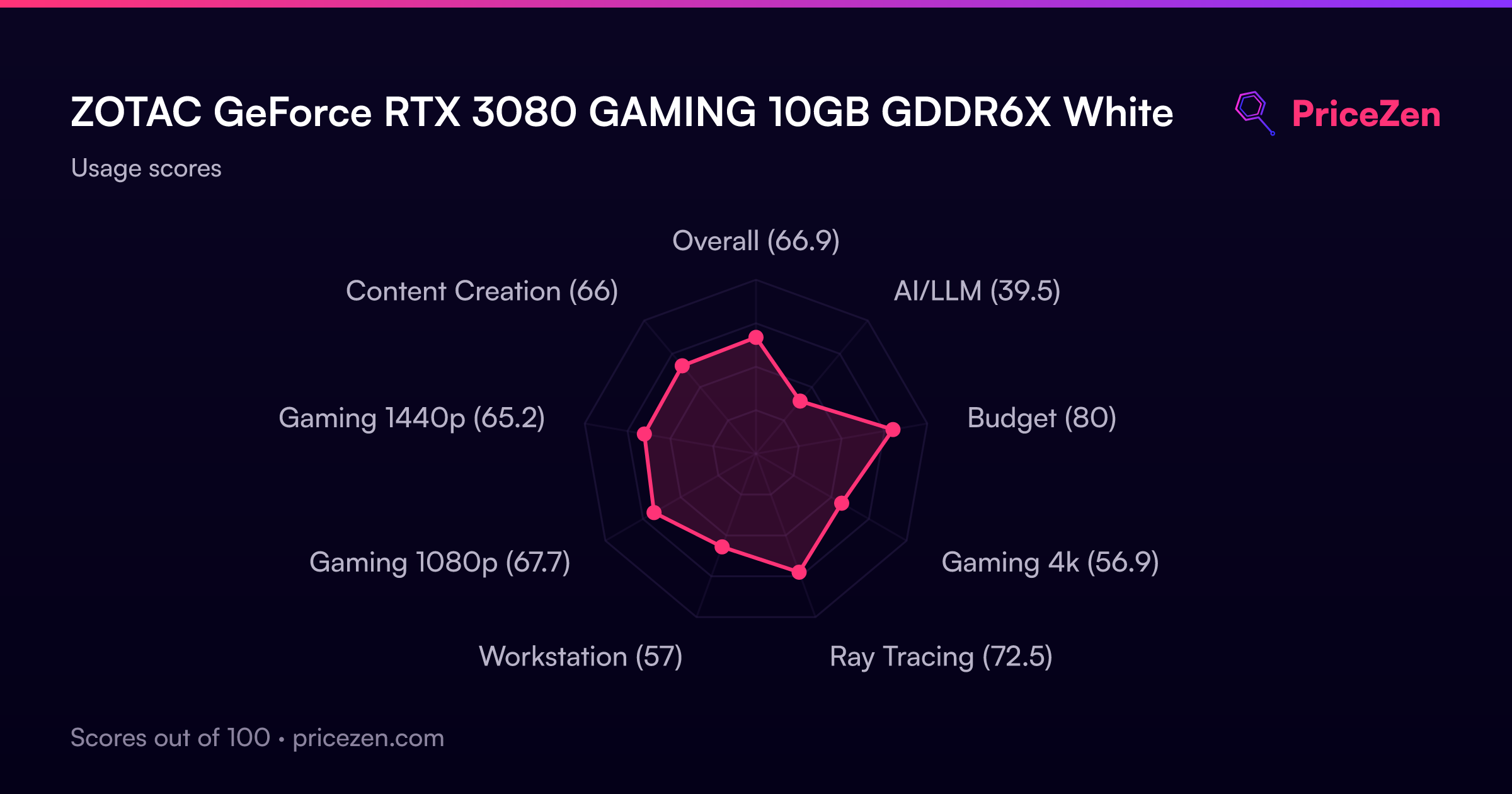
- Overall66.9
- AI/LLM39.5
- Budget80
- Gaming 4k56.9
- Ray Tracing72.5
- Workstation57
- Gaming 1080p67.7
- Gaming 1440p65.2
- Content Creation66