ASUS GeForce RTX 3070 Ti TUF Gaming OC 8GB GDDR6X

Triple-fan cooler for long gaming sessions verified Nov 28
62/100 overall score 4.6 average from 759 owner ratings
- GPU
- GeForce RTX 3070 Ti
- VRAM
- 8GB GDDR6X
- Boost clock
- 1815 MHz
- TDP
- 290 W
- Memory bus
- 256 bit
- Ray tracing
- Yes
- Class
- consumer
Compare prices at 1 store
Cheapest first. New, refurbished and bundled offers are kept apart, so you compare like with like.
| Store | Sold by | Colour and condition | Price | vs lowest | Last checked | Link |
|---|---|---|---|---|---|---|
| New1 offerSingle unit | ||||||
| Not checked in the last 7 days, so these prices may have changed | ||||||
| Amazon | Not known | Not listed | €2,719.91 | Nov 6 | Go to store | |
 Source: PriceZen, checked Nov 6, 2026
A price counts as current when we checked it in the last 7 days. “Marketplace seller” means a third-party seller on that store, not the store itself.
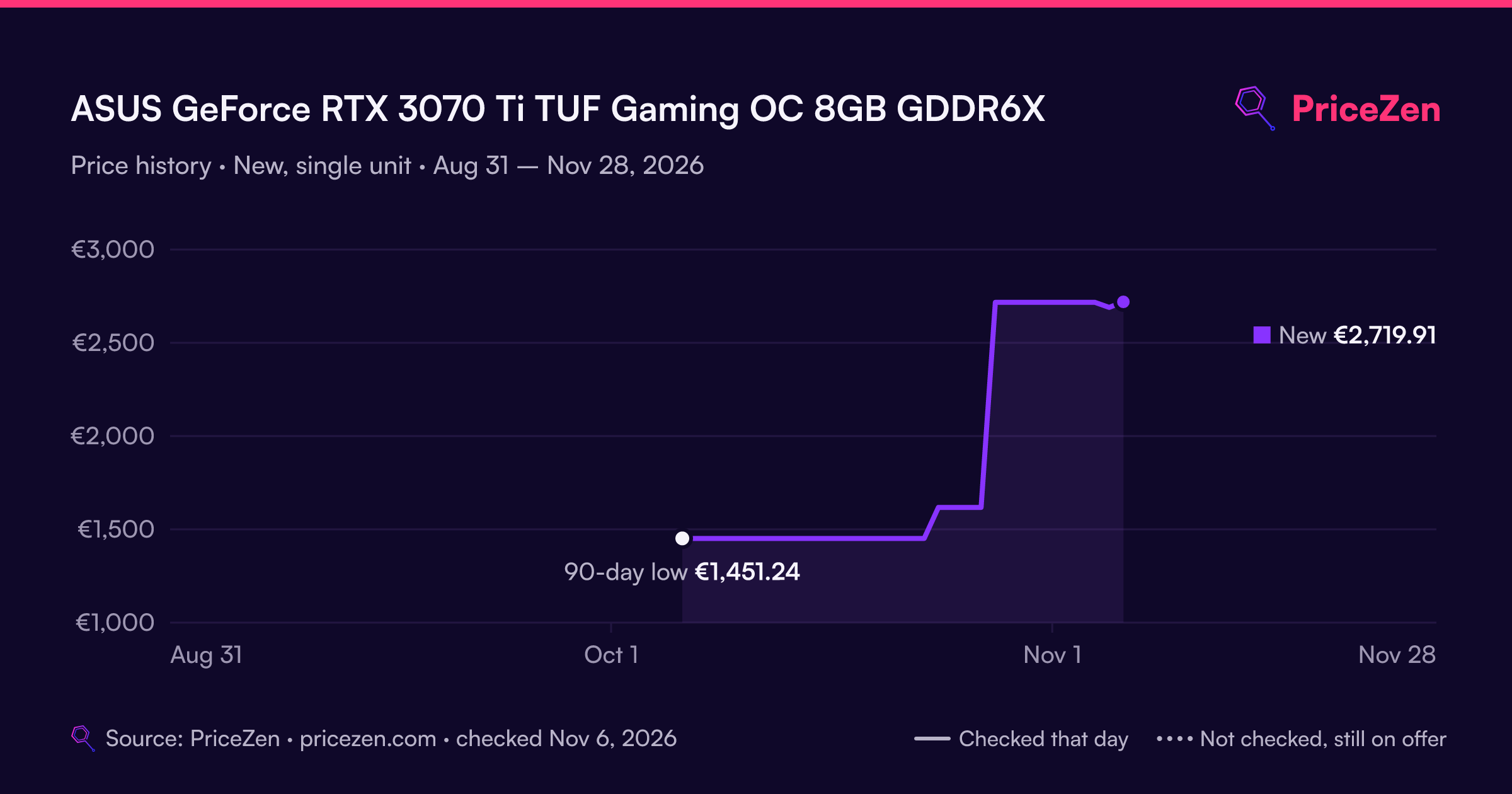
Price history
Checked that dayNot checked that day, still on offer
Source: PriceZen, checked Nov 6, 2026











Snapshot
The 30-Second Version
A well-built RTX 3070 Ti that still games nicely at 1080p and 1440p, backed by a 4.6/5 rating from 759 owners. Its best score is budget value at 73.3/100, but only if you snag it near USD 490. At USD 899, walk away.
Pros & Cons
Pros
- Strong 1080p and capable 1440p gaming per owner reports. 84th
- Factory OC to 1815MHz out of the box. 72nd
- TUF build quality with dual ball fan bearings owners praise. 71st
- Five outputs (3x DP, 2x HDMI) give you plenty of display options. 66th
Cons
- 8GB VRAM is already about average and will age poorly.
- 290W TDP makes efficiency one of its worst rankings.
- AI and LLM performance lags behind most of the category.
- USD pricing currently runs well above what this tier of card should cost.
What owners think
The Word on the Street
- Multiple owners praise the build quality and report smooth 1440p gaming performance.
- Several buyers felt the price was acceptable given market conditions, though they acknowledged paying over MSRP.
- A common complaint is the card's size and weight, plus at least one owner noting the VRMs run hot due to missing thermal pads.
How owner sentiment changed over time
ExclusiveBased on when customers actually wrote their reviews - so you can see whether early praise held up.
12 written reviews, Apr 2022 – Feb 2026: 12 happy
Across all 759 store ratings: 4.6★. Most owners rate without writing a review. The chart counts the 12 written reviews.
Each dot is one written review, in the month it was written. Happy = 4-5★, mixed = 3★, unhappy = 1-2★.
The proof
Performance
The raw numbers are respectable: 16.6 FP32 TFLOPS, 448 GB/s of memory bandwidth, and that 23203 G3D benchmark result put raster performance above the middle of the pack. Ray tracing sits similarly, helped by 46 RT cores and DLSS support. But 8GB of VRAM is only about average for this category now, and it's the ceiling you'll hit first in modern titles at high settings. Efficiency is a genuine weak spot: 290W TDP with a 750W PSU recommendation and two 8-pin connectors means this thing drinks. And AI/LLM work scores just 32.2/100, so don't buy it for that. One owner flagged missing thermal pads on the VRMs, which matches the thermal score landing at merely solid rather than great despite the triple-fan setup.
Specifications
Full Specifications
Chipset
| GPU Chipset | GeForce RTX 3070 Ti |
| Brand | NVIDIA |
| Architecture | Ampere |
| Class | consumer |
| Process | 8 |
Memory
| VRAM | 8 GB |
| Memory Type | GDDR6X |
| Memory Bus | 256 |
| Bandwidth | 448 |
Compute
| CUDA Cores | 6144 |
| Tensor Cores | 184 |
| RT Cores | 46 |
| Base Clock | 1785 |
| Boost Clock | 1815 |
| FP16 TFLOPS | 16.6 |
| FP32 TFLOPS | 16.6 |
Performance
| PassMark G3D | 23203 |
| GPU Compute | 11474 |
Power & Cooling
| TDP | 290 |
| Recommended PSU | 750 |
| Power Connectors | 2 x 8-Pin |
| Cooler | Triple Fan |
| Fans | 3 |
Connectivity
| Interface | PCI Express 4.0 x16 |
| DisplayPort | 3 |
| HDMI | 2 |
| Max Displays | 4 |
| Max Resolution | 7680 x 4320 |
Physical
| Length | 300 |
| Slot Width | 2.7 |
| Form Factor | Full Height |
| Weight | 1.4 kg / 3.1 lbs |
Features
| Ray Tracing | Yes |
| Upscaling | DLSS |
| VR Ready | Yes |
| DirectX | 12 Ultimate |
vs Competition
Cross-shop the Gigabyte GeForce RTX 5070 Ti Eagle Ice and MSI GeForce RTX 5070 Ti Ventus 3X OC first, because this card's 8GB buffer and mid-pack raster ranking are exactly where newer cards pull ahead. If you want top-of-the-charts performance, the ZOTAC GeForce RTX 5080 APOCALYPSE and PNY GeForce RTX 5080 ARGB OC are the cards to look at instead. The Sapphire Radeon RX 7900 XTX NITRO+ is worth a look too if VRAM headroom is your priority, since 8GB here ranks below average. The TUF only makes sense against these if the price gap is big.
| Spec | ASUS GeForce RTX 3070 Ti TUF Gaming OC | Gigabyte GeForce RTX 5070 Ti Eagle Ice | MSI GeForce RTX 5070 Ti Ventus 3X OC | ZOTAC GeForce RTX 5080 APOCALYPSE | PNY GeForce RTX 5080 ARGB OC | Sapphire Radeon RX 7900 XTX NITRO+ |
|---|---|---|---|---|---|---|
| Chipset | GeForce RTX 3070 Ti | GeForce RTX 5070 Ti | GeForce RTX 5070 Ti | GeForce RTX 5080 | GeForce RTX 5080 | Radeon RX 7900 XTX |
| Vram | 8GB GDDR6X | 16GB GDDR7 | 16GB GDDR7 | 16GB GDDR7 | 16GB GDDR7 | 24GB GDDR6 |
| Boost Clock Mhz | 1815 | 2542 | 2482 | 2730 | 2620 | 2680 |
| Tdp W | 290 | 300 | 300 | 360 | 360 | 339 |
| Memory Bus Bits | 256 | 256 | 256 | 256 | 256 | 384 |
| Ray Tracing | Yes | Yes | Yes | Yes | Yes | Yes |
| GPU Class | consumer | consumer | consumer | consumer | consumer | consumer |
| Compare | Compare | Compare | Compare | Compare |
| Product | AI | Rt | Vram | Raster | Compute | Feature | Thermal | Efficiency | Connectivity | Social Proof | Affordability |
|---|---|---|---|---|---|---|---|---|---|---|---|
| ASUS GeForce RTX 3070 Ti TUF Gaming OC | 41.3 | 70.9 | 41.8 | 61.2 | 47.9 | 65.6 | 71.8 | 32.9 | 54.7 | 83.9 | 37.8 |
| Gigabyte GeForce RTX 5070 Ti Eagle Ice Compare | 78.9 | 88.6 | 86 | 88.9 | 87.9 | 95.7 | 91.8 | 71.6 | 94.2 | 93.4 | 23 |
| MSI GeForce RTX 5070 Ti Ventus 3X OC Compare | 78.9 | 92.4 | 86 | 88.9 | 87.9 | 95.7 | 91.8 | 71.6 | 94.2 | 83.9 | 21.1 |
| ZOTAC GeForce RTX 5080 APOCALYPSE Compare | 85.5 | 97.7 | 89.1 | 94.4 | 93.3 | 95.7 | 91.8 | 56.6 | 94.2 | 98.7 | 23.3 |
| PNY GeForce RTX 5080 ARGB OC Compare | 85.5 | 97.7 | 89.1 | 94.4 | 93.3 | 95.7 | 91.8 | 56.6 | 94.2 | 75 | 15.9 |
| Sapphire Radeon RX 7900 XTX NITRO+ Compare | 95.3 | 96.4 | 92.1 | 83.4 | 95.6 | 95.7 | 91.8 | 51.3 | 98.8 | 69.3 | 13.7 |
Price
Value & Pricing
Here's the problem. We track USD listings from $490 to $899, a $409 spread, and the only new in-stock option right now is Amazon at USD 899. That's rough for a card with 8GB of VRAM and a 38th-percentile affordability ranking. EUR listings are even wilder, ranging from EUR 1,286 to EUR 2,720 across four European stores. At the low end of that USD range this is a decent grab. At $899, you're paying current-gen money for previous-gen silicon. Our budget score of 73.3/100 assumes you find it cheap. Watch the price with our community extension and pounce on a deal, not the sticker.
Read more
Overview
This is ASUS's factory-overclocked take on the RTX 3070 Ti: 6144 CUDA cores, 8GB of GDDR6X on a 256-bit bus, and an 1815MHz boost in OC mode. Three Axial-tech fans, a MaxContact heatsink, and TUF-grade components. It's a big card at 300mm long and 2.7 slots thick, so measure your case first.
Our scoring puts it at 65.9/100 for 1080p gaming and 64.5/100 for ray tracing, with a PassMark G3D benchmark score of 23203. Solid raster performance, middle-of-the-pack compute, and a weak spot in AI workloads at 32.2/100. Owners rate it 4.6/5 across 759 reviews, which is strong social proof.
Common Questions
Q: Will this fit in my case and work with my power supply?
It's 300mm long and takes up 2.7 slots, so check clearance before buying. ASUS recommends a 750W PSU, and you'll need two free 8-pin PCIe connectors.
Q: Is 8GB of VRAM enough for modern games?
For 1080p and most 1440p gaming, yes, and owners report good results there. But 8GB ranks below average in our data, so maxed-out textures in newer titles will push against that limit.
Q: Can I use this for running local AI models?
We'd steer you elsewhere. Its AI/LLM score is just 32.2/100, one of its weakest areas, and the 8GB buffer limits model sizes.
Who Should Skip This
If you're building for local AI or LLM tinkering, look elsewhere, because the 32.2/100 AI score and 8GB of VRAM will frustrate you fast. Same story if you want maxed-out 4K or plan to keep this card for years: the memory ceiling and 290W appetite mean newer cards are the smarter spend. And anyone facing that USD 899 listing should just close the tab.
Verdict
Buy this if you find it near the bottom of its price range and you game at 1080p or 1440p. Owners consistently report good frame rates there, and the TUF cooler and build get real praise. You'll want a 750W PSU and a case that swallows 300mm and 2.7 slots. Skip it at full current asking price, and skip it entirely for AI work.
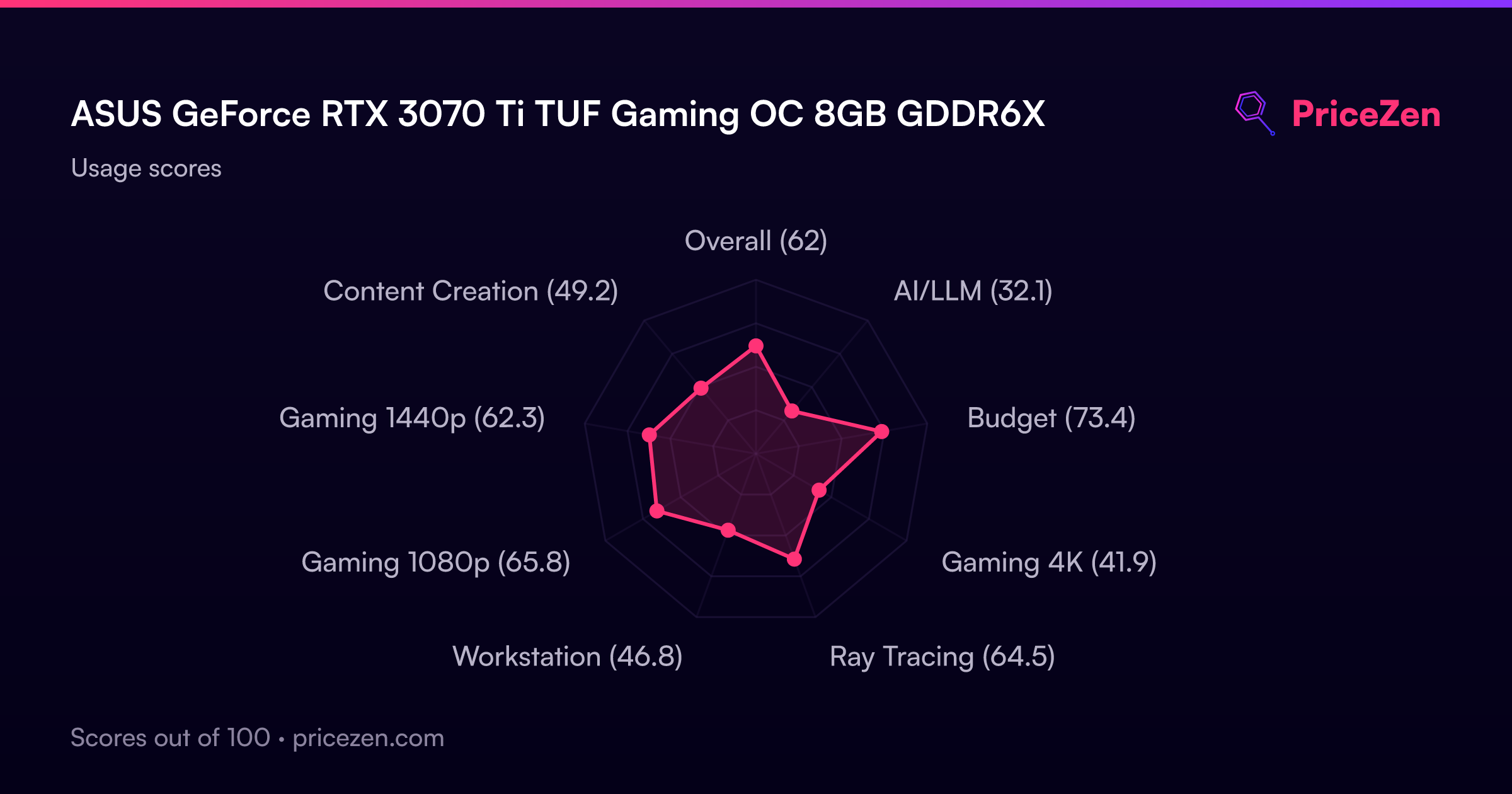
Usage Scores
- Overall62
- AI/LLM32.1
- Budget73.4
- Gaming 4K41.9
- Ray Tracing64.5
- Workstation46.8
- Gaming 1080p65.8
- Gaming 1440p62.3
- Content Creation49.2