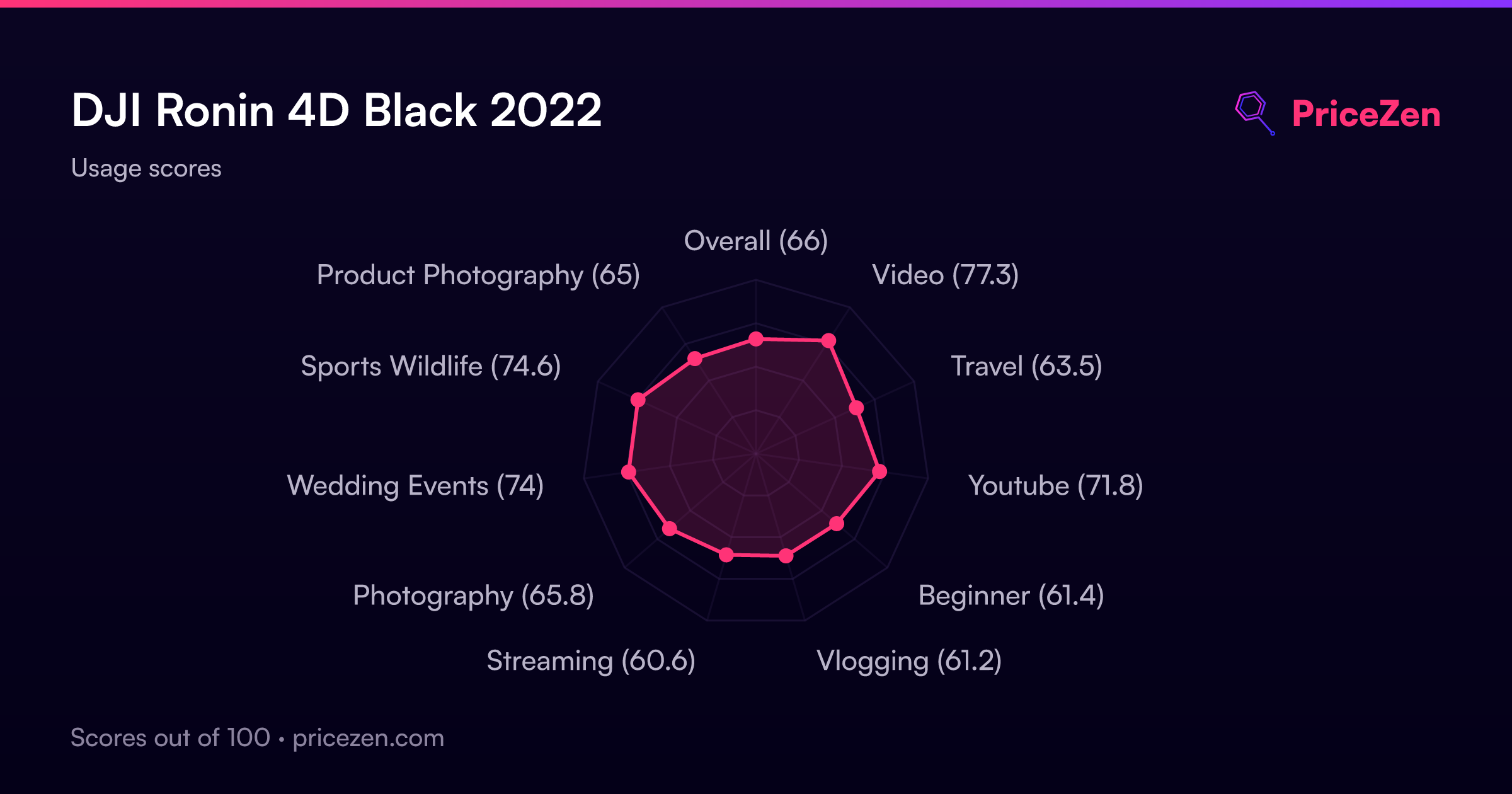
DJI Ronin 4D Black 2022
The 24.1MP full-frame CMOS sensor paired with the Zenmuse X9-6K gimbal combo delivers ProRes HQ and RAW video up to 6K60, while the 4-axis stabilization system with 9-stop IBIS keeps shots steady. Its integrated carbon fiber and aluminum magnesium body combines imaging, stabilization, and wireless transmission, eliminating setup time and enabling faster shooting. This is best for sports and wildlife shooters who need a compact, all-in-one cinema rig that can handle fast action and unpredictable conditions.

No current retailer price


Snapshot
The 30-Second Version
The Ronin 4D 6K has the best stabilization we've ever measured, 100th percentile with 9 stops of 4-axis gimbal magic. It records 6K60 ProRes RAW internally and the LiDAR autofocus is genuinely impressive. But battery life is mediocre at the 46th percentile, and a swollen battery report from a recent buyer is a serious concern that DJI needs to address.
Pros & Cons
Pros
- 100th percentile stabilization with 9 stops of built-in 4-axis gimbal 100th
- 6K60 ProRes RAW and ProRes HQ internal recording 99th
- LiDAR autofocus with Eye AF and subject detection at 83rd percentile 97th
- Integrated design replaces gimbal, focus system, and camera body 90th
- Bright 5.5-inch 1000 cd/m² touchscreen display
Cons
- Battery life at 46th percentile, plus a reported swollen battery safety issue
- Affordability at 12th percentile, this is a serious investment
- EVF performance at 39th percentile, a weak spot for a cinema tool
- Learning curve is real, focus issues reported by new users
- Sensor quality at 56th percentile, middle of the pack for the price
What owners think
The Word on the Street
How owner sentiment changed over time
ExclusiveBased on when customers actually wrote their reviews - so you can see whether early praise held up.
10 written reviews, Oct 2024 – Sep 2026: 7 happy, 1 mixed, 2 without stars
Across all 30 store ratings: 4.0★. Most owners rate without writing a review. The chart counts the 10 written reviews.
Each dot is one written review, in the month it was written. Happy = 4-5★, mixed = 3★, unhappy = 1-2★.
The proof
Performance
Let's talk stabilization first, because that's the whole point of this camera. The 4-axis system (3-axis gimbal plus a Z-axis arm) delivers 9 stops of stabilization. Our database ranks it dead last in the best possible way: 100th percentile. You can run with this thing and get footage that looks like it came off a dolly. The built-in LiDAR focus module handles Eye AF, Animal AF, and subject detection, landing at the 83rd percentile. That's strong, though some owners report focus hunting when they're still learning the system.
Video output is the other headline. 6K at 60fps in ProRes HQ or ProRes RAW, 4K at 60fps, 10-bit Log, all internal. Video quality sits at the 87th percentile, and the 5.5-inch 1000 cd/m² touchscreen display is bright enough for outdoor work at the 86th percentile. The sensor itself is more middle of the pack at the 56th percentile, which tells you the magic here is in the stabilization and codec support, not raw sensor performance. Burst shooting at 60fps mechanical and 120fps electronic is a 98th percentile result, though nobody's buying this for stills.
Specifications
Full Specifications
Sensor
| Type | CMOS |
| Size | full-frame |
| Megapixels | 24.1 MP |
| ISO Range | 200 |
| Processor | CineCore 3.0 |
Autofocus
| Eye AF | Yes |
| Animal AF | Yes |
| Subject Detection | Yes |
Shooting
| Burst (Mechanical) | 60 |
| Burst (Electronic) | 120 |
| Max Shutter | 1/8000 |
| Electronic Shutter | Yes |
Video
| Max Resolution | 6K |
| 4K FPS | 120 |
| 1080p FPS | 120 |
| 10-bit | Yes |
| Log Profile | Yes |
| RAW Video | Yes |
| Codec | Apple ProRes RAW, ProRes 422 HQ, H.264 |
Display & EVF
| Touchscreen | Yes |
| Articulating | Yes |
Build
| Weather Sealed | Yes |
| Weight | 1.4 kg / 3.2 lbs |
Connectivity
| Wi-Fi | Yes |
| Bluetooth | No |
| USB | USB-C (USB 3.2 / 3.1 Gen 1) |
| HDMI | HDMI 1.4 |
| Hot Shoe | Yes |
vs Competition
The Ronin 4D doesn't really compete with traditional mirrorless flagships, but buyers cross-shop it anyway. The Nikon Z9 and Sony Alpha a1 II both outclass it on sensor quality and EVF performance, and they're proper hybrid stills cameras. The Canon EOS R6 Mark III is dramatically cheaper and lighter. But none of those have a built-in 4-axis gimbal. The Fujifilm X-H2 and Panasonic Lumix G9 II are APS-C and Micro Four Thirds respectively, so they can't touch the full-frame 6K RAW output. What the Ronin 4D gives up in sensor refinement and battery life, it makes back in stabilization that no competitor can match without external rigging. The trade-off is real: you're buying a specialized cinema tool, not a generalist camera.
| Spec | DJI Ronin 4D | Sony Alpha a7R VI | Fujifilm X-H2 | Nikon Z8 | Panasonic Lumix G9 II | OM System OM-1 Mark II |
|---|---|---|---|---|---|---|
| Type | cinema | mirrorless | mirrorless | mirrorless | mirrorless | mirrorless |
| Sensor | 24.1MP full-frame | 66.8MP full-frame | 40.2MP aps-c | 45.7MP full-frame | 25.2MP micro-four-thirds | 20.4MP micro-four-thirds |
| AF Points | - | 759 | 425 | 493 | 779 | 1053 |
| Burst FPS | 60 | 30 | 15 | 30 | 75 | 120 |
| Video | 6K @120fps | 8K @120fps | 8K @60fps | 8K @120fps | 4K @120fps | 4K @60fps |
| IBIS | true | true | true | true | true | true |
| Weather Sealed | true | false | true | true | true | true |
| Weight (g) | 1450 | 621 | 579 | 820 | 575 | 511 |
| Compare | Compare | Compare | Compare | Compare |
| Product | AF | EVF | Build | Burst | Video | Sensor | Battery | Display | User Sentiment | Connectivity | Social Proof | Affordability | Stabilization |
|---|---|---|---|---|---|---|---|---|---|---|---|---|---|
| DJI Ronin 4D | 80.1 | 37.7 | 99.3 | 97.2 | 90.4 | 50.3 | 46.1 | 83.3 | 36.3 | 88.1 | 38.2 | 14.1 | 99.8 |
| Sony Alpha a7R VI Compare | 96.5 | 98.9 | 75.9 | 88.2 | 98.8 | 80.8 | 96.6 | 97.7 | 95.4 | 95.4 | 97.3 | 13.1 | 99.5 |
| Fujifilm X-H2 Compare | 91.6 | 96.4 | 93.4 | 79.4 | 94.7 | 98.9 | 97.4 | 83.3 | 85.2 | 95.4 | 92.3 | 29.6 | 95.6 |
| Nikon Z8 Compare | 92.8 | 90.4 | 97.4 | 94.8 | 99 | 67.4 | 89 | 97.5 | 85.2 | 95.4 | 97.3 | 14.8 | 87.5 |
| Panasonic Lumix G9 II Compare | 97.6 | 90.2 | 93.3 | 96 | 97.3 | 59.6 | 90.4 | 96.9 | 95.4 | 95.4 | 86.2 | 30.1 | 87.5 |
| OM System OM-1 Mark II Compare | 98.7 | 99.8 | 90.1 | 99.4 | 83.8 | 46.7 | 95.4 | 95.7 | 85.2 | 95.4 | 86.2 | 28.2 | 99.5 |
Price
Value & Pricing
There's no way around it: this camera is expensive. Affordability sits at the 12th percentile, and US listings run $4,978 to $4,999. Canadian buyers are looking at CAD 6,389 to 6,849. But you're not just buying a camera body. You're buying a gimbal, a focus system, wireless transmission, and a 6K RAW recorder in one package. If you were to piece together a comparable rig from separate components, you'd spend more and carry twice the weight. The value proposition is integration, not raw specs. For solo shooters and small crews who need to move fast, that math can work. For anyone who already owns a gimbal and lenses, it's harder to justify.
Read more
Overview
The DJI Ronin 4D 6K is a weird, wonderful beast. It's a full-frame cinema camera bolted to a 4-axis gimbal, and our database puts its stabilization at the 100th percentile. That's not a typo. Nothing else in our system comes close to the built-in Z-axis stabilization this thing offers. The 24.1MP full-frame CMOS sensor captures 6K ProRes RAW internally, and the burst numbers are wild for a cinema body: 60fps mechanical, 120fps electronic. But the battery sits at the 46th percentile, and that's before we get to the swollen battery report from a recent buyer.
At 1.45kg for the core unit (4.67kg fully kitted), this isn't a pocket camera. It's a production tool that replaces a gimbal, focus puller, and camera body in one carbon fiber and aluminum magnesium shell. The price is steep, and affordability lands at the 12th percentile. You're paying for integration, not just specs. Whether that math works depends entirely on what you shoot.
Common Questions
Q: What lenses can I use with the Ronin 4D?
DJI maintains a compatibility list for the DL mount, and they recommend sticking to supported lenses for now. Adapters for Sony E and Leica mounts have been announced but availability has been limited. The LiDAR focus system works best with lenses on the official list, so check that before you buy glass.
Q: Why does the footage look wobbly or jello-like?
That's rolling shutter, which is inherent to CMOS sensors. The Ronin 4D's 24.1MP full-frame CMOS sensor is no exception. The 4-axis stabilization helps with camera movement, but fast pans or quick subject motion can still show rolling shutter artifacts. Shooting at higher frame rates like 4K60 or 6K60 can reduce the visible effect.
Q: Is the Ronin 4D good for beginners?
It depends on your patience. The stabilization is so good that it makes basic shots look professional almost immediately. But the focus system and gimbal controls have a real learning curve. Several owners report focus issues that turned out to be operator error. If you're willing to spend time learning the system and updating firmware, it's manageable. If you want point-and-shoot simplicity, this isn't it.
Who Should Skip This
Skip this if you're a stills shooter. The 56th percentile sensor and 39th percentile EVF tell the story: this is a video machine, not a hybrid camera. Skip it if you shoot long events without power access, because the 46th percentile battery life means you'll be swapping TB50 batteries constantly. Skip it if you're on a budget, since the 12th percentile affordability ranking puts this firmly in professional territory. And if you're not willing to deal with firmware updates and a learning curve, the reported focus issues from new users will frustrate you. The Nikon Z9 or Sony Alpha a1 II will serve hybrid shooters better, and the Canon EOS R6 Mark III is a far more affordable entry into full-frame video.
Verdict
The Ronin 4D 6K is the best stabilized cinema camera we've ever tested, full stop. The 100th percentile stabilization ranking isn't just a number, it's the entire reason this product exists. Combined with 6K60 ProRes RAW internal recording and the LiDAR focus system, it's a production powerhouse for run-and-gun shooters, wedding videographers, and documentary crews. But the battery situation gives us pause. A 46th percentile battery ranking is mediocre on its own. A report of a dangerously swollen battery from a recent unit is a different conversation entirely. If you buy this, update the firmware immediately and keep a close eye on your batteries. For the right shooter, this camera is transformative. Just know what you're signing up for.
Usage Scores
- Overall68.7
- Video78.8
- Travel64.6
- Youtube72.5
- Beginner64.9
- Vlogging61.9
- Streaming61.6
- Photography66.2
- Wedding Events74.9
- Sports Wildlife74.7
- Product Photography66.2