ASUS GeForce RTX 5090 ROG Astral BTF OC 32GB GDDR7 Black
Equipped with 21,760 CUDA cores and 32GB of GDDR7 memory on the Blackwell architecture, this card delivers a 2610 MHz boost clock for extreme 4K gaming and AI workloads. Its quad-fan design with a patented vapor chamber and phase-change thermal pad ensures sustained peak performance under load. This GPU is best for AI researchers training large models and enthusiasts seeking uncompromised 4K ray-traced gaming.

अभी किसी विक्रेता की मौजूदा कीमत नहीं है


एक नज़र में
The 30-Second Version
38,958 in PassMark G3D and 32GB of GDDR7 on a 512-bit bus put this card at the top of our ray tracing, compute and raster charts. It also pulls 575W and costs USD 5,600 to USD 7,250, landing it in the bottom handful for value. Fastest money can buy, and it really does need all your money.
Pros & Cons
खूबियाँ
- Best-in-class ray tracing, with a 97.8/100 best-for score and 170 RT cores 100th
- 32GB of GDDR7 on a 512-bit bus at 28Gb/s, one of the strongest memory setups we track 99th
- 38,958 PassMark G3D and 21,760 CUDA cores put compute at the top of the charts 99th
- Five outputs (3x DP 2.1b, 2x HDMI 2.1b) make connectivity a standout 99th
- Detachable GC-HPWR gold finger rated to 1000W for cable-free BTF builds
कमियाँ
- USD 5,600 to USD 7,250 makes it one of the worst value picks in our data
- 575W TDP and a 1000W PSU requirement leave efficiency lagging behind most cards
- 358mm long and 3.8 slots thick, so small cases are out
- Thermal ranking is only about average despite the quad-fan vapor chamber setup
- Just 9 owner reviews so far, so the 5/5 rating rests on a thin sample
मालिकों की राय
The Word on the Street
मालिकों की राय समय के साथ कैसे बदली
विशेषग्राहकों ने वास्तव में अपनी समीक्षाएँ कब लिखीं, इसके आधार पर - ताकि आप देख सकें कि शुरुआती तारीफ़ टिकी या नहीं।
6 लिखित समीक्षाएँ, दिस॰ 2025 – अक्टू॰ 2026: 3 संतुष्ट, 3 बिना स्टार
स्टोर की सभी 9 रेटिंग में: 5.0★। चार्ट 6 लिखित समीक्षाएँ गिनता है।
हर बिंदु एक लिखित समीक्षा है, उस महीने में जब वह लिखी गई। संतुष्ट = 4-5★, मिश्रित = 3★, असंतुष्ट = 1-2★।
प्रमाण
Performance
Start with the silicon: 21,760 CUDA cores, 680 Tensor cores and 170 RT cores, feeding off 32GB of GDDR7 running at 28Gb/s across a 512-bit interface. That memory setup is why our numbers put it near the top for VRAM and AI workloads, and why its best-for scores read 97.8/100 for ray tracing, 97.3/100 for content creation and 96.7/100 for local LLM tinkering. The 38,958 PassMark G3D score backs that up, and DLSS 4 plus AV1 encode mean the frame generation and export side isn't an afterthought either.
Cooling is where it gets interesting. ASUS lists a quad-fan axial design with a vapor chamber, denser fins and a phase-change GPU thermal pad, which sounds like overkill until you remember the 575W TDP. Even so, our thermal ranking only puts it around the middle of the pack, and efficiency sits in the bottom quarter. Owners seem happy anyway: one buyer moved over from a ZOTAC 5090 LC and reports roughly 100 more FPS in Counter Strike 2 at 1440p. That's an owner report, not our measurement, but it lines up with the compute ranking.
Specifications
Full Specifications
Chipset
| GPU Chipset | GeForce RTX 5090 |
| Brand | NVIDIA |
| Architecture | Blackwell |
| Class | consumer |
Memory
| VRAM | 32 GB |
| Memory Type | GDDR7 |
| Memory Bus | 512 |
Compute
| CUDA Cores | 21760 |
| Tensor Cores | 680 |
| RT Cores | 170 |
| Base Clock | 2610 |
| Boost Clock | 2580 |
Performance
| PassMark G3D | 38958 |
| GPU Compute | 26734 |
Power & Cooling
| TDP | 575 |
| Recommended PSU | 1000 |
| Power Connectors | 1 x 16-pin, Graphics card high-power (GC-HPWR) gold finger |
| Cooler | Triple Fan |
| Fans | 3 |
Connectivity
| Interface | PCI Express 5.0 |
| DisplayPort | 3 |
| HDMI | 2 |
| Max Displays | 4 |
| Max Resolution | 7680 x 4320 |
Physical
| Length | 358 |
| Slot Width | 3.8 |
| Form Factor | Full Height |
| Weight | 4.5 kg / 9.9 lbs |
Features
| Ray Tracing | Yes |
| Upscaling | DLSS 4 |
| AV1 Encode | Yes |
| VR Ready | Yes |
| DirectX | 12 |
| RGB | Yes |
vs Competition
Against the Gigabyte GeForce RTX 5080 AORUS Master, MSI GeForce RTX 5080 Gaming Trio, ZOTAC GeForce RTX 5080 AMP Extreme Infinity and PNY GeForce RTX 5080 ARGB OC, the argument here is simple: this card sits at the 99th percentile for both raster and compute, and tops our ray tracing chart outright. If you're chasing maximum frames or feeding local models, the 32GB of GDDR7 and 21,760 CUDA cores are the reason to cross-shop it against those 5080 boards rather than settling. The Sapphire Radeon RX 7900 XTX NITRO+ is the other name in the mix, and again the case for this ASUS rests on its own numbers: top-tier AI and VRAM rankings plus DLSS 4 and AV1 encode. Where the field bites back is efficiency and price. This card lands in the bottom quarter for efficiency and the bottom handful for affordability, so if your build is a modest case with a modest PSU, one of those alternatives deserves a serious look.
| Spec | ASUS GeForce RTX 5090 ROG Astral BTF OC | Gigabyte GeForce RTX 5070 Ti Eagle Ice | MSI GeForce RTX 5070 Ti Ventus 3X OC | ZOTAC GeForce RTX 5080 APOCALYPSE | Sapphire Radeon RX 7900 XTX NITRO+ | PNY GeForce RTX 5080 ARGB OC |
|---|---|---|---|---|---|---|
| Chipset | GeForce RTX 5090 | GeForce RTX 5070 Ti | GeForce RTX 5070 Ti | GeForce RTX 5080 | Radeon RX 7900 XTX | GeForce RTX 5080 |
| Vram | 32GB GDDR7 | 16GB GDDR7 | 16GB GDDR7 | 16GB GDDR7 | 24GB GDDR6 | 16GB GDDR7 |
| Boost Clock Mhz | 2580 | 2542 | 2482 | 2730 | 2680 | 2620 |
| Tdp W | 575 | 300 | 300 | 360 | 339 | 360 |
| Memory Bus Bits | 512 | 256 | 256 | 256 | 384 | 256 |
| Ray Tracing | Yes | Yes | Yes | Yes | Yes | Yes |
| GPU Class | consumer | consumer | consumer | consumer | consumer | consumer |
| Compare | Compare | Compare | Compare | Compare |
| उत्पाद | AI | Rt | Vram | Raster | Compute | Thermal | Efficiency | Connectivity | सामाजिक प्रमाण | Affordability |
|---|---|---|---|---|---|---|---|---|---|---|
| ASUS GeForce RTX 5090 ROG Astral BTF OC | 98.4 | 99.7 | 97.8 | 98.8 | 99 | 71.9 | 23.2 | 99.3 | 43.7 | 4.4 |
| Gigabyte GeForce RTX 5070 Ti Eagle Ice Compare | 79 | 88.7 | 86 | 89 | 87.9 | 91.8 | 71.7 | 94.2 | 93.4 | 22.8 |
| MSI GeForce RTX 5070 Ti Ventus 3X OC Compare | 79 | 92.4 | 86 | 89 | 87.9 | 91.8 | 71.7 | 94.2 | 83.9 | 22.6 |
| ZOTAC GeForce RTX 5080 APOCALYPSE Compare | 85.5 | 97.7 | 89.1 | 94.5 | 93.3 | 91.8 | 56.7 | 94.2 | 98.7 | 23.1 |
| Sapphire Radeon RX 7900 XTX NITRO+ Compare | 95.3 | 96.4 | 92.1 | 83.4 | 95.6 | 91.8 | 51.4 | 98.8 | 69.3 | 13.5 |
| PNY GeForce RTX 5080 ARGB OC Compare | 85.5 | 97.7 | 89.1 | 94.5 | 93.3 | 91.8 | 56.7 | 94.2 | 74.9 | 15.7 |
कीमत
Value & Pricing
Let's not pretend: USD 5,600 is the floor here, and that's Micro Center. Amazon wants USD 7,250 for the same card, a USD 1,650 spread across four US listings that you should absolutely exploit before clicking buy. In Canada the range runs CAD 5,560 to CAD 8,604, a CAD 3,044 gap across four listings, so shopping around matters even more up north. What you get for it is genuinely top-tier: 32GB of GDDR7, a 2610MHz OC boost, five modern outputs and PCIe 5.0. Our affordability ranking still puts it in the bottom handful, and the budget score of 69/100 is its weakest area for a reason. We track prices over time, partly through our community browser extension, and this is a card where waiting for the low end of the range pays for a whole other component.
और पढ़ें
Overview
38,958 in PassMark G3D. That's the number that tells you what this card is: ASUS took Nvidia's Blackwell RTX 5090, strapped 32GB of GDDR7 on a 512-bit bus to it, and pushed the boost clock to 2610MHz on the OC setting (2580MHz stock). Our scoring model puts it at the very top for ray tracing, compute and raster performance, with AI and VRAM capacity right behind. It's not a card that wins one category and shrugs at the rest. It wins nearly all of them.
And then there's the bill. USD 5,600 at Micro Center, USD 7,250 at Amazon, which lands it in the bottom handful of everything we track for affordability. Add a 575W TDP, a 1000W PSU recommendation, 358mm of length and 3.8 slots of thickness, and this thing demands as much from your case and wallet as it gives back in frames. The BTF party trick is the detachable GC-HPWR gold finger rated for up to 1000W, so power can come through the board instead of a cable draped across your build.
Common Questions
Q: How much memory does it have, and is it enough for local AI models?
32GB of GDDR7 on a 512-bit interface at 28Gb/s. That combination puts it among the best we track for VRAM, and its AI/LLM best-for score is 96.7/100, backed by 680 Tensor cores. For loading larger models locally, that's about as good as a single consumer card gets in our data.
Q: What resolution and displays can it drive?
It supports up to 7680 x 4320, and you get five outputs: three DisplayPort 2.1b and two HDMI 2.1b over PCIe 5.0. Connectivity is a standout in our rankings, so multi-monitor and high-refresh setups aren't a compromise here.
Q: Will it fit my case and power supply?
Plan carefully. It's 358mm long and takes 3.8 slots, with a 575W TDP and a 1000W PSU recommendation. Power comes via a single 16-pin connector or the detachable GC-HPWR gold finger rated to 1000W on supported BTF boards. Efficiency ranks in the bottom quarter of our data, so this is not a small-build card.
Who Should Skip This
Skip it if your budget has a ceiling, because a 69/100 budget score and the bottom handful of our affordability ranking aren't going to talk you into feeling good about USD 5,600. Skip it too if you're building compact or quiet-ish: 358mm, 3.8 slots, a 575W TDP and a 1000W PSU ask add up fast, and our efficiency ranking has it lagging behind most of the field while thermals sit only around average. And if you mostly play esports titles at 1440p, the 5080 options from Gigabyte, MSI, ZOTAC and PNY are worth cross-shopping before you spend flagship money on headroom you'll never touch.
Verdict
If you want the fastest thing you can bolt into a gaming or creation rig and you've already accepted the cost, this is it. Top-of-the-charts ray tracing, compute and raster rankings, 32GB of GDDR7 and a 97.3/100 content creation score make it a genuine flagship, and the 5/5 owner rating (from 9 reviews) suggests buyers aren't regretting it. Buy it at Micro Center's USD 5,600, not Amazon's USD 7,250, and make sure your case clears 358mm and 3.8 slots and your PSU can handle a 1000W recommendation. Nobody can pay us to say a card is worth this much, so here's the honest version: the performance is real, the price is brutal, and only you know which one wins.
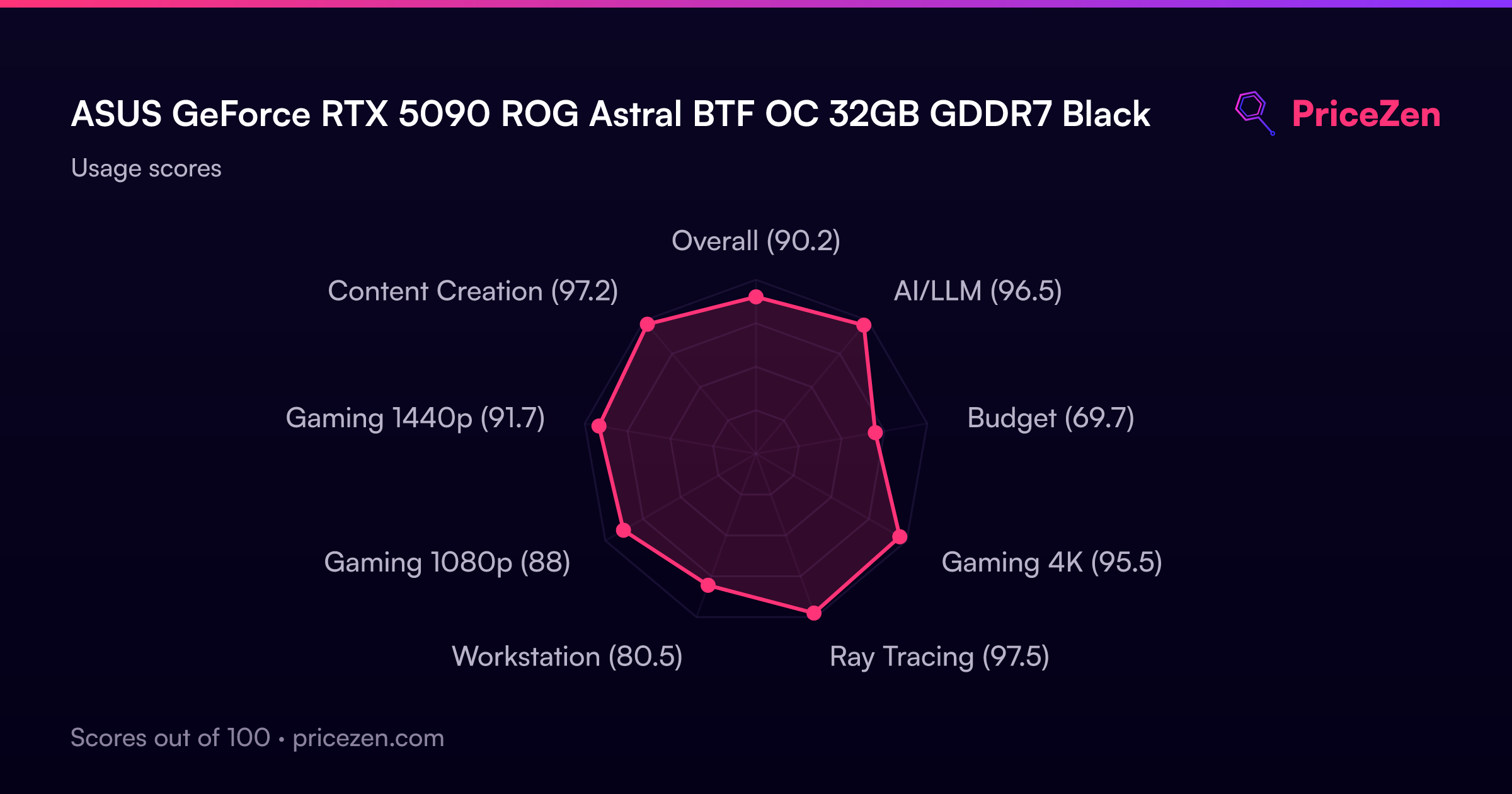
Usage Scores
- कुल90.2
- AI/LLM96.5
- Budget69.7
- Gaming 4K95.5
- Ray Tracing97.5
- Workstation80.5
- Gaming 1080p88
- Gaming 1440p91.7
- Content Creation97.2