NVIDIA RTX PRO 6000 Blackwell 96GB GDDR7 workstation
Equipped with 96GB of GDDR7 memory on a 512-bit bus, this passive Blackwell workstation card delivers massive memory bandwidth for large-scale AI model training and inference. Its server-focused, single-slot passive design at 267mm enables dense multi-GPU configurations in data center racks. This card is best for enterprises deploying LLMs and complex simulations that require silent, high-density compute without active cooling.

अभी किसी विक्रेता की मौजूदा कीमत नहीं है
हमने इसे पहले यहाँ देखा था। आज की कीमत स्टोर पर देखें।











एक नज़र में
The 30-Second Version
The NVIDIA RTX PRO 6000 Blackwell is a 96GB GDDR7 ECC workstation graphics card that tops our category rankings for AI, compute, ray tracing and VRAM. It's also the most expensive and one of the hottest-running cards we track, at 600W and around USD 19,499. Buy it for large AI and rendering workloads, not for gaming.
Pros & Cons
खूबियाँ
- 96GB GDDR7 ECC, best-in-class VRAM capacity 100th
- Top-ranked AI, compute, raster and ray tracing scores 100th
- Over 1.8 TB/s bandwidth on a 512-bit bus 100th
- NVLink multi-GPU support for scaling up 100th
- Four DisplayPort 2.1 outputs and PCIe 5.0 x16
कमियाँ
- Pricing is brutal, dead last for affordability
- 600W TDP hurts efficiency and thermals
- Passive cooling needs serious chassis airflow
- Three slots and a 12VHPWR connector to plan around
- Listing confusion between Server and Workstation editions
मालिकों की राय
मालिकों की राय समय के साथ कैसे बदली
विशेषग्राहकों ने वास्तव में अपनी समीक्षाएँ कब लिखीं, इसके आधार पर - ताकि आप देख सकें कि शुरुआती तारीफ़ टिकी या नहीं।
18 लिखित समीक्षाएँ, जून 2025 – अक्टू॰ 2026: 13 संतुष्ट, 5 बिना स्टार
स्टोर की सभी 43 रेटिंग में: 4.4★। ज़्यादातर मालिक समीक्षा लिखे बिना रेटिंग देते हैं। चार्ट 18 लिखित समीक्षाएँ गिनता है।
- जुल॰–सित॰ 20263 में से 3 संतुष्ट
Buyers in this period praised the product's reliability, ease of use, and value, with one noting excellent service. All reviews were positive.
- Product works reliably and as expected; 'plug it in and it just works.'
- Good value for money, especially for calculations.
- Excellent service and overall positive experience.
- जुल॰–सित॰ 20253 में से 3 संतुष्ट · 2 बिना स्टार
Buyers praise the PRO 6000 Blackwell for exceptional performance in high-resolution media and AI workloads, citing major render time reductions and ample VRAM. One review notes it's not cost-effective for gaming, but overall sentiment is strongly positive.
- Outstanding performance for high-res, high-frame-rate media and AI workloads, with significant render time improvements.
- 96GB VRAM enables larger models and workflows, a major upgrade from previous GPUs.
- Not recommended for gaming due to poor price-to-performance ratio; better suited for professional use.
- Considered a worthwhile investment for professionals, despite high cost.
हर बिंदु एक लिखित समीक्षा है, उस महीने में जब वह लिखी गई। संतुष्ट = 4-5★, मिश्रित = 3★, असंतुष्ट = 1-2★। अवधि के सारांश अंग्रेज़ी में हैं।
प्रमाण
Performance
The external benchmark numbers back up the spec sheet. PassMark G3D comes in at 39287, and in our category rankings this card is top of the charts for raster, ray tracing, AI, compute and VRAM. Nothing else we track in this class beats it on those axes. Compute is rated at 126 FP32 TFLOPS and 126 FP16 TFLOPS, with fifth-gen Tensor cores handling FP8, FP16 and BF16, plus fourth-gen RT cores. Memory bandwidth is listed at 1790 GB/s, so over 1.8 TB/s feeding all those cores. In practice that combination means big models and big scenes stay resident on the card instead of getting chopped up or spilled to system RAM, which is where most workstation pain lives.
The weak spots are physical, not computational. A 600W TDP with a 12VHPWR connector puts efficiency in the bottom quarter of the category, and the thermal score is worse still, sitting near the floor at the 13th percentile. That's a lot of heat to move out of a three-slot, 267mm card, especially in the passive configuration. Feature and connectivity scores are middling rather than exciting: four DisplayPort 2.1 outputs, PCIe 5.0 x16, NVLink for multi-GPU, ECC, DLSS and ray tracing. Great toolbox, but nothing exotic beyond the memory and the silicon.
Specifications
Full Specifications
Chipset
| GPU Chipset | NVIDIA RTX PRO 6000 Blackwell |
| Brand | NVIDIA |
| Architecture | Blackwell |
| Class | workstation |
| Process | 5 |
Memory
| VRAM | 96 GB |
| Memory Type | GDDR7 |
| Memory Bus | 512 |
| Bandwidth | 1790 |
| ECC | Yes |
Compute
| CUDA Cores | 24064 |
| Tensor Cores | 752 |
| RT Cores | 188 |
| Base Clock | 1590 |
| Boost Clock | 2617 |
| FP16 TFLOPS | 126 |
| FP32 TFLOPS | 126 |
Performance
| PassMark G3D | 39287 |
| GPU Compute | 20029 |
Power & Cooling
| TDP | 600 |
| Recommended PSU | 1000 |
| Power Connectors | 1x 16-Pin PCI Connector |
| Cooler | Passive |
| Fans | 0 |
Connectivity
| Interface | PCI Express 5.0 x16 |
| DisplayPort | 4 |
| HDMI | 0 |
| Max Displays | 4 |
| Max Resolution | 7680 x 4320 |
Physical
| Length | 305 |
| Slot Width | 2 |
| Form Factor | Full Height |
| Weight | 2.8 kg / 6.1 lbs |
Features
| Ray Tracing | Yes |
| Upscaling | DLSS 4 |
| VR Ready | Yes |
| DirectX | 12 |
| RGB | No |
vs Competition
Against consumer flagships like the Gigabyte GeForce RTX 4090 WINDFORCE, the ASUS GeForce RTX 5090 TUF Gaming OC, the MSI GeForce RTX 5090 VANGUARD and the ZOTAC GeForce RTX 5090 SOLID OC White Edition, the argument for this card is simple: 96GB of ECC GDDR7 and NVLink. Those are the two things a gaming board isn't built to give you, and they're exactly what large model training, heavy scene rendering and error-sensitive scientific work depend on. If your projects fit comfortably in less memory, cross-shop the 5090 boards hard, because you'll get a much friendlier price and a far easier thermal situation. If they don't fit, no amount of gaming-card shopping fixes that.
The more interesting rival is the PNY NVIDIA RTX PRO 6000 Blackwell Max-Q Workstation Edition, which shares this family name. Given how badly this configuration scores on efficiency and thermals, the Max-Q variant is the one to investigate if you're building a desk-side workstation rather than racking a server with proper airflow. Same argument for anyone eyeing the Gigabyte RTX 4090 WINDFORCE as a budget stopgap: it's a different tier of capability, but if your work is mid-sized rendering rather than frontier AI, the money you keep is enormous.
| Spec | NVIDIA RTX PRO 6000 Blackwell | ASUS GeForce RTX 5090 TUF Gaming | Gigabyte GeForce RTX 5070 Ti Eagle Ice | MSI GeForce RTX 5070 Ti Ventus 3X OC | ZOTAC GeForce RTX 5080 APOCALYPSE | Sapphire Radeon RX 7900 XTX NITRO+ |
|---|---|---|---|---|---|---|
| Chipset | NVIDIA RTX PRO 6000 Blackwell | GeForce RTX 5090 | GeForce RTX 5070 Ti | GeForce RTX 5070 Ti | GeForce RTX 5080 | Radeon RX 7900 XTX |
| Vram | 96GB GDDR7 | 32GB GDDR7 | 16GB GDDR7 | 16GB GDDR7 | 16GB GDDR7 | 24GB GDDR6 |
| Boost Clock Mhz | 2617 | 2407 | 2542 | 2482 | 2730 | 2680 |
| Tdp W | 600 | 575 | 300 | 300 | 360 | 339 |
| Memory Bus Bits | 512 | 512 | 256 | 256 | 256 | 384 |
| Ray Tracing | Yes | Yes | Yes | Yes | Yes | Yes |
| GPU Class | workstation | consumer | consumer | consumer | consumer | consumer |
| Compare | Compare | Compare | Compare | Compare |
| उत्पाद | AI | Rt | Vram | Raster | Compute | Feature | Thermal | User Sentiment | Efficiency | Connectivity | सामाजिक प्रमाण | Affordability |
|---|---|---|---|---|---|---|---|---|---|---|---|---|
| NVIDIA RTX PRO 6000 Blackwell | 99.9 | 99.9 | 99.8 | 99.9 | 99.9 | 85 | 13.3 | 57.7 | 21.3 | 73.4 | 50.4 | 0.2 |
| ASUS GeForce RTX 5090 TUF Gaming Compare | 97.2 | 90.5 | 97.8 | 98.8 | 97.7 | 95.8 | 72.1 | 85.2 | 23.5 | 99.3 | 98.7 | 2.4 |
| Gigabyte GeForce RTX 5070 Ti Eagle Ice Compare | 79.1 | 88.7 | 86 | 89 | 88 | 95.8 | 91.9 | 85.2 | 71.8 | 94.2 | 93.3 | 24.5 |
| MSI GeForce RTX 5070 Ti Ventus 3X OC Compare | 79.1 | 92.4 | 86 | 89 | 88 | 95.8 | 91.9 | 85.2 | 71.8 | 94.2 | 83.8 | 23.8 |
| ZOTAC GeForce RTX 5080 APOCALYPSE Compare | 85.4 | 97.6 | 89.1 | 94.5 | 93.4 | 95.8 | 91.9 | 99.5 | 56.8 | 94.2 | 98.7 | 21 |
| Sapphire Radeon RX 7900 XTX NITRO+ Compare | 95.2 | 96.4 | 92 | 83.4 | 95.7 | 95.8 | 91.9 | 85.2 | 51.6 | 98.8 | 69.1 | 19.1 |
कीमत
Value & Pricing
Let's be honest: nobody buys this because it's a good deal. Affordability ranks at the absolute bottom of the category, and our budget sub-score of 46.5/100 is the single biggest drag on an otherwise stellar profile. We track its price across stores, and the spread matters here. Canadian listings range from CAD 19,375 to CAD 24,999, a gap of CAD 5,624 for what is nominally the same product, so shopping around within Canada alone can save you real money. In Europe the range is tighter at EUR 21,303 to EUR 22,900, and the single US listing we have is USD 19,499 at Amazon. If your workload genuinely needs 96GB of ECC memory, the cost per gigabyte argument works. If it doesn't, you're paying a fortune for headroom you'll never touch, and something like the ASUS GeForce RTX 5090 TUF Gaming OC or MSI GeForce RTX 5090 VANGUARD deserves a look first.
और पढ़ें
Overview
The NVIDIA RTX PRO 6000 Blackwell is a workstation graphics card, and it sits at the very top of that pile: 96GB of GDDR7 ECC memory on a 512-bit bus, roughly 24,000 CUDA cores, 752 Tensor cores and 188 RT cores on a 5nm Blackwell chip. It's also priced like the industrial tool it is. In our data the US listing sits at USD 19,499, European listings run EUR 21,303 to EUR 22,900, and Canadian listings span CAD 19,375 to CAD 24,999. This isn't a gaming card that happens to have lots of memory. It's built for AI training, GPU rendering, simulation and 8K finishing work.
So who's actually shopping for this? People whose jobs break on smaller cards. If you're loading large language models locally, rendering scenes that eat VRAM for breakfast, or running digital twin and CAE work in SolidWorks, CATIA or Siemens NX, the 96GB pool with ECC is the whole point. Our scoring model puts it at 92.1/100 for AI and LLM work and 84.8/100 for general workstation use, which is about as high as those scores go. The overall score lands at 75.7/100, dragged down almost entirely by price and heat rather than capability.
One thing worth flagging early because the listings are messy about it: the retailer notes describe a Server Edition passive PCIe board, while the description talks about a workstation blower. Passive means the card has no fan of its own and expects your chassis to shove air through it. Confirm which version you're buying before you click, because that decision changes what case or server you need.
Common Questions
Q: Is the RTX PRO 6000 Blackwell good for AI and running large language models?
Yes, that's its strongest use case. Our AI and LLM score is 92.1/100, and the 96GB of ECC GDDR7 with over 1.8 TB/s bandwidth plus fifth-gen Tensor cores supporting FP8 lets big models stay on the card.
Q: Can you game on an RTX PRO 6000 Blackwell?
It supports ray tracing and DLSS and ranks at the top for raster performance, so technically yes. But at USD 19,499 it's a terrible way to buy frames, and a GeForce RTX 5090 board makes far more sense for gaming.
Q: What power supply and case do I need for the RTX PRO 6000 Blackwell?
Plan for a 600W TDP card using a 12VHPWR connector, three slots of space and 267mm of length. The passive server version has no onboard fan, so your chassis or server has to supply the airflow.
Q: How does the RTX PRO 6000 Blackwell compare to the RTX 5090?
The main differences are the 96GB ECC memory pool and NVLink multi-GPU support, which the GeForce RTX 5090 boards from ASUS, MSI and ZOTAC aren't built around. If your work fits in less VRAM, the 5090 options are much cheaper to buy and cool.
Who Should Skip This
Gamers, streamers and hobbyist creators should skip this entirely, and so should anyone doing mid-sized 3D or video work that doesn't come close to filling 96GB. The 600W draw, three-slot footprint and passive cooling option make it a poor fit for a normal desktop case, and small-form-factor or quiet-office builds are outright incompatible with that thermal profile. If you want raw gaming and creative speed, look at the ASUS GeForce RTX 5090 TUF Gaming OC, MSI GeForce RTX 5090 VANGUARD or ZOTAC GeForce RTX 5090 SOLID OC White Edition. On a tighter budget, the Gigabyte GeForce RTX 4090 WINDFORCE is the sensible cross-shop. And if you need this silicon but in a desk-side machine, check the PNY NVIDIA RTX PRO 6000 Blackwell Max-Q Workstation Edition before committing to a passive server board.
Verdict
Buy it if 96GB of ECC memory is the difference between your job working and not working. For AI labs, LLM training, large-scale GPU rendering and simulation teams, this is the strongest card in our rankings on every performance axis that matters, and the price is a business expense rather than a splurge. Just budget for the platform too: 600W, three slots, 12VHPWR, and real airflow if you end up with the passive server board.
Don't buy it as a halo purchase. The overall 75.7/100 reflects a card that's phenomenal at its job and punishing everywhere else, and the value case collapses the moment your workloads shrink. Nobody can pay us to call this a bargain, and it isn't one.
Usage Scores
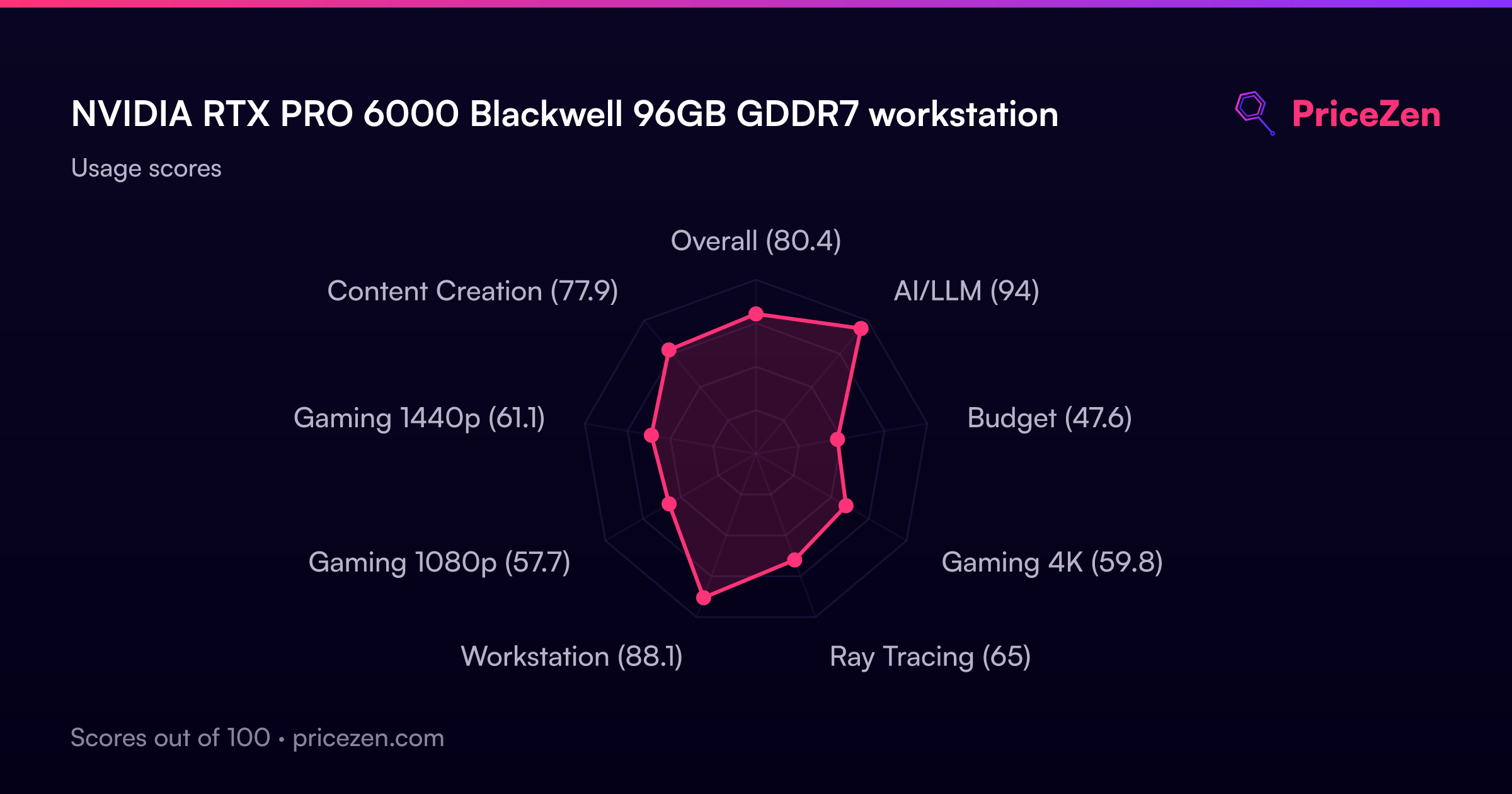
- कुल80.4
- AI/LLM94
- Budget47.6
- Gaming 4K59.8
- Ray Tracing65
- Workstation88.1
- Gaming 1080p57.7
- Gaming 1440p61.1
- Content Creation77.9