ASUS GeForce RTX 5060 Ti PRIME OC 16GB GDDR7 Black

79/100 कुल स्कोर 4.6 319 मालिकों की रेटिंग का औसत
- GPU
- GeForce RTX 5060 Ti
- VRAM
- 16GB GDDR7
- Boost clock
- 2647 MHz
- TDP
- 250 W
- Memory bus
- 128 bit
- Ray tracing
- हाँ
- Class
- consumer
1 स्टोर पर मूल्यों की तुलना करें
सबसे सस्ते पहले। नए, रीफर्बिश्ड और बंडल वाले ऑफ़र अलग रखे जाते हैं, ताकि आप समान की तुलना समान से करें।
| स्टोर | विक्रेता | रंग और स्थिति | मूल्य | न्यूनतम से अंतर | आख़िरी जाँच | लिंक |
|---|---|---|---|---|---|---|
| नया1 ऑफ़रएकल इकाई | ||||||
| आख़िरी जाँच में स्टॉक में नहीं था | ||||||
| Amazon | अज्ञात | सूचीबद्ध नहीं | कोई मूल्य नहीं | स्टॉक में नहीं | 2 नव॰ | स्टोर पर जाएँ |
 स्रोत: PriceZen, 2 नव॰ 2026 को जाँचा गया
कोई मूल्य तब वर्तमान माना जाता है जब हमने उसे पिछले 7 दिनों में जाँचा हो। “मार्केटप्लेस विक्रेता” का मतलब उस स्टोर पर मौजूद किसी तीसरे पक्ष का विक्रेता है, स्टोर खुद नहीं।
कीमत इतिहास
उस दिन जाँचा गयाउस दिन जाँचा नहीं गया, ऑफ़र अब भी चालू
स्रोत: PriceZen, checked 20 अक्टू॰ 2026











एक नज़र में
The 30-Second Version
Owners love this card far more than the tech press does, with 4.6/5 across 319 reviews and quiet operation plus 1440p muscle coming up constantly. The 16GB of GDDR7 at 448 GB/s is the standout spec, paired with a triple-fan cooler that ranks near the top for thermals. Raw raster is only mid-pack at 22099 on PassMark G3D, so DLSS 4 is doing real work here. Buy it near USD 610 at B&H Photo rather than the USD 830 the other big stores want, and it's an easy recommendation for budget 1440p builds.
Pros & Cons
खूबियाँ
- 16GB of GDDR7 at 448 GB/s, well above average VRAM for the class 94th
- Triple-fan 2.5-slot cooler ranks near the top for thermals, and owners consistently call it quiet 92nd
- Connectivity is a standout: 3x DP 2.1b plus HDMI 2.1b on PCIe 5.0 88th
- 86.6/100 in our budget-build scoring, with 4.6/5 from 319 owners backing it up 84th
- DLSS 4, AV1 encode and reported overclocking headroom give it room beyond stock raster
कमियाँ
- Raster and compute both sit mid-pack, with a 22099 PassMark G3D score
- 250W TDP and a 550W PSU requirement put efficiency below average
- Workstation scoring is its weakest area at 64/100
- Several owners needed a driver update just to get a display signal
- USD pricing swings from 586 to 880 across listings, so overpaying is easy
मालिकों की राय
The Word on the Street
- Price-to-performance is the single most repeated theme, with multiple owners saying the value is excellent at MSRP and specifically pushing back on the negative coverage this chip has received from tech reviewers.
- Quiet operation comes up again and again, with buyers describing a card they barely hear under load. Several also report meaningful overclocking headroom straight out of the box, which fits the oversized triple-fan cooler ASUS fitted.
- 1440p gaming is where owners say this thing shines, with reports of high or maxed settings in demanding modern titles. A recurring detail is how much DLSS 4 and frame generation contribute, even on modest CPUs.
- A small but consistent group needed a driver update before the card would output a signal at all, and one owner had to roll back to older drivers to stop crashes in a specific game. Not a dealbreaker, but plan for it rather than expecting a plug-and-play evening.
मालिकों की राय समय के साथ कैसे बदली
विशेषग्राहकों ने वास्तव में अपनी समीक्षाएँ कब लिखीं, इसके आधार पर - ताकि आप देख सकें कि शुरुआती तारीफ़ टिकी या नहीं।
48 लिखित समीक्षाएँ, अप्रैल 2025 – जून 2026: 40 संतुष्ट, 8 बिना स्टार
स्टोर की सभी 319 रेटिंग में: 4.6★। ज़्यादातर मालिक समीक्षा लिखे बिना रेटिंग देते हैं। चार्ट 48 लिखित समीक्षाएँ गिनता है।
- अप्रैल–जून 202629 में से 29 संतुष्ट · 1 बिना स्टार
Buyers praise the RTX 5060 Ti for excellent price-to-performance, quiet operation, and easy installation. A few note the price is slightly high, and one reports a PCIe compatibility issue requiring a BIOS update.
- Excellent price-to-performance ratio, especially at MSRP, with strong 1440p and 1080p gaming.
- Very quiet operation, even under load, with fans often stopping at idle.
- Easy installation, single 8-pin power connector, and good build quality.
- One user had black screen issues resolved by switching PCIe from Gen 3 to Gen 2; a driver fix was later released.
- अक्टू॰–दिस॰ 20252 में से 2 संतुष्ट · 3 बिना स्टार
Buyers in Q4 2025 praised the GPU for boosting gaming performance and handling large widescreen monitors, though one noted a required driver update before getting a signal.
- Great for gaming and content creation, with significant performance boost.
- Requires driver update before signal to monitor; workaround needed.
- Works well with large curved widescreen monitors and high-end PCs.
- Easy setup and overall satisfaction, would buy again.
- जुल॰–सित॰ 20254 में से 4 संतुष्ट · 2 बिना स्टार
Buyers in this period praised the card's price-to-performance, calling it a budget-friendly upgrade that tripled frame rates. Some noted it's best at MSRP and recommend the 16GB version, while one reviewer gave a low rating despite positive comments.
- Excellent value for money, outperforming older cards like 1080ti and 3050 at a fraction of next-tier cost.
- Strong performance gains, tripling frame rates and handling gaming and video with high visual quality.
- Mixed reviews on pricing: praised at MSRP but criticized by tech reviewers; recommend 16GB over 8GB.
- One low rating with no clear defect, possibly a mistake or dissatisfaction not explained in text.
- अप्रैल–जून 20254 में से 4 संतुष्ट · 1 बिना स्टार
Buyers praise the 5060 Ti for price-to-performance, overclocking headroom, and stability. It handles 1440p and modern games well, though one review notes it requires tweaking.
- Excellent price-to-performance, especially at MSRP, making it a strong budget option.
- Impressive overclocking headroom and stability, with one user reaching 3,000 MHz core.
- Good 1440p performance and handles modern games like Tarkov and Monster Hunter Wilds on high settings.
- Performance may require tweaking (overclocking/undervolting) to fully meet expectations.
हर बिंदु एक लिखित समीक्षा है, उस महीने में जब वह लिखी गई। संतुष्ट = 4-5★, मिश्रित = 3★, असंतुष्ट = 1-2★। अवधि के सारांश अंग्रेज़ी में हैं।
प्रमाण
Performance
The PassMark G3D benchmark score is 22099, which puts raw raster throughput right around the middle of the graphics card field. That's the honest headline: this isn't a monster, it's a competent mid-ranger. Compute sits at 19.18 TFLOPS for both FP16 and FP32, exactly average in our rankings, and ray tracing lands at the 65th percentile, so RT is present and usable but not a reason to buy. Where it claws back ground is DLSS 4 and frame generation. Owners repeatedly bring up how much those features carry the experience, with one buyer on a 12th gen i5 and 32GB of RAM describing max-settings play in demanding titles thanks to the AI upscaling doing heavy lifting. If you're the sort who turns frame gen off on principle, you're paying for a chunk of this card's value and then refusing to use it.
The thermals and acoustics story is genuinely strong. ASUS went with a triple Axial-tech fan setup on a 2.5-slot cooler, 304mm long, and thermal performance ranks among the best we track. Owners back that up: quiet operation is one of the most repeated themes in the reviews, showing up again and again without prompting. There's also real overclocking headroom according to multiple buyers, which fits a card with this much cooling attached to a 250W TDP. And that's the trade-off worth naming: 250W with a 550W PSU recommendation and a single 8-pin connector means efficiency lands below average in our data. It's cool and quiet because ASUS threw a big cooler at a fairly thirsty chip. In a small case with a modest power supply, that's the number to check before you click buy, not the frame rates.
Specifications
Full Specifications
Chipset
| GPU Chipset | GeForce RTX 5060 Ti |
| Brand | NVIDIA |
| Architecture | Blackwell |
| Class | consumer |
| Process | 5 |
Memory
| VRAM | 16 GB |
| Memory Type | GDDR7 |
| Memory Bus | 128 |
| Bandwidth | 448 |
| ECC | No |
Compute
| CUDA Cores | 4608 |
| Tensor Cores | 120 |
| RT Cores | 30 |
| Base Clock | 2617 |
| Boost Clock | 2647 |
| FP16 TFLOPS | 19.18 |
| FP32 TFLOPS | 19.18 |
Performance
| PassMark G3D | 22099 |
| GPU Compute | 10484 |
Power & Cooling
| TDP | 250 |
| Recommended PSU | 550 |
| Power Connectors | 8-Pin |
| Cooler | Triple Fan |
| Fans | 3 |
Connectivity
| Interface | PCI Express 5.0 x8 |
| DisplayPort | 3 |
| HDMI | 1 |
| Max Displays | 4 |
| Max Resolution | 7680 x 4320 |
Physical
| Length | 304 |
| Slot Width | 2.5 |
| Form Factor | ATX |
| Weight | 0.9 kg / 2.0 lbs |
Features
| Ray Tracing | Yes |
| Upscaling | DLSS 4 |
| AV1 Encode | Yes |
| VR Ready | Yes |
| DirectX | 12 Ultimate |
| RGB | No |
vs Competition
Against the Gigabyte GeForce RTX 5070 Ti Eagle Ice, MSI GeForce RTX 5070 Ti Ventus 3X OC and PNY GeForce RTX 5070 Ti OC, the argument for this ASUS is entirely about money and restraint. Its raster and compute rankings sit mid-field, so if you want raw horsepower those cards are the obvious step up. But if you're playing at 1440p with DLSS 4 doing the heavy lifting, this card's 16GB buffer and top-tier connectivity cover the same desk setup for less outlay, and our budget scoring reflects that. Cross-shop the 5070 Ti trio if you're chasing high-refresh 1440p or planning a 4K move and your budget can stretch.
The ZOTAC GeForce RTX 5080 APOCALYPSE is a different weight class entirely, and nothing in this card's mid-pack raster or 65th-percentile ray tracing ranking suggests it competes there. Don't let anyone talk you into it as a budget substitute. The more interesting fight is the Sapphire Radeon RX 9070 XT PULSE, and here the ASUS wins on things that aren't frame rates: DLSS 4 and frame generation, AV1 encoding for streamers and editors, and a thermal ranking near the top of the field with owners confirming the quiet operation. If you lean on upscaling and encode features, this is the easier card to live with. If you just want the most raw frames per dollar and don't care about the feature stack, put the PULSE on your shortlist too.
| Spec | ASUS GeForce RTX 5060 Ti PRIME OC | Gigabyte GeForce RTX 5070 Ti Eagle Ice | MSI GeForce RTX 5070 Ti Ventus 3X OC | ZOTAC GeForce RTX 5080 APOCALYPSE | PNY GeForce RTX 5080 ARGB OC | Sapphire Radeon RX 7900 XTX NITRO+ |
|---|---|---|---|---|---|---|
| Chipset | GeForce RTX 5060 Ti | GeForce RTX 5070 Ti | GeForce RTX 5070 Ti | GeForce RTX 5080 | GeForce RTX 5080 | Radeon RX 7900 XTX |
| Vram | 16GB GDDR7 | 16GB GDDR7 | 16GB GDDR7 | 16GB GDDR7 | 16GB GDDR7 | 24GB GDDR6 |
| Boost Clock Mhz | 2647 | 2542 | 2482 | 2730 | 2620 | 2680 |
| Tdp W | 250 | 300 | 300 | 360 | 360 | 339 |
| Memory Bus Bits | 128 | 256 | 256 | 256 | 256 | 384 |
| Ray Tracing | Yes | Yes | Yes | Yes | Yes | Yes |
| GPU Class | consumer | consumer | consumer | consumer | consumer | consumer |
| Compare | Compare | Compare | Compare | Compare |
| उत्पाद | AI | Rt | Vram | Raster | Compute | Feature | User Sentiment | Efficiency | Connectivity | सामाजिक प्रमाण | Affordability |
|---|---|---|---|---|---|---|---|---|---|---|---|
| ASUS GeForce RTX 5060 Ti PRIME OC | 68 | 65 | 83 | 55.4 | 49.8 | 88.4 | 57.6 | 43.6 | 94.2 | 83.9 | 43.8 |
| Gigabyte GeForce RTX 5070 Ti Eagle Ice Compare | 79 | 88.7 | 86 | 89 | 87.9 | 95.7 | 85 | 71.7 | 94.2 | 93.4 | 23 |
| MSI GeForce RTX 5070 Ti Ventus 3X OC Compare | 79 | 92.4 | 86 | 89 | 87.9 | 95.7 | 85 | 71.7 | 94.2 | 83.9 | 21 |
| ZOTAC GeForce RTX 5080 APOCALYPSE Compare | 85.5 | 97.7 | 89.1 | 94.5 | 93.3 | 95.7 | 99.5 | 56.7 | 94.2 | 98.7 | 23.3 |
| PNY GeForce RTX 5080 ARGB OC Compare | 85.5 | 97.7 | 89.1 | 94.5 | 93.3 | 95.7 | 71.1 | 56.7 | 94.2 | 74.9 | 15.7 |
| Sapphire Radeon RX 7900 XTX NITRO+ Compare | 95.3 | 96.4 | 92.1 | 83.4 | 95.6 | 95.7 | 85 | 51.4 | 98.8 | 69.3 | 13.6 |
कीमत
Value & Pricing
This is where you need to pay attention, because the spread is wild. In the US we're tracking nine listings ranging from USD 586 to USD 880, a USD 294 gap for the identical card. Right now B&H Photo is cheapest at USD 610, with Newegg at USD 829 and both Amazon and Best Buy at USD 830. That's a difference of over two hundred dollars depending on which tab you happen to have open. We track prices over time, partly through our community browser extension, and this is exactly the kind of product where checking a second store pays for your lunch several times over.
Canada is messier: eight listings from CAD 873 to CAD 2,730, a CAD 1,857 spread that frankly looks like marketplace sellers having a laugh. European listings run EUR 915 to EUR 1,457. At the low end of any of those ranges, the 86.6/100 budget score makes total sense and owners say so explicitly, praising price-to-performance at MSRP. At the top end, affordability drops to about average in our rankings and you should be cross-shopping harder. Same silicon, wildly different deal.
और पढ़ें
Overview
The RTX 5060 Ti has been the punching bag of this generation, and ASUS's PRIME OC 16GB is one of the cards taking the hits. Here's the thing though: we pull specs, prices, ratings and owner reviews from a pile of stores with our own automated system, and the people who actually bought this card are far happier than the discourse suggests. It sits at 4.6/5 across 319 reviews, with an 82/100 sentiment score in our data. That gap between reviewer grumbling and owner satisfaction is basically the whole story here.
On paper it's a Blackwell chip on a 5nm process, 4608 CUDA cores boosting to 2647MHz, and 16GB of GDDR7 pushing 448 GB/s across a 128-bit bus. That memory config is the interesting part. The 16GB buffer lands well above average for this category, while the narrow bus is the compromise NVIDIA made to get there at this price. You also get DLSS 4, AV1 encode, three DisplayPort 2.1b outputs plus HDMI 2.1b, and PCIe 5.0 x8. Connectivity ranks near the very top of everything we track, which matters if you're running a high-refresh panel or a multi-monitor desk.
Who's it for? Someone building or upgrading a 1440p gaming rig who doesn't want to spend flagship money and doesn't want to gamble on 8GB of VRAM aging badly. Our scoring model puts it at 86.6/100 for budget builds and 79/100 overall, with 4K gaming at 77.1/100. The weak spot is workstation use at 64/100, and that tracks with the compute ranking sitting dead center of the pack. This is a games card that can do some creative work on the side, not the other way around.
Common Questions
Q: Can it actually handle 4K, or is this a 1440p card?
Our scoring model gives it 77.1/100 for 4K gaming, which is respectable but not the sweet spot. With 16GB of GDDR7 you won't run out of memory at 4K, but the 22099 PassMark G3D score sits mid-field, so you'll be leaning on DLSS 4 and frame generation to get there. For native 4K at high refresh, look at the 5070 Ti options instead.
Q: Will my power supply cope?
ASUS specs a 250W TDP and recommends a 550W PSU, with a single 8-pin connector rather than the newer 12-pin style. That's a straightforward swap for most existing builds, but efficiency lands below average in our rankings, so don't try to squeeze it into a system running a tired 450W unit. Check the wattage before you check the frame rates.
Q: Does it fit in a smaller case?
It's 304mm long and 2.5 slots thick, and ASUS markets it as SFF-Ready with a dual BIOS. That's compact enough for many small-form-factor cases, but measure your clearance first because triple-fan cards vary. The upside is that this cooler is why thermal performance ranks near the top of the category and owners keep calling it quiet.
Q: Should I save money on the 8GB version instead?
We'd say no, and owners agree, specifically flagging the 8GB variant as the one to skip. The 16GB buffer here ranks well above average for this class and is the main reason this card will age gracefully at 1440p with heavy textures. Given the USD 586 to USD 880 spread we're tracking, shopping around for a cheap 16GB listing beats buying the cut-down version.
Who Should Skip This
Skip this if your work involves serious 3D rendering, simulation or professional compute. Our model scores it 64/100 for workstation use, its weakest area, and the 19.18 TFLOPS figure sits exactly at the midpoint of the field. Ray tracing at the 65th percentile also means it's not the card for someone who wants path-traced visuals at high frame rates. And if you're philosophically opposed to frame generation, you're paying for DLSS 4 and then throwing away the part that makes this card competitive, so put the Sapphire Radeon RX 9070 XT PULSE on your list instead.
Also skip it if you're being asked to pay the top of the range. At USD 830 from Amazon or Best Buy, or anywhere near CAD 2,730 or EUR 1,457, the value argument evaporates and you should be looking hard at the Gigabyte GeForce RTX 5070 Ti Eagle Ice, MSI GeForce RTX 5070 Ti Ventus 3X OC or PNY GeForce RTX 5070 Ti OC. This card is a great buy at USD 610. It's a much harder sell at two hundred dollars more.
Verdict
For a 1440p gamer building on a real budget, we'd recommend this without much hesitation, provided you buy it near the bottom of the price range. The 16GB of GDDR7 means you're not sweating texture settings two years out, the cooler is one of the better ones in the category, and 319 owners averaging 4.6/5 is not a fluke. Our 79/100 overall score and 86.6/100 budget rating line up with what buyers actually report: quiet, easy to set up, plenty fast with DLSS 4 switched on. Just budget an evening for driver updates, because a couple of owners hit no-signal issues out of the box.
For anything else, temper expectations. Our model gives it 64/100 for workstation duty and its compute ranking is exactly average, so heavy 3D, simulation or pro render work should look elsewhere. Pure raster purists who refuse frame generation are buying a mid-pack card at a premium for features they won't touch. And if you're eyeing the 8GB sibling to save cash, don't. Owners specifically flag it as the version to avoid, and the whole appeal of this model is that 16GB buffer.
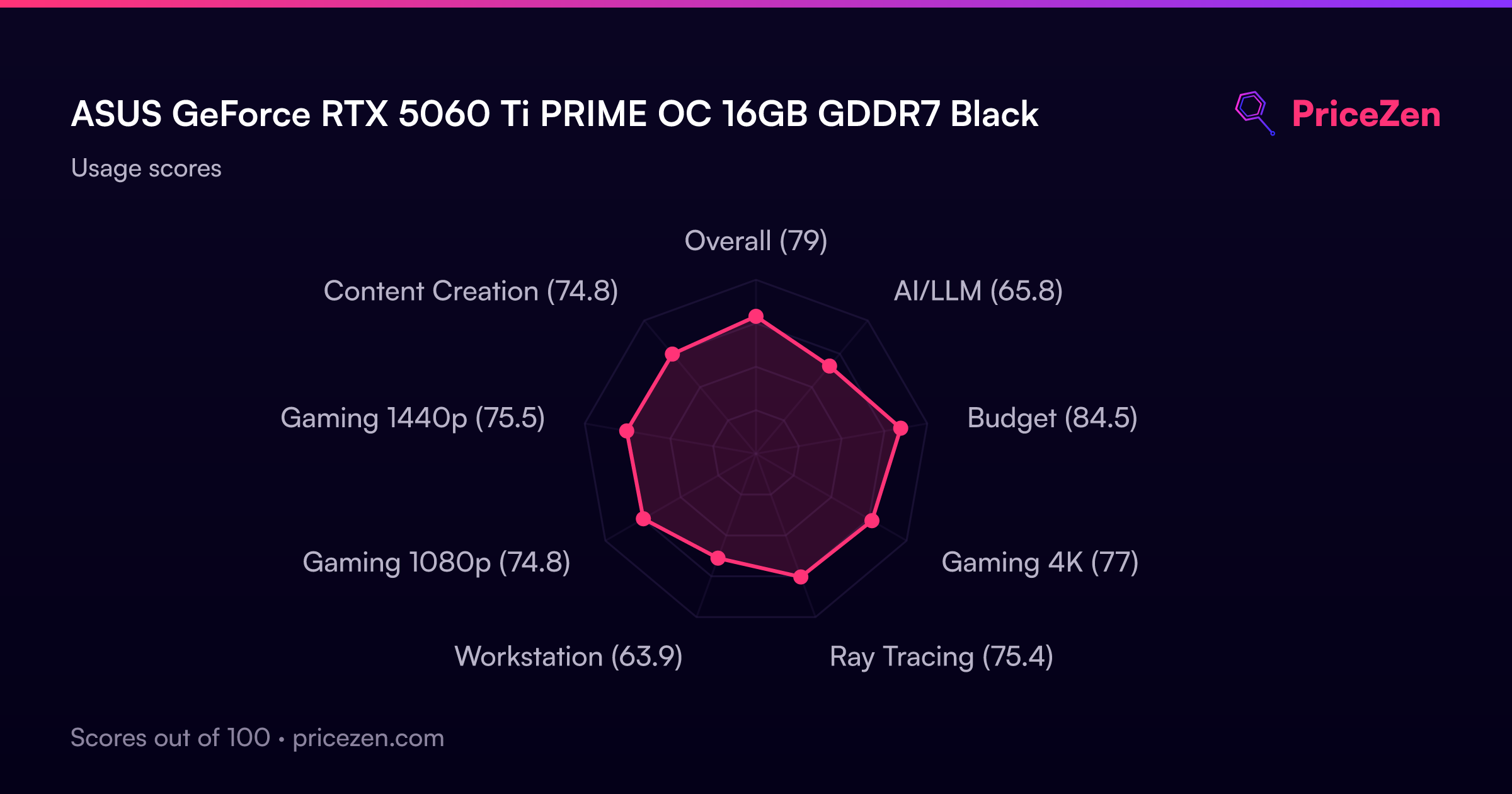
Usage Scores
- कुल79
- AI/LLM65.8
- Budget84.5
- Gaming 4K77
- Ray Tracing75.4
- Workstation63.9
- Gaming 1080p74.8
- Gaming 1440p75.5
- Content Creation74.8