Gigabyte GeForce RTX 5070 Ti Eagle 16GB GDDR7 Black
The Blackwell-based RTX 5070 Ti Eagle pairs 8960 CUDA cores with 16GB of GDDR7 memory on a 256-bit bus, delivering 43.94 FP32 TFLOPS and a 2452MHz boost clock. Its triple-fan cooler and 2.5-slot design keep the 300W TDP manageable, while PCIe 5.0 and DisplayPort 2.1b outputs future-proof connectivity. Best for 4K gamers who want high frame rates without paying flagship prices, though budget-conscious buyers may find better value elsewhere.

अभी किसी विक्रेता की मौजूदा कीमत नहीं है
एक नज़र में
The 30-Second Version
The Gigabyte GeForce RTX 5070 Ti Eagle is a fast Blackwell graphics card with 16GB of GDDR7 and top-tier raster performance, scoring 81/100 for 4K gaming. The problem is the CAD 3,200 price tag, which lands it near the bottom of our affordability rankings. Great card, wait for a better deal.
Pros & Cons
खूबियाँ
- Top-tier raster performance, 81/100 for 4K gaming 89th
- 16GB GDDR7 at 896 GB/s gives real headroom 88th
- Strong compute at 43.94 TFLOPS for AI and rendering work 86th
- PCIe 5.0 with three DP 2.1b and HDMI 2.1b outputs 82nd
- Manageable 304mm length for a triple-fan card
कमियाँ
- CAD 3,200 is a brutal ask, affordability ranks near the bottom
- 300W TDP and a 750W PSU requirement aren't cheap to feed
- Ray tracing lags behind its own raster strength
- 2.5 slots will crowd a compact build
- Feature set scores only about average for the category
प्रमाण
Performance
The PassMark G3D benchmark score of 32373 lands this card among the best we've tracked, and our category scores back that up: 81/100 for 4K gaming, 80.5 for 1080p and 80.4 for 1440p. That flat spread across resolutions is the interesting part. This thing isn't a 1080p card you're overpaying for, it's genuinely built to push 4K, and the 16GB of GDDR7 with 896 GB/s of bandwidth is why. Raw compute sits at 43.94 TFLOPS for both FP16 and FP32, which puts it well above average for AI and compute workloads too.
Ray tracing scores 79/100, which is strong but a step behind its raster showing, so heavy RT titles will lean on upscaling more than pure raster ones. Thermals and efficiency both land around the middle of the pack at 72, which tracks with a 300W TDP and a 750W PSU recommendation. Not alarming, just not frugal. You'll want a case that can breathe and a power supply that isn't already sweating.
Specifications
Full Specifications
Chipset
| GPU Chipset | GeForce RTX 5070 Ti |
| Brand | NVIDIA |
| Architecture | Blackwell |
| Class | consumer |
| Process | 5 |
Memory
| VRAM | 16 GB |
| Memory Type | GDDR7 |
| Memory Bus | 256 |
| Bandwidth | 896 |
Compute
| CUDA Cores | 8960 |
| Tensor Cores | 280 |
| RT Cores | 70 |
| Base Clock | 2300 |
| Boost Clock | 2452 |
| FP16 TFLOPS | 43.94 |
| FP32 TFLOPS | 43.94 |
Performance
| PassMark G3D | 32373 |
| GPU Compute | 17898 |
Power & Cooling
| TDP | 300 |
| Recommended PSU | 750 |
| Power Connectors | 1 x 16-Pin |
| Cooler | Triple Fan |
| Fans | 3 |
Connectivity
| Interface | PCI Express 5.0 |
| DisplayPort | 3 |
| HDMI | 1 |
| Max Displays | 4 |
| Max Resolution | 7680 x 4320 |
Physical
| Length | 304 |
| Slot Width | 2.5 |
| Form Factor | ATX |
Features
| Ray Tracing | Yes |
| VR Ready | Yes |
| DirectX | 12 |
vs Competition
Against the MSI GeForce RTX 5070 Ti Ventus 3X OC, you're looking at the same chipset, so the decision comes down to cooler design, board layout and whatever price gap you find. The Eagle's triple-fan, 2.5-slot design and 304mm length are reasonable middle ground, and its connectivity score of 82 is well above average thanks to those DP 2.1b outputs.
If your budget stretches further, the ASUS GeForce RTX 5090 TUF Gaming and the two RTX 5080 options (ZOTAC APOCALYPSE and PNY ARGB OC) sit above this card in the stack, and given how high the Eagle's price already is, the gap may be smaller than you'd expect. On the AMD side, the Sapphire Radeon RX 7900 XTX NITRO+ is worth a look if raw raster and memory capacity matter more to you than ray tracing, since RT is the Eagle's softer spot at 79/100. Our ranking puts this card firmly in the upper tier for raster and compute, but it doesn't win on value against any of these.
| Spec | Gigabyte GeForce RTX 5070 Ti Eagle | ASUS GeForce RTX 5090 TUF Gaming | MSI GeForce RTX 5070 Ti Ventus 3X OC | ZOTAC GeForce RTX 5080 APOCALYPSE | Sapphire Radeon RX 7900 XTX NITRO+ | PNY GeForce RTX 5080 ARGB OC |
|---|---|---|---|---|---|---|
| Chipset | GeForce RTX 5070 Ti | GeForce RTX 5090 | GeForce RTX 5070 Ti | GeForce RTX 5080 | Radeon RX 7900 XTX | GeForce RTX 5080 |
| Vram | 16GB GDDR7 | 32GB GDDR7 | 16GB GDDR7 | 16GB GDDR7 | 24GB GDDR6 | 16GB GDDR7 |
| Boost Clock Mhz | 2452 | 2407 | 2482 | 2730 | 2680 | 2620 |
| Tdp W | 300 | 575 | 300 | 360 | 339 | 360 |
| Memory Bus Bits | 256 | 512 | 256 | 256 | 384 | 256 |
| Ray Tracing | Yes | Yes | Yes | Yes | Yes | Yes |
| GPU Class | consumer | consumer | consumer | consumer | consumer | consumer |
| Compare | Compare | Compare | Compare | Compare |
| उत्पाद | AI | Rt | Vram | Raster | Compute | Feature | Thermal | Efficiency | Connectivity | Affordability |
|---|---|---|---|---|---|---|---|---|---|---|
| Gigabyte GeForce RTX 5070 Ti Eagle | 79.1 | 79.2 | 86 | 89 | 88 | 43.7 | 72.1 | 71.8 | 81.5 | 12.8 |
| ASUS GeForce RTX 5090 TUF Gaming Compare | 97.2 | 90.5 | 97.8 | 98.8 | 97.7 | 95.8 | 72.1 | 23.5 | 99.3 | 2.3 |
| MSI GeForce RTX 5070 Ti Ventus 3X OC Compare | 79.1 | 92.4 | 86 | 89 | 88 | 95.8 | 91.9 | 71.8 | 94.2 | 23.9 |
| ZOTAC GeForce RTX 5080 APOCALYPSE Compare | 85.4 | 97.6 | 89.1 | 94.5 | 93.4 | 95.8 | 91.9 | 56.8 | 94.2 | 21.2 |
| Sapphire Radeon RX 7900 XTX NITRO+ Compare | 95.2 | 96.4 | 92 | 83.4 | 95.7 | 95.8 | 91.9 | 51.6 | 98.8 | 19.1 |
| PNY GeForce RTX 5080 ARGB OC Compare | 85.4 | 97.6 | 89.1 | 94.5 | 93.4 | 95.8 | 91.9 | 56.8 | 94.2 | 15.4 |
कीमत
Value & Pricing
Here's where we have to be blunt. CAD 3,200 at Newegg is the only listing we're tracking, and our affordability ranking puts this card in the bottom stretch of the entire GPU category. The budget score of 68.1/100 is its weakest area by a clear margin. You're paying flagship-adjacent money for a card whose performance, while excellent, isn't at the very top of the charts. If you're cross-shopping the MSI GeForce RTX 5070 Ti Ventus 3X OC or stepping up toward a ZOTAC GeForce RTX 5080 APOCALYPSE or PNY GeForce RTX 5080 ARGB OC, do that math carefully before committing. We track prices over time through our community browser extension, and patience tends to pay off on cards priced like this.
और पढ़ें
Overview
The Gigabyte GeForce RTX 5070 Ti Eagle is a Blackwell-based graphics card built on a 5nm process, packing 8960 CUDA cores and 16GB of GDDR7 across a 256-bit bus. It's the kind of card people search for when they want serious 4K gaming without jumping to flagship pricing. And here's the thing: at CAD 3,200 from Newegg, "without flagship pricing" is doing a lot of heavy lifting.
On paper this is a strong card. You get 896 GB/s of memory bandwidth, a 2452MHz boost clock, PCI Express 5.0, three DisplayPort 2.1b outputs plus HDMI 2.1b, and a triple-fan cooler in a 304mm, 2.5-slot package. Our scoring model puts its raster performance in the top tier of every GPU we track, with compute and VRAM capacity close behind. The weak spot is affordability, where it sits near the bottom of our rankings.
So the short version: great silicon, awkward price. We'll get into whether that trade makes sense.
Common Questions
Q: Is the RTX 5070 Ti Eagle good for 4K gaming?
Yes. Our scoring model gives it 81/100 for 4K gaming, and the 16GB of GDDR7 with 896 GB/s of bandwidth is exactly what high-resolution textures need. It's one of the stronger 4K cards in our rankings.
Q: How much VRAM does the Gigabyte RTX 5070 Ti Eagle have?
It has 16GB of GDDR7 on a 256-bit bus, running at 896 GB/s. That VRAM capacity ranks among the best in the GPU category we track.
Q: What power supply do I need for the RTX 5070 Ti Eagle?
Gigabyte specs a 750W PSU, and the card draws 300W with a single 16-pin connector. Efficiency scores around the middle of the pack, so don't plan on squeezing it into a tight power budget.
Q: Will the RTX 5070 Ti Eagle fit in my case?
It's 304mm long and takes up 2.5 slots with its triple-fan cooler. That's manageable for most mid-tower cases, but measure before you buy if you're building small.
Who Should Skip This
Skip this if you're building on a budget, full stop. At CAD 3,200 it's one of the worst value picks in our GPU rankings, and a 1080p-only gamer is paying for headroom they'll never touch. Small-form-factor builders should also look elsewhere, since 2.5 slots and a 750W PSU recommendation don't play nicely with compact cases and SFX power supplies. And if ray tracing is your main event, the 79/100 RT score means the Sapphire Radeon RX 7900 XTX NITRO+ for raster or a step up to the PNY GeForce RTX 5080 ARGB OC deserve a serious look first.
Verdict
Should you buy the Gigabyte RTX 5070 Ti Eagle? If you find it at a sane price, yes. It's a fast, well-specced 4K card with 16GB of GDDR7 that won't feel cramped in a couple of years, and the performance scores hold up across every resolution we track. At CAD 3,200, though, we'd hesitate. That price sits in the worst 11th percentile for affordability, and there are enough strong alternatives that paying this much for a 5070 Ti feels like buying the ticket after the surge pricing kicked in.
Our advice: watch the price, cross-shop the Ventus 3X OC and the 5080 options, and pull the trigger when the number makes sense. The card deserves better than the price it's currently wearing.
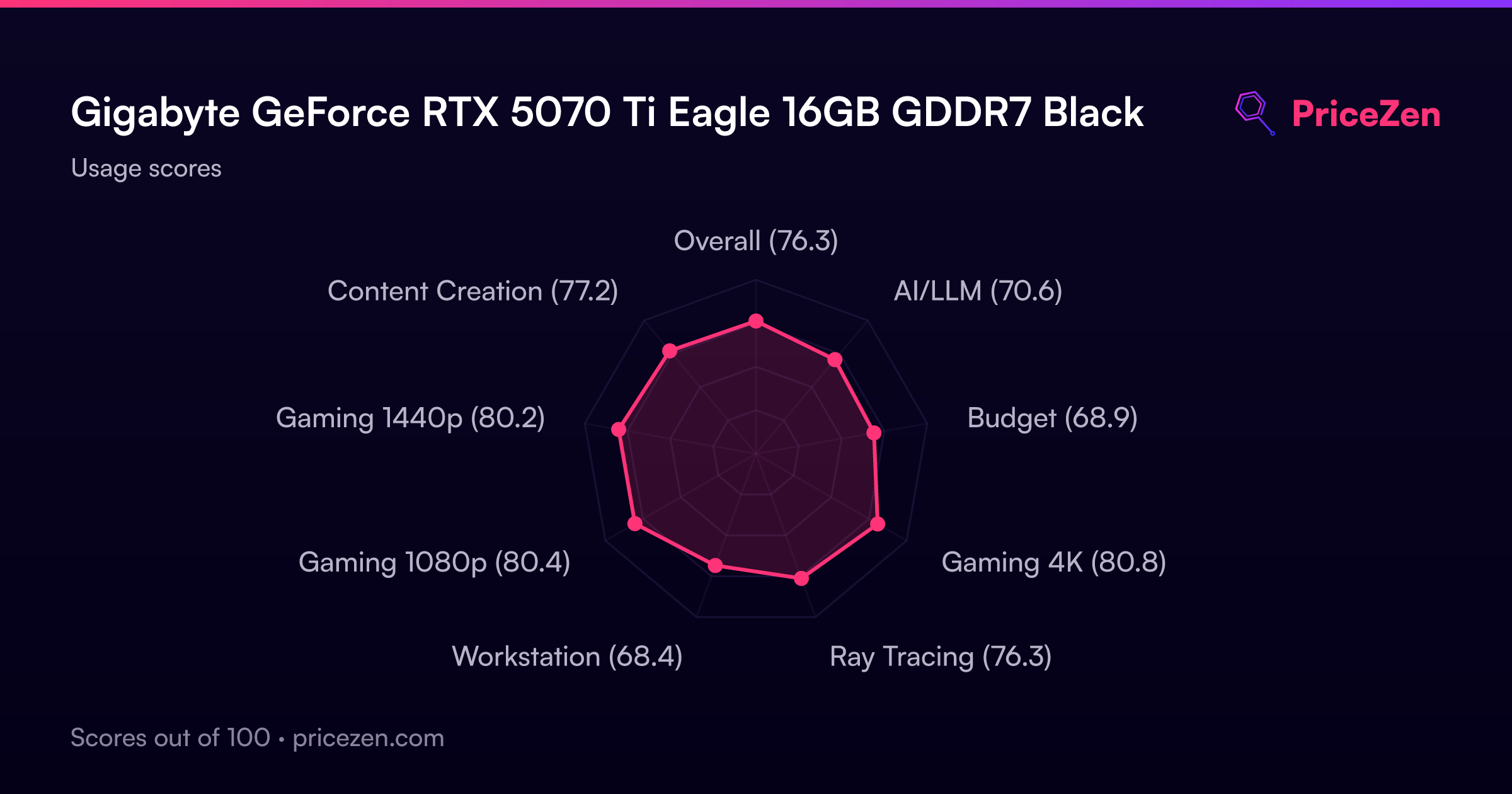
Usage Scores
- कुल76.3
- AI/LLM70.6
- Budget68.9
- Gaming 4K80.8
- Ray Tracing76.3
- Workstation68.4
- Gaming 1080p80.4
- Gaming 1440p80.2
- Content Creation77.2