SAPLOS Radeon HD 6570 1GB GDDR3
A 60W TDP and low-profile design allow this Radeon HD 6570 to slot into compact office PCs without needing external power. Dual HDMI outputs and a 1GB GDDR3 frame buffer provide stable multi-monitor support up to 1920x1080 for basic productivity. This card is best for users upgrading aging systems for office work or coding, as discontinued driver support limits it to Windows 10 and DirectX 11.

No current retailer price








Snapshot
The 30-Second Version
The SAPLOS Radeon HD 6570 is a cheap, low-power card that adds dual HDMI to old office PCs. It's great for basic multitasking but useless for gaming, with a PassMark score of 553 and 1GB of slow GDDR3. Buy it if you need a display adapter for an aging desktop, skip it if you want any real performance.
Pros & Cons
Pros
- Dual HDMI outputs make two-monitor setups painless on old machines. 97th
- 60W power draw means no extra power cables, just plug it into the PCIe slot.
- Low-profile, single-slot design fits in small form factor cases.
- Easy installation on older Windows systems, per multiple owners.
Cons
- Drivers are ancient, with the latest from 2015 and no Windows 11 support.
- Fan noise gets noticeable under load, according to some buyers.
- 1GB GDDR3 on a 64-bit bus is nearly useless for any modern workload.
- The included driver CD is often defective or outdated.
What owners think
The Word on the Street
How owner sentiment changed over time
ExclusiveBased on when customers actually wrote their reviews - so you can see whether early praise held up.
11 written reviews, May 2023 – Dec 2025: 8 happy, 2 mixed, 1 unhappy
Across all 227 store ratings: 4.0★. Most owners rate without writing a review. The chart counts the 11 written reviews.
Each dot is one written review, in the month it was written. Happy = 4-5★, mixed = 3★, unhappy = 1-2★.
The proof
Performance
The numbers tell the story. A PassMark G3D score of 553 puts this card in the bottom 7% for raster performance, and the 1GB of GDDR3 on a 64-bit bus lands in the bottom 3% for VRAM. Gaming at 1080p scores 13.3 out of 100, and 1440p drops to 10.5. This thing is not built for frames per second. What it does handle is desktop output. Full HD video over dual HDMI works fine for office multitasking, and the 60W TDP means it runs cool enough in tight cases. The 650MHz boost clock is modest, but for pushing pixels on a couple of monitors, it's adequate. Just don't ask it to do anything resembling modern 3D work.
Specifications
Full Specifications
Chipset
| GPU Chipset | Radeon HD 6570 |
| Brand | AMD |
| Class | consumer |
Memory
| VRAM | 1 GB |
| Memory Type | GDDR3 |
| Memory Bus | 64 |
Compute
| Stream Processors | 480 |
| Base Clock | 650 |
| Boost Clock | 650 |
Performance
| PassMark G3D | 553 |
| GPU Compute | 319 |
Power & Cooling
| TDP | 60 |
| Recommended PSU | 300 |
| Power Connectors | No |
| Cooler | Fan |
| Fans | 1 |
Connectivity
| Interface | PCI Express x16 2.0 |
| DisplayPort | 0 |
| HDMI | 2 |
| USB-C | 0 |
| Max Resolution | 1920 x 1080 |
Physical
| Length | 160 |
| Slot Width | 1 |
| Form Factor | Low Profile |
| Weight | 0.1 kg / 0.3 lbs |
Features
| Ray Tracing | No |
| DirectX | 11 |
vs Competition
Stacked against the competition, the HD 6570 is in a different league entirely, and not in a good way. The Gigabyte WINDFORCE GTX 1080 and EVGA GTX 1070 SC are from a completely different era of performance, with VRAM and compute scores that make this card look like a museum piece. The MSI Ventus GTX 1660 Ti is also miles ahead for gaming. Even the NVIDIA Quadro P2200, a workstation card, runs circles around it for compute tasks. The only place the HD 6570 competes is price and power draw. If you need a cheap, low-power card for basic display output, this works. If you need any real GPU horsepower, every competitor here is a better choice.
| Spec | SAPLOS Radeon HD 6570 | ASUS GeForce RTX 5090 TUF Gaming | Gigabyte GeForce RTX 5090 WINDFORCE OC | MSI GeForce RTX 5090 Gaming Trio | ZOTAC GeForce RTX 5080 AMP Extreme Infinity | PNY NVIDIA RTX PRO 6000 Blackwell Max-Q Workstation Edition |
|---|---|---|---|---|---|---|
| Chipset | Radeon HD 6570 | GeForce RTX 5090 | GeForce RTX 5090 | GeForce RTX 5090 | GeForce RTX 5080 | NVIDIA RTX PRO 6000 Blackwell Max-Q Workstation Edition |
| Vram | 1GB GDDR3 | 32GB GDDR7 | 32GB GDDR7 | 32GB GDDR7 | 16GB GDDR7 | 96GB GDDR7 |
| Boost Clock Mhz | 650 | 2407 | 2467 | 2480 | 2670 | 2280 |
| Tdp W | 60 | 575 | 575 | 575 | 360 | 300 |
| Memory Bus Bits | 64 | 512 | 512 | 512 | 256 | 512 |
| Ray Tracing | false | true | true | true | true | true |
| GPU Class | consumer | consumer | consumer | consumer | consumer | workstation |
| Compare | Compare | Compare | Compare | Compare |
| Product | AI | Rt | Vram | Raster | Compute | Feature | Thermal | User Sentiment | Efficiency | Connectivity | Social Proof | Affordability |
|---|---|---|---|---|---|---|---|---|---|---|---|---|
| SAPLOS Radeon HD 6570 | 4.2 | 7.4 | 2.6 | 7.7 | 3.3 | 10.7 | 25.2 | 15.4 | 8 | 17.9 | 59.3 | 96.8 |
| ASUS GeForce RTX 5090 TUF Gaming Compare | 97.1 | 90.6 | 97.8 | 98.8 | 97.6 | 95.8 | 72.1 | 85.5 | 23.6 | 99.3 | 98.7 | 2.4 |
| Gigabyte GeForce RTX 5090 WINDFORCE OC Compare | 98.4 | 84.1 | 97.8 | 98.8 | 98.2 | 95.8 | 91.8 | 71.6 | 23.6 | 94.1 | 69.2 | 3.1 |
| MSI GeForce RTX 5090 Gaming Trio Compare | 97.5 | 90.9 | 97.8 | 98.8 | 98.2 | 95.8 | 91.8 | 0 | 23.6 | 94.1 | 93.4 | 4.1 |
| ZOTAC GeForce RTX 5080 AMP Extreme Infinity Compare | 85.5 | 97.6 | 89.1 | 94.5 | 93.4 | 95.8 | 91.8 | 71.6 | 56.6 | 94.1 | 98.7 | 7.3 |
| PNY NVIDIA RTX PRO 6000 Blackwell Max-Q Workstation Edition Compare | 99.7 | 99.6 | 99.8 | 87.3 | 99.3 | 99.8 | 25.2 | 96.1 | 69 | 87.2 | 46.6 | 0.3 |
Price
Value & Pricing
At around $60 USD, this card is cheap. And for what it does, that price is fair. You're getting a reliable way to add dual HDMI outputs to an old desktop without upgrading the power supply. The affordability score sits in the 97th percentile, which is the one place this card genuinely shines. But value depends on expectations. If you think you're getting a budget gaming card, you're not. You're getting a display adapter. For office work, kid PCs, or security monitoring rigs, it's a reasonable spend. For anything else, save your money.
Price history
Read more
Overview
The SAPLOS Radeon HD 6570 is a low-profile, single-slot card aimed at breathing a little life into old office PCs. It sips power at 60W, pulls everything from the PCIe slot, and gives you dual HDMI outputs for a clean two-monitor setup. That's the pitch, and for basic desktop work it mostly delivers.
But let's be real about what this is. A 1GB GDDR3 card on a 64-bit bus with a PassMark score of 553 is not a gaming card. It's a display adapter with a fan. If you need something to run spreadsheets, browse the web, or keep an aging Optiplex useful, it fits the bill. If you want to play anything made after 2012, keep scrolling.
Common Questions
Q: Will this card work with Windows 11?
It's hit or miss. The latest official drivers are from 2015, and several users report installation failures on Windows 11. It's safest to stick with Windows 10 or older.
Q: Can I use this for gaming?
Not really. With a PassMark score of 553 and 1GB of GDDR3, it's built for desktop work and video output, not modern games. Older titles from before 2012 might run at low settings, but that's about it.
Q: Does it need a power cable from the PSU?
No. It draws 60W directly from the PCIe slot, so as long as your motherboard has a PCIe x16 slot, you're good to go without any extra cables.
Who Should Skip This
Skip this if you need any kind of modern gaming performance, AI workloads, or VRAM-heavy tasks. The 1GB of GDDR3 and bottom-tier compute scores make it a non-starter for anything beyond basic display output. Also skip it if you're on Linux or Windows 11, since driver support is either nonexistent or unreliable. If you need a card that can handle 1080p gaming or creative work, look at something with at least 4GB of GDDR5 and a modern driver package.
Verdict
This card is for people with old computers who need dual monitors and don't want to replace their power supply. It's a utility purchase, not an upgrade. If you have a Dell Optiplex or Lenovo small form factor machine that's still kicking, this will keep it useful for office work and web browsing. The installation is straightforward, and the price is right. Just know that driver support is a headache, especially if you're on Windows 11 or Linux. For the right use case, it's a solid buy. For everyone else, it's a pass.
Usage Scores
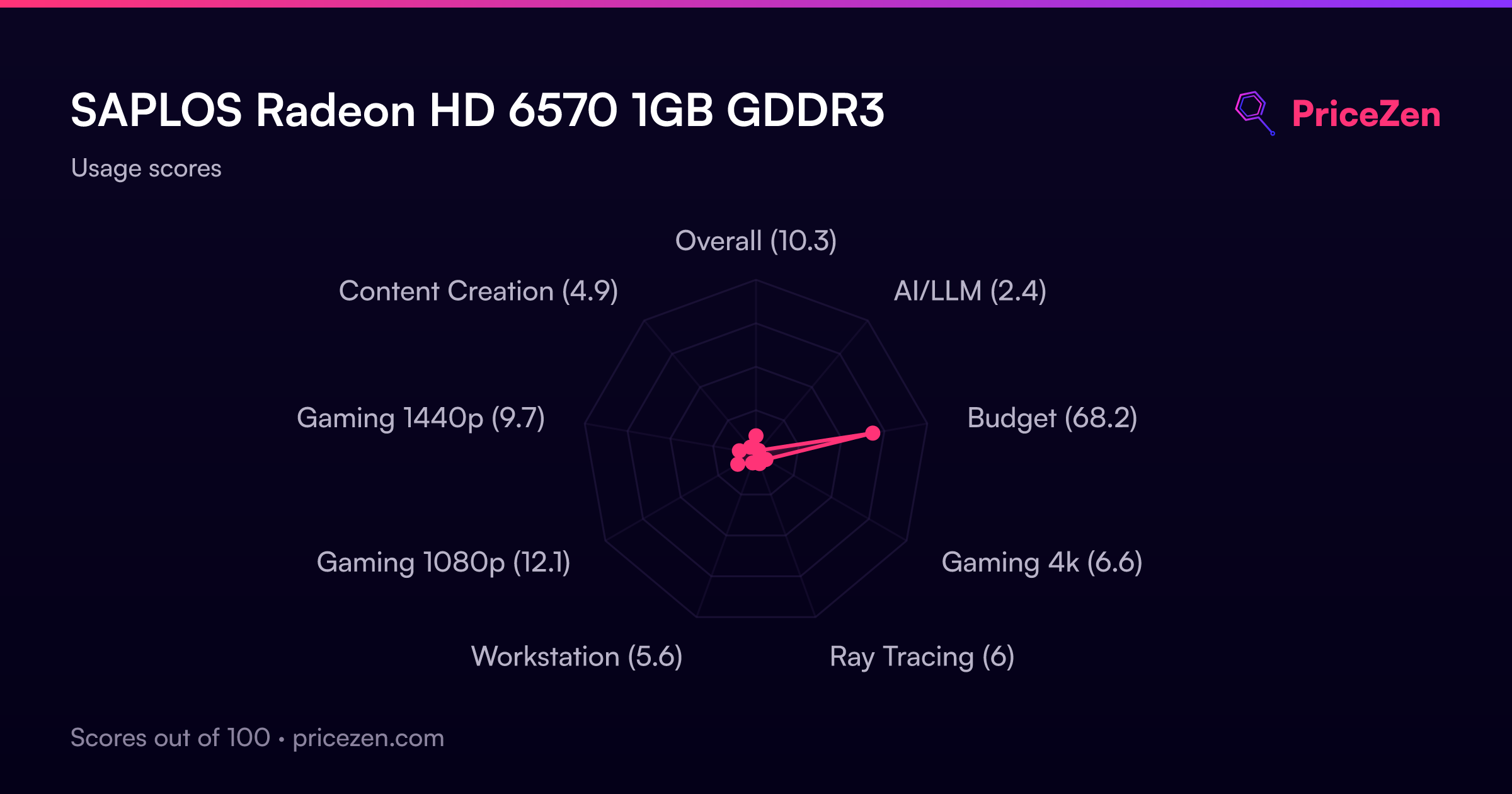
- Overall10.3
- AI/LLM2.4
- Budget68.2
- Gaming 4k6.6
- Ray Tracing6
- Workstation5.6
- Gaming 1080p12.1
- Gaming 1440p9.7
- Content Creation4.9