ASUS GeForce RTX 4070 Dual EVO OC 12GB GDDR6X Black

AV1 encoding for streaming and recording verified Nov 29
78/100 overall score 4.7 average from 176 owner ratings
- GPU
- GeForce RTX 4070
- VRAM
- 12GB GDDR6X
- Boost clock
- 2520 MHz
- TDP
- 200 W
- Memory bus
- 192 bit
- Ray tracing
- Yes
- Class
- consumer
Compare prices at 1 store
Cheapest first. New, refurbished and bundled offers are kept apart, so you compare like with like.
| Store | Sold by | Colour and condition | Price | vs lowest | Last checked | Link |
|---|---|---|---|---|---|---|
| New1 offerSingle unit | ||||||
| Out of stock when last checked | ||||||
| Amazon | Not known | Not listed | No price | Out of stock | Nov 12 | Go to store |
 Source: PriceZen, checked Nov 12, 2026
A price counts as current when we checked it in the last 7 days. “Marketplace seller” means a third-party seller on that store, not the store itself.
Price history
No offers of this kind in this period.
Checked that dayNot checked that day, still on offer
Source: PriceZen, checked Aug 17, 2026











Snapshot
The 30-Second Version
The ASUS Dual RTX 4070 EVO OC scores 26,881 on PassMark, putting it in the 73rd percentile for raster performance, and its 90th percentile efficiency with a 200W TDP is genuinely impressive. But user sentiment sits at the 37th percentile, and the 12GB VRAM on a 192-bit bus has owners worried about longevity. At USD 530 it's a good deal; at USD 1,100 it's a trap.
Pros & Cons
Pros
- PassMark G3D score of 26,881 puts it in the 73rd percentile for raster performance 94th
- 90th percentile efficiency with a modest 200W TDP 89th
- 227mm length and 2.5-slot design fit easily in small cases 85th
- 0dB technology keeps fans off during light gaming 72nd
- DLSS 3 and AV1 encode support add real value
Cons
- User sentiment sits at the 37th percentile, below what the specs suggest
- Affordability ranks in the 38th percentile, and owners agree it's pricey for a 192-bit card
- 12GB VRAM is only 59th percentile, which could age poorly
- AI and compute performance are middling at 58th and 65th percentile
- Listing photos show a 16-pin connector while the card actually uses 8-pin
What owners think
The Word on the Street
- Owners consistently praise the compact 2.5-slot design and 227mm length for fitting into small cases without drama.
- Multiple buyers note the card runs cool and quiet, with the 0dB technology keeping fans off during light gaming.
- A recurring complaint is confusion over the power connector, with listing photos showing a 16-pin while the actual card uses an 8-pin.
- Some owners question the value, suggesting the price is too high for a 192-bit card with 12GB of VRAM.
How owner sentiment changed over time
ExclusiveBased on when customers actually wrote their reviews - so you can see whether early praise held up.
Owners are as happy as early on: 100% lately, 97% in Apr 2023 – Mar 2026
Across all 176 store ratings: 4.7★. Most owners rate without writing a review. The chart counts the 57 written reviews with stars and their own date.
3 written reviews without stars are left out of the trend.
Show the numbers
| Period | Reviews | Happy | Mixed | Unhappy | Happy share |
|---|---|---|---|---|---|
| Apr 2023 – Mar 2026 | 33 | 32 | 1 | 0 | 97% |
| Apr – May 2026 | 24 | 24 | 0 | 0 | 100% |
Each column joins calendar quarters until it holds at least 10 reviews with stars and their own date. Happy = 4-5★, mixed = 3★, unhappy = 1-2★.
The proof
Performance
The 26,881 PassMark score puts this card in the 73rd percentile for raster performance, which translates to well above average for 1080p and 1440p gaming. The 5,888 CUDA cores and 2,555MHz boost clock (in OC mode) do the heavy lifting, and the 29.15 FP32 TFLOPS of compute is respectable for this tier. Ray tracing performance sits at the 70th percentile, so it's not going to blow you away in heavy RT workloads, but DLSS 3 support helps close the gap in games that use it.
The 12GB of GDDR6X on a 192-bit bus gives you 480 GB/s of memory bandwidth. That's fine for most games today, but the VRAM capacity ranks in the 59th percentile, which means it's about average for the category. If you're planning to keep this card for four or five years, the 12GB might start feeling tight as games get hungrier. The efficiency story is better: 90th percentile efficiency with a 200W TDP means you're getting a lot of frames per watt, and the dual axial-tech fans with 0dB technology keep things quiet under light loads.
Specifications
Full Specifications
Chipset
| GPU Chipset | GeForce RTX 4070 |
| Brand | NVIDIA |
| Architecture | Ada Lovelace |
| Class | consumer |
| Process | 5 |
Memory
| VRAM | 12 GB |
| Memory Type | GDDR6X |
| Memory Bus | 192 |
| Bandwidth | 480 |
Compute
| CUDA Cores | 5888 |
| Tensor Cores | 144 |
| RT Cores | 36 |
| Base Clock | 2520 |
| Boost Clock | 2520 |
| FP16 TFLOPS | 29.15 |
| FP32 TFLOPS | 29.15 |
Performance
| PassMark G3D | 26881 |
| GPU Compute | 14631 |
Power & Cooling
| TDP | 200 |
| Recommended PSU | 550 |
| Power Connectors | 8-Pin |
| Cooler | Dual Fan |
| Fans | 2 |
Connectivity
| Interface | PCI Express 4.0 |
| DisplayPort | 3 |
| HDMI | 1 |
| Max Displays | 4 |
| Max Resolution | 7680 x 4320 |
Physical
| Length | 227 |
| Slot Width | 2.5 |
| Form Factor | ATX |
| Weight | 1.4 kg / 3.0 lbs |
Features
| Ray Tracing | Yes |
| Upscaling | DLSS 3 |
| AV1 Encode | Yes |
| DirectX | 12 |
| RGB | No |
vs Competition
Against the MSI Ventus RTX 5070 Ti, this ASUS card is simply outclassed on raw performance, but it also costs significantly less at the low end of its price range. The 5070 Ti brings 16GB of VRAM and a wider memory bus, which matters if you're gaming at 1440p or higher. The Gigabyte AORUS RTX 5080 is in a completely different league, with roughly double the compute and memory bandwidth, but you'll pay for it. The ZOTAC RTX 5080 and Sapphire NITRO+ are similarly positioned as high-end options. Where the ASUS Dual 4070 EVO OC makes its case is efficiency and size: the 200W TDP and 227mm length beat most of those bigger cards for small form factor builds. If you're building in a compact case and want DLSS 3 without a massive power draw, this card is a reasonable pick. If you have a full tower and a bigger budget, the 5070 Ti is the smarter long-term play.
| Spec | ASUS GeForce RTX 4070 Dual EVO OC | Gigabyte GeForce RTX 5070 Ti Eagle Ice | MSI GeForce RTX 5070 Ti Ventus 3X OC | ZOTAC GeForce RTX 5080 APOCALYPSE | PNY GeForce RTX 5080 ARGB OC | Sapphire Radeon RX 7900 XTX NITRO+ |
|---|---|---|---|---|---|---|
| Chipset | GeForce RTX 4070 | GeForce RTX 5070 Ti | GeForce RTX 5070 Ti | GeForce RTX 5080 | GeForce RTX 5080 | Radeon RX 7900 XTX |
| Vram | 12GB GDDR6X | 16GB GDDR7 | 16GB GDDR7 | 16GB GDDR7 | 16GB GDDR7 | 24GB GDDR6 |
| Boost Clock Mhz | 2520 | 2542 | 2482 | 2730 | 2620 | 2680 |
| Tdp W | 200 | 300 | 300 | 360 | 360 | 339 |
| Memory Bus Bits | 192 | 256 | 256 | 256 | 256 | 384 |
| Ray Tracing | Yes | Yes | Yes | Yes | Yes | Yes |
| GPU Class | consumer | consumer | consumer | consumer | consumer | consumer |
| Compare | Compare | Compare | Compare | Compare |
| Product | AI | Rt | Vram | Raster | Compute | Feature | Thermal | User Sentiment | Efficiency | Connectivity | Social Proof | Affordability |
|---|---|---|---|---|---|---|---|---|---|---|---|---|
| ASUS GeForce RTX 4070 Dual EVO OC | 56.6 | 70.2 | 58.1 | 72.2 | 64.5 | 71.4 | 54.2 | 85.1 | 89.4 | 68.6 | 93.7 | 30.3 |
| Gigabyte GeForce RTX 5070 Ti Eagle Ice Compare | 78.9 | 88.6 | 85.9 | 88.9 | 87.8 | 95.7 | 91.8 | 85.1 | 71.6 | 94.2 | 93.7 | 22.9 |
| MSI GeForce RTX 5070 Ti Ventus 3X OC Compare | 78.9 | 92.4 | 85.9 | 88.9 | 87.8 | 95.7 | 91.8 | 85.1 | 71.6 | 94.2 | 84.1 | 23.3 |
| ZOTAC GeForce RTX 5080 APOCALYPSE Compare | 85.5 | 97.7 | 89.1 | 94.5 | 93.3 | 95.7 | 91.8 | 99.5 | 56.6 | 94.2 | 98.8 | 23.8 |
| PNY GeForce RTX 5080 ARGB OC Compare | 85.5 | 97.7 | 89.1 | 94.5 | 93.3 | 95.7 | 91.8 | 71.2 | 56.6 | 94.2 | 75.1 | 16.1 |
| Sapphire Radeon RX 7900 XTX NITRO+ Compare | 95.3 | 96.4 | 92 | 83.4 | 95.6 | 95.7 | 91.8 | 85.1 | 51.3 | 98.8 | 69.5 | 13.6 |
Price
Value & Pricing
Here's where things get messy. The affordability score is in the 38th percentile, and the price spread across US listings is wild: USD 530 to USD 1,100. That's a USD 570 gap between the cheapest and most expensive listing for the same card. If you're shopping in the US, the USD 530 listing is the one to grab, and honestly, anything above USD 700 starts to feel like you're paying a premium for availability rather than performance. Canadian buyers face a similar spread, with prices ranging from CAD 830 to CAD 1,296, a CAD 466 difference. The CAD 830 listing is the clear value pick there. At the low end of those ranges, this card makes sense. At the high end, you're flirting with territory where a 4070 Ti or a used 4080 starts looking tempting.
Read more
Overview
The ASUS Dual RTX 4070 EVO OC posts a PassMark G3D score of 26,881, which lands it in the 73rd percentile for raster performance. That's a solid showing for a card aimed at 1080p and 1440p gaming, and it's backed by 12GB of GDDR6X on a 192-bit bus. The 2.5-slot design and 227mm length make it one of the easier 4070s to squeeze into smaller cases, which is a real selling point if you're not running a full tower.
But here's the thing: user sentiment sits at the 37th percentile, and the affordability score is even lower at the 38th. Owners generally like the card once it's installed, but there's some grumbling about the price and confusion over the power connector. The photos on some listings show a 16-pin connector while the actual card uses a standard 8-pin. That's a listing problem, not a card problem, but it's the kind of thing that makes buyers nervous.
Common Questions
Q: What power connector does this card actually use?
It's a standard 8-pin connector. Some retailer listings show a 16-pin in the photos, which has caused confusion, but the actual card uses a single 8-pin. The 200W TDP means you don't need anything more exotic, and a 650W PSU is the recommended minimum.
Q: Will this fit in a small form factor case?
Probably, and that's one of its biggest strengths. At 227mm long and 2.5 slots thick, it's shorter than most RTX 4070 variants. The axial-tech fan design and 0dB technology also help with airflow in tighter spaces. Just make sure your case has clearance for the 2.5-slot width, since it's slightly thicker than a standard 2-slot card.
Q: Is 12GB of VRAM enough for 1440p gaming?
For most current games, yes. The 12GB of GDDR6X with 480 GB/s of bandwidth handles 1440p fine, and the 26,881 PassMark score backs that up. But VRAM capacity ranks in the 59th percentile for this category, which means it's about average. If you plan to keep the card for several years, games with heavy texture packs or high-resolution ray tracing could start pushing against that 12GB ceiling.
Who Should Skip This
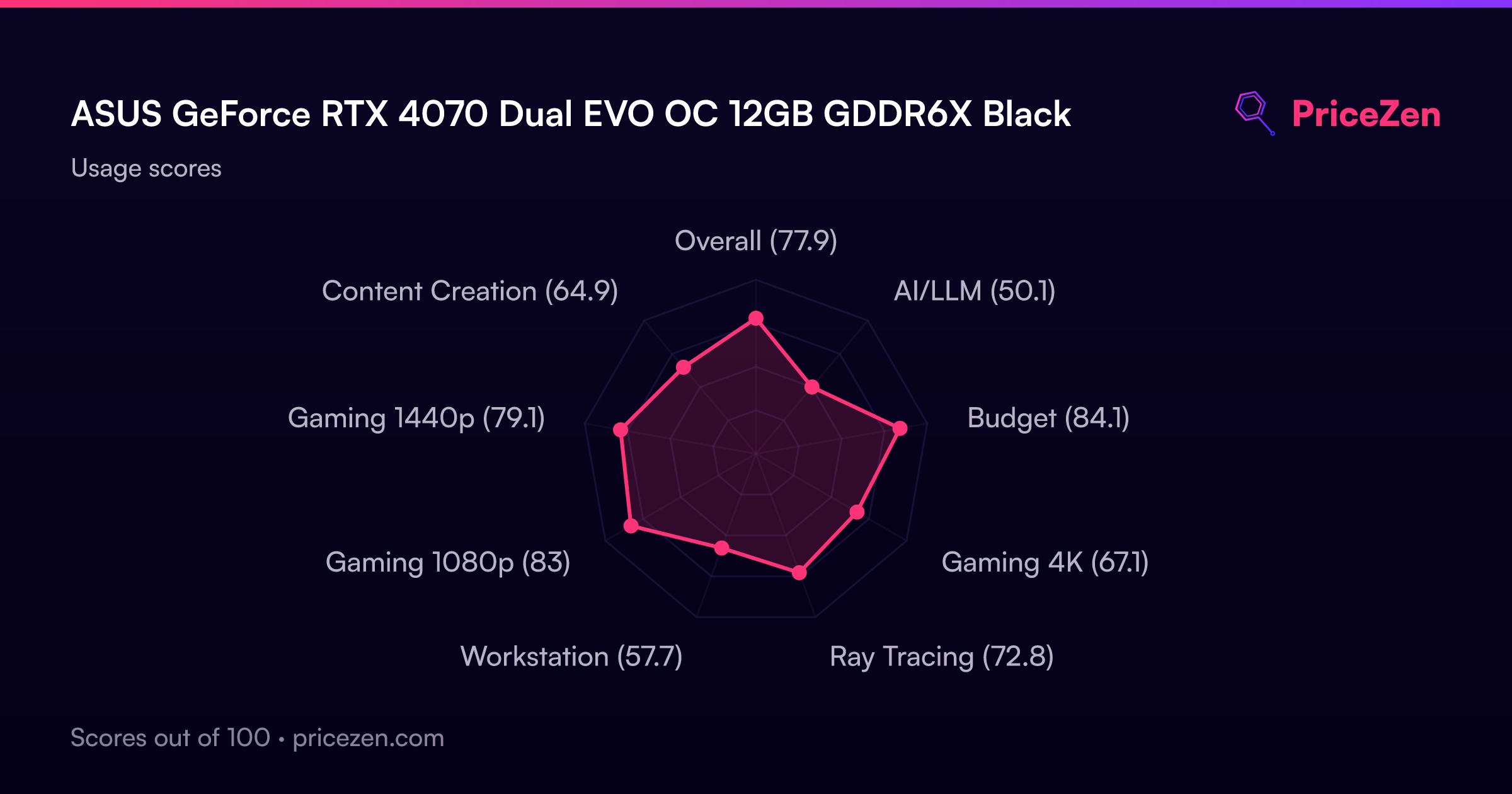
If you're planning to game at 4K or want a card that will age gracefully over the next four or five years, this isn't it. The 12GB VRAM sits at the 59th percentile, and the AI performance is even weaker at the 58th percentile, which matters if you're doing any local model work or AI upscaling. The 51.1/100 AI LLM score is the weakest area of this card by a wide margin. And if you're paying anywhere near the USD 1,100 top end of the price range, you're getting fleeced. At that price, you're within striking distance of cards with 16GB of VRAM and significantly better ray tracing. This card makes sense for compact 1080p and 1440p builds at the low end of its price range, and not much else.
Verdict
The ASUS Dual RTX 4070 EVO OC is a capable 1080p and 1440p card that excels in efficiency and compact builds. The 26,881 PassMark score and 90th percentile efficiency are genuinely impressive for a 200W card. But the 37th percentile user sentiment and 38th percentile affordability scores tell a story of a product that's good but not great value. The 12GB VRAM is a real concern for longevity, and the price spread across vendors means you could easily overpay by hundreds of dollars if you're not careful. If you can find it near the USD 530 mark, it's a solid buy. If you're looking at the USD 1,100 end of the range, walk away and buy something with more VRAM.
Usage Scores
- Overall77.9
- AI/LLM50.1
- Budget84.1
- Gaming 4K67.1
- Ray Tracing72.8
- Workstation57.7
- Gaming 1080p83
- Gaming 1440p79.1
- Content Creation64.9