TCL QM5K Series 85QM5K 85"
QD-Mini LED backlighting paired with the TCL Halo Control System and AIPQ Processor drives 500 local dimming zones for halo-free blacks and high HDR brightness. Its 144 VRR Game Accelerator ensures responsive gaming, while Google TV with built-in voice assistants delivers strong smart home performance at an accessible price point. This 85-inch display is best for budget-minded home theater fans and gamers who want precise backlight control and seamless streaming integration.

No current retailer price
Snapshot
The 30-Second Version
The TCL QM5K is an 85-inch QD-Mini LED TV that delivers deep blacks, strong contrast, and excellent smart features, and its price has fallen to as little as $334 across US listings. The 500-zone local dimming and Google TV integration are the standout features, and the gaming VRR support keeps things smooth despite the 60Hz native panel. Listings still stretch up to $850, so shop around and don't pay the top of the range. It's a great value for movie and sports fans, but serious gamers and anyone bothered by occasional lag should look elsewhere.
Pros & Cons
Pros
- Up to 500 local dimming zones deliver deep blacks and strong contrast for the price 96th
- Bright Mini-LED panel handles well-lit rooms without washing out 80th
- Google TV with Assistant, Alexa, and AirPlay 2 is best-in-class smart functionality 78th
- Game Accelerator 144 VRR keeps gaming smooth and lag-free 78th
- 85 inches of QD-Mini LED with listings starting at $334
Cons
- 60Hz native panel limits motion clarity for fast content
- User sentiment ranks among the worst, with lag and freezing complaints
- Audio is mediocre, a 2.1 channel setup that owners say needs a soundbar
- Picture quality is about average in our ranking despite the strong HDR score
- Wi-Fi 5 and occasional internet disconnection reports make streaming less reliable
What owners think
The Word on the Street
How owner sentiment changed over time
ExclusiveBased on when customers actually wrote their reviews - so you can see whether early praise held up.
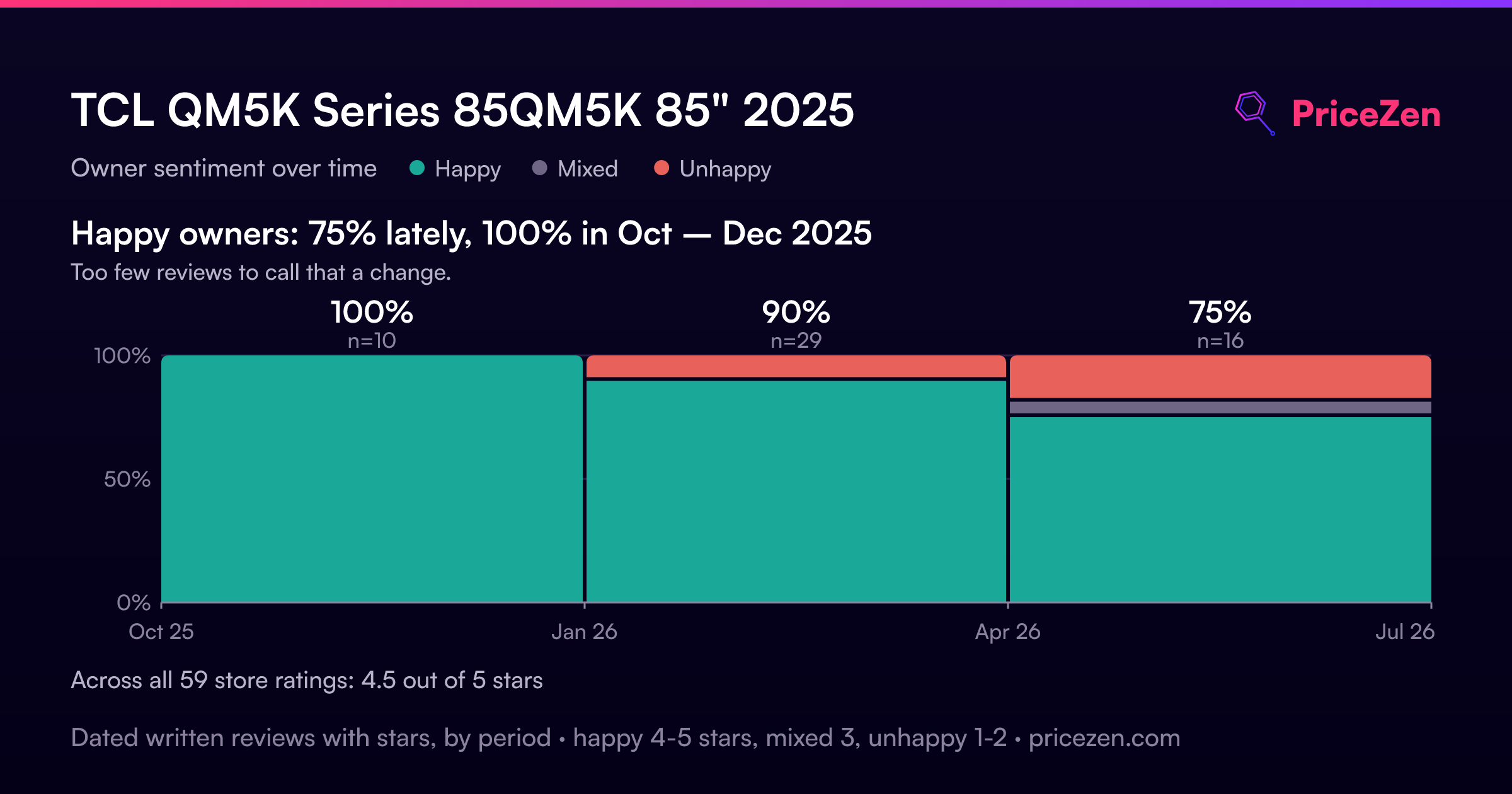
Happy owners: 75% lately, 100% in Oct – Dec 2025
Too few reviews to call that a change.
Across all 118 store ratings: 4.5★. Most owners rate without writing a review. The chart counts the 55 written reviews with stars and their own date.
Show the numbers
| Period | Reviews | Happy | Mixed | Unhappy | Happy share |
|---|---|---|---|---|---|
| Oct – Dec 2025 | 10 | 10 | 0 | 0 | 100% |
| Jan – Mar 2026 | 29 | 26 | 0 | 3 | 90% |
| Apr – Jun 2026 | 16 | 12 | 1 | 3 | 75% |
Each column joins calendar quarters until it holds at least 10 reviews with stars and their own date. Happy = 4-5★, mixed = 3★, unhappy = 1-2★.
The proof
Performance
Let's talk about what this panel does well, because on paper it's doing a lot. The QD-Mini LED backlight with up to 500 local dimming zones is the headline feature, and it's the reason the HDR score lands in the 85th percentile. Deep blacks on a full-array local dimming set at this price are genuinely impressive. The TCL Halo Control System, which bundles a new LED microchip, condensed micro lens, and a 23-bit backlight controller, is TCL's way of saying they've tightened up the light control to reduce blooming and halo effects around bright objects. In practice, owners consistently mention deep blacks and good contrast as standout strengths, so the tech isn't just marketing fluff.
But the picture quality score overall sits at the 36th percentile, which tells you something important. The QM5K is bright and punchy, but it's not the most accurate or refined panel out there. The 60Hz native refresh rate is a real limitation for fast motion, even though TCL markets the Game Accelerator 144 as a VRR feature. That's a 144Hz variable refresh rate signal, not a true 144Hz panel, so you're getting smoothness benefits in supported games but not the raw motion clarity of a native 120Hz or 144Hz display. The AIPQ Processor does solid upscaling work, but it's not going to compete with the processing muscle in a Sony or LG OLED. For most content, movies, sports, streaming, this TV looks great. For pixel-peeping enthusiasts, there are sharper tools out there.
Specifications
Full Specifications
Display
| Size | 85" |
| Resolution | 4K |
| Panel Type | QLED |
| Backlight | Full-Array LED |
| Aspect Ratio | 16:9 |
| Curved | No |
Picture Quality
| Motion Tech | Motion Rate 240 |
| Processor | TCL AIPQ Processor |
HDR
| HDR Formats | HDR10+, HDR10, HLG |
| Dolby Vision | No |
| HDR10+ | Yes |
| HLG | Yes |
Gaming
| Refresh Rate | 60 Hz |
| VRR | ✓ |
| ALLM | Yes |
| Game Mode | Yes |
Smart TV
| Platform | Google TV |
| Voice Assistant | Google Assistant, Amazon Alexa |
| Screen Mirroring | Apple AirPlay 2 |
| Works With | Google Home, Amazon Alexa, Apple Home |
Audio
| Speaker Config | 2.1 |
| Dolby Atmos | Yes |
| Surround Sound | Dolby Atmos, DTS Virtual:X |
| eARC | Yes |
Connectivity
| HDMI Ports | 3 |
| HDMI Version | 2.1 |
| USB Ports | 1 |
| Wi-Fi | Wi-Fi 5 |
| Bluetooth | 5.4 |
| Ethernet | Yes |
| Optical Audio | Yes |
| VESA Mount | 600x400 |
Power & Size
| Energy Star | No |
| Annual Energy | 250 |
| Weight | 32.6 kg / 71.9 lbs |
vs Competition
Our ranking puts the QM5K up against a very different group right now, and the first thing you'll notice is size. Every one of its closest rivals is a 55-inch or 65-inch class set: the LG OLED evo OLED55C5PUA at 55 inches, the Hisense U7 Series 65U75QG at 64.5 inches, the Samsung Neo QLED QN80H and Sony BRAVIA XR65X90L at 65 inches, and the Roku Plus Series 55R6C7 at 55 inches. The TCL is 85 inches. If filling a wall is the goal, nothing else in this group is playing the same game, and with listings starting at $334 the size-per-dollar argument is about as strong as it gets.
The LG OLED evo is the picture-quality pick of the bunch. Per-pixel light control means blacks the QM5K's 500-zone backlight can't fully match, and motion handling is in another class compared with a 60Hz native panel. What you give up is a lot of screen and a lot of brightness headroom in a sunlit room, which is exactly where the TCL's Mini-LED backlight and top-tier HDR score earn their keep.
The Hisense U7 Series is the closest philosophical match, another value-first Mini-LED set aimed at the same buyer who wants premium backlight tech without premium pricing. Between the two, the TCL's case is sheer size and a Google TV interface that scores among the best in our data. The Samsung Neo QLED QN80H and Sony BRAVIA XR65X90L are the step-up options if processing and out-of-the-box accuracy matter more to you than inches, and the QM5K's picture quality score, which is about average, is a fair reminder that its panel is punchy rather than refined. The Roku Plus Series is the simpler, cheaper-feeling alternative, but you're back down to 55 inches and away from the Mini-LED backlight that makes this TCL interesting in the first place.
| Spec | TCL QM5K Series 85QM5K 85" | Samsung QN990F QN75QN990FFXZA 75" | LG OLED evo OLED55C5PUA 55" | Sony BRAVIA 9 K85XR90 85" | Hisense U7 Series 65U75QG 64.5" | Roku Plus Series 55R6C7 55" |
|---|---|---|---|---|---|---|
| Screen Size | 85 | 75 | 55 | 85 | 64.5 | 55 |
| Resolution | 4K | 7680x4320 | 3840x2160 | 3840x2160 | 3840x2160 | 3840x2160 |
| Panel Type | QLED | QD-Mini-LED | OLED | Mini-LED | Mini-LED | Mini-LED |
| Refresh Rate | 60 | 120 | 120 | 120 | 165 | 60 |
| Hdr | HDR10+, HDR10, HLG | HDR10, HDR10+, HLG | Dolby Vision, HDR10 | HDR10, HLG, Dolby Vision | Dolby Vision, HDR 10+, HDR 10, Hybrid Log-Gamma (HLG) | Dolby Vision, HDR 10+, Hybrid Log-Gamma (HLG) |
| Smart Platform | Google TV | Tizen | webOS | Google TV | Google TV | Roku TV |
| Dolby Vision | No | No | Yes | Yes | Yes | Yes |
| Dolby Atmos | Yes | Yes | Yes | Yes | Yes | Yes |
| Hdmi Version | 2.1 | 2.1 | 2.1 | 2.1 | 2.1 | 2.1 |
| Compare | Compare | Compare | Compare | Compare |
| Product | HDR | Audio | Smart | Gaming | Display | User Sentiment | Connectivity | Social Proof | Affordability | Picture Quality |
|---|---|---|---|---|---|---|---|---|---|---|
| TCL QM5K Series 85QM5K 85" | 78.3 | 79.7 | 96.1 | 57.1 | 47.8 | 30.1 | 69.6 | 77.9 | 49.8 | 34.1 |
| Samsung QN990F QN75QN990FFXZA 75" Compare | 91.6 | 99.7 | 90.5 | 86.3 | 99.8 | 83.4 | 99.9 | 99.6 | 13.1 | 98.9 |
| LG OLED evo OLED55C5PUA 55" Compare | 90.1 | 93.3 | 86.4 | 97.5 | 86.6 | 62.9 | 98.6 | 92.8 | 36.3 | 92 |
| Sony BRAVIA 9 K85XR90 85" Compare | 83 | 96.9 | 88.8 | 75.6 | 94.8 | 72.8 | 91 | 85.2 | 7.5 | 74.5 |
| Hisense U7 Series 65U75QG 64.5" Compare | 88.3 | 94.4 | 93.3 | 94.1 | 75.9 | 94.6 | 91 | 85.2 | 57.9 | 96.9 |
| Roku Plus Series 55R6C7 55" Compare | 70.2 | 79.7 | 99.5 | 57.1 | 75.9 | 94.6 | 85.7 | 92.8 | 75.5 | 34.1 |
Price
Value & Pricing
Here's where the QM5K gets interesting. Prices across US listings now run from $334 to $850, a spread wide enough that where you buy matters almost as much as what you buy. The floor has dropped a long way from where it sat before, and at $334 you're looking at an 85-inch QD-Mini LED TV for less than plenty of far smaller sets cost. That's absurd value, and it's the main reason the budget score sits at 69.5 out of 100. We track this price over time, partly through our community browser extension, so if the listing you're watching is sitting near the top of that range, waiting is a reasonable play.
At the high end, around $850, the value proposition gets murkier. You're paying flagship-adjacent money for a set with a 60Hz native panel and a user sentiment score that ranks among the worst, and that combination is harder to defend when the same TV has been listed for a fraction of it. The QM5K's value story is strongest when you're paying closer to the bottom of the range. At that price, the compromises, the 60Hz panel, the mediocre audio, the occasional software hiccup, feel a lot more forgivable. At $850, they start to sting.
Read more
Overview
The TCL QM5K is one of those TVs that makes you wonder why you'd spend twice as much on a flagship from the big three. It's an 85-inch QD-Mini LED panel with up to 500 local dimming zones, Google TV built in, and a spec sheet that reads like a wishlist for anyone who wants a huge screen without taking out a second mortgage. TCL has been quietly eating the mid-range TV market alive for a few years now, and the QM5K series is their latest swing at making premium picture tech feel almost suspiciously affordable.
Who's this for? Someone who wants a genuinely big, bright, feature-rich TV for movies, sports, and casual gaming. The 85-inch size class means you're filling a wall, not a corner. If you've got a bright living room with lots of windows, the Mini-LED backlight and high HDR brightness are doing real work here. And if you're already living in the Google ecosystem, the built-in Google TV with Assistant, Alexa support, and AirPlay 2 covers basically every smart home angle you could want. Our database puts the smart features at the 98th percentile, which is about as good as it gets on any TV right now.
But here's the thing. The user sentiment score sits at just the 29th percentile, and that gap between the spec sheet and real-world happiness is the story of this TV. Owners love the picture when it's working. They're less thrilled when the interface stutters, the audio falls flat, or the Wi-Fi drops mid-stream. So the QM5K is a bit of a gamble, a spectacular panel wrapped in software and build choices that don't always keep up. We'll dig into all of that below.
Common Questions
Q: Is the TCL QM5K good for gaming?
It's decent but not top-tier. The Game Accelerator 144 supports up to 144Hz VRR, which helps reduce screen tearing and keeps gameplay smooth, but the native panel is only 60Hz. That means you won't get the true motion clarity of a native 120Hz or 144Hz display. For casual and console gaming it's perfectly fine, but competitive PC gamers who want every frame should look at a TV with a native high refresh rate panel.
Q: How does the picture quality compare to OLED TVs?
The QM5K uses a QD-Mini LED backlight with up to 500 local dimming zones, which gives it deep blacks and strong contrast, but it can't match the per-pixel control of an OLED. A set like the LG OLED evo OLED55C5PUA will have perfect blacks, better viewing angles, and superior motion handling. The QM5K's advantage is brightness and size per dollar, and it's a big one here: 85 inches against 55. In a bright room, the QM5K might actually look better than an OLED, but in a dark room, the OLED wins.
Q: Does the QM5K support all the major streaming apps?
It runs Google TV, which has access to the vast majority of streaming services including Netflix, Disney+, Hulu, Prime Video, and YouTube. However, some owners have reported that certain apps, like Spectrum, are missing from the Google TV app store on this model. If you rely on a specific niche app, it's worth checking compatibility before buying.
Q: Is the built-in audio good enough, or do I need a soundbar?
The built-in audio is a 2.1 channel system with Dolby Atmos and DTS Virtual:X support, but owners consistently say it sounds mediocre. For casual viewing it's passable, but for movies or gaming, a soundbar is strongly recommended. The eARC port makes it easy to connect a quality soundbar or AV receiver without losing audio quality.
Who Should Skip This
If you're a competitive gamer or someone who watches a lot of fast-paced sports, the 60Hz native panel is going to be a dealbreaker. You'll notice motion blur and judder that a native 120Hz or 144Hz panel would handle cleanly. The Hisense U7 Series is worth a look if you want to stay in value Mini-LED territory, and the Sony BRAVIA XR65X90L or LG OLED evo OLED55C5PUA are the picks if motion handling comes first, though both mean stepping down to a 65-inch or 55-inch class screen. Similarly, if you're sensitive to interface lag or you've been burned by buggy smart TV software before, the QM5K's reported freezing and internet disconnection issues might drive you up the wall. The Roku Plus Series 55R6C7 is the simpler platform to consider there, but you'll sacrifice the Mini-LED backlight and a lot of screen. And if you're an audio purist who refuses to buy a soundbar, the weak built-in speakers will disappoint. Budget for a soundbar or look elsewhere.
Verdict
If you're shopping for a massive screen on a budget and you mostly watch movies, sports, and streaming content in a bright room, the QM5K is a genuinely compelling buy. The Mini-LED backlight does real work, the smart features are excellent, and the price, especially near the $334 end of that $334 to $850 range, is hard to argue with. You're getting a lot of TV for your money, and for most people, the picture quality will impress.
But if you're a serious gamer who wants true 120Hz or 144Hz motion clarity, or if you're sensitive to interface lag and software quirks, this TV might frustrate you. The 60Hz panel is the biggest technical compromise, and the user sentiment data suggests that lag and freezing are real issues for some owners. In that case, the LG OLED evo OLED55C5PUA or the Sony BRAVIA XR65X90L are the better targets if motion and processing come first, or the Hisense U7 Series if you want to stay in the value Mini-LED world. Just know you're dropping to a 55-inch or 65-inch class screen to get there. The QM5K is a great value TV, but it's not a no-compromise TV.
Usage Scores
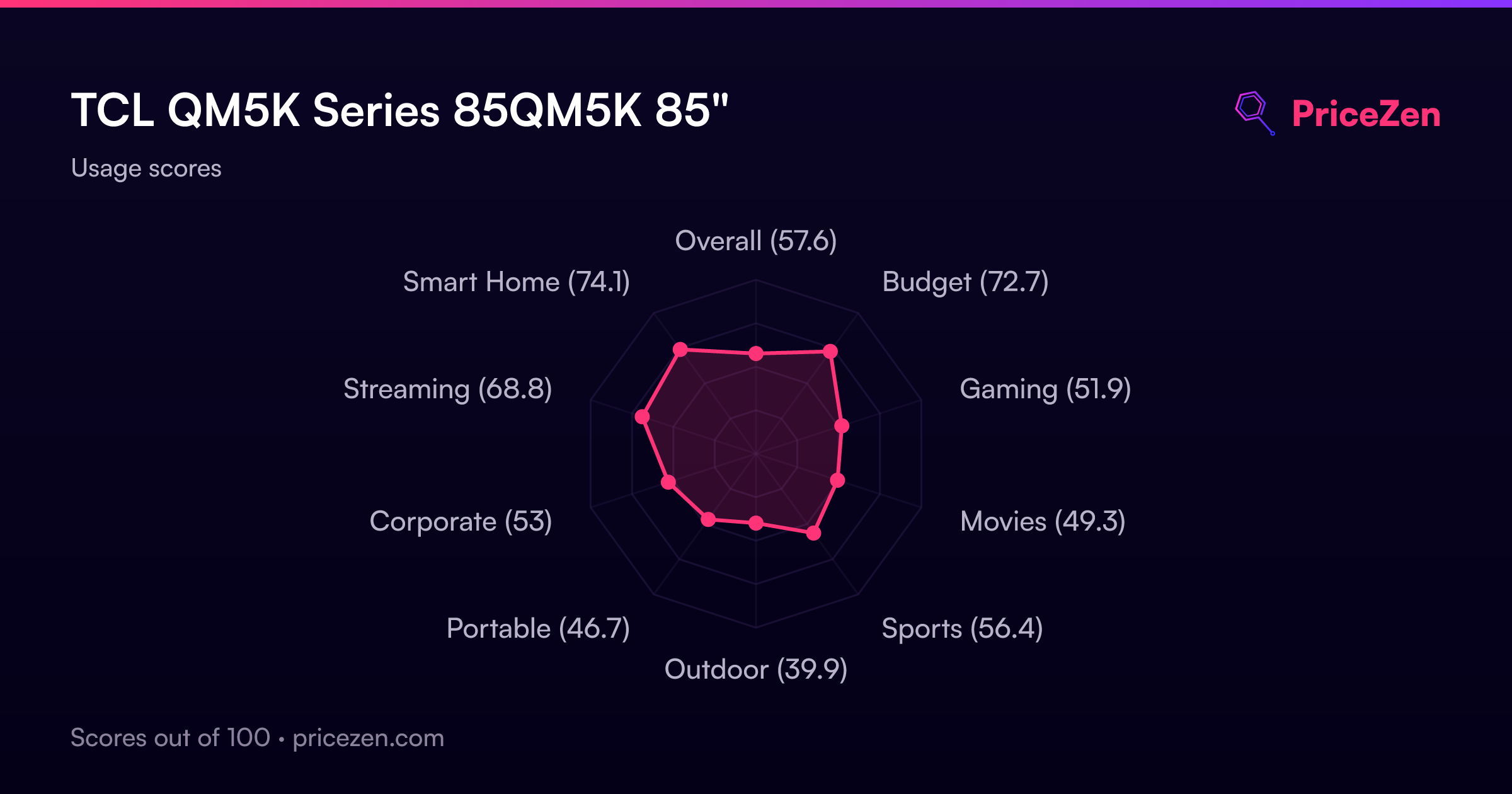
- Overall57.6
- Budget72.7
- Gaming51.9
- Movies49.3
- Sports56.4
- Outdoor39.9
- Portable46.7
- Corporate53
- Streaming68.8
- Smart Home74.1