Acer Predator 2TB PCIe 4.0 x4 NVMe M.2 2280
The PCIe 4.0 x4 interface delivers up to 7400 MB/s reads and 6500 MB/s writes, with TLC NAND and a DRAM-less design that uses HMB and SLC cache for efficient loading. Its thermal throttling and power management keep temperatures in check during heavy workloads, while the 2TB capacity supports large game libraries and content projects. Best for budget-conscious gamers and creators who need fast NVMe storage for gaming and file transfers without paying a premium.












Snapshot
The 30-Second Version
The Predator GM7 2TB posts near-ceiling PCIe 4.0 numbers, 7400 MB/s read and 6500 MB/s write, and our speed ranking puts it in the top stretch of the category. But it's DRAM-less, its endurance ranks near the bottom, and at USD 346 or EUR 350 to EUR 528 it isn't the bargain the spec sheet implies. Great as a fast game-and-boot drive at the cheap end of that spread, wrong choice for sustained heavy writes.
Pros & Cons
Pros
- Rated 7400 MB/s read and 6500 MB/s write, near the PCIe 4.0 x4 ceiling 85th
- Speed ranks at the 85th percentile, one of the faster drives we track 79th
- 2TB capacity scores well above average for the category
- TLC NAND rather than cheaper QLC flash
- Low-power controller with thermal throttling suits laptops (68.1/100)
Cons
- Endurance ranks at the 15th percentile, a genuine weak spot
- DRAM-less, relying on HMB instead of onboard cache
- Random performance only middling at the 62nd percentile
- Affordability ranks just 30th despite the budget positioning
- EUR listings span EUR 350 to EUR 528, a wide spread for one drive
The proof
Performance
Let's translate the numbers. A rated 7400 MB/s read is close to the practical ceiling of a PCIe 4.0 x4 link, and 6500 MB/s write is right up there too, which is why our speed ranking puts it in leading territory rather than mid-pack. For a real buyer, that means game installs, big file copies and loading large project assets off this drive won't be bottlenecked by the interface. Capacity ranks well above average at the 79th percentile, so 2TB is a comfortable amount of room for a modern game library plus a working media folder. But random performance, the small scattered reads and writes that make an OS feel snappy and that dominate compiling code or running databases, only ranks 62nd, which is solidly middle of the pack. That's the DRAM-less trade-off showing up exactly where you'd expect: sequential sprints are excellent, small-block grunt work is merely fine.
The second thing to understand is what HMB and the SLC cache mean under pressure. HMB works well for everyday bursty desktop use, but it isn't a substitute for dedicated DRAM when the queue gets deep and messy, and an SLC cache is by definition a fast lane that eventually fills. Pair that with an endurance ranking in the bottom stretch of the category and the picture is clear: this drive is built to be read from heavily and written to occasionally. The thermal throttling and power management are a sensible inclusion for a laptop or a cramped case, though throttling is a safety net, not extra performance. If your day involves dumping huge video files or writing datasets over and over, you'll meet the limits of this design sooner than the 7400 MB/s sticker suggests.
Specifications
Full Specifications
Drive
| Capacity | 2000 |
| Form Factor | M.2 2280 |
| Interface | PCIe 4.0 x4 |
| Protocol | NVMe |
| PCIe Generation | 4 |
| External | No |
Performance
| Sequential Read (MB/s) | 7400 |
Hardware
| NAND | TLC |
| DRAM Cache | No |
vs Competition
The competitor set here is stiff: Western Digital WD_BLACK SN8100, Kingston FURY Renegade, Samsung 990 PRO, Crucial T700 and Team Group MP44. Against the Samsung 990 PRO and the Kingston FURY Renegade, the GM7's argument is purely its sequential ratings and its capacity score. If your work is mostly reading big files and loading games, 7400 MB/s read is competitive ground to stand on. Where it gives ground is everything behind the headline: a DRAM-less design with random performance at the 62nd percentile and endurance at the 15th is not the drive we'd point a heavy-write user toward when those alternatives are on the shortlist. Cross-shop them if you edit video, run VMs or write large amounts daily.
The Crucial T700 and WD_BLACK SN8100 sit in a different performance conversation altogether, and if your platform and budget can support that tier, the GM7 isn't trying to compete on absolute throughput. Its pitch is that most desktops and laptops don't need that tier, and a fast PCIe 4.0 drive with sensible thermals is the smarter spend. The closest philosophical rival is the Team Group MP44, another value-leaning PCIe 4.0 option, and there the decision comes down to price on the day and how much you weight endurance. Our feature score of the 53rd percentile says the GM7 is about average on the extras, so don't buy it expecting a feature advantage over any of these.
| Spec | Acer Predator | Western Digital WD_BLACK SN8100 | Kingston FURY Renegade | Samsung 990 PRO | Crucial T700 | Team Group MP44 |
|---|---|---|---|---|---|---|
| Capacity | 2TB | 4TB | 4TB | 4TB | 2TB | 4TB |
| Form Factor | M.2 2280 | M.2 2280 | M.2 2280 | M.2 2280 | M.2 2280 | M.2 2280 |
| Interface | PCIe 4.0 x4 | PCIe 5.0 x4 | PCIe 4.0 x4 | PCIe 4.0 x4 | PCIe 5.0 x4 | PCIe 4.0 x4 |
| Seq Read | 7,400 MB/s | 14,900 MB/s | 7,300 MB/s | 7,450 MB/s | 12,400 MB/s | 7,400 MB/s |
| Nand Type | TLC | TLC | TLC | TLC | TLC | TLC |
| Dram Cache | false | false | true | true | true | false |
| Endurance | - | 2400 TBW | 4000 TBW | 2400 TBW | 1200 TBW | 2000 TBW |
| Compare | Compare | Compare | Compare | Compare |
| Product | Speed | Random | Feature | Capacity | Endurance | Affordability |
|---|---|---|---|---|---|---|
| Acer Predator | 84.6 | 61.8 | 53.3 | 78.8 | 14.9 | 29.7 |
| Western Digital WD_BLACK SN8100 Compare | 99.7 | 99.6 | 86 | 92.6 | 80.4 | 8.5 |
| Kingston FURY Renegade Compare | 93.5 | 94.4 | 94.1 | 92.6 | 94 | 10.9 |
| Samsung 990 PRO Compare | 93.9 | 97.8 | 94.1 | 92.6 | 85.7 | 7.3 |
| Crucial T700 Compare | 96.7 | 97.7 | 97.7 | 78.8 | 82.6 | 21.9 |
| Team Group MP44 Compare | 93.7 | 88.7 | 53.3 | 92.6 | 76.7 | 16.1 |
Price
Value & Pricing
Here's where we'd pump the brakes a little. We track this drive at USD 346 on Amazon in the US, CAD 485 in Canada and GBP 280 in the UK, and across Germany, Spain, France and Italy the euro listings run from EUR 350 all the way to EUR 528. That's a EUR 178 spread on the same product, which is enormous, and it means the difference between a decent deal and a bad one is entirely down to which listing you happen to click. Our affordability ranking of the 30th percentile reflects that: for a DRAM-less PCIe 4.0 drive, this isn't pricing like a bargain bin part right now.
So the value case is conditional. At the bottom of that EUR range, you're getting near-top-tier sequential throughput and 2TB of TLC storage for a reasonable outlay, and the 70.6/100 budget score makes sense. At EUR 528, you're paying a premium for a drive whose endurance and random-access rankings are below average, and that's a much harder sell. We'd treat the low end of the spread as the only price worth acting on, and we'd wait rather than pay the top end.
Amazon 1 offer From £280
We started tracking prices for this product on Nov 22, 2026. The chart appears once we have more data.
Read more
Overview
The BIWIN Predator GM7 in its 2TB form is a very specific kind of SSD: it chases the top of the PCIe 4.0 speed charts while quietly cutting the two components that usually make an NVMe drive expensive, namely onboard DRAM and a big endurance rating. You get an M.2 2280 stick on a PCIe 4.0 x4 interface with NVMe 2.0, TLC NAND, and rated sequential speeds of 7400 MB/s read and 6500 MB/s write. Instead of dedicated cache memory on the drive, it leans on HMB (Host Memory Buffer), which borrows a slice of your system RAM, plus an SLC cache to keep writes quick. That's the whole design philosophy in one sentence: spend the money on flash and controller throughput, not on extras.
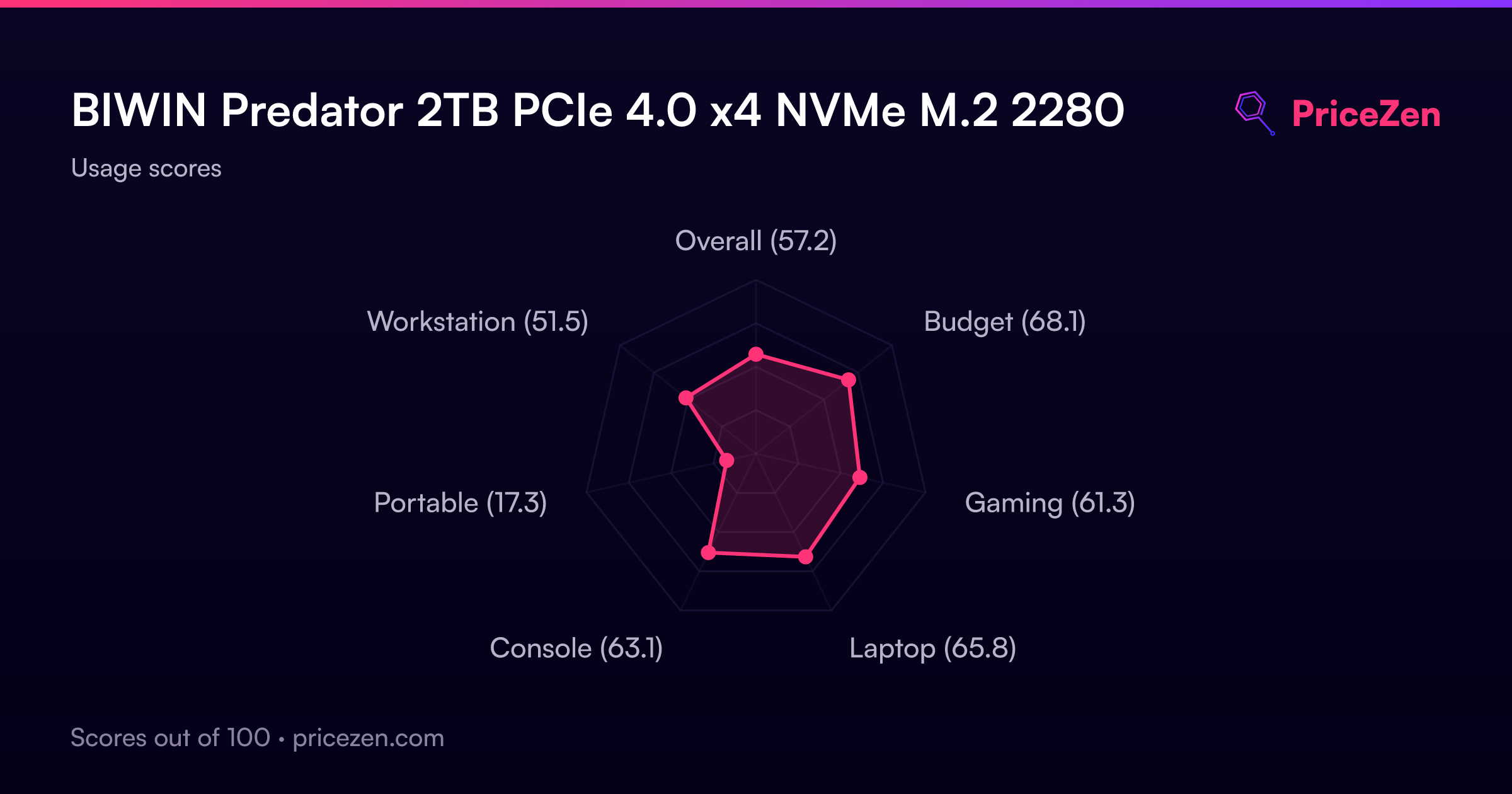
Our scoring model likes it most as a budget pick, where it lands at 70.6 out of 100, followed by laptop use at 68.1 and console duty at 64.5. That ordering tells you a lot. This is a drive for someone who wants a big, fast internal boot-and-games volume in a desktop or a notebook with a spare M.2 slot, and who isn't going to hammer it with sustained writes all day. The low-power controller and the built-in thermal throttling and power management are aimed squarely at machines where heat and battery matter more than raw stamina.
What makes it interesting is the gap between how it looks on a spec sheet and how it ranks once we compare it against everything else in the category. Speed sits at the 85th percentile, which puts it among the faster drives we track. Endurance sits at the 15th, which is a weak spot, full stop. And affordability, despite the budget-friendly framing, only reaches the 30th percentile at current prices. So this is a drive with a genuinely strong headline number and two real asterisks attached, and whether it's a good buy depends entirely on which of those three things your workload actually cares about.
Common Questions
Q: Does being DRAM-less actually matter for gaming?
For loading games, not much. Game loads are largely big sequential reads, and this drive is rated at 7400 MB/s with a speed ranking at the 85th percentile, so it's well suited to that. Where the missing DRAM shows up is random access, which only ranks 62nd in our data, so heavy multitasking, compiling or database-style workloads will feel less impressive than the headline speed suggests.
Q: Is 2TB enough, and how long will it last?
2TB scores well above average for capacity in this category, so it's a comfortable size for a large game library plus working files. Longevity is the concern: endurance ranks at the 15th percentile against comparable drives, which is one of the weaker results we track. Normal desktop and gaming use writes relatively little, but if you rewrite large volumes daily, this is the spec that should worry you.
Q: Will it run hot in a laptop or a console?
The controller is designed for lower power draw and reduced heat output, and the drive includes thermal throttling and power management to ride out heat spikes under heavy load. That's why our model scores it 68.1 for laptop use and 64.5 for console duty. Just remember throttling protects the drive by slowing it down, so sustained heavy writes in a tight chassis won't hold peak speeds.
Q: Is USD 346 a good price for this drive?
Not especially. Our affordability ranking sits at the 30th percentile, meaning most comparable drives offer better price-to-spec value right now. In Europe the spread is even more telling, with listings from EUR 350 to EUR 528 for the same model, so buying at the bottom of that range is the only version of this purchase we'd endorse.
Who Should Skip This
Skip this if you write a lot, every day. Video editors dumping and re-rendering footage, anyone running virtual machines or databases, developers doing constant large builds, or people using an SSD as a scratch disk will run straight into the two weakest parts of this design: an endurance ranking at the 15th percentile and random performance that's only about average. A DRAM-less drive with HMB and an SLC cache is tuned for bursts, not grind, and paying up to EUR 528 for that privilege makes no sense. Look at the Samsung 990 PRO or Kingston FURY Renegade instead, and if your platform supports the faster tier and your budget stretches, the Crucial T700 or WD_BLACK SN8100.
Also skip it if you wanted an external drive. Our portable score for this product is 17.7 out of 100, which is a real letdown, and that's unsurprising for a bare M.2 2280 module meant to live inside a machine. If you need something you can plug in and carry around, buy a purpose-built portable SSD rather than trying to make an internal NVMe stick do a job it wasn't designed for.
Verdict
For a gaming desktop or a laptop upgrade where you want 2TB of fast storage and your writes are mostly install-and-forget, this is a reasonable pick at the low end of its price range. The sequential numbers are strong, the capacity is generous, and the low-power controller with thermal management fits a notebook better than a hot, hungry flagship would. Our laptop score of 68.1 and console score of 64.5 back that up: it's a competent internal drive for consumer workloads, and most people will never notice the missing DRAM.
For anything write-heavy or mission-critical, we'd steer you elsewhere. An endurance ranking at the 15th percentile combined with middling random performance is the wrong combination for a scratch disk, a database volume or a daily video ingest drive, and the Samsung 990 PRO, Kingston FURY Renegade or the higher-tier Crucial T700 and WD_BLACK SN8100 are the names to look at instead. Buy the GM7 for speed you can feel in load times, not for stamina you'll never get.
Usage Scores
- Overall58.9
- Budget70.6
- Gaming62.6
- Laptop68.2
- Console64.5
- Portable17.7
- Workstation52.6