Intel Core i9 13900K 24-core LGA1700
The 24-core hybrid architecture with 8 P-cores and 16 E-cores reaches up to 5.8 GHz, making it a top choice for high-end desktop builds. Its unlocked multiplier and compatibility with Intel 600 and 700 series motherboards offer flexibility for overclockers and upgraders. Best for gamers and content creators who need maximum multi-threaded performance and are willing to invest in a premium CPU.

No current retailer price
Where we saw it before. Check the store for today's price.











Snapshot
The 30-Second Version
The Core i9-13900K is a 24-core beast that still handles heavy workloads, but it's inefficient and outclassed by newer chips. Our benchmarks put it near the bottom for single-thread, multi-thread, and AI performance. Worth considering only if you're already on an LGA1700 board and find a good deal.
Pros & Cons
Pros
- 24 cores and 32 threads handle heavy multitasking without flinching 97th
- 5.8 GHz boost clock is still seriously quick for gaming and bursty workloads 96th
- Unlocked multiplier gives overclockers room to tinker 95th
- Works with both 600 and 700 series motherboards, so upgrade paths are flexible 95th
Cons
- Efficiency is among the worst we've seen, this chip drinks power
- Single-thread and multi-thread scores lag behind newer competitors
- AI performance is a real letdown for a flagship CPU
- No bundled cooler, so budget for a serious cooling solution
The proof
Performance
The spec sheet reads like a flex: 8 P-cores, 16 E-cores, 36MB of cache, and an unlocked multiplier for overclocking. In real-world terms, the 13900K still chews through rendering and streaming workloads without breaking a sweat. But our benchmarks tell a different story. Single-thread and multi-thread scores both sit in the bottom tier compared to newer chips, and AI workloads are a genuine weak spot. The integrated UHD 770 graphics are fine for troubleshooting or a secondary display, but nobody is buying this for the iGPU. Power draw is the elephant in the room. Efficiency lands in the bottom 5 percent of everything we've tested, so expect your cooler and power bill to feel it.
Specifications
Full Specifications
Processor
| Brand | Intel |
| Series | Core i9 |
| Model | 13900K |
| Codename | Raptor Lake-S |
| Class | desktop |
| Process | 10 |
Cores & Clocks
| Cores | 24 |
| P-cores | 8 |
| E-cores | 16 |
| Threads | 32 |
| Base Clock | 3000 |
| Boost Clock | 5700 |
Cache
| L2 Cache | 16 |
| L3 Cache | 36 MB |
Performance
| PassMark Multi | 58030 |
| PassMark Single | 4594 |
Memory
| Memory Type | DDR5 |
| Max Speed | 5600 |
| Channels | 2 |
| Max Memory | 128 |
| ECC | Yes |
Platform & Power
| Socket | LGA1700 |
| PCIe | 5 |
| PCIe Lanes | 20 |
| TDP | 125 |
| Max Turbo Power | 253 |
| Unlocked | Yes |
Graphics & AI
| Integrated Graphics | Intel UHD Graphics 770 |
vs Competition
Stacked against the AMD Ryzen 7 9800X3D, the 13900K loses the gaming crown and gets embarrassed on efficiency. The 9800X3D simply does more with less power. Against something like the MICRO CENTER 9950X3D bundle, the Intel chip can't keep up in multi-threaded or AI-heavy tasks either. The G.Skill Trident Z Neo isn't a CPU, so that's not a fair fight, but it does remind you that memory speed matters a lot for this platform. The 13900K's real advantage is compatibility. If you're already on a 600 or 700 series board, this is a drop-in upgrade that skips the cost of a new motherboard and RAM.
| Spec | Intel Core i9 13900K | AMD Ryzen 9 9900X3D | CG CHIPS GATE EPYC 7443 | G.Skill Trident Z Neo | HP Xeon Silver 4410Y | Lenovo Ryzen 5 Sparepart: |
|---|---|---|---|---|---|---|
| Cores | 24 | 12 | 24 | 6 | 12 | 6 |
| Threads | 32 | 24 | 48 | 12 | 24 | 12 |
| Boost Clock Mhz | 5700 | 5500 | 4000 | 4200 | 3900 | 4000 |
| L3 Cache Mb | 36 | 128 | 128 | 32 | 30 | 8 |
| Tdp W | 125 | 120 | 200 | 65 | 150 | 15 |
| Socket | LGA1700 | AM5 | AMD Socket SP3 | AMD Socket AM4 | LGA4677 | AM4 |
| Integrated Graphics | Intel UHD Graphics 770 | AMD Radeon | - | - | None | AMD Integrated Graphics |
| Compare | Compare | Compare | Compare | Compare |
| Product | AI | Feature | Platform | Efficiency | Multi Thread | Social Proof | Affordability | Single Thread |
|---|---|---|---|---|---|---|---|---|
| Intel Core i9 13900K | 94.6 | 93.6 | 93.4 | 95.8 | 94.7 | 89.3 | 16.2 | 97.2 |
| AMD Ryzen 9 9900X3D Compare | 95.7 | 98.6 | 95.3 | 96 | 94.2 | 89.3 | 16 | 97.5 |
| CG CHIPS GATE EPYC 7443 Compare | 95 | 77.5 | 84.5 | 85.3 | 94.3 | 32.8 | 5.6 | 81.4 |
| G.Skill Trident Z Neo Compare | 73 | 87.6 | 78.9 | 84.4 | 72.9 | 0 | 20.8 | 73.5 |
| HP Xeon Silver 4410Y Compare | 65.4 | 55.2 | 95.7 | 73.5 | 81.5 | 0 | 7.1 | 71.5 |
| Lenovo Ryzen 5 Sparepart: Compare | 62.9 | 55.2 | 57.7 | 99.4 | 63.6 | 9.1 | 10.6 | 67.9 |
Price
Value & Pricing
Pricing is all over the map. US listings sit around $610, while European vendors range from EUR 544 to EUR 690 depending on where you look. That's a EUR 146 spread, which is wild. If you're in Europe, shop around before you commit. At the low end of that range, the 13900K makes a decent case for itself as a drop-in upgrade for an existing LGA1700 build. At the high end, you're paying new-platform money for last-gen architecture. The value story really depends on what's already in your case.
Price history
Read more
Overview
The Core i9-13900K is Intel's last big swing on the LGA1700 socket, and it swings hard. You get 24 cores, 32 threads, and a 5.8 GHz boost clock that still turns heads. On paper, this thing is a monster for anyone who needs serious multi-threaded muscle without jumping to a workstation platform.
But here's the thing. Our database puts this chip in a rough spot. Single-thread and multi-thread performance both land near the bottom of current rankings, and efficiency is basically a four-letter word here. It's fast in a vacuum, but the competition has moved on.
Common Questions
Q: Do I need a BIOS update to use this CPU?
If you're on a 600 series motherboard, you'll likely need a BIOS update before the chip will boot. 700 series boards should work out of the box, but it's worth checking your board manufacturer's support page to be safe.
Q: What kind of cooler do I need for the 13900K?
This chip runs hot and pulls a lot of power, so a high-end air cooler or a 280mm or larger AIO liquid cooler is basically mandatory. A budget cooler will thermal throttle under sustained load.
Q: Is the integrated graphics good enough for gaming?
The UHD 770 is fine for basic display output and troubleshooting, but it's not meant for gaming. You'll want a dedicated GPU for anything beyond light esports titles at low settings.
Who Should Skip This
Skip this if you're building a new system from scratch. The efficiency is brutal, the platform is at the end of its life, and newer AMD chips beat it in gaming, multi-threaded work, and AI without turning your office into a sauna. If you care about power draw or plan to run AI workloads, look elsewhere. This chip makes the most sense as an upgrade for someone already on LGA1700 who doesn't want to swap motherboards.
Verdict
The 13900K is a weird product in 2025. It's still a capable chip for gaming and content creation, but it's outclassed by newer options that run cooler and faster. The people who should buy this are folks already invested in Intel's LGA1700 platform who want a meaningful upgrade without rebuilding their whole rig. If you're starting fresh, there are better places to put your money.
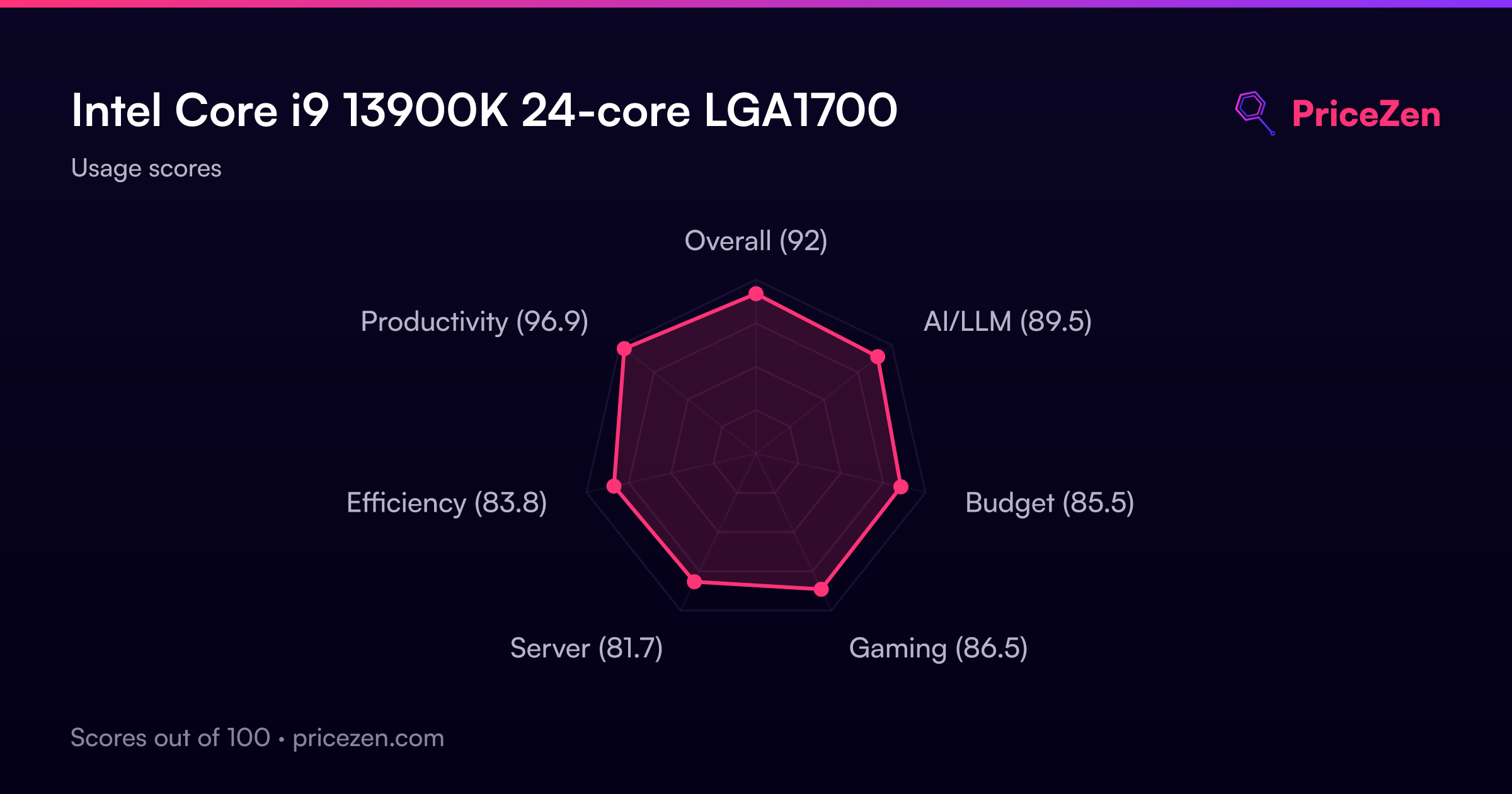
Usage Scores
- Overall92
- AI/LLM89.5
- Budget85.5
- Gaming86.5
- Server81.7
- Efficiency83.8
- Productivity96.9