Blackmagic Design PYXIS 6K












Snapshot
The 30-Second Version
The PYXIS 6K is a rig-it-yourself cinema box with a full-frame 6K sensor, 13 stops of dynamic range and open gate capture at up to 36 fps, ranking in the top 8% for video in our data. It records 12-bit Blackmagic RAW plus H.264 proxies to dual CFexpress Type B cards, with 12G-SDI, 10GbE and XLR built in. At USD 2,245 (EUR 1,890 to EUR 2,143 depending on the shop), it's a serious amount of production pipeline for the price. Buy it for crew-based filmmaking, skip it for vlogging or handheld solo work, because there's no stabilization and autofocus lags behind most.
Pros & Cons
Pros
- Video capability in the top 8%, among the best in our cinema category 92nd
- Full-frame 36 x 24 mm sensor with 13 stops of dynamic range and ISO to 25,600 86th
- Open gate 6048 x 4032 at up to 36 fps, strong reframing freedom in post 78th
- 12-bit Blackmagic RAW plus simultaneous H.264 proxies on dual CFexpress Type B slots 77th
- Pro connectivity: 12G-SDI, 10GbE Ethernet for Blackmagic Cloud, XLR with 48 V
Cons
- No stabilization whatsoever, ranking in the bottom 33%
- Autofocus is a weak spot in the bottom 37%, so expect manual focus work
- Not weather sealed, which limits run-and-gun outdoor shoots
- Fixed 4-inch screen, no tilt or articulation, display sits mid-pack at 59
- Affordability ranks in the bottom 28%, and 1500g before you rig anything
The proof
Performance
Let's talk about what the numbers actually buy you. Open gate capture runs at 6048 x 4032 up to 36 fps, which puts its burst capability in the top 14% of the category, one of the better results. In practice that means you're grabbing the whole sensor area and deciding your framing later, whether you need a wide deliverable or a vertical crop for social. Add 4K at 60fps for slow motion and 10-bit recording, and you've got room to push color around in the grade without the image falling apart. The 13 stops of dynamic range are the number I'd point at first for anyone shooting interviews near a window: highlights and shadow detail survive together instead of you picking one.
The trade-off sits right next to the strength. Autofocus lands in the bottom 37% and stabilization in the bottom 33%, both well below the middle of the pack, and there's no IBIS at all. Handheld walking shots will look like handheld walking shots, and tracking a moving subject is your job, not the camera's. Battery scores 46 out of a hundred in our ranking, roughly average, so plan on external power for long days. And the sensor sub-score is a genuine oddity in the bottom 4% despite the full-frame size, which tells you our model weights resolution heavily and 6MP stills output is thin. Buy this for the video pipeline, not for the spec sheet bragging rights.
Specifications
Full Specifications
Sensor
| Type | CMOS |
| Size | full-frame |
| Megapixels | 6 MP |
| ISO Range | 100 |
Shooting
| Burst (Mechanical) | 36 |
Video
| Max Resolution | 6K |
| 4K FPS | 60 |
| 10-bit | Yes |
| RAW Video | Yes |
| Codec | Blackmagic RAW, H.264 |
Display & EVF
| Screen Size | 4" |
| Touchscreen | Yes |
| Articulating | No |
Build
| Weight | 1.5 kg / 3.3 lbs |
Connectivity
| Bluetooth | Yes |
| USB | USB-C |
| HDMI | 12G-SDI |
| Hot Shoe | No |
vs Competition
Our data lists the Sony Alpha a7R VI, Fujifilm X-H2, Nikon Z8, Panasonic Lumix G9 II and OM System OM-1 Mark II as the closest cross-shop options, and the split is pretty clean. Those are cameras built to do a bit of everything. The PYXIS gives ground on all the convenience stuff: its autofocus ranks in the bottom 37%, stabilization in the bottom 33%, EVF in the bottom 37%, and it isn't weather sealed. If your shooting involves chasing kids, wildlife or events without a focus puller, any of those alternatives is the safer bet, and the Nikon Z8 and Sony Alpha a7R VI in particular are the ones I'd put in front of a hybrid stills-and-video shooter first.
Where the PYXIS wins is the film side of the ledger, and it isn't close. Video in the top 8%, burst in the top 14%, connectivity in the top 23% and build in the top 22% all sit well above the middle of our category. Recording 12-bit Blackmagic RAW with proxies already generated, straight to two CFexpress Type B cards, with 10GbE for cloud handoff and 12G-SDI for a monitor or switcher, is a workflow argument rather than a spec argument. The Panasonic Lumix G9 II and Fujifilm X-H2 are the ones worth comparing if you want a smaller rig for solo work, but you'll be building your post pipeline yourself. Pick the PYXIS when the camera lives on a rig and the footage goes to an editor.
| Spec | Blackmagic Design PYXIS 6K | Sony Alpha a7R VI | Fujifilm X-H2 | Nikon Z8 | Panasonic Lumix G9 II | OM System OM-1 Mark II |
|---|---|---|---|---|---|---|
| Type | cinema | mirrorless | mirrorless | mirrorless | mirrorless | mirrorless |
| Sensor | 6MP full-frame | 66.8MP full-frame | 40.2MP aps-c | 45.7MP full-frame | 25.2MP micro-four-thirds | 20.4MP micro-four-thirds |
| AF Points | - | 759 | 425 | 493 | 779 | 1053 |
| Burst FPS | 36 | 30 | 15 | 30 | 75 | 120 |
| Video | 6K @60fps | 8K @120fps | 8K @60fps | 8K @120fps | 4K @120fps | 4K @60fps |
| IBIS | No | Yes | Yes | Yes | Yes | Yes |
| Weather Sealed | No | Yes | Yes | Yes | Yes | Yes |
| Weight (g) | 1500 | 622 | 579 | 820 | 575 | 511 |
| Compare | Compare | Compare | Compare | Compare |
| Product | AF | EVF | Build | Burst | Video | Sensor | Battery | Display | Connectivity | Affordability | Stabilization |
|---|---|---|---|---|---|---|---|---|---|---|---|
| Blackmagic Design PYXIS 6K | 37 | 37.4 | 78.3 | 86.1 | 91.8 | 3.7 | 46 | 58.7 | 76.8 | 28.5 | 33 |
| Sony Alpha a7R VI Compare | 96.5 | 98.9 | 94.3 | 88.1 | 98.9 | 80.6 | 96.3 | 97.4 | 95.3 | 12.2 | 99.6 |
| Fujifilm X-H2 Compare | 91.4 | 96.3 | 93.3 | 79.2 | 94.8 | 98.8 | 97.1 | 94.9 | 95.3 | 26.9 | 95.7 |
| Nikon Z8 Compare | 92.8 | 90.6 | 97.4 | 94.7 | 98.4 | 67.1 | 88.5 | 97.1 | 95.3 | 15.2 | 87.9 |
| Panasonic Lumix G9 II Compare | 97.7 | 90.3 | 93.2 | 95.9 | 97.4 | 59.1 | 89.9 | 96.4 | 95.3 | 37.1 | 87.9 |
| OM System OM-1 Mark II Compare | 98.6 | 99.8 | 92.7 | 99.4 | 83.6 | 46.2 | 95.1 | 94.9 | 95.3 | 24.8 | 99.6 |
Price
Value & Pricing
At USD 2,245 from Amazon, this is a lot of camera pipeline for the money, even if our affordability score sits in the bottom 28% against the wider category. That low score is about absolute price, not about what you get per dollar. Dual CFexpress Type B recorders, 12G-SDI, 10GbE and a proper XLR input with phantom power are the kind of thing you'd normally add through accessories and adapters. Here they're in the box.
Pricing across regions is worth watching. Euro listings run from EUR 1,890 to EUR 2,143, a spread of EUR 253 across three shops in Germany, France and Italy, so shopping around there saves you real money on media cards. Canadian buyers see CAD 2,975 with free shipping, and UK listings sit at GBP 2,078. We track these prices over time, partly through our community browser extension, and nobody pays us to nudge you toward one store over another. Budget beyond the body too: L-Mount glass, CFexpress Type B cards and rigging parts are all separate line items.
Amazon 1 offer From £2,078
Price history
Read more
Overview
The PYXIS 6K is Blackmagic's take on a camera you build around rather than buy finished. It's a box: a full-frame 36 x 24 mm CMOS sensor behind an L-Mount, wrapped in a body covered in mounting points and accessory side plates so you can bolt on whatever your shoot needs. Our automated system pulls specs, prices and owner feedback from a pile of stores, and this one lands in the top 8% for video against everything else in our cinema camera category. That's the headline, and it's earned.
Who's it for? People who light their scenes, pull their own focus, and grade their own footage. You get 13 stops of dynamic range, ISO up to 25,600, 12-bit Blackmagic RAW recorded alongside tiny H.264 proxies, dual CFexpress Type B slots, 12G-SDI, 10GbE Ethernet and an XLR input with 48 V phantom power. That's a production camera's connection list, not a hybrid shooter's. If you've ever wanted to hand off footage to an editor before you've wrapped for the day, the Ethernet link into Blackmagic Cloud is the part that'll make you grin.
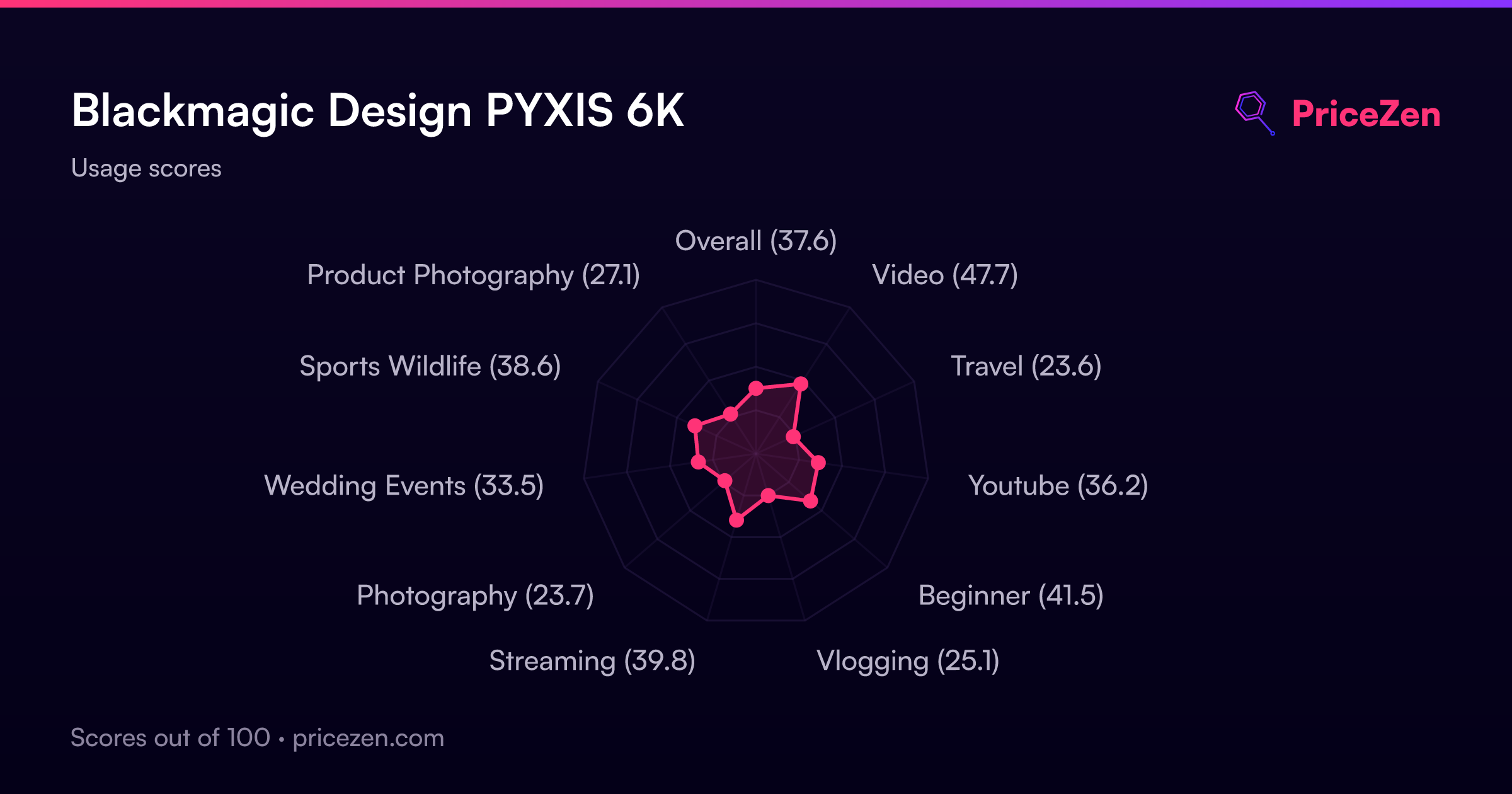
And here's the interesting tension. This thing scores 27.5/100 for vlogging and 48.1/100 for beginners in our model, which is about as clear a "wrong tool for that job" signal as we publish. There's no stabilization, no weather sealing, and the screen is a fixed 4-inch 1920 x 1080 HDR touchscreen that doesn't flip out. The PYXIS knows exactly what it is. Our ranking rewards it heavily for the things a film crew cares about and shrugs at everything else.
Common Questions
Q: Can I shoot handheld with the PYXIS 6K, or do I need a rig?
There's no stabilization in the body at all, and our ranking puts it in the bottom 33% for that, so handheld footage will show every bit of your movement. The design assumes you're building around it: multiple mounting points and accessory side plates let you add handles, rails and a shoulder pad. At 1500g before accessories, a properly rigged setup is comfortable enough, but a gimbal or tripod is the realistic answer for smooth motion.
Q: Is the autofocus good enough for solo shooting?
Honestly, no. Autofocus sits in the bottom 37% in our data, well below the middle of the category, and the fixed 4-inch screen doesn't articulate for self-framing either. This camera expects you to pull focus manually or have someone doing it for you. If reliable subject tracking is a must-have, the Nikon Z8 or Sony Alpha a7R VI from our competitor list are better fits.
Q: What media and storage workflow does it need?
You get dual CFexpress Type B slots, and it writes 12-bit Blackmagic RAW alongside small H.264 proxy files at the same time, so editors can start cutting immediately while you keep the full-quality masters. The 10GbE Ethernet port pushes media to Blackmagic Cloud, and USB-C gives you another route out. Factor CFexpress Type B card costs into your budget, since they're a separate purchase from the USD 2,245 body.
Q: Why does the sensor score so low if it's full-frame?
Our scoring model weighs several sensor factors, and the 6MP stills resolution drags that sub-score down to the bottom 4% even though the physical 36 x 24 mm size is generous. For motion work the picture is completely different: video ranks in the top 8% thanks to 6K open gate capture, 13 stops of dynamic range and ISO up to 25,600. Read the sensor score as a stills verdict, not a film one.
Who Should Skip This
Vloggers and solo travel creators should walk away now. A 27.5/100 vlogging score, zero stabilization, a fixed non-articulating screen and no weather sealing make this a poor companion for filming yourself on the move. Serious photographers should skip it too, given the sensor sub-score in the bottom 4% and 6MP stills output. Look at the Panasonic Lumix G9 II or OM System OM-1 Mark II if you want something lighter and more forgiving for run-and-gun work.
Also skip it if you need one camera to cover weddings, events or anything where you can't control the moment. Autofocus in the bottom 37% and battery life around the category average mean you'll be fighting the tool instead of shooting. The Sony Alpha a7R VI, Nikon Z8 and Fujifilm X-H2 are the cross-shops I'd suggest for that kind of mixed, unpredictable workload.
Verdict
If you're shooting narrative shorts, commercials, music videos or documentary work with a small crew, this is an easy recommendation. The 13 stops of dynamic range, open gate 6K at 36 fps and simultaneous RAW-plus-proxy recording solve problems you'd otherwise spend hours fixing in post, and the mounting points mean the body grows with your productions. At USD 2,245 it's the cheapest way into that specific workflow that our data covers. Beginners scoring 48.1/100 in our model isn't a knock on the camera, it's a warning that you need to know your way around exposure and focus before this thing rewards you.
If you're a solo creator who films yourself, travels light, or needs one camera for photos and video, look elsewhere. A 27.5/100 vlogging score, no stabilization, a fixed screen and 1500g of body before accessories add up to a frustrating daily driver. And if you shoot stills seriously, the sensor sub-score in the bottom 4% should settle it. For everyone else, this is a genuinely focused tool that does its one job extremely well, which is more than most cameras manage.
Usage Scores
- Overall45.2
- Video51.7
- Travel28.7
- Youtube40
- Beginner49.6
- Vlogging28
- Streaming43.5
- Photography28.4
- Wedding Events36.8
- Sports Wildlife40.1
- Product Photography32.7