Team Group T-Force Delta RGB 32GB (2x16GB) DDR5-6000 CL28 White

DDR5-6000 at CL28, quick and tight verified Nov 28
71/100 overall score
Prices checked on 1 days so far, too few to say what is usual.
- Capacity
- 32GB
- Kit
- 2 x 16GB
- Memory
- DDR5
- Speed
- 6000 MT/s
- CAS latency
- CL28
- Form factor
- UDIMM
Compare prices at 1 store
Cheapest first. New, refurbished and bundled offers are kept apart, so you compare like with like.
| Store | Sold by | Colour and condition | Price | vs lowest | Last checked | Link |
|---|---|---|---|---|---|---|
| New1 offerSingle unit | ||||||
| Amazon | Marketplace seller | Not listed | €736.55 | Lowest price | 3 days ago | Go to store |
 Source: PriceZen, checked Nov 26, 2026
A price counts as current when we checked it in the last 7 days. “Marketplace seller” means a third-party seller on that store, not the store itself.











Snapshot
The 30-Second Version
The T-Force Delta RGB DDR5 6000 CL28 kit has near-best-in-class latency, near the top in our rankings, and owners love the overclocking headroom and RGB. But stability reports are mixed, with crashes at rated speeds and sleep-wake issues on some Ryzen chips, and pricing is steep at USD 670 with European listings ranging from EUR 737 to EUR 1,731. Buy it if you tune your own system and want the tightest timings; skip it if you want plug-and-play certainty.
Pros & Cons
Pros
- CL28 at 6000 MT/s, near the top for latency in our rankings 97th
- Speed is a standout for DDR5 90th
- Both Intel XMP 3.0 and AMD EXPO supported, no platform lock-in 88th
- Owners repeatedly praise strong overclocking headroom 71st
- 120-degree RGB light bar and effective heat spreader, strong feature score
Cons
- Sentiment is low despite a 4.4/5 rating
- Multiple owners report instability at rated speeds on Ryzen boards
- Wake-from-sleep crashes reported with 9800X3D specifically
- Affordability is low, this is expensive memory
- Social proof is thin, only 2 US listings tracked
What owners think
The Word on the Street
- Stability is the most discussed topic by a wide margin, with roughly a dozen mentions split between owners who report flawless EXPO/XMP operation on compatible boards and those who hit immediate memory test failures and blue screens at rated speeds.
- Overclocking is where enthusiasm runs highest, with multiple buyers describing pushing well beyond the rated profile and attributing the headroom to the Hynix dies under the spreader.
- The RGB lighting comes up repeatedly as a highlight, with owners calling it bright, smooth and unusually wide, and several noting the heat spreader keeps temperatures in check even at elevated voltage.
- Compatibility complaints cluster around specific CPUs, particularly wake-from-sleep crashes on 9800X3D systems, alongside scattered reports of RGB software sync problems and a small number of modules failing within months.
How owner sentiment changed over time
ExclusiveBased on when customers actually wrote their reviews - so you can see whether early praise held up.
52 written reviews, Mar 2026: 20 happy, 2 mixed, 4 unhappy, 26 without stars
Each dot is one written review, in the month it was written. Happy = 4-5★, mixed = 3★, unhappy = 1-2★.
The proof
Performance
Let's talk about what CL28 at 6000 MT/s actually buys you. CAS latency is how many clock cycles the memory waits before it starts handing over data, and lower is better. At 28-36-36-76, this kit is tighter than the typical 6000 kit, and that shows up as slightly snappier frame pacing in CPU-bound games and better responsiveness in latency-sensitive workloads. Our latency ranking puts it near the top, so basically nothing we track does better. The trade-off is voltage: 1.4V is on the higher side for a daily-driver DDR5 kit, which is why the heat spreader isn't just decoration. Owners do report the spreader doing its job and temps staying reasonable, but you're feeding it more power than a stock-voltage kit, and that's part of why some boards get fussy.
Capacity is the more ordinary part of the equation. 32GB across two sticks sits above average in our data, which is solid and about what a modern gaming or content build wants, but it's not a standout. Two DIMMs also leaves you two slots free on most boards, though populating all four on DDR5 usually means dropping speed, so plan around 32GB being your ceiling unless you replace the kit. Overclocking is where owners get excited: multiple buyers describe pushing well past the rated profile with Hynix-based dies and getting stable results. The flip side is that the same tuning sensitivity means the rated 6000 CL28 profile itself doesn't always boot cleanly. Several owners report memory test failures and blue screens on Ryzen setups even with updated BIOS, so treat the XMP/EXPO toggle as a starting point rather than a guarantee.
Specifications
Full Specifications
Memory
| Type | DDR5 |
| Form Factor | UDIMM |
| Total Capacity | 32768 |
| Modules | 2 |
| Per Module | 16384 |
| Pins | 288 |
Performance
| Speed | 6000 |
| CAS Latency | 28 |
| Timings | 28-36-36-76 |
| Voltage | 1.4 |
Class
| ECC | No |
| Registered | No |
| OC Profile | Intel XMP 3.0, AMD EXPO |
Features
| RGB | Yes |
| Heat Spreader | Yes |
vs Competition
The obvious cross-shop is Kingston FURY Beast, and the argument there is boring reliability versus this kit's timing advantage. The Delta wins on latency, near the top is hard to argue with, and it wins on visuals if you want the wide RGB bar. But given that our sentiment data puts this kit low while owners report boot and wake issues, a buyer who just wants to enable a profile and forget about it should look hard at the FURY Beast route. Same logic applies to G.Skill Ripjaws S5 and Crucial Pro Overclocking: if your priority is a kit that behaves on the first try, the Delta's spec-sheet edge may not be worth the troubleshooting hours.
Against Corsair VENGEANCE RGB and XPG Lancer Blade RGB, the fight is closer because those are also the pretty options. Here the Delta's case rests on that CL28 timing set and its strong feature ranking, plus dual XMP 3.0 and EXPO support so it works whichever side of the CPU aisle you're on. Where it gives ground is consistency and price. With affordability low and social proof even lower, you're taking on more risk and paying more for it than the category norm. Our advice: if you enjoy tuning and want the tightest timings you can get, the Delta earns its spot. If you want RGB and calm, cross-shop the Corsair and XPG options seriously before committing.
| Spec | Team Group T-Force Delta RGB | Kingston FURY Beast | G.Skill Trident Z5 Royal | Corsair VENGEANCE RGB | Crucial Pro Overclocking | XPG Lancer Blade RGB |
|---|---|---|---|---|---|---|
| Capacity | 32GB | 64GB | 64GB | 64GB | 32GB | 32GB |
| Kit | 2 x 16GB | 2 x 32GB | 2 x 32GB | 2 x 32GB | 2 x 16GB | 2 x 16GB |
| Memory Type | DDR5 | DDR5 | DDR5 | DDR5 | DDR5 | DDR5 |
| Speed Mts | 6000 | 6400 | 6000 | 6400 | 6400 | 6000 |
| Cas Latency | CL28 | CL32 | CL26 | CL32 | CL32 | CL30 |
| Form Factor | UDIMM | UDIMM | UDIMM | UDIMM | UDIMM | UDIMM |
| Ecc | No | No | No | No | No | No |
| Compare | Compare | Compare | Compare | Compare |
| Product | Speed | Feature | Latency | Capacity | User Sentiment | Social Proof | Affordability |
|---|---|---|---|---|---|---|---|
| Team Group T-Force Delta RGB | 87.6 | 89.5 | 97.1 | 70.5 | 22.1 | 8.2 | 17.1 |
| Kingston FURY Beast Compare | 94.8 | 89.5 | 87.6 | 89.5 | 90.2 | 96.4 | 7.6 |
| G.Skill Trident Z5 Royal Compare | 87.6 | 89.5 | 99 | 89.5 | 90.2 | 58.4 | 3.9 |
| Corsair VENGEANCE RGB Compare | 94.8 | 89.5 | 87.6 | 89.5 | 97.6 | 96.4 | 6.8 |
| Crucial Pro Overclocking Compare | 94.8 | 74.8 | 87.6 | 70.5 | 49.4 | 76.9 | 26.8 |
| XPG Lancer Blade RGB Compare | 87.6 | 89.5 | 87.6 | 70.5 | 0 | 96.4 | 16.5 |
Price
Value & Pricing
Here's where we have to be blunt. This kit ranks low for affordability in our data, and the prices back that up. In the US we're tracking USD 670 at both Amazon and Newegg, so there's no shopping-around advantage domestically, the two stores are identical. Across Europe the spread is genuinely wild: EUR 737 at the low end up to EUR 1,731 at the high end across four listings in DE, ES, FR and IT. That's a EUR 994 gap for the same kit, which means where you buy matters enormously. Canadian listings run CAD 805 to CAD 971, a CAD 166 spread, and Brazil sits at BRL 7,808 on a single listing.
So the value argument depends entirely on which price you land on. At the bottom of the European range, tight CL28 timings and best-in-class latency start to look like a reasonable enthusiast premium. At the top of that range, you're paying flagship money for a 32GB kit with mixed stability reports, and that's a much harder sell. Interestingly, owners themselves rate value positively, it's one of the recurring strengths in the feedback, which suggests a lot of them bought at friendlier prices than what we're seeing now. If you're staring at USD 670, know that you're buying near the top of the market for capacity that's merely solid.
We started tracking prices for this product on Nov 26, 2026. The chart appears once we have more data.
Read more
Overview
Team Group's T-Force Delta RGB has been the flashy option in DDR5 for a while now, and this particular kit is the one enthusiasts point at: 32GB (2 x 16GB) of DDR5 running 6000 MT/s at CL28, with timings of 28-36-36-76 at 1.4V. That CAS latency is the headline. Most 6000 kits you'll see sit at looser timings, and this one lands near the top for latency in our rankings, which puts it right at the top of everything we track in desktop memory. Speed is also a standout, just not quite as extreme as the timing story.
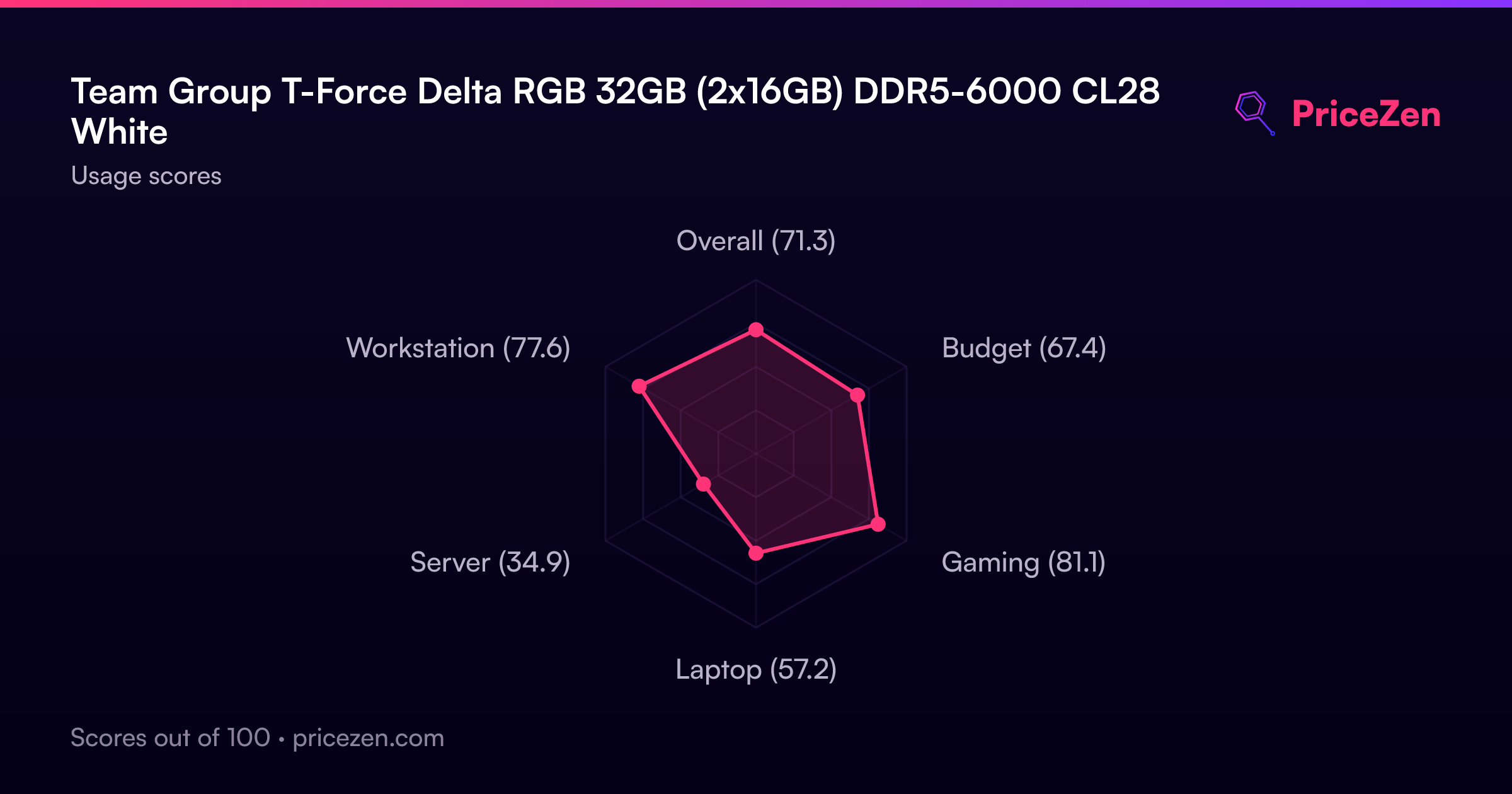
The pitch is simple: this is a gaming and tuning kit. Our scoring model gives it 81.2/100 for gaming and 77.7/100 for workstation use, against a total score of 71.3. It supports both Intel XMP 3.0 and AMD EXPO, so you're not locked to one platform, and the aluminum heat spreader plus that 120-degree ultra-wide RGB light bar means it's meant to be seen. Team Group leaned into a stealth-aircraft look with the geometric silhouette, and owners consistently single out the lighting as one of the best parts of the package.
But here's the tension we have to flag up front. On paper this thing is close to ideal. In owner feedback, it's messier. The sentiment in our data is low, meaning it lags behind most of the category despite a 4.4/5 customer rating and a distilled sentiment score of 72/100 from 57 pieces of evidence. Plenty of buyers report rock-solid EXPO and XMP operation and wild overclocking headroom. A meaningful minority report instability at rated speeds, wake-from-sleep crashes on certain CPUs, and a handful of early failures. That gap between spec sheet and lived experience is the whole story with this kit.
Common Questions
Q: Will this run at 6000 CL28 straight out of the box?
On many boards, yes, since it carries both Intel XMP 3.0 and AMD EXPO profiles. But owner feedback is split, with several reporting failed memory tests and blue screens at rated speeds on Ryzen platforms even after BIOS updates. Budget some troubleshooting time and make sure your board's memory support list is friendly to 1.4V kits.
Q: Is 32GB enough, or should I go bigger?
For gaming and most creative work, 32GB is comfortable, and our capacity ranking puts it above average, solidly above average. It's two 16GB sticks, so you keep two slots open, but filling all four DDR5 slots typically forces lower speeds. If you need more than 32GB, buy a larger kit rather than adding to this one.
Q: Why is DDR5 memory so expensive right now?
Our affordability ranking for this kit is low, and the pricing reflects broader market pressure rather than anything unique to Team Group. Demand from AI and data center buildouts has tightened consumer DDR5 supply. Practically, that means shopping across regions matters, European listings for this exact kit span EUR 737 to EUR 1,731.
Q: Does the RGB work with my motherboard software?
The kit uses a 120-degree ultra-wide light bar and its feature set ranks strong in our data, so visually it's a strong pick. That said, RGB sync issues are one of the recurring gripes in owner feedback, so expect occasional fiddling with your board's lighting utility rather than instant harmony.
Who Should Skip This
If you're building a PC for someone else, or a work machine that has to boot every morning without drama, this isn't the kit we'd hand you. The pattern of instability at rated speeds and sleep-wake crashes on certain CPUs, including the 9800X3D, is exactly the sort of intermittent problem that eats weekends. Look at Kingston FURY Beast or Crucial Pro Overclocking instead, where the goal is a stable profile rather than the tightest possible timings.
Also skip it if you're price-sensitive or need lots of capacity. At USD 670 and a low affordability ranking, you're paying a premium for latency, not for gigabytes, and 32GB is only solid rather than generous in our rankings. Server and heavy virtualization use is a clear no, our model scores it just 34.9/100 there, and unbuffered consumer DDR5 with RGB is simply the wrong tool for that job.
Verdict
For an enthusiast who likes dialing things in, this is a genuinely appealing kit. CL28 at 6000 MT/s is about as tight as daily DDR5 gets, our gaming score of 81.2/100 reflects that, and owners who get a good sample on a compatible board report excellent stability and impressive overclocking room. If you're the type who updates BIOS without complaining and knows their way around memory voltages, the upside here is real and the RGB is a nice bonus rather than the reason to buy.
For anyone building a machine that needs to just work, we'd hesitate. The recurring reports of instability at rated speeds, sleep-wake crashes on 9800X3D systems, and a few units dying within months are not the kind of thing you want in a work machine or a PC you built for someone else. Add the low affordability ranking and the thin listing coverage, and the risk-to-reward math tilts away from this kit unless you specifically want its timings. Great memory, conditional recommendation.
Usage Scores
- Overall71.3
- Budget67.4
- Gaming81.1
- Laptop57.2
- Server34.9
- Workstation77.6