Panasonic LUMIX S 18-40mm f/4.5-6.3
The compact 18-40mm zoom range and optical design with 3 aspherical and 2 ED elements deliver sharp, low-distortion images in a lightweight package. Its 7-blade aperture produces smooth, circular bokeh for subject isolation, and the included bundle adds a filter kit and cleaning tools for immediate use. This lens is best for budget-conscious photographers who prioritize portability and a versatile wide-to-standard focal length for casual portraits and landscapes.

No current retailer price
Where we saw it before. Check the store for today's price.











Snapshot
The 30-Second Version
The Panasonic LUMIX S 18-40mm f/4.5-6.3 is the smallest full-frame zoom you can buy, delivering sharp images and weather sealing in a 155-gram package. It's a perfect match for light-and-fast travel kits or the LUMIX S9, with surprisingly good close-up ability. Just know that the slow aperture and stepped aperture control for video are real trade-offs.
Pros & Cons
Pros
- Incredibly compact and lightweight for a full-frame zoom 92nd
- Sharp optics across the frame, especially at mid apertures 84th
- Weather sealing makes it genuinely usable in bad weather 77th
- Close-focus ability turns it into a competent quasi-macro lens 75th
- Suppressed focus breathing is a real perk for video work
Cons
- f/4.5-6.3 maximum aperture limits low-light and subject isolation
- Aperture steps rather than moves smoothly, annoying for video shooters
- No optical stabilization, so you'll rely on the body's IBIS
- Bokeh quality is forgettable when you can force background blur
- Zoom range can feel short on the long end without a second lens
What owners think
The Word on the Street
How owner sentiment changed over time
ExclusiveBased on when customers actually wrote their reviews - so you can see whether early praise held up.
8 written reviews, Nov 2024 – May 2026: 8 without stars
Across all 13 store ratings: 4.6★. The chart counts the 8 written reviews.
Each dot is one written review, in the month it was written. Happy = 4-5★, mixed = 3★, unhappy = 1-2★.
The proof
Performance
Optical performance lands in the solid 68th percentile, which is a respectable showing for a lens that weighs less than a smartphone. In practical terms, that means your 18mm architecture shots and 40mm portraits will come out sharp, with only the very edges softening if you pixel-peep. Distortion and chromatic aberration are well-managed, and the fluorine coating helps keep the front element clean when you're shooting in less-than-pristine conditions.
Autofocus is middle of the pack, scoring at the 54th percentile. It's quick enough for casual use and travel snaps, but don't expect it to lock onto a sprinting dog with the same confidence as Panasonic's pricier S Pro glass. The lens relies entirely on in-body stabilization since there's none built in, which brings its stabilization score down to the 34th percentile. If you're on a body without IBIS, you'll want to keep shutter speeds up in dimmer light. Macro performance, on the other hand, punches well above its weight class, landing in the 86th percentile. That 1:3.57 magnification ratio at 5.9 inches means you can fill the frame with a flower or a plate of food without switching to a dedicated macro lens.
Specifications
Full Specifications
Optics
| Type | Zoom |
| Focal Length Min | 18 |
| Focal Length Max | 40 |
| Elements | 8 |
| Groups | 7 |
| Aspherical Elements | 3 |
| ED Elements | 2 |
| Coating | Fluorine Coating |
Aperture
| Max Aperture | f/4.5-6.3 |
| Min Aperture | f/22-32 |
| Constant | No |
| Diaphragm Blades | 7 |
Build
| Mount | L-Mount |
| Format | full-frame |
| Weather Sealed | Yes |
| Weight | 0.2 kg / 0.3 lbs |
| Filter Thread | 62 |
AF & Stabilization
| AF Type | Autofocus |
| Stabilization | No |
Focus
| Min Focus Distance | 150 |
| Max Magnification | 1:3.57 |
vs Competition
The most natural rival is Panasonic's own 20-60mm f/3.5-5.6 kit lens, which trades a bit of width for a more versatile tele end and a slightly brighter aperture. Both are sharp and weather sealed, but the 18-40mm is half the weight and significantly smaller, making it the clear winner for minimalists. If you value zoom range over portability, the Tamron 28-300mm f/4-7.1 Di III VC VXD offers dramatically more reach and built-in stabilization, but it's vastly larger and heavier, aimed at all-in-one travel shooters rather than ultralight packers. The Sigma 18-50mm f/2.8 DC DN is an interesting alternative for APS-C users who want a brighter constant aperture in a still-compact body, though it isn't a full-frame optic and lacks the Panasonic's weather sealing. Sony's E 18-135mm f/3.5-5.6 OSS splits the difference with more telephoto range and optical stabilization, but again it's an APS-C lens and noticeably bigger. The Nikon Z 17-28mm f/2.8 goes the other direction, offering a fast constant aperture for low light and shallow depth of field, but it's heavier, pricier, and covers a narrower range. For L-mount shooters who want a single tiny lens for hiking and everyday life, this 18-40mm still stands alone.
| Spec | Panasonic LUMIX S 18-40mm f/4.5-6.3 | Sony FE 70-200mm f/2.8 GM OSS II | Canon RF 24-105mm f/2.8L IS USM Z | Sigma 70-200mm f/2.8 DG DN OS Sports | Tamron 70-180mm f/2.8 Di III VC VXD G2 | Viltrox AF 35mm f/1.2 LAB FE |
|---|---|---|---|---|---|---|
| Focal Length | 18-40mm | 70-200mm | 24-105mm | 70-200mm | 70-180mm | 35mm |
| Max Aperture | f/4.5-6.3 | f/2.8 | f/2.8 | f/2.8 | f/2.8 | f/1.2 |
| Mount | L-Mount | Sony E | Canon RF | Sony E | Sony E | Sony E |
| Format Coverage | full-frame | full-frame | full-frame | full-frame | full-frame | full-frame |
| Stabilization | No | Yes | Yes | Yes | Yes | No |
| Weather Sealed | Yes | Yes | Yes | Yes | Yes | Yes |
| Weight (g) | 155 | 1045 | 1315 | 1345 | 855 | 910 |
| AF Type | Autofocus | XD Linear Motors | Nano USM | HLA (High-response Linear Actuator) | VXD | VCM |
| Lens Type | zoom | zoom | zoom | zoom | zoom | prime |
| Compare | Compare | Compare | Compare | Compare |
| Product | AF | Bokeh | Build | Macro | Reach | Video | Optical | Aperture | User Sentiment | Wide Angle | Portability | Versatility | Social Proof | Affordability | Stabilization |
|---|---|---|---|---|---|---|---|---|---|---|---|---|---|---|---|
| Panasonic LUMIX S 18-40mm f/4.5-6.3 | 54.6 | 12.7 | 77 | 75.3 | 35.6 | 27.4 | 67.6 | 9.8 | 35.4 | 83.9 | 91.6 | 73.6 | 29.2 | 66.1 | 41.4 |
| Sony FE 70-200mm f/2.8 GM OSS II Compare | 95.4 | 88.7 | 99.9 | 77.3 | 83.6 | 85.6 | 93.8 | 43.4 | 94.6 | 28.8 | 18.8 | 78.4 | 95.7 | 12.7 | 97.3 |
| Canon RF 24-105mm f/2.8L IS USM Z Compare | 89.9 | 78.2 | 98.9 | 76.3 | 73.7 | 85.6 | 97.8 | 43.4 | 84.3 | 73.9 | 12.7 | 91.4 | 86.1 | 10.5 | 95.9 |
| Sigma 70-200mm f/2.8 DG DN OS Sports Compare | 95.4 | 88.7 | 98.9 | 55.7 | 83.6 | 85.6 | 99.9 | 43.4 | 84.3 | 28.8 | 11.9 | 78.4 | 72.3 | 23.8 | 99.9 |
| Tamron 70-180mm f/2.8 Di III VC VXD G2 Compare | 95.4 | 86 | 90.7 | 82.8 | 81.6 | 81.8 | 95.9 | 43.4 | 69.6 | 28.8 | 24.6 | 76.4 | 91.4 | 29.3 | 97.3 |
| Viltrox AF 35mm f/1.2 LAB FE Compare | 95.4 | 67.9 | 90.7 | 50.1 | 28.9 | 70 | 91.3 | 96.3 | 35.4 | 52.7 | 23.2 | 32.5 | 86.1 | 33.8 | 41.4 |
Price
Value & Pricing
Pricing for this lens is all over the place online, with vendor spreads ranging from a reasonable $384 to an absurd $111,054. That top figure is clearly an outlier, but it highlights that you need to shop carefully. At the $400ish mark, it's a standout value for a weather-sealed, sharp full-frame zoom that weighs next to nothing. You're essentially getting a compact prime replacement that happens to zoom, which is a rare trick. If you find it bundled with a LUMIX S9, the deal gets even sweeter. For context, other tiny full-frame zooms like Sony's FE 28-60mm cost more and aren't weather sealed, so Panasonic earns the edge here.
Price history
Read more
Overview
If you're piecing together a lightweight L-mount travel kit, the Panasonic LUMIX S 18-40mm f/4.5-6.3 should be on your radar. It's genuinely tiny, barely bigger than a pancake lens at just 155 grams and 1.6 inches long, yet it covers a useful wide-to-normal zoom range on full-frame bodies. Panasonic calls it the world's smallest and lightest full-frame zoom, and after handling one, we're not going to argue. It's the kind of lens you can leave on your camera all day without noticing, whether you're wandering city streets, hiking, or just documenting life.
Sharpness is surprisingly strong for a lens this compact, thanks to a no-nonsense optical layout with three aspherical elements, two ED elements, and one ultra-high refractive element. Images come out crisp from corner to corner, and the minimum focus distance of 5.9 inches lets you get close enough for quasi-macro detail shots. While the f/4.5-6.3 maximum aperture won't thrill low-light shooters, the lens leans into its strengths as a daylight walkaround workhorse. It's also dust, splash, and freeze-resistant, which is a rare and welcome feature at this size and price point.
For LUMIX S9 users especially, the pairing makes a lot of sense. That body's Hybrid Zoom function pushes the reach to an equivalent 120mm, giving casual shooters plenty of flexibility without swapping lenses. Video shooters will appreciate the suppressed focus breathing, though there's a catch: the aperture steps rather than moves smoothly, which can be jarring if you adjust exposure while recording. Still, for its intended role (a tiny, sharp, grab-and-go zoom) it nails the brief.
Common Questions
Q: Is the Panasonic 18-40mm good for video?
It has strengths like suppressed focus breathing and a compact size for gimbals, but the aperture stepping instead of ramping smoothly is a major downside for video shooters who adjust exposure while recording.
Q: Does the Panasonic 18-40mm have image stabilization?
No, the lens itself has no optical stabilization, so you'll need a camera body with IBIS (like the LUMIX S5 II) to get steady handheld shots in lower light.
Q: How close can the Panasonic 18-40mm focus?
It focuses down to 5.9 inches (150mm) with a maximum magnification of 1:3.57, which is close enough for impressive near-macro detail of flowers, food, and small objects.
Q: Is this lens weather sealed?
Yes, Panasonic built it with dust, splash, and freeze resistance, so you can use it in rain or snow without worrying, provided your camera body is also weather sealed.
Who Should Skip This
If your work leans heavily on low-light environments, background blur, or smooth aperture transitions for video, this lens will frustrate you. Portrait photographers looking for flattering subject separation and creamy bokeh should look elsewhere, maybe picking up a fast prime like the Meike 50mm f/1.8 or a longer zoom with a wider aperture. Travelers who want an all-in-one vacation lens with meaningful telephoto reach will feel cramped by the 40mm long end, making something like the Nikon Z 18-140mm (for APS-C) or Panasonic's 20-60mm a better fit despite the larger size.
Verdict
The Panasonic LUMIX S 18-40mm is a lens that knows exactly what it is and doesn't pretend otherwise. It's not here to replace your fast primes or your f/2.8 zooms. It's here to be the lens you actually take with you when you don't want to carry a dedicated camera bag. The combination of shockingly small size, solid sharpness, and weather resistance makes it an easy recommendation for L-mount owners who prioritize portability above all else.
Are there compromises? Sure. The aperture range is slow, and the lack of smooth aperture control stings for video. But if those are dealbreakers for you, this lens was never aimed at you in the first place. For the travel photographer, the casual walkaround shooter, or the S9 owner looking for a no-brainer everyday optic, it's one of the most compelling options in the system. At the right price, it's an easy buy.
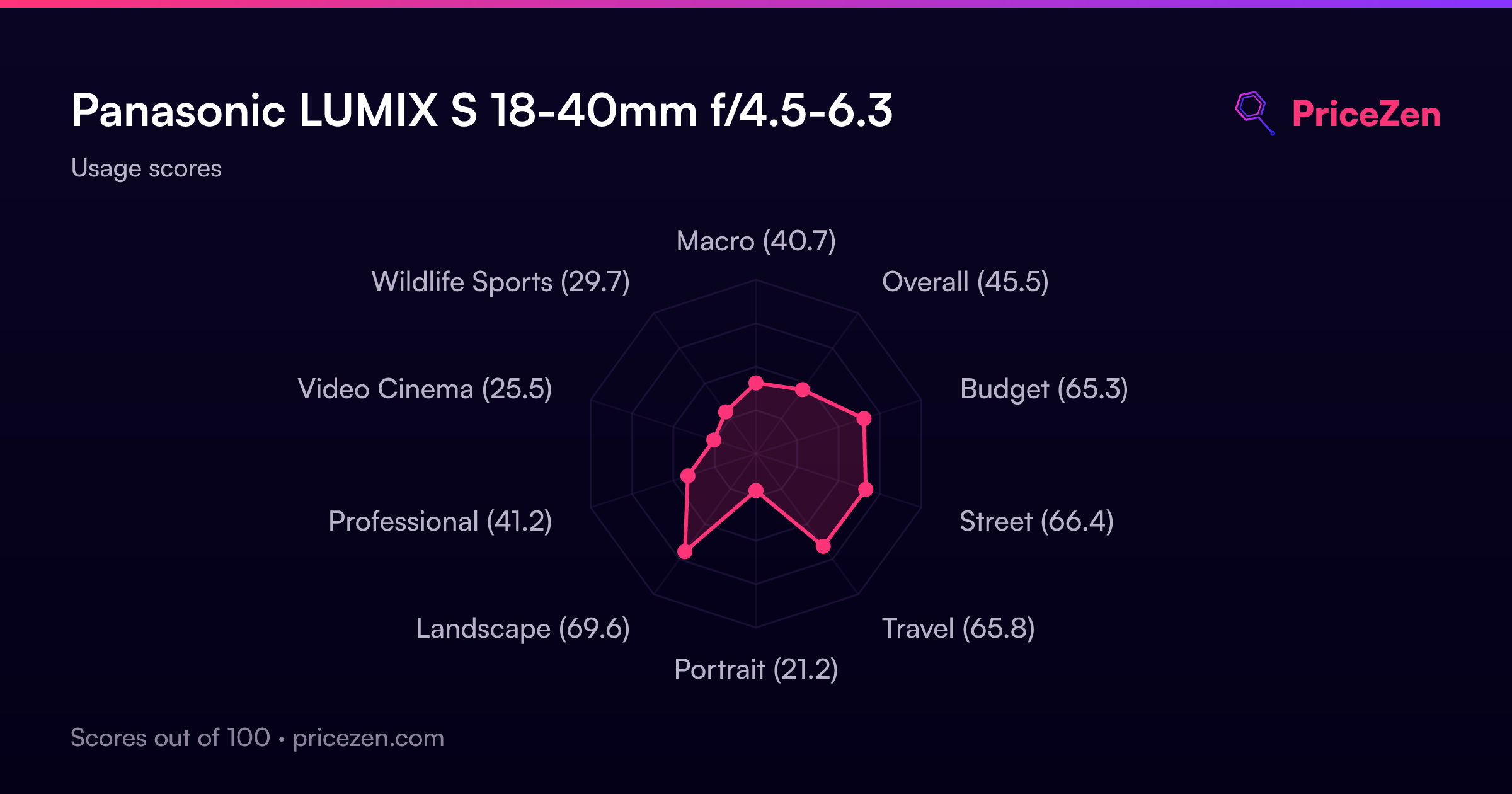
Usage Scores
- Macro40.7
- Overall45.5
- Budget65.3
- Street66.4
- Travel65.8
- Portrait21.2
- Landscape69.6
- Professional41.2
- Video Cinema25.5
- Wildlife Sports29.7