Lenovo ThinkCentre M90q Gen 5 2025, Core i9 i9-14900, 32GB, 1TB SSD, Black
Packing a 24-core Intel Core i9-14900 with vPro and 32GB of DDR5 RAM into a tiny chassis, this system delivers full desktop power for demanding multitasking. The 1TB SSD and Intel Q670 chipset provide fast data access and robust enterprise manageability in a space-saving design. It is best for IT administrators and business users who need a secure, high-performance workstation that can be mounted virtually anywhere.

No current retailer price


Snapshot
The 30-Second Version
The ThinkCentre M90q Gen 5 Tiny crams a 24-core i9-14900 and 32GB of DDR5 into a mini chassis, and our CPU ranking puts it among the best. The catch is integrated UHD Graphics 770 and a gaming score of just 14.2/100, so this is a work machine, full stop. We track it at USD 2,131 at Newegg and USD 2,172 at Amazon. Great for tight business desks and CPU-heavy home offices, wrong for anyone who games.
Pros & Cons
Pros
- 24-core i9-14900 ranks among the best for CPU, strong for a mini 86th
- 32GB DDR5 sits well above average 82nd
- Tiny form factor with a 230W PSU, our compact score is 78.4/100 70th
- vPro, Q670 chipset and Windows 11 Pro for managed business fleets 66th
- Drives up to four independent displays over DisplayPort and HDMI
Cons
- Integrated UHD Graphics 770 only, GPU ranks low
- Gaming score of 14.2/100 is our weakest area for this machine
- 1TB SSD is only mid-pack
- Just one USB-C port against six USB-A
- USD 2,131 at the cheapest store is a lot for a machine with no discrete GPU
The proof
Performance
The CPU is the headline and it earns it. In our rankings the i9-14900 here is one of the best processors in this category, and 24 cores at a 2.0GHz base means heavily threaded work has plenty to chew on. Compiling code, running several VMs, crunching large spreadsheets, juggling a browser with far too many tabs while a video call runs, that's the territory where this thing feels quick. Pair it with 32GB of DDR5, which ranks well above average, and you've got a machine that won't start swapping the moment you open a second heavy application. For a mini PC, that combination is genuinely unusual.
Storage is the quiet middle child: 1TB of SSD lands at the 53rd percentile, basically dead center for the category. Fine for an OS, apps and working files, less fine if you're keeping large media libraries or datasets locally. Ports rank solid rather than exceptional, and the actual layout is DisplayPort, HDMI, one USB-C, six USB-A, Ethernet and Wi-Fi 6. Six USB-A ports on a tiny box is a nice practical win for keyboard, mouse, headset, dock and a couple of leftovers. Graphics are the weak spot, and our gaming score of 14.2/100 is blunt about it: UHD 770 will drive four monitors and handle video fine, but it's not going to render anything demanding. The 230W PSU makes that limitation structural, not something you upgrade around later.
Specifications
Full Specifications
Processor
| CPU | Intel Core i9 14900 |
| Cores | 24 |
| Frequency | 2.0 GHz |
| L3 Cache | 36 MB |
Graphics
| GPU | Intel UHD Graphics 770 |
| Type | Integrated |
| VRAM Type | Shared |
Memory & Storage
| RAM | 32 GB |
| RAM Generation | DDR5 |
| Storage | 1 TB |
| Storage Type | SSD |
Build
| Form Factor | mini |
| PSU | 230 |
| Weight | 4.5 kg / 10.0 lbs |
Connectivity
| USB-C Ports | 1 |
| USB Ports | 6 |
| HDMI | 1x HDMI |
| DisplayPort | 2x DisplayPort |
| Wi-Fi | Wi-Fi 6 |
| Bluetooth | ✓ |
| Ethernet | Gigabit Ethernet |
System
| OS | Windows 11 Pro |
vs Competition
Our data lists the Apple Mac Studio M5 Max, HP OMEN GT16-0364, Dell Desktop ECT1250, ASUS ROG GM700 and MSI Aegis ZS2 A9NVP-1407US as the closest competitors, and they split into two very different camps. The Mac Studio is the natural cross-shop if what you want is maximum compute in minimum space, and it's the one to weigh seriously against this Lenovo. The M90q's argument is Windows 11 Pro, vPro manageability and the Q670 platform, plus a 24-core i9 that ranks among the best. If your software chain or your IT policy is Windows-only, that settles it before specs even enter the conversation.
The OMEN GT16-0364, ROG GM700 and Aegis ZS2 are the other direction entirely, and the reason to look at them is the same reason to skip this Lenovo: graphics. Our GPU ranking and a gaming score of 14.2/100 mean the M90q gives up a lot of ground to anything built around a discrete card. The Dell ECT1250 is the closer philosophical match, another business-oriented desktop, and there the decision comes down to whether you need the tiny chassis and the four-display support. Our compact score of 78.4/100 is the M90q's clearest advantage over conventional towers.
| Spec | Lenovo ThinkCentre M90q Gen 5 | Apple Mac Studio M5 Max | HP OMEN GT16-0364 | Dell Desktop ECT1250 | ASUS ROG GM700 | MSI Aegis ZS2 A9NVP-1407US |
|---|---|---|---|---|---|---|
| CPU | Intel Core i9 14900 | Apple M5 Max | AMD Ryzen 7 8700F | Intel Core Ultra 7 265 | AMD Ryzen 7 9800X3D | AMD Ryzen 9 9900X |
| RAM (GB) | 32 | 48 | 32 | 32 | 32 | 32 |
| Storage (GB) | 1024 | 1024 | 1024 | 2048 | 2048 | 2048 |
| GPU | Intel UHD Graphics 770 | Apple (40-Core) | NVIDIA GeForce RTX 5070 | Intel UHD Graphics | NVIDIA GeForce RTX 5070 Ti | NVIDIA GeForce RTX 5070 |
| Form Factor | mini | mini | mid-tower | sff | mid-tower | mid-tower |
| Psu W | 230 | 480 | 850 | 180 | 850 | 750 |
| OS | Windows 11 Pro | macOS | Windows 11 Home | Windows 11 Home | Windows 11 Home | Windows 11 Home |
| Compare | Compare | Compare | Compare | Compare |
| Product | CPU | GPU | RAM | Ports | Storage | Reliability |
|---|---|---|---|---|---|---|
| Lenovo ThinkCentre M90q Gen 5 | 85.8 | 36.5 | 81.6 | 65.5 | 53.3 | 70.3 |
| Apple Mac Studio M5 Max Compare | 95.7 | 84.9 | 95 | 89.1 | 68.6 | 99.3 |
| HP OMEN GT16-0364 Compare | 69.3 | 90.6 | 87 | 97.9 | 53.3 | 70.3 |
| Dell Desktop ECT1250 Compare | 88.1 | 60 | 81.6 | 75 | 82.5 | 70.3 |
| ASUS ROG GM700 Compare | 80.3 | 94.6 | 81.6 | 96.1 | 90 | 37.8 |
| MSI Aegis ZS2 A9NVP-1407US Compare | 92.3 | 90.6 | 87 | 90.4 | 82.5 | 37.8 |
Price
Value & Pricing
We track this config across two US listings and the spread is narrow: Newegg has it at USD 2,131 and Amazon at USD 2,172. That's a USD 41 gap, so there's no clever arbitrage to hunt here, just buy from whichever store you trust on shipping and returns. What you're paying for is dense compute in a tiny chassis plus the enterprise plumbing: vPro, ThinkShield, Windows 11 Pro, Q670. If your organization actually uses remote management and fleet security, that overhead is money well spent. If you're a solo buyer who just wants speed per dollar, you're paying a premium for features you'll never touch.
And that's the honest framing. Against the wider desktop field, USD 2,131 buys you a top-tier CPU and generous RAM but only average storage and below-average graphics. The value case rests almost entirely on the size constraint. If a tiny box is a hard requirement, this is a reasonable price for this much processor. If it isn't, the same budget stretches further elsewhere.
Read more
Overview
There's something a little absurd about a box this small carrying an Intel Core i9-14900. The ThinkCentre M90q Gen 5 Tiny is Lenovo's mini business desktop, and this particular config (12TH0012US) stuffs a 24-core 14th gen chip, 32GB of DDR5 and a 1TB SSD into a chassis that runs off a 230W power supply. It ships with Windows 11 Pro, sits on the Intel Q670 chipset, and comes with vPro for remote management. This is not a machine aimed at people who want RGB lighting. It's aimed at people who want a serious workstation that disappears behind a monitor.
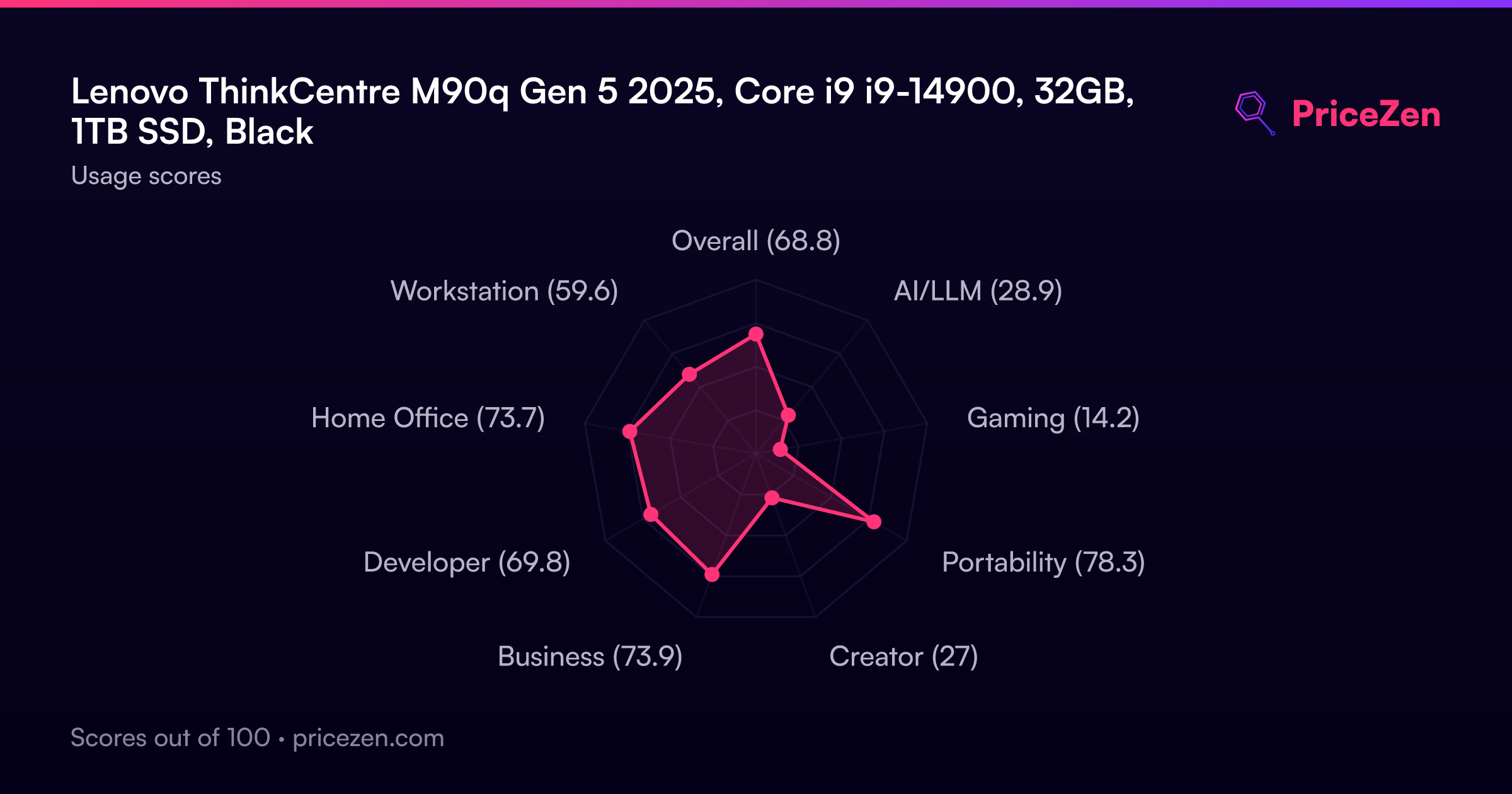
Our scoring model puts it strongest in exactly the places you'd hope: compact at 78.4/100, business at 74/100 and home office at 73.8/100. That trio tells you the whole story. Lenovo built this for desks where space is tight but the workload isn't, and the description leans hard into healthcare, retail and finance deployments. Support for up to four independent displays, an optional removable dust cover for maintenance, and ThinkShield security all point at IT departments rather than hobbyists.
The interesting tension here is the graphics. You get Intel UHD Graphics 770, which is integrated, and nothing else. So you've got one of the stronger CPUs we track paired with graphics that land in the bottom half of the field. That's a deliberate trade, not an oversight, and whether it works for you depends entirely on what you plan to do with all 24 cores.
Common Questions
Q: How much storage do you get, and is it enough?
This config ships with a 1TB SSD, which lands at the 53rd percentile in our rankings, so basically average for a desktop right now. That's comfortable for Windows 11 Pro, your applications and active project files. If you keep large video archives or datasets locally, plan on external or network storage rather than expecting headroom.
Q: Which processor is in it, and does it actually matter for a mini PC?
It's an Intel Core i9-14900, 14th gen, 24 cores at a 2.0GHz base, with vPro Technology on the Intel Q670 chipset. Yes, it matters: our CPU ranking puts it among the best, which is one of the stronger processors in this category and unusual in a chassis this small. Threaded work like compiling, virtual machines and heavy multitasking is where you'll feel it.
Q: Can I game on this or add a graphics card later?
Not realistically. Graphics are handled by integrated Intel UHD Graphics 770, which ranks low in our data, and our gaming score for this machine is 14.2/100. The 230W power supply and tiny chassis make a discrete GPU upgrade a non-starter, so if gaming is on your list, look at the HP OMEN GT16-0364 or MSI Aegis ZS2 instead.
Q: How many monitors can it run, and what ports do I have to work with?
Lenovo supports up to four independent displays, which is a real selling point for finance and control-room style setups. Physical connectivity is DisplayPort, one HDMI, one USB-C, six USB-A, Ethernet and Wi-Fi 6, and our port ranking sits solid without being class-leading. The single USB-C is the pinch point if your dock and accessories all want Type-C.
Who Should Skip This
Gamers and anyone doing GPU-heavy work should walk away. Integrated UHD Graphics 770 and a gaming score of 14.2/100 tell you everything, and the 230W PSU means there's no upgrade path out of it. The HP OMEN GT16-0364, ASUS ROG GM700 and MSI Aegis ZS2 A9NVP-1407US in our competitor set are the machines to cross-shop instead.
Also skip it if you don't need the tiny chassis or the enterprise features. At USD 2,131 to USD 2,172 you're paying for vPro, ThinkShield and a small footprint, and if none of those matter to you, that money buys more elsewhere. Storage hoarders should think twice too: 1TB is mid-pack, and the Dell ECT1250 or a conventional tower gives you more room to grow.
Verdict
For a business buying a fleet of small desks, this is an easy recommendation. vPro, ThinkShield, Windows 11 Pro and an optional dust cover are the kind of things IT teams actually care about, and 32GB of DDR5 with a 24-core i9 means these machines won't feel slow in a couple of years. Healthcare counters, finance desks, retail back offices, anyone running four monitors in a cramped space, that's the bullseye. Our business score of 74/100 and compact score of 78.4/100 line up with that read.
For a home office power user who does CPU-heavy work and no gaming, it's still a good buy, just a pricier one. You're getting leading-tier processing and well above average memory in a box that vanishes on your desk. But if any part of your week involves games, 3D work or GPU-accelerated anything, stop here and look at the OMEN, ROG or Aegis options instead. And at USD 2,131 to USD 2,172, this isn't an impulse purchase either way. Owners rate it 4.4/5 across 20 reviews, which suggests the people who bought it for the right reasons are happy.
Usage Scores
- Overall68.8
- AI/LLM28.9
- Gaming14.2
- Portability78.4
- Creator27
- Business74
- Developer69.8
- Home Office73.8
- Workstation59.6