Lenovo IdeaCentre 12TAS02M00 2025, Ryzen 7 PRO 8700G, 64GB, 1TB SSD, Raven Black
The Ryzen 7 PRO 8700G processor with integrated Radeon 780M graphics delivers competent performance for a compact 11.7-pound chassis, backed by 64GB of DDR5 RAM. Its small-form-factor design in Raven Black includes extensive connectivity with 8 USB-A ports, HDMI 2.1, and Wi-Fi 6, making it a versatile fit for space-constrained offices. This desktop is best for developers and business users who need a reliable, security-focused Windows 11 Pro workstation without a discrete GPU.

No current retailer price
Snapshot
The 30-Second Version
The IdeaCentre 12TAS02M00 packs 64GB of DDR5 into a small form factor chassis, putting it in the top few percent of the category for memory. The Ryzen 7 PRO 8700G with eight cores and a 5.1GHz boost is solid, and the port selection is a genuine standout. But integrated Radeon 780M graphics and a 260W supply mean a gaming score of just 18.2/100. At USD 1,499 from Newegg, it's a strong pick for developers and heavy multitaskers, and a bad one for gamers.
Pros & Cons
Pros
- 64GB DDR5 at 5200MHz, top few percent of the category for memory 96th
- Strong port selection selection: DisplayPort, HDMI 2.1, USB-C, eight USB-A, Ethernet, Wi-Fi 6 87th
- Compact 13.4 x 3.6 x 11.7 inch chassis at 11.7 lb 72nd
- Windows 11 Pro included, plus a USB keyboard and mouse in the box 70th
- Eight cores and sixteen threads with a 5.1GHz boost ceiling
Cons
- Gaming suitability scores just 18.2/100, our weakest area for this machine
- Integrated Radeon 780M only, no discrete graphics card
- 260W power supply leaves no realistic room for a powerful add-in GPU
- CPU ranks around the 72nd percentile, solid rather than leading
- Only one USB-C port despite eight USB-A
The proof
Performance
Let's start with the number that matters most here. 64GB of DDR5 at 5200MHz sits at the 96th percentile in our data, meaning almost nothing else in this category ships with that much memory. For a developer, RAM is usually the first wall you hit, not CPU speed. Once you're running a couple of VMs plus Docker plus your editor, a smaller machine starts swapping and everything gets sticky. This one has room to breathe. The Ryzen 7 PRO 8700G itself lands around the 72nd percentile for CPU, which is solid but not chart-topping. Eight cores and sixteen threads with a 5.1GHz boost is plenty for compiling, multitasking and general productivity, but if your workload is pure sustained number-crunching, the CPU isn't the standout part of this build. The memory is.
Graphics are where the story changes. The Radeon 780M is integrated, sharing system resources rather than sitting on its own card with its own cooling and power budget. Our GPU ranking puts it at the 65th percentile, which sounds respectable until you see the gaming suitability score of 18.2/100. Those two numbers aren't contradicting each other: the 780M is a capable integrated chip for displays, video and light graphical work, but it's not built for demanding games. The 260W power supply makes the design intent pretty clear too. There's no headroom here for a big discrete card. Storage at 1TB NVMe ranks around the 69th percentile, so it's comfortably mid-pack: fast enough that you won't notice it, large enough for most work setups, but not a media archive. Port selection is genuinely a highlight at the 87th percentile, with DisplayPort, HDMI 2.1, one USB-C, eight USB-A, Ethernet and Wi-Fi 6. Eight USB-A ports on a box this small is the kind of thing you only appreciate after you've owned a machine with three.
Specifications
Full Specifications
Processor
| CPU | AMD Ryzen 7 8700G |
| Cores | 8 |
| Frequency | 4.2 GHz |
| L3 Cache | 16 MB |
Graphics
| GPU | AMD Radeon 780M |
| Type | Integrated |
| VRAM Type | Shared |
Memory & Storage
| RAM | 64 GB |
| RAM Generation | DDR5 |
| Storage | 1 TB |
| Storage Type | NVMe SSD |
Build
| Form Factor | sff |
| PSU | 260 |
Connectivity
| USB-C Ports | 1 |
| USB Ports | 8 |
| HDMI | 1x HDMI 2.1 |
| DisplayPort | 2x DisplayPort |
| Wi-Fi | Wi-Fi 6 |
| Bluetooth | Bluetooth 5.3 |
| Ethernet | Gigabit Ethernet |
System
| OS | Windows 11 Pro |
vs Competition
The competitor set here is interesting because most of it isn't really competing for the same buyer. The HP OMEN GT16-0364, ASUS ROG GM700 and MSI Aegis ZS2 A9NVP-1407US are all gaming-oriented names, and that's precisely where this IdeaCentre folds: 18.2/100 for gaming with integrated Radeon 780M graphics and a 260W power supply. If gaming is anywhere on your list of reasons to buy a desktop, cross-shop those three first and don't try to talk yourself into this one. The Dell Desktop ECT1250 is the closer conceptual rival, another mainstream desktop, and there the argument comes down to configuration: 64GB of DDR5 at the 96th percentile is a hard spec to match, and our port ranking of 87 suggests this Lenovo is unusually well connected for its size.
Then there's the Apple Mac Studio M5 Max, which is the machine people mention when they want a small, quiet, powerful desk box. We're not going to pretend the IdeaCentre wins a straight performance fight against something in that class. What it wins on is platform and practicality: Windows 11 Pro out of the box, x86 compatibility for whatever odd legacy tool your job depends on, and a port array that includes eight USB-A alongside DisplayPort and HDMI 2.1. If your workflow is Windows-native and memory-hungry rather than graphics-hungry, this Lenovo is the more sensible purchase. If you need GPU throughput of any kind, look elsewhere in this list.
| Spec | Lenovo IdeaCentre 12TAS02M00 | Apple Mac Studio M5 Max | HP OMEN GT16-0364 | Dell Desktop ECT1250 | ASUS ROG GM700 | MSI Aegis ZS2 A9NVP-1407US |
|---|---|---|---|---|---|---|
| CPU | AMD Ryzen 7 8700G | Apple M5 Max | AMD Ryzen 7 8700F | Intel Core Ultra 7 265 | AMD Ryzen 7 9800X3D | AMD Ryzen 9 9900X |
| RAM (GB) | 64 | 48 | 32 | 32 | 32 | 32 |
| Storage (GB) | 1024 | 1024 | 1024 | 2048 | 2048 | 2048 |
| GPU | AMD Radeon 780M | Apple (40-Core) | NVIDIA GeForce RTX 5070 | Intel UHD Graphics | NVIDIA GeForce RTX 5070 Ti | NVIDIA GeForce RTX 5070 |
| Form Factor | sff | mini | mid-tower | sff | mid-tower | mid-tower |
| Psu W | 260 | 480 | 850 | 180 | 850 | 750 |
| OS | Windows 11 Pro | macOS | Windows 11 Home | Windows 11 Home | Windows 11 Home | Windows 11 Home |
| Compare | Compare | Compare | Compare | Compare |
| Product | CPU | GPU | RAM | Ports | Storage | Reliability |
|---|---|---|---|---|---|---|
| Lenovo IdeaCentre 12TAS02M00 | 71.7 | 64.5 | 95.7 | 87.3 | 68.6 | 70.3 |
| Apple Mac Studio M5 Max Compare | 95.7 | 84.9 | 95 | 89.1 | 68.6 | 99.3 |
| HP OMEN GT16-0364 Compare | 69.4 | 90.7 | 87 | 97.9 | 53.3 | 70.3 |
| Dell Desktop ECT1250 Compare | 88.1 | 60 | 81.6 | 75 | 82.5 | 70.3 |
| ASUS ROG GM700 Compare | 80.4 | 94.6 | 81.6 | 96.1 | 90 | 37.8 |
| MSI Aegis ZS2 A9NVP-1407US Compare | 92.4 | 90.7 | 87 | 90.4 | 82.5 | 37.8 |
Price
Value & Pricing
We track this at USD 1,499, currently from a single US listing at Newegg. With one store carrying it, there's no cross-shop arbitrage to chase here, so the question is simply whether the configuration earns that number. Our take: it does if memory is your bottleneck. Configurations with 64GB of DDR5 preinstalled are rare in small form factor desktops, and buying that capacity yourself means opening the case, sourcing compatible sticks and hoping the vendor warranty doesn't get weird about it. You're also getting Windows 11 Pro rather than Home, which matters if you need BitLocker, Hyper-V or domain join for work.
But be honest with yourself about what you're paying for. At USD 1,499 you're buying RAM capacity, compactness and business-ready software, not raw compute or graphics muscle. The CPU sits mid-pack and the gaming score is 18.2/100. If your work is mostly email, spreadsheets and video calls, this is more machine than you need and the money would sit better elsewhere. If you're the person whose laptop fans spin up every time you start a second container, the math looks a lot friendlier.
Read more
Overview
The Lenovo IdeaCentre 12TAS02M00 is a small form factor desktop that makes one very loud argument: memory. It ships with 64GB of DDR5, which puts it in the top few percent of everything we track in this category. Most desktops at this size ship with a fraction of that, and most people who need more end up opening the case themselves. Lenovo just does it for you.
Under the hood is an AMD Ryzen 7 PRO 8700G, eight cores and sixteen threads, running at 4.2GHz with a boost ceiling of 5.1GHz and 16MB of cache. Graphics come from the integrated Radeon 780M rather than a separate card, storage is a 1TB NVMe SSD, and Windows 11 Pro is preinstalled. The whole thing measures 13.4 x 3.6 x 11.7 inches and weighs 11.7 lb, powered by a 260W adapter. That's a machine you can tuck behind a monitor or slide onto a shelf without rearranging your desk.
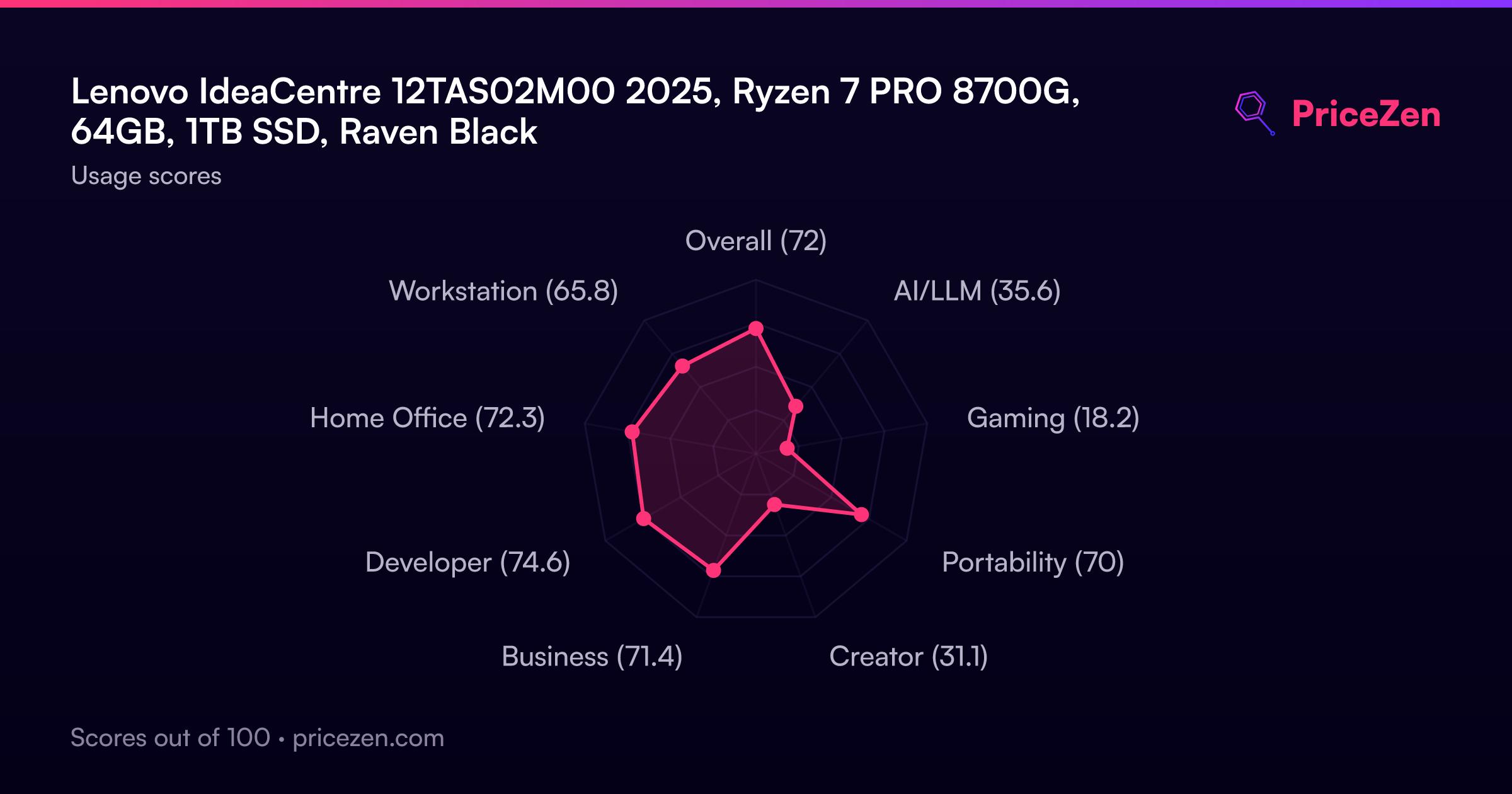
So who's it for? Our scoring model gives it 74.6/100 for developers and 72.3/100 for home office work, against a total of 72/100. That gap tells you exactly what this box is: a compact workstation for people who run a lot of things at once. Containers, virtual machines, forty browser tabs, a local database, an IDE indexing in the background. And then there's the gaming score of 18.2/100, which we'll get to, because it's the trade-off you're accepting whether you like it or not.
Common Questions
Q: How much RAM does it have, and is that actually overkill?
It ships with 64GB of DDR5 running at 5200MHz, which lands at the 96th percentile in our category data, so almost nothing else at this size matches it. For everyday browsing and office work, yes, that's more than you'll use. For running virtual machines, containers or large datasets locally, it's the single best reason to buy this machine.
Q: What processor is inside and how quick is it?
It's an AMD Ryzen 7 PRO 8700G with eight cores and sixteen threads, a 4.2GHz base clock, a 5.1GHz maximum boost and 16MB of cache. Our CPU ranking places it around the 72nd percentile, so it's solidly above average rather than class-leading. That's plenty for compiling code and heavy multitasking, but it's not the fastest chip you can buy in a desktop.
Q: Can I game on it, or add a graphics card later?
Not seriously. Graphics come from the integrated Radeon 780M, and our gaming suitability score for this machine is just 18.2/100, the weakest area by a wide margin. The 260W power supply also rules out adding a demanding discrete card, so this isn't a machine you can upgrade into a gaming rig down the road.
Q: Does it come with everything I need to get started?
You get Windows 11 Pro preinstalled along with a USB keyboard and mouse, plus Wi-Fi 6 and Bluetooth 5.3 for wireless. There's no display included, so budget for a monitor. Connectivity is generous: DisplayPort, HDMI 2.1, one USB-C, eight USB-A and Ethernet, which ranks at the 87th percentile in our data.
Who Should Skip This
Gamers should walk away immediately. An 18.2/100 gaming score with integrated Radeon 780M graphics and a 260W power supply is not a starting point you upgrade from, it's a design decision. The HP OMEN GT16-0364, ASUS ROG GM700 and MSI Aegis ZS2 A9NVP-1407US are all worth your time instead. Same goes for anyone doing 3D rendering, video effects or local AI workloads that lean on GPU throughput.
And if your computing life is genuinely light (email, documents, streaming, a dozen tabs), 64GB of DDR5 is capacity you're paying for and never using. The 72.3/100 home office score is flattering here, but it's driven by a spec you won't stress. Look at simpler desktops like the Dell Desktop ECT1250 and put the savings toward a better monitor or a bigger SSD, because 1TB at the 69th percentile is the part of this build you'll actually feel the limits of.
Verdict
For developers, IT folks and anyone running heavy multitasking on Windows, we think this is a smart buy. The 74.6/100 developer score reflects a real strength: 64GB of DDR5 means you can keep several environments alive at once without the machine choking, and the eight-core, sixteen-thread Ryzen 7 PRO 8700G handles the compile-and-switch rhythm of actual work. The small chassis and 11.7 lb weight make it easy to place, Windows 11 Pro covers the business requirements, and the port count means you're not buying a dock on day one. Our reliability ranking sits around the 70th percentile, which is respectable if unremarkable.
For gamers, 3D artists and anyone doing GPU-heavy work, skip it. An 18.2/100 gaming score isn't a nuance, it's a verdict, and the 260W power supply means you can't fix it later with a graphics card. Home office users land at 72.3/100, which is good, but a lot of that score is memory you'll never touch if your day is browsers and documents. Buy this because you specifically need the RAM in a small Windows box. Don't buy it because it looks like a bargain all-purpose desktop, because it isn't one.
Usage Scores
- Overall72
- AI/LLM35.6
- Gaming18.2
- Portability70
- Creator31.1
- Business71.4
- Developer74.6
- Home Office72.3
- Workstation65.8