HamiltonBuhl VividPro CAM17SV Silver 2020
The 18MP sensor and 8x optical zoom let you capture detailed stills, while the 2.7-inch fixed preview screen helps frame shots. Digital image stabilization and a self-timer reduce blur and make group photos easier to set up. This camera is best for casual users who want a simple point-and-shoot for everyday snapshots and basic 1080p video.

No current retailer price











Snapshot
The 30-Second Version
The HamiltonBuhl Vivid Pro is a cheap, simple classroom camera with an 8x zoom and surprisingly decent stabilization. Image quality is rough, with the sensor ranking near the bottom of our database, and the build quality doesn't live up to the 'rugged' marketing. The price has crept up to $157 USD, which trims the value but keeps it tolerable for schools and youth programs. Anyone else should look at used enthusiast compacts or entry-level mirrorless cameras instead.
Pros & Cons
Pros
- 8x optical zoom is genuinely useful for a budget compact 76th
- Image stabilization ranks in the 76th percentile, great for shaky hands
- Simple, easy-to-use controls suit beginners and kids
- Self-timer and red-eye reduction are handy for classroom group shots
- Lightweight at 272g, easy for small hands to carry
Cons
- Sensor quality ranks in the 14th percentile, image quality is rough
- Build quality sits in the bottom 9 percent, 'rugged' claim is questionable
- Video is 1080p AVI only, ranking in the 23rd percentile
- 2.7-inch fixed display is small and dim, no touchscreen
- Connectivity is nearly nonexistent, ranking in the 17th percentile
The proof
Performance
Let's talk about what this camera actually does when you press the shutter. The 18MP sensor sounds impressive until you realize it's a small sensor in a budget compact, and our data ranks it in the 14th percentile for its class. That means fine detail, low-light performance, and dynamic range are all going to be rough. You'll get usable snapshots in good daylight, but indoor shots without the flash will look mushy, and anything past ISO 400 is going to get noisy fast. The 8x optical zoom is the one spec that punches above its weight here. That's genuinely useful for a classroom camera, letting kids zoom in on a bird feeder or a science experiment without moving.
Video tops out at 1080p in AVI format, which is a blast from the past. AVI files are chunky and not great for editing, and the video quality itself ranks in the 23rd percentile. It'll capture a school play or a science fair project, but don't expect smooth pans or crisp detail. The image stabilization is the surprise standout, sitting at the 76th percentile. For a camera aimed at shaky hands, that's actually a meaningful win. It won't turn bad footage into cinema, but it'll keep things from looking like an earthquake recording. The 2.7-inch fixed display is small and dim by modern standards, ranking in the 28th percentile, and there's no touchscreen. You'll be navigating menus with buttons like it's 2009.
Specifications
Full Specifications
Sensor
| Type | CMOS |
| Megapixels | 18 MP |
Video
| Max Resolution | 1080p |
| 1080p FPS | 30 |
| Codec | AVI |
Display & EVF
| Screen Size | 2.7" |
| Touchscreen | No |
| Articulating | No |
Build
| Weight | 0.1 kg / 0.2 lbs |
Connectivity
| Wi-Fi | No |
| Bluetooth | No |
| Hot Shoe | No |
vs Competition
Stacked against the competition, the Vivid Pro is in a weird spot. Our ranking puts the Nikon Z50 well ahead of it, and the Canon EOS M5 and Olympus OM-D E-M5 Mark II sit in the same conversation: real cameras with real sensors, and our data has them beating the Vivid Pro's bottom-14-percent sensor and bottom-23-percent video by a wide margin. They're also more complicated and more fragile in the hands of someone who might drop them on a tile floor, which is exactly the trade-off you're making when you buy the cheap one.
The Sony Alpha NEX-6 is the interesting comparison. It's an older camera, and that's the point: it's the kind of thing you find used rather than new, and it gives a kid something to grow into instead of something to outgrow in a month. The Leica Q2 Monochrom is in our competitor list too, but let's be honest, nobody cross-shopping a $157 classroom camera and a monochrome Leica needs our advice. The real takeaway is that the Vivid Pro only wins on simplicity and replacement cost. Every other competitor beats it on image quality, build, and features.
| Spec | HamiltonBuhl VividPro CAM17SV | Sony Alpha a7R VI | Fujifilm X-H2 | Nikon Z8 | Panasonic Lumix G9 II | OM System OM-1 Mark II |
|---|---|---|---|---|---|---|
| Type | compact | mirrorless | mirrorless | mirrorless | mirrorless | mirrorless |
| Sensor | 18MP | 66.8MP full-frame | 40.2MP aps-c | 45.7MP full-frame | 25.2MP micro-four-thirds | 20.4MP micro-four-thirds |
| AF Points | - | 759 | 425 | 493 | 779 | 1053 |
| Burst FPS | - | 30 | 15 | 30 | 75 | 120 |
| Video | 1080p | 8K @120fps | 8K @60fps | 8K @120fps | 4K @120fps | 4K @60fps |
| IBIS | false | true | true | true | true | true |
| Weather Sealed | false | true | true | true | true | true |
| Weight (g) | 110 | 622 | 579 | 820 | 575 | 511 |
| Compare | Compare | Compare | Compare | Compare |
| Product | AF | EVF | Build | Burst | Video | Sensor | Battery | Display | Connectivity | Affordability | Stabilization |
|---|---|---|---|---|---|---|---|---|---|---|---|
| HamiltonBuhl VividPro CAM17SV | 36.9 | 37.3 | 0.8 | 31.6 | 21.7 | 19.7 | 46 | 27.2 | 13.7 | 75.7 | 32.8 |
| Sony Alpha a7R VI Compare | 96.5 | 98.9 | 94.3 | 88 | 98.9 | 80.5 | 96.4 | 97.3 | 95.3 | 13 | 99.6 |
| Fujifilm X-H2 Compare | 91.3 | 96.3 | 93.2 | 79 | 94.8 | 98.8 | 97.2 | 94.9 | 95.3 | 27.7 | 95.7 |
| Nikon Z8 Compare | 92.7 | 90.5 | 97.4 | 94.7 | 98.4 | 66.8 | 88.6 | 97.1 | 95.3 | 16.2 | 87.7 |
| Panasonic Lumix G9 II Compare | 97.6 | 90.3 | 93.1 | 95.9 | 97.3 | 58.8 | 89.9 | 96.4 | 95.3 | 37.5 | 87.7 |
| OM System OM-1 Mark II Compare | 98.6 | 99.8 | 92.6 | 99.4 | 83.5 | 45.7 | 95.1 | 94.9 | 95.3 | 26.6 | 99.6 |
Price
Value & Pricing
At $157 USD, the Vivid Pro is still cheap enough to be a disposable classroom tool, but the margin is thinner than it used to be. We've watched this price climb from $136, and nothing about the camera got better along the way. You're not buying image quality here, you're buying a device that teaches kids the basics of framing, zooming, and pressing a button. For that purpose, the price is tolerable. But the value proposition gets shaky when you look at what else is out there. A used enthusiast compact will absolutely demolish this camera in image quality, build, and features, often for not much more money. The catch is those cameras aren't as simple, and they're not as easy to hand to a seven-year-old.
The Canadian price of $304 CAD is a harder sell. At that point, you're competing with entry-level mirrorless kits on the used market, or even a decent smartphone with a better camera. The Vivid Pro only makes sense if you specifically need a dedicated camera that's cheap to replace and simple to operate. If you're buying one for a single kid who's really into photography, save your money and get something better. If you're buying ten for a classroom, the math still works, but every dollar of that increase comes straight out of the supply budget.
We started tracking prices for this product on Jul 22, 2026. The chart appears once we have more data.
Read more
Overview
The HamiltonBuhl Vivid Pro CAM17SV is one of those cameras that makes you do a double take. An 18MP sensor, 8x optical zoom, and 1080p video for around $157 USD? On paper, that sounds like a steal. But then you look closer and realize this is aimed at a very specific crowd: classrooms, kids, and anyone who needs a camera that can survive being dropped on a tile floor more than once. It's built rugged, it's simple, and it won't make anyone cry if it gets lost on a field trip.
Who is this actually for? Teachers who need a class set of cameras without selling a kidney. Parents who want to hand a kid something that isn't a phone. Maybe a scout troop or an after-school program. The Vivid Pro is not for enthusiasts, not for vloggers, and definitely not for anyone who cares about image quality beyond "yep, that's a picture of a squirrel." And that's fine. Not every camera needs to chase specs.
The interesting thing here is the mismatch between the marketing and reality. The box says "stunning images" and "18 megapixel," but our database puts this sensor in the bottom 14 percent for compact cameras. That's not a typo. The stabilization is actually decent, ranking among the best (76th percentile), which is genuinely useful for shaky kid hands. But the build quality ranks in the bottom 9 percent. So the "rugged" claim? We'd take that with a grain of salt.
As for the price, we track it over time, and it has climbed to $157 USD from $136. That's roughly 15% more for the same camera, and it eats into the one argument this thing had going for it. There's also a Canadian listing at $304 CAD, and that spread tells you this camera isn't widely distributed. You might have to hunt for it, and the price you pay depends a lot on where you are and who's selling it. For a classroom budget, $157 is still workable, just less comfortable than it was. At $304 CAD, you're inching toward territory where a used enthusiast compact starts to look a lot more appealing.
Common Questions
Q: Is this camera good for a child just learning photography?
For very young kids or classroom settings, yes. The controls are simple, the 8x zoom is fun to use, and the image stabilization helps with shaky hands. But the image quality is limited, so a kid who gets serious about photography will outgrow it quickly. If you're buying for one child who shows real interest, a used enthusiast compact or an older mirrorless camera like the Sony Alpha NEX-6 is a better long-term investment.
Q: Can I use this camera for vlogging or YouTube videos?
Not really. The video is 1080p in AVI format, which is awkward for editing, and the video quality is about average for compact cameras (23rd percentile). The fixed 2.7-inch screen can't flip around for self-recording, and there's no microphone input. If video is your main goal, the Nikon Z50 or Canon EOS M5 are far better fits, and both sit well above this camera in our ranking.
Q: How durable is the Vivid Pro really?
The marketing says 'built rugged for daily use,' but our data tells a different story. The build quality ranks in the bottom 9 percent of compact cameras in our database. It's lightweight at 272g, which helps it survive drops, but there's no weather sealing and the materials feel budget-grade. It'll probably survive a classroom, but don't expect it to shrug off a fall onto concrete.
Q: Does this camera have Wi-Fi or Bluetooth for transferring photos?
No. Connectivity is one of the weakest areas, ranking in the bottom 17 percent. You'll need to transfer photos the old-fashioned way, by pulling the SD card and plugging it into a computer or card reader. For a classroom setting, that's actually fine, but it's a hassle if you're used to instant phone transfers.
Who Should Skip This
Anyone who cares about image quality should skip this. The sensor ranks in the bottom 14 percent, which means photos will look soft, noisy, and flat compared to even a mid-range smartphone from the last few years. If you're buying a camera for travel, family memories, or creative work, this isn't it. Look at a used Sony Alpha NEX-6 or a Canon EOS M5 instead. You'll spend more, but you'll actually want to keep the photos.
Vloggers and video shooters should also steer clear. The 1080p AVI video, fixed screen, and lack of a mic input make this a non-starter for content creation. The Nikon Z50 or Olympus OM-D E-M5 Mark II are much better fits for that use case. And if you're in Canada looking at the $304 CAD price, skip it entirely. At that price, the value evaporates and you're better off with almost anything else on the used market.
Verdict
If you're a teacher or youth program leader who needs a pile of cheap, simple cameras that won't break your heart when they break, the Vivid Pro is still a reasonable choice at the US price, even after the climb to $157 USD. The 8x zoom and decent stabilization mean kids can actually get shots they're proud of, and the simple controls mean less time troubleshooting and more time shooting. Just don't expect the photos to look great when you zoom in on a computer screen. They'll be fine for slideshows, class projects, and fridge doors.
For anyone else, this is a pass, and the price increase makes that easier to say. A parent buying a camera for a kid who's genuinely interested in photography should look at a used enthusiast compact or an older mirrorless kit like the Sony Alpha NEX-6. You'll spend a bit more, but you'll get a camera that can grow with them. The Vivid Pro is a tool for a specific job, and that job is "cheap, simple, and replaceable." If that's not your situation, keep looking.
Usage Scores
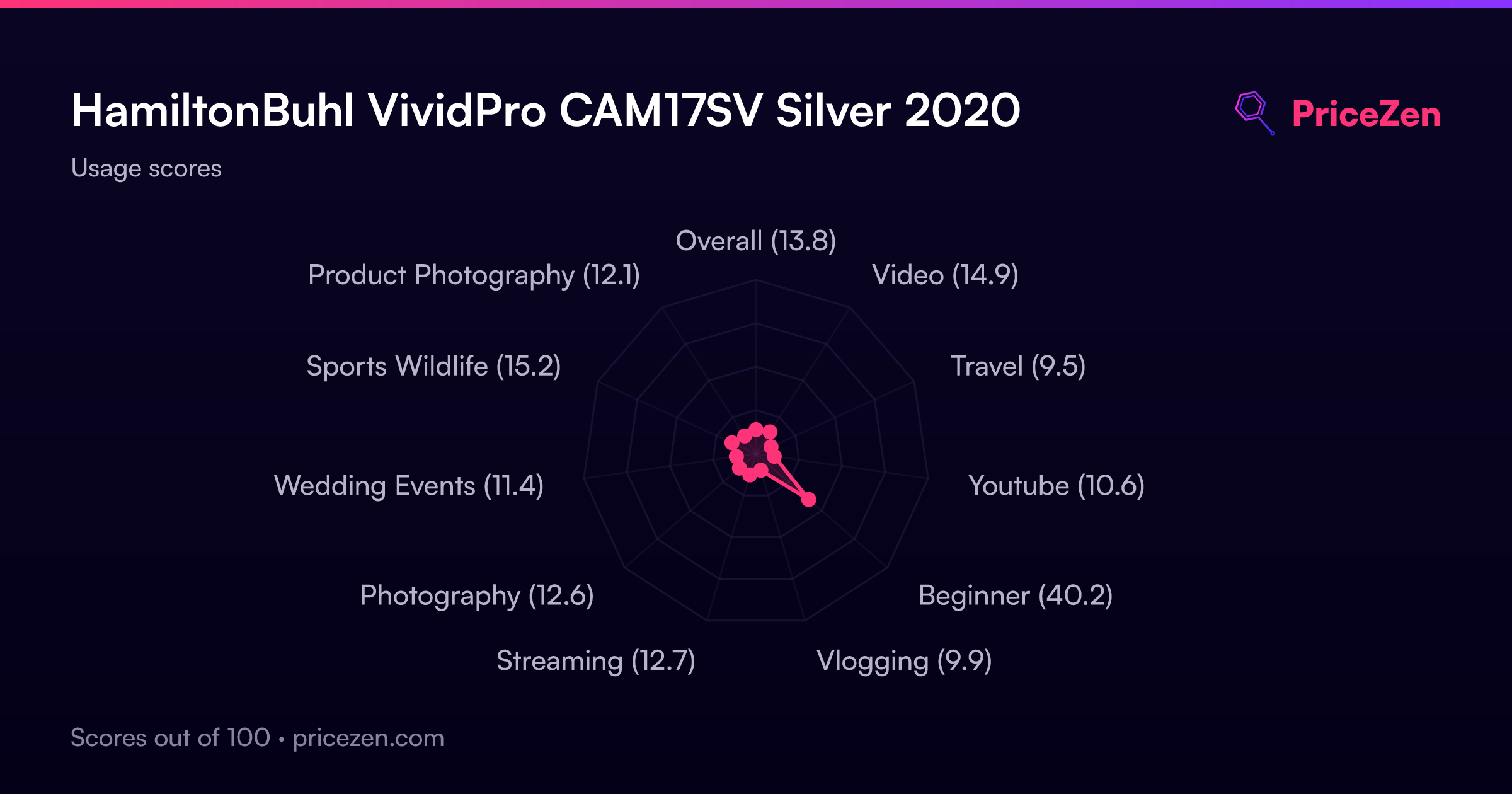
- Overall13.8
- Video14.9
- Travel9.5
- Youtube10.6
- Beginner40.2
- Vlogging9.9
- Streaming12.7
- Photography12.6
- Wedding Events11.4
- Sports Wildlife15.2
- Product Photography12.1