Samsung PM9C1 256GB PCIe 4.0 x4 NVMe M.2 2280
The PCIe 4.0 x4 interface delivers up to 4000 MB/s reads and 230K random read IOPS, with 256-bit AES encryption for data security. Its 4.2W active power draw and 50mW idle consumption make it efficient for laptops, backed by a 150 TBW endurance rating. Best for budget-conscious PC builders needing a reliable, compact boot drive for everyday tasks.

No current retailer price


Snapshot
The 30-Second Version
The Samsung PM9C1 is a solid budget boot drive with surprisingly good random performance (300K write IOPS) and strong 150 TBW endurance for its size. The catches are a 1300 MB/s write ceiling and just 256GB of space, which ranks near the bottom of the category. At USD 77 on Amazon it's fairly priced for what it does. Great for a cheap OS drive, wrong for gaming libraries or heavy creative work.
Pros & Cons
Pros
- 300K random write IOPS, well above average for the class 83rd
- 150 TBW endurance on a small drive, better than most we track 81st
- 4.2W active and 50mW idle keeps laptops cool and unplugged longer 80th
- 256-bit AES hardware encryption included at this price 79th
- Affordability ranks in the top 19% in our data
Cons
- 256GB capacity sits near the bottom of the category
- 1300 MB/s sequential write is the clear bottleneck
- OEM bulk packaging means no accessories at all
- Only 4 reviews behind the 4.7/5 rating, thin social proof
- 3-year OEM warranty rather than a longer retail term
The proof
Performance
Let's unpack the numbers, because they don't all point the same direction. The 4000 MB/s sequential read is fine for PCIe 4.0, not exciting. Our speed ranking puts this drive in the top 40%, so slightly above the middle of the field rather than anywhere near the front. The 1300 MB/s write is the real limiter: copy a big folder of video files or install a huge game and you'll be waiting noticeably longer than you would on a drive with a proper high-end write figure. But random performance is where it claws ground back. 230K read IOPS and 300K write IOPS land it in the top 17% for random work, which is well above average. Random IOPS is what governs how quickly Windows boots, how fast apps launch, and how the system behaves when a dozen background processes are all poking the disk at once. For an OS drive, that matters more than the headline sequential number.
Endurance and efficiency are quietly strong here. 150 TBW on a 256GB drive is a lot of writes relative to its size, and our endurance ranking has it in the top 20%, so better than most of what we track. Pair that with a 1,500,000 hour MTBF rating and a 3-year OEM warranty and you've got a part that's built to survive office duty. Power draw of 4.2W under load and 50mW idle is low enough that laptop battery life won't take a hit, and thermals shouldn't be dramatic in a cramped chassis. The trade-off is unavoidable though: all that efficiency and endurance is wrapped around 256GB. Our capacity ranking puts it in the bottom 19%, one of the smallest drives in the category. Fast-ish and durable doesn't help much when you run out of room.
Specifications
Full Specifications
Drive
| Capacity | 256 |
| Form Factor | M.2 2280 |
| Interface | PCIe 4.0 x4 |
| Protocol | NVMe |
| PCIe Generation | 4 |
| External | No |
Performance
| Sequential Read (MB/s) | 4000 |
| Sequential Write (MB/s) | 1300 |
| Random Read (IOPS) | 230000 |
| Random Write (IOPS) | 300000 |
Hardware
| NAND | TLC |
Reliability
| Endurance (TBW) | 150 |
| MTBF (hours) | 1500000 |
| Warranty (years) | 3 |
Features
| Hardware Encryption | Yes |
vs Competition
The competitive set here is genuinely tough. The Crucial T500, Western Digital Black SN850X, Corsair MP700 Elite, MSI SPATIUM M480 PRO and Kingston KC3000 are all names that come up when people want serious NVMe performance, and the PM9C1 isn't playing in that bracket. With a speed ranking in the top 40% and a 1300 MB/s write ceiling, it gives ground on raw throughput to anything aimed at enthusiasts. If you're editing video, moving large project files, or you just want the fastest thing your motherboard will accept, cross-shop the T500 and the SN850X first. Those are the drives people buy when write speed is the point.
Where the Samsung fights back is elsewhere. Its top 17% random performance means app launches and OS responsiveness are competitive even against pricier sticks, and its top 20% endurance rating with 150 TBW is a legitimately strong figure for a drive this small. The top 21% feature ranking reflects that AES encryption and NVMe 1.4 support aren't stripped out just because it's OEM. So the honest framing: against the KC3000 or the MP700 Elite you're trading peak speed for lower cost and lower power draw. Against nothing at all, meaning an old SATA drive or a spinning disk, this thing is a night-and-day upgrade. Also worth saying out loud: our console score for this drive is 29.5/100, its weakest area by far. Don't buy it thinking it'll solve a console storage problem.
| Spec | Samsung PM9C1 | Western Digital WD_BLACK SN8100 | Kingston FURY Renegade | Crucial T500 | SanDisk WD_BLACK | Seagate FireCuda 530R |
|---|---|---|---|---|---|---|
| Capacity | 256GB | 4TB | 4TB | 2TB | 8TB | 4TB |
| Form Factor | M.2 2280 | M.2 2280 | M.2 2280 | M.2 2280 | M.2 2280 | M.2 2280 |
| Interface | PCIe 4.0 x4 | PCIe 5.0 x4 | PCIe 4.0 x4 | PCIe 4.0 x4 | PCIe 5.0 x4 | PCIe 4.0 x4 |
| Seq Read | 4,000 MB/s | 14,900 MB/s | 7,300 MB/s | 7,400 MB/s | 14,900 MB/s | 7,400 MB/s |
| Nand Type | TLC | TLC | TLC | TLC | TLC | TLC |
| Dram Cache | - | No | Yes | Yes | Yes | No |
| Endurance | 150 TBW | 2400 TBW | 4000 TBW | 1200 TBW | 4800 TBW | 5050 TBW |
| Compare | Compare | Compare | Compare | Compare |
| Product | Speed | Random | Feature | Capacity | Endurance | Social Proof | Affordability |
|---|---|---|---|---|---|---|---|
| Samsung PM9C1 | 60.1 | 83.3 | 79.4 | 19.9 | 80.3 | 14.4 | 80.5 |
| Western Digital WD_BLACK SN8100 Compare | 99.7 | 99.6 | 86.4 | 91.8 | 80.7 | 94.9 | 9.4 |
| Kingston FURY Renegade Compare | 93.6 | 94.7 | 94.3 | 91.8 | 94.1 | 94.9 | 12.1 |
| Crucial T500 Compare | 94.1 | 97.1 | 99 | 78.5 | 82.9 | 94.9 | 18.9 |
| SanDisk WD_BLACK Compare | 99.1 | 99.4 | 97.7 | 97.2 | 80.7 | 39.9 | 3.7 |
| Seagate FireCuda 530R Compare | 93.1 | 96.9 | 54.2 | 91.8 | 95.7 | 85.7 | 8.4 |
Price
Value & Pricing
At USD 77 on Amazon, this is priced like a budget part, and our affordability ranking of 81 backs that up. We also track a Canadian listing at CAD 130, and those two amounts live in different currencies so don't try to line them up directly. Within the US market there's currently one listing in our data, so there's no store-hopping arbitrage to chase here. What you're paying for is a decent controller, TLC NAND rather than cheaper QLC, hardware encryption, and endurance that punches above the capacity. That's a reasonable bundle for seventy-seven bucks.
But value is relative to what you need. If 256GB covers your use case, this is a smart buy and the price-to-performance math works. If you need half a terabyte or more, the per-gigabyte story falls apart fast and you'd be better off spending more once than buying twice. Our budget score of 71.4/100 is the highest thing on this drive's report card for a reason: it's a good cheap drive, not a cheap good drive. Know which one you're shopping for.
Read more
Overview
The Samsung PM9C1 MZVL8256HEJD is one of those drives you find when you're digging through OEM listings instead of the shiny retail boxes. It's a 256GB M.2 2280 stick running PCIe 4.0 x4 with NVMe 1.4, built on TLC 3D-NAND, and it ships loose. No box, no screws, no heatsink, no manual. Just the drive. That's not a flaw, it's the whole business model: this is the part Samsung sells to laptop and desktop builders, and it ends up on Amazon for people who already know what an M-Key slot looks like.
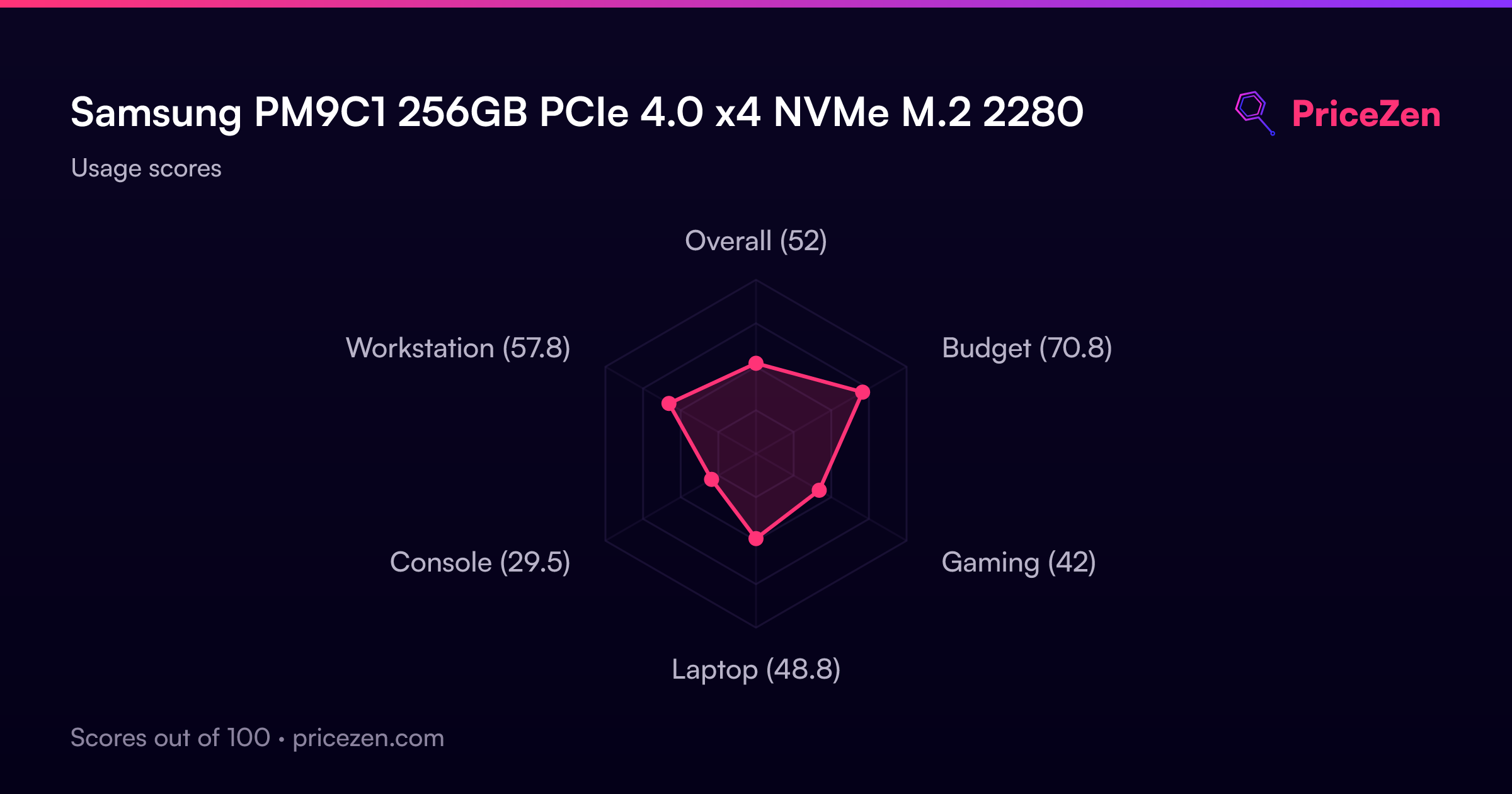
So who's it for? Honestly, someone putting together a cheap boot drive, refreshing an older office machine, or building a small secondary system where 256GB is genuinely enough. Our scoring model gives it 71.4/100 for budget builds and only 57.8/100 for workstation duty, which tells you pretty clearly where it sits. The overall score lands at 52.1/100, dead center of the pack for internal SSDs. This isn't a drive that wins arguments. It's a drive that quietly does a job for not much money.
What makes it interesting is the shape of its spec sheet. Reads up to 4000 MB/s are respectable, writes cap out at 1300 MB/s, and yet random write IOPS hit 300K against 230K for reads. That's an unusual split, and it means the drive feels snappier in day-to-day small-file work than its sequential write number suggests. Add 256-bit AES hardware encryption, 4.2W active draw and 50mW idle, and you've got a genuinely tidy little OEM part. The catch is right there in the capacity line, and we'll get to it.
Common Questions
Q: Is 256GB enough for a main drive?
For a lot of people, no. Our capacity ranking puts this drive in the bottom 19%, meaning it's among the smallest SSDs we track, and a modern Windows install plus a handful of applications eats into that quickly. It works well as a dedicated boot drive with your files living elsewhere, or in a light-use machine, but if you install games or work with media you'll outgrow it fast.
Q: Will this work in my laptop or desktop?
It's a standard M.2 2280 M-Key drive using PCIe 4.0 x4 and NVMe 1.4, measuring 80 x 22 x 2.4 mm, so it fits the vast majority of modern M.2 slots. It'll also negotiate down in older PCIe 3.0 systems, though you won't see the full 4000 MB/s read there. Just remember it ships OEM bulk with no mounting screw or heatsink, so have those on hand.
Q: Why is the write speed so much lower than the read speed?
That's typical for small-capacity drives, since fewer NAND packages means less parallelism to write across. Here it's 4000 MB/s read against 1300 MB/s write, which is why our speed ranking sits in the top 40% despite strong random figures. Interestingly the random write IOPS of 300K actually exceed the 230K read figure, so small-file work stays snappy even though big transfers drag.
Q: Is the OEM warranty a problem?
You get a 3-year OEM warranty rather than the longer terms retail drives often carry, and support goes through the seller rather than a consumer retail channel. The underlying hardware is rated for 150 TBW and 1,500,000 hours MTBF, which is better than most drives in our endurance ranking, so failure risk isn't the concern. It's more about who you call if something goes wrong.
Who Should Skip This
Gamers with big libraries should walk away immediately. 256GB holds a couple of modern titles and nothing else, and the 1300 MB/s write speed means installing and updating those titles is slower than it needs to be. Same story for video editors, photographers working with RAW batches, anyone running virtual machines, or anyone who hoards files locally. Our workstation score of 57.8/100 says it plainly: this isn't a working drive. Look at the Crucial T500, Western Digital Black SN850X or Kingston KC3000 instead, and buy a bigger capacity than this while you're at it.
Console owners should skip it too. Our console score for this drive is 29.5/100, the weakest number on its entire scorecard, so it's not the answer to expanding console storage. And if you're the kind of buyer who wants a retail box, a bundled heatsink, mounting hardware and a straightforward consumer warranty experience, the OEM bulk packaging here will annoy you from the moment the envelope arrives. There's nothing wrong with the drive, it's just sold as a component rather than a product, and that distinction matters more than people expect.
Verdict
If you're building or refreshing a budget machine and 256GB genuinely fits your life, buy it. A boot drive for a home office PC, a Linux box, a lightweight laptop upgrade, a secondary system that mostly runs a browser and a few apps: the PM9C1 handles all of that well. The random IOPS figures mean it'll feel responsive, the 4.2W draw and 50mW idle mean it won't cook a thin laptop, and 150 TBW means you're unlikely to wear it out doing normal work. At USD 77 with TLC NAND and hardware encryption, that's a sensible purchase and our 71.4/100 budget score agrees.
If you're doing anything heavier, look elsewhere. Our workstation score of 57.8/100 is middling, and the 1300 MB/s write plus 256GB capacity is a bad combination for creative work, large game libraries, or virtual machines. You'll fill it in a weekend and then spend every day after that fighting the write speed. For those jobs, step up to one of the enthusiast drives in the comparison list and buy more capacity than you think you need. And if you want a retail box with accessories and a proper consumer warranty path, this OEM listing simply isn't that product. Buy it knowing exactly what it is and you'll be happy. Buy it hoping it's something else and you won't.
Usage Scores
- Overall52
- Budget70.8
- Gaming42
- Laptop48.8
- Console29.5
- Workstation57.8