Timetec 960GB SSD PCIe 3.0 x4 NVMe M.2 22110
The 960GB M.2 22110 PCIe 3.0 x4 NVMe drive with 3D TLC NAND delivers 1,700MB/s reads and 750MB/s writes, backed by a 1367 TBW endurance rating. Its 110mm length fits only M.2 22110 slots, so check your motherboard manual for compatibility with NVMe and M-key support. Best for budget-conscious desktop builders doing heavy 3D animation, rendering, or video and photo editing who need high endurance at a low cost.










Snapshot
The 30-Second Version
The Timetec TS256GML4C is a 960GB endurance monster wrapped in an awkward body: 1367 TBW on TLC NAND, but a 110mm 22110 form factor that most machines can't fit. Speeds are mid-pack at 1,700/750 MB/s on PCIe 3.0. At USD 100 it's excellent value for write-heavy workstation use, and a poor pick for laptops, consoles or speed chasers. Check your motherboard manual first, seriously.
Pros & Cons
Pros
- Endurance is a standout: 1367 TBW at 1.3 DWPD, near the top of our rankings 94th
- TLC NAND, not the cheaper QLC found in many budget drives 71st
- 460,000 random read IOPS keeps everyday workloads feeling responsive
- Strong budget score of 80.3/100 in our model
- 960GB capacity at USD 100 is decent money-per-gig
Cons
- M.2 22110 (110mm) won't fit most laptops or standard 2280 slots
- 750 MB/s sequential writes trail much of the current field
- PCIe 3.0 x4 caps peak speeds well below newer-gen drives
- No B notch and M-key only, so SATA M.2 slots are a hard no
- Console suitability scores just 23.7/100, our weakest area for this drive
The proof
Performance
Let's unpack the numbers, because they tell two very different stories. Sequential throughput is 1,700 MB/s read and 750 MB/s write over PCIe Gen3 x4. For loading games, opening big project files or copying media around, that's perfectly usable, but it sits mid-pack against the current field of drives we compare. The write figure is the softer one: sustained large file transfers will lean on that 750 MB/s ceiling, so if you regularly move huge video files, you'll notice the pace. Random performance is more encouraging at 460,000 read IOPS and 60,000 write IOPS, which ranks above the midpoint in our data. High random read IOPS is what makes an OS and app-heavy workload feel snappy, lots of small scattered reads rather than one big stream.
The headline is endurance, full stop. 1367 TBW means you could write the drive's entire 960GB capacity roughly 1.3 times every day and still be inside the rated lifespan. In our rankings that's a standout, comfortably ahead of almost everything else in the category. Pair that with TLC NAND rather than cheaper QLC and you get a drive built to absorb punishment. The catch is that all this stamina arrives on a Gen3 interface, so the workloads that benefit most are write-heavy, steady-state jobs, not people chasing peak benchmark bragging rights. Our scoring reflects the split: budget value scores 80.3 out of 100, while the overall total sits at 55.8. Great at its job, just a specific job.
Specifications
Full Specifications
Drive
| Capacity | 960 |
| Form Factor | M.2 22110 |
| Interface | PCIe 3.0 x4 |
| Protocol | NVMe |
| PCIe Generation | 3 |
| External | No |
Hardware
| NAND | TLC |
Reliability
| Endurance (TBW) | 1367 |
vs Competition
Cross-shopping this against the WD_BLACK SN8100, Samsung 9100 PRO or Crucial T500 is a bit like comparing a delivery van to race cars. Those drives sit at the top of the enthusiast pile, and the Timetec gives ground to all of them on outright speed: its Gen3 x4 interface and mid-pack speed ranking mean it simply isn't playing the peak-throughput game. If your priority is the fastest possible load times or bleeding-edge sequential numbers, the Corsair MP700 Elite and MSI SPATIUM M480 PRO are also names to look at before settling here. The Timetec's counterargument is stamina and cost, where its endurance ranking near the top of the charts does the talking.
Where it wins is a narrower lane. Against that whole competitor set, the pitch is simple: a 1367 TBW rating on TLC NAND at USD 100, in a form factor aimed at boards that support 22110 modules. If you're running constant write workloads, render output, capture files, VM images, the endurance gap matters more than the speed gap, because a drive that wears out is slower than any drive that doesn't. But be honest with yourself about the workload. For a general-purpose gaming or everyday desktop build, the Crucial T500 or Samsung 9100 PRO are the more natural cross-shops, and the Timetec only makes sense if the write-heavy use case is real, not hypothetical.
| Spec | Timetec 960GB SSD | Samsung 9100 PRO | Kingston KC3000 | Crucial T700 | Western Digital WD_BLACK SN8100 | Team Group MP44 |
|---|---|---|---|---|---|---|
| Capacity | 960GB | 2TB | 2TB | 2TB | 1TB | 4TB |
| Form Factor | M.2 22110 | M.2 2280 | M.2 2280 | M.2 2280 | M.2 2280 | M.2 2280 |
| Interface | PCIe 3.0 x4 | PCIe 5.0 x4 | PCIe 4.0 x4 | PCIe 5.0 x4 | PCIe 5.0 x4 | PCIe 4.0 x4 |
| Seq Read | - | 14,700 MB/s | 7,000 MB/s | 12,400 MB/s | 14,900 MB/s | 7,400 MB/s |
| Nand Type | TLC | TLC | TLC | TLC | TLC | TLC |
| Dram Cache | - | Yes | Yes | Yes | Yes | No |
| Endurance | 1367 TBW | 1200 TBW | 1600 TBW | 1200 TBW | 600 TBW | 2000 TBW |
| Compare | Compare | Compare | Compare | Compare |
| Product | Speed | Random | Feature | Capacity | Endurance | Affordability |
|---|---|---|---|---|---|---|
| Timetec 960GB SSD | 53.9 | 62.3 | 54.3 | 43.9 | 93.8 | 71.1 |
| Samsung 9100 PRO Compare | 98.9 | 99.8 | 99.8 | 78.4 | 85.9 | 23.9 |
| Kingston KC3000 Compare | 89 | 94.7 | 94.3 | 78.4 | 93 | 27.1 |
| Crucial T700 Compare | 96.8 | 97.7 | 97.7 | 78.4 | 82.9 | 25.5 |
| Western Digital WD_BLACK SN8100 Compare | 97.9 | 98.7 | 99.8 | 56.6 | 80.7 | 38.8 |
| Team Group MP44 Compare | 93.8 | 89.2 | 54.3 | 91.7 | 77.1 | 17.1 |
Price
Value & Pricing
At USD 100 from Amazon, the price-to-endurance math here is genuinely good. You're getting a 1367 TBW rating and TLC NAND for what most brands charge for consumer-grade drives with a fraction of that write tolerance. Our budget score of 80.3 out of 100 reflects that: if longevity is your priority, this is a lot of drive for the money. Affordability ranks solidly above average across the category too, though not at the bargain-bin extreme.
Pricing gets messier outside the US. We track EUR listings between EUR 128 and EUR 170 across three European stores, a EUR 42 spread that's worth shopping around for, since the top of that range eats into the value story considerably. UK buyers see GBP 97 and Brazilian listings sit at BRL 612. If you're in Europe, check multiple sellers before pulling the trigger. The difference between the low and high listing is real money for the exact same hardware.
Amazon 1 offer From €170
We started tracking prices for this product on Nov 25, 2026. The chart appears once we have more data.
Read more
Overview
The Timetec TS256GML4C is a 960GB NVMe SSD that looks like it wandered in from a server room and decided to try civilian life. The giveaway is the shape: this is an M.2 22110 drive, 110mm long instead of the usual 80mm, with an M-key edge connector and no B notch. That's enterprise-style hardware, and it comes with enterprise-style stamina. The rated endurance is 1367 TBW at 1.3 drive writes per day, which puts it in the top tier of every drive we track for write longevity.
So who's this actually for? Someone with a desktop board or workstation that explicitly supports 110mm M.2 modules, who writes a lot of data and doesn't want to think about wear levels for years. Think scratch disks for video projects, render caches, VM storage, that kind of workload. The spec sheet leans into exactly that, calling out 3D animation, rendering and video or photo editing as the target jobs. And honestly, the endurance rating backs up the pitch.
What makes it interesting is the split personality. On durability it's one of the best on the market. On raw speed it's... fine. PCIe 3.0 x4 with 1,700 MB/s reads and 750 MB/s writes lands it right around the middle of our speed rankings. You're buying a tank, not a sports car. Whether that trade works for you depends entirely on what you plan to do with it, and whether your motherboard can physically swallow the thing.
Common Questions
Q: Will this fit in my laptop or motherboard?
Only if the M.2 slot explicitly supports 110mm (22110) modules with PCIe NVMe and an M-key connector. This drive measures 110mm x 22mm x 4mm, which is 30mm longer than the common 2280 size, and it has no B notch, so SATA-only M.2 slots won't work at all. Check your motherboard manual before ordering, because our laptop suitability score of 57.2 reflects exactly this compatibility gamble.
Q: Is it fast enough for gaming and everyday use?
Yes, with caveats. The 1,700 MB/s reads and 460,000 random read IOPS handle game loads and general desktop work fine, sitting around the middle of our speed rankings. But 750 MB/s writes lag behind much of the current field, so big file transfers won't impress anyone. It's adequate, not exciting.
Q: Can I use this in a PS5 or other console?
We'd skip it. Console suitability is this drive's weakest area in our scoring at 23.7 out of 100, and the 22110 length plus Gen3 interface make it a poor match for console storage expansion. Look at drives built for that job instead.
Q: How long will it actually last?
On paper, a very long time for normal use. The 1367 TBW rating at 1.3 drive writes per day ranks among the best we track, meaning you'd need to write close to a terabyte every single day to approach the rated limit. Combined with TLC NAND, this is the drive's strongest selling point by a wide margin.
Who Should Skip This
Laptop owners, console upgraders and anyone whose motherboard only takes standard 2280 drives should walk away immediately. The 110mm length is a physical dealbreaker, not a workaround situation, and the M-key-only connector rules out SATA M.2 slots entirely. If you're expanding PS5 storage, the 23.7/100 console score says everything: this isn't the drive for that.
Speed-first buyers should skip it too. If you want the quickest game loads or fastest file transfers you can get, the mid-pack Gen3 performance will leave you wishing you'd bought a Crucial T500 or Samsung 9100 PRO instead. And if your writing habits are ordinary, browsing, gaming, occasional downloads, you're paying in speed and compatibility for endurance you'll never touch. This drive rewards a specific buyer. Make sure that's you.
Verdict
If you've confirmed your motherboard takes 110mm M.2 NVMe modules and you hammer your storage with writes, this is a smart buy. Video editors dumping project files daily, anyone running VMs or render caches, homelab folks who want endurance without enterprise pricing: the 1367 TBW rating and strong budget score make a genuinely compelling case. Buy it for what it is, a durable workhorse, and it should serve you well for a very long time.
For everyone else, we'd point you elsewhere. A typical gaming or office PC doesn't need this much write tolerance, and the mid-pack speed plus awkward 22110 length mean you're accepting compromises for a benefit you'll never use. Our overall score of 55.8 out of 100 captures it fairly: this is a specialist tool that scores brilliantly in its niche and averagely everywhere else. Match the tool to the job and it's great. Buy it as a general-purpose upgrade and you'll wonder why your new SSD is slower than your friend's.
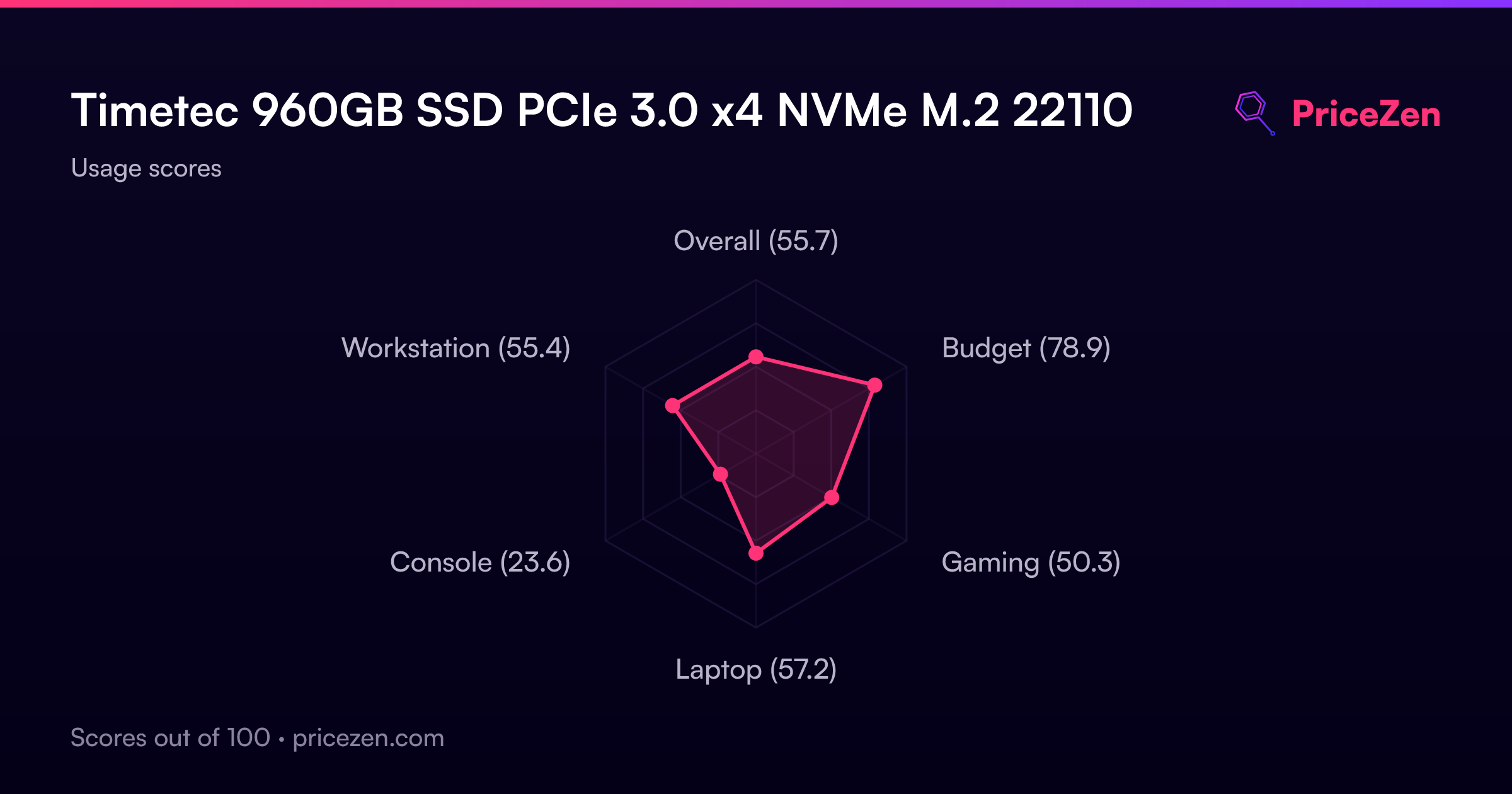
Usage Scores
- Overall55.7
- Budget78.9
- Gaming50.3
- Laptop57.2
- Console23.6
- Workstation55.4