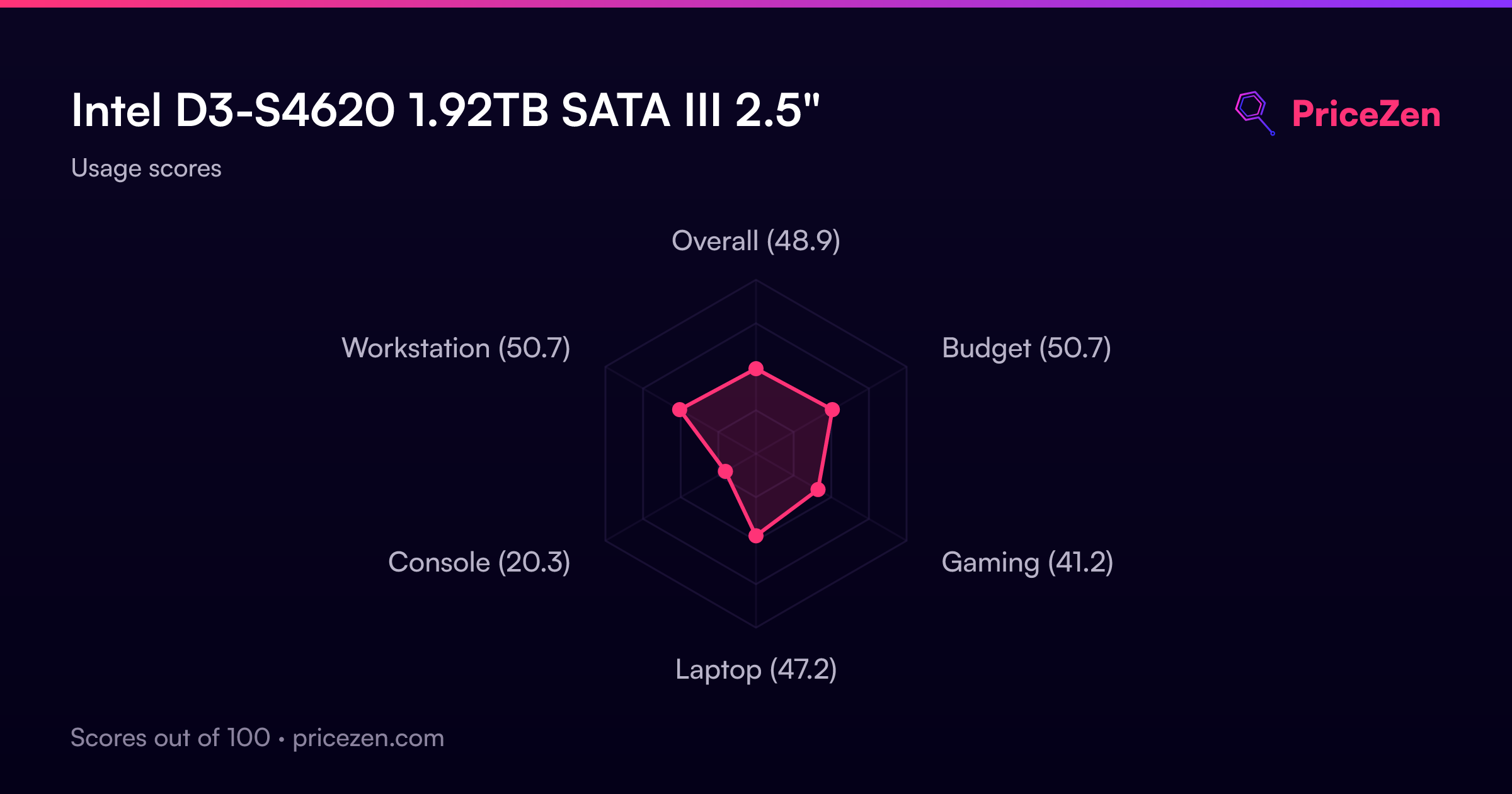
Intel D3-S4620 1.92TB SATA III 2.5"
The 1.92TB capacity with 550 MB/s read and 510 MB/s write speeds over SATA/600 delivers reliable bulk storage for large file libraries. Hardware encryption with 256-bit encoding protects data from theft, backed by a 5-year warranty and 2,000,000 h MTBF. Best for workstation users needing secure, high-capacity archival storage rather than top-tier performance.

No current retailer price











Snapshot
The 30-Second Version
The Intel D3-S4620 is a 1.92TB SATA SSD built for endurance, not speed. It tops out at 550 MB/s reads, which is fine for SATA but slow by modern standards. The 2 million hour MTBF and 5-year warranty are impressive, but the $1,463 to $1,475 price tag is hard to swallow. Buy it for SATA-only servers or workstations where reliability matters more than performance, otherwise look at NVMe alternatives.
Pros & Cons
Pros
- 1.92TB capacity is plenty for OS, VMs, or media storage 79th
- 2 million hour MTBF and 5-year warranty signal serious longevity 69th
- 256-bit AES hardware encryption for data security
- SATA III compatibility works with older systems and servers
- Low power draw at 3.3W active and 1.2W idle
Cons
- 550 MB/s reads are slow by modern standards, 32nd percentile for speed
- Random performance is weak at 23rd percentile
- Pricing is brutal, 8th percentile for affordability
- SATA interface limits it to legacy or budget systems
- No customer reviews available to verify real-world reliability
The proof
Performance
Let's talk numbers. The D3-S4620 tops out at 550 MB/s sequential reads and 510 MB/s writes. That's basically the ceiling for SATA III, so Intel isn't leaving anything on the table there. But here's the thing: in our database, that puts it in the 32nd percentile for speed. Most modern NVMe drives are running circles around it with 5,000 to 7,000 MB/s reads. If you're coming from an older SATA SSD, this will feel fine. If you've used anything NVMe in the last three years, it'll feel like going back to dial-up.
Random performance is where it really shows its age. The 23rd percentile ranking for random operations means this drive struggles with the small, scattered reads and writes that make up most everyday computing. Booting an OS, launching apps, loading game levels, all of that is going to feel noticeably slower than even a budget NVMe drive. The TLC NAND is fine for what it is, but SATA's 6 Gbps ceiling is a hard wall. For sequential file transfers, like moving large video files or backups, it'll do the job at a steady clip. Just don't expect it to feel snappy under mixed workloads.
Specifications
Full Specifications
Drive
| Capacity | 1920 |
| Form Factor | 2.5" |
| Interface | SATA III |
| Protocol | SATA |
| External | No |
Performance
| Sequential Read (MB/s) | 550 |
| Sequential Write (MB/s) | 510 |
Hardware
| NAND | TLC |
Reliability
| MTBF (hours) | 2000000 |
| Warranty (years) | 5 |
Features
| Hardware Encryption | Yes |
vs Competition
Stacked against the competition, the D3-S4620 is fighting a different battle. The Samsung 9100 PRO and WD_BLACK SN850X are NVMe drives that absolutely demolish this Intel in every speed metric. We're talking 10x the sequential throughput and random performance that's in a completely different league. The Kingston FURY Renegade G5 and Crucial T700 are similarly fast, and all of them cost less than what this Intel is listed for. If you have an M.2 slot available, there's almost no reason to choose the D3-S4620 over any of these.
Where the Intel makes its stand is in the SATA ecosystem. If you're working with an older motherboard, a server with only SATA bays, or a NAS that needs 2.5" drives, those NVMe competitors simply won't fit. The Seagate FireCuda 530R is another NVMe option that's faster and cheaper, but again, it's not SATA. So the D3-S4620 isn't competing on speed, it's competing on compatibility and endurance. The 2 million hour MTBF and 5-year warranty are enterprise numbers, and that's the niche Intel is targeting. It's a narrow niche, but it exists.
| Spec | Intel D3-S4620 | Samsung 9100 PRO | Western Digital WD_BLACK SN850X | SanDisk WD_BLACK | Solidigm D7-PS1010 | Micron 7450 PRO |
|---|---|---|---|---|---|---|
| Capacity | 1.92TB | 8TB | 8TB | 8TB | 7.68TB | 3.84TB |
| Form Factor | 2.5" | M.2 2280 | M.2 2280 | M.2 2280 | U.2 | M.2 22110 |
| Interface | SATA III | PCIe 5.0 x4 | PCIe 4.0 x4 | PCIe 5.0 x4 | PCIe 5.0 x4 | PCIe 4.0 x4 |
| Seq Read | 550 MB/s | 14,800 MB/s | 7,200 MB/s | 14,900 MB/s | 13,000 MB/s | 5,000 MB/s |
| Nand Type | TLC | TLC | TLC | TLC | TLC | TLC |
| Dram Cache | - | true | true | true | true | - |
| Endurance | - | 4800 TBW | 4800 TBW | 4800 TBW | - | 25700 TBW |
| Compare | Compare | Compare | Compare | Compare |
| Product | Speed | Random | Feature | Capacity | Endurance | Affordability |
|---|---|---|---|---|---|---|
| Intel D3-S4620 | 33.1 | 23.5 | 78.7 | 69.3 | 64.9 | 8.1 |
| Samsung 9100 PRO Compare | 99.2 | 99.8 | 99.8 | 98 | 85.6 | 2 |
| Western Digital WD_BLACK SN850X Compare | 87.7 | 96.5 | 94.1 | 98 | 88 | 4.1 |
| SanDisk WD_BLACK Compare | 99.1 | 99.3 | 97.6 | 98 | 80.4 | 3.3 |
| Solidigm D7-PS1010 Compare | 96.5 | 81 | 97.6 | 97 | 65.7 | 3.1 |
| Micron 7450 PRO Compare | 66.7 | 85.5 | 78.7 | 88 | 99.6 | 1.1 |
Price
Value & Pricing
This is where things get uncomfortable. The D3-S4620 sits in the 8th percentile for affordability, which is our polite way of saying it's one of the most expensive SATA drives we've tracked. In the US, you're looking at $1,463 to $1,475. Over in Europe, the spread is even wider, EUR 2,537 to EUR 3,117 depending on which retailer you hit. That's a huge range, and if you're shopping in Europe, it pays to check the German, Spanish, and French listings carefully before you commit.
For that kind of money, you could buy a top-tier 4TB NVMe drive and still have cash left over for lunch. The Samsung 9100 PRO, Kingston FURY Renegade G5, and WD_BLACK SN850X all deliver dramatically better performance at similar or lower price points. What you're paying for here is the enterprise-grade endurance and the Intel name on the label. If you need that reliability story for a business or a server that can't go down, the premium might be justified. For everyone else, it's a tough sell.
We started tracking prices for this product on Nov 15, 2026. The chart appears once we have more data.
Read more
Overview
The Intel D3-S4620 is one of those drives that makes you do a double take. It's a 1.92TB SATA SSD in a world that's gone all-in on NVMe, and the price tag looks like it wandered in from a server room budget meeting. But there's a reason this thing exists, and it's not for people chasing benchmark glory. This is a drive built for endurance, reliability, and the kind of boring, predictable performance that keeps a workstation or small server humming along for years.
Who's this actually for? If you're running a home lab, a NAS that needs a boot drive, or an older workstation that still relies on SATA, this drive makes a lot of sense. The 2 million hour MTBF and 5-year warranty tell you Intel expects this thing to outlive most of the hardware it gets installed in. And at 1.92TB, you've got enough room for a serious OS install, a pile of VMs, or a decent chunk of a media library.
The catch is the price. We're seeing this listed anywhere from $1,463 to $1,475 in the US, and EUR 2,537 to EUR 3,117 across European retailers. That's enterprise money for what is, at the end of the day, a SATA drive with 550 MB/s reads. You're paying for the reliability story, not the speed story. Whether that trade-off makes sense depends entirely on what you're planning to do with it.
Common Questions
Q: Is this drive compatible with my older desktop or laptop?
If your system has a standard 2.5-inch SATA bay and a SATA III port, yes. The D3-S4620 uses the SATA III interface, which is backward compatible with SATA II and SATA I, though you'll see reduced speeds on older controllers. It's a drop-in replacement for any 2.5-inch SATA drive, so it works in most desktops, laptops, and servers from the last decade or so.
Q: Why is this drive so expensive compared to other SATA SSDs?
You're paying for the enterprise-grade endurance and reliability ratings. The 2 million hour MTBF and 5-year warranty are significantly better than what you'll find on consumer SATA drives, which typically offer 1.5 million hours MTBF and 3-year warranties. Intel also includes 256-bit AES hardware encryption, which adds cost. Whether that premium is worth it depends on whether you need that level of reliability for a server or business-critical system.
Q: Can I use this drive in a NAS or server?
Yes, and that's actually one of the better use cases for it. The 2.5-inch form factor fits standard NAS bays, and the high endurance rating means it can handle the constant read/write cycles that NAS and server workloads generate. The low power draw (3.3W active, 1.2W idle) is also a plus for systems that run 24/7. Just keep in mind that SATA speeds will limit performance in multi-drive RAID configurations compared to NVMe alternatives.
Q: How does the hardware encryption work?
The D3-S4620 includes 256-bit AES hardware encryption, which means the encryption and decryption happen on the drive itself rather than using your CPU. This is transparent to the operating system and doesn't impact performance. It's useful for protecting data at rest, especially in business or shared environments. You'll need to set up a password or key through your system's BIOS or a management tool to actually use it.
Who Should Skip This
If you're building a gaming PC, a general-purpose desktop, or upgrading a laptop that has an M.2 slot, skip this drive entirely. The SATA interface caps performance at 550 MB/s, and the random performance is weak enough that everyday tasks will feel sluggish compared to even budget NVMe drives. You'd be paying a premium for endurance you'll never need and speed you'll definitely notice is missing. Look at the Samsung 9100 PRO, WD_BLACK SN850X, or Crucial T700 instead, all of which are faster and cheaper.
Also skip it if you're on a budget. The 8th percentile affordability ranking isn't a fluke. At $1,463 to $1,475, you can buy a 4TB NVMe drive or two 2TB SATA drives from other brands for the same money. Unless you specifically need the enterprise endurance ratings and hardware encryption for a business or server deployment, there are far better values out there.
Verdict
If you're running a home lab, a small business server, or any SATA-only system where uptime matters more than raw speed, the D3-S4620 is a solid choice. The 1.92TB capacity gives you room to work, the endurance ratings are genuinely impressive, and the hardware encryption is a nice bonus for sensitive data. You'll get reliable, predictable performance for years, and the 5-year warranty means Intel is betting on it lasting even longer.
For everyone else, this drive is hard to recommend. The price is simply too high for what you get. A $100 NVMe drive will run circles around it in everyday use, and even a mid-range SATA SSD from Crucial or Samsung will deliver similar real-world performance for a fraction of the cost. The D3-S4620 is a specialist tool for a specific job. If that job isn't yours, save your money and buy something faster.
Usage Scores
- Overall49.7
- Budget52
- Gaming41.6
- Laptop48.3
- Console20.7
- Portable13.2
- Workstation51.2