ASUS GeForce RTX 4070 Prime OC 12GB GDDR6X
The Ada Lovelace architecture and 12GB of GDDR6X memory deliver strong 1440p gaming with DLSS 3 and full ray tracing, all within a compact 2.5-slot, 300mm design. Its triple Axial-tech fan cooler with 0dB technology enables silent operation during light loads, making it a rare SFF-Ready card that doesn't sacrifice acoustics. This GPU is best for small-form-factor builders seeking high-refresh 1440p performance without compromising on noise or case compatibility.

No current retailer price











Snapshot
The 30-Second Version
The ASUS Prime RTX 4070 OC scores 26,881 in PassMark and keeps thermals in the 92nd percentile with its triple-fan cooler. Gaming performance is solid at 1440p with a 76.5 score, but AI workloads are weak at 48.3. You're paying a premium for excellent cooling and SFF compatibility rather than raw performance.
Pros & Cons
Pros
- Thermals in the 92nd percentile thanks to the triple-fan axial-tech cooler 92nd
- 200W TDP delivers efficiency in the 90th percentile 90th
- DLSS 3 support with 4th gen Tensor Cores 89th
- 2.5-slot design fits small form factor builds 73rd
- 0dB mode keeps fans off during light gaming
Cons
- AI performance scores just 48.3 out of 100
- Connectivity sits in the 34th percentile with only 1 DP and 1 HDMI
- Affordability ranks in the 23rd percentile
- 12GB VRAM on a 128-bit bus limits 4K future-proofing
- Ray tracing performance is middle of the pack at 72 out of 100
What owners think
The Word on the Street
The proof
Performance
The 26,881 PassMark score puts this card in the 74th percentile for raster performance, which translates to well above average but not chart-topping. In real terms, you're looking at smooth 1440p gaming with headroom for high refresh rates in most titles. The 2,550MHz boost clock and 4,608 CUDA cores do the heavy lifting, and DLSS 3 support means you can push frame rates higher in supported games without tanking image quality.
Ray tracing lands at 72 out of 100, which is decent but not exceptional. The 3rd gen RT cores help, but this isn't a card that'll max out Cyberpunk with path tracing at 4K. Where this card genuinely shines is efficiency and thermals. The 200W TDP is modest for this performance tier, and the triple-fan axial-tech design keeps temperatures in the 92nd percentile. That's the kind of thermal headroom that keeps boost clocks stable during long sessions.
Specifications
Full Specifications
Chipset
| GPU Chipset | GeForce RTX 4070 |
| Brand | NVIDIA |
| Architecture | Ada Lovelace |
| Class | consumer |
| Process | 5 |
Memory
| VRAM | 12 GB |
| Memory Type | GDDR6X |
| Memory Bus | 128 |
| Bandwidth | 480 |
Compute
| CUDA Cores | 4608 |
| Tensor Cores | 4 |
| RT Cores | 3 |
| Base Clock | 2550 |
| Boost Clock | 2550 |
| FP16 TFLOPS | 29.15 |
| FP32 TFLOPS | 29.15 |
Performance
| PassMark G3D | 26881 |
| GPU Compute | 14631 |
Power & Cooling
| TDP | 200 |
| Recommended PSU | 550 |
| Power Connectors | 1 x 16-pin |
| Cooler | Triple Fan |
| Fans | 3 |
Connectivity
| Interface | PCI Express 4.0 x16 |
| DisplayPort | 1 |
| HDMI | 1 |
| Max Resolution | 7680 x 4320 |
Physical
| Length | 300 |
| Slot Width | 2.5 |
| Form Factor | SFF |
Features
| Ray Tracing | Yes |
| Upscaling | DLSS 3 |
| AV1 Encode | Yes |
| VR Ready | Yes |
| DirectX | 12 Ultimate |
| RGB | No |
vs Competition
Against the MSI Ventus RTX 5070 Ti, this card gives up significant raw performance, the 5070 Ti has more VRAM, more bandwidth, and newer architecture. The Gigabyte AORUS RTX 5080 is in a completely different performance class. But here's the thing: those cards are also more expensive and physically larger. The Prime RTX 4070 OC's 2.5-slot, 300mm length makes it one of the few cards in this performance bracket that fits in compact builds. The Sapphire NITRO+ and ZOTAC SOLID OC are also strong competitors, but they're aimed at different use cases. If you need a card that balances decent 1440p performance with excellent thermals and small form factor compatibility, this ASUS model carves out a real niche.
| Spec | ASUS GeForce RTX 4070 Prime OC | Gigabyte GeForce RTX 5070 Ti Eagle Ice | MSI GeForce RTX 5070 Ti Ventus 3X OC | ZOTAC GeForce RTX 5080 APOCALYPSE | Sapphire Radeon RX 7900 XTX NITRO+ | PNY GeForce RTX 5080 ARGB OC |
|---|---|---|---|---|---|---|
| Chipset | GeForce RTX 4070 | GeForce RTX 5070 Ti | GeForce RTX 5070 Ti | GeForce RTX 5080 | Radeon RX 7900 XTX | GeForce RTX 5080 |
| Vram | 12GB GDDR6X | 16GB GDDR7 | 16GB GDDR7 | 16GB GDDR7 | 24GB GDDR6 | 16GB GDDR7 |
| Boost Clock Mhz | 2550 | 2542 | 2482 | 2730 | 2680 | 2620 |
| Tdp W | 200 | 300 | 300 | 360 | 339 | 360 |
| Memory Bus Bits | 128 | 256 | 256 | 256 | 384 | 256 |
| Ray Tracing | true | true | true | true | true | true |
| GPU Class | consumer | consumer | consumer | consumer | consumer | consumer |
| Compare | Compare | Compare | Compare | Compare |
| Product | AI | Rt | Vram | Raster | Compute | Feature | Efficiency | Connectivity | Social Proof | Affordability |
|---|---|---|---|---|---|---|---|---|---|---|
| ASUS GeForce RTX 4070 Prime OC | 54.5 | 67.2 | 58.3 | 72.6 | 63.4 | 88.7 | 89.6 | 31.3 | 56.7 | 20.2 |
| Gigabyte GeForce RTX 5070 Ti Eagle Ice Compare | 79.3 | 88.7 | 86 | 89 | 88 | 95.8 | 71.6 | 94.1 | 93.3 | 23.8 |
| MSI GeForce RTX 5070 Ti Ventus 3X OC Compare | 79.3 | 92.4 | 86 | 89 | 88 | 95.8 | 71.6 | 94.1 | 83.8 | 23.5 |
| ZOTAC GeForce RTX 5080 APOCALYPSE Compare | 85.5 | 97.6 | 89.1 | 94.5 | 93.4 | 95.8 | 56.6 | 94.1 | 98.7 | 20.7 |
| Sapphire Radeon RX 7900 XTX NITRO+ Compare | 95.2 | 96.3 | 92 | 83.4 | 95.7 | 95.8 | 51.5 | 98.8 | 69.1 | 18.8 |
| PNY GeForce RTX 5080 ARGB OC Compare | 85.5 | 97.6 | 89.1 | 94.5 | 93.4 | 95.8 | 56.6 | 94.1 | 74.8 | 14.5 |
Price
Value & Pricing
Pricing is tricky here since we only have one listing at JPY 288,800 in Japan, and no other currency data to compare against. What we can say is that affordability ranks in the 23rd percentile, meaning this card is priced above most of its peers. You're paying a premium for the ASUS build quality, the excellent cooler, and the SFF-ready form factor. Whether that's worth it depends on how much you value thermals and compact compatibility over raw performance per dollar.
We started tracking prices for this product on Jun 8, 2026. The chart appears once we have more data.
Read more
Overview
The ASUS Prime RTX 4070 OC lands with a PassMark G3D score of 26,881, which puts it in solid territory for 1440p gaming without pretending to be a flagship. You're getting 12GB of GDDR6X on a 128-bit bus pushing 480 GB/s, 4,608 CUDA cores, and a 2,550MHz boost clock. The triple-fan cooler keeps thermals in the top 10% of cards we've tracked, which is genuinely impressive for a 2.5-slot design.
But the numbers tell a mixed story. Gaming performance at 1080p scores 80.3 out of 100, dropping to 76.5 at 1440p, and ray tracing sits at 72. That's respectable, but the card's weakest area is AI workloads at 48.3. If you're buying this for gaming and light creative work, it makes sense. If you're training models or running heavy compute, keep walking.
Common Questions
Q: Can this card handle 1440p gaming at high refresh rates?
Yes. With a gaming score of 76.5 out of 100 at 1440p and a PassMark G3D score of 26,881, this card handles most modern titles at 1440p with high settings comfortably. DLSS 3 support helps push frame rates higher in supported games.
Q: Will this fit in a small form factor case?
Most likely. The card is 300mm long and uses a 2.5-slot design, which ASUS specifically markets as SFF-Ready. The triple-fan cooler still manages thermals in the 92nd percentile despite the compact footprint.
Q: Is the 12GB of VRAM enough for future games?
For 1080p and 1440p gaming, 12GB is adequate today and should hold up for a few years. However, the 128-bit memory bus and 480 GB/s bandwidth put this card in the 59th percentile for VRAM, so 4K gaming with high texture settings may become a limitation sooner than cards with 16GB or wider buses.
Who Should Skip This
Skip this card if you're into AI workloads or heavy compute. The AI score of 48.3 out of 100 is the weakest area of this card, and the 12GB VRAM on a 128-bit bus won't do you any favors for model training or large dataset work. Also skip it if you're on a tight budget, the 23rd percentile affordability ranking means you're paying a premium for the ASUS name and cooler. And if you need more than two display outputs, the single DisplayPort 1.4a and single HDMI 2.1a put connectivity in the 34th percentile, which is limiting for multi-monitor setups.
Verdict
The ASUS Prime RTX 4070 OC is a well-built card with a genuinely impressive cooler, but it's not a value play. The 26,881 PassMark score and 76.5 gaming score at 1440p mean it handles modern games well, especially with DLSS 3 in the mix. The thermal performance is the real standout here, top 10% of all cards we've tracked. But the 23rd percentile affordability ranking and weak AI performance mean you're paying extra for build quality and cooling rather than raw horsepower. If you're building a compact PC and want a quiet, cool card that handles 1440p gaming without drama, this is a solid pick. If you want maximum frames per dollar, look elsewhere.
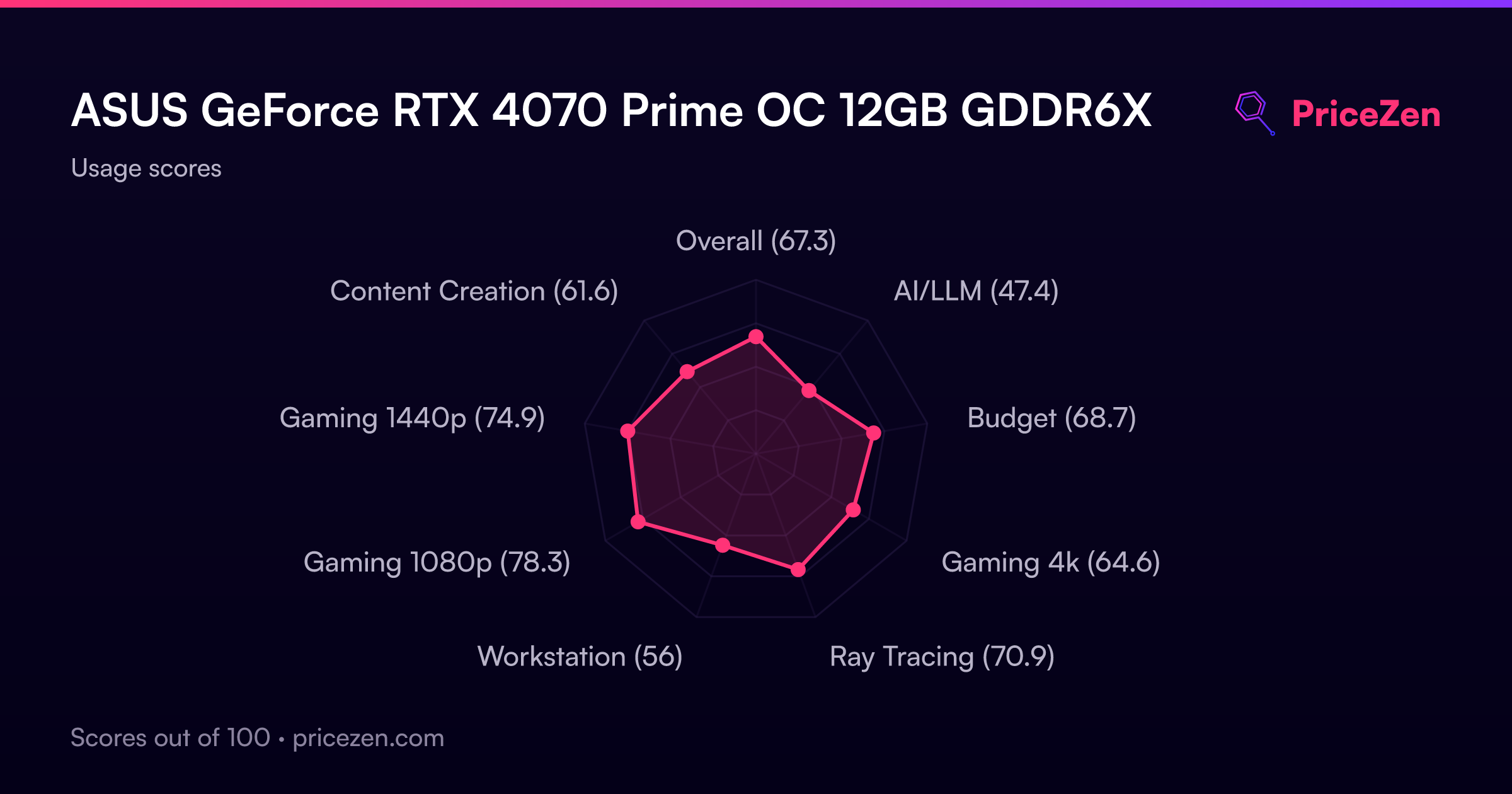
Usage Scores
- Overall67.3
- AI/LLM47.4
- Budget68.7
- Gaming 4k64.6
- Ray Tracing70.9
- Workstation56
- Gaming 1080p78.3
- Gaming 1440p74.9
- Content Creation61.6