Canon PowerShot G7 X Mark III Black
Its 20.1MP 1-inch CMOS sensor and 4K recording at 120fps deliver slow-motion clarity in a fixed-lens design. The 3-inch touch articulating screen and bundled accessory kit with extra battery enhance handheld vlogging flexibility. It's best for YouTube creators needing high-framerate 4K in a pocketable camera, though its low travel score makes it less suited for rugged shooting.

No current retailer price
Snapshot
The 30-Second Version
The Canon PowerShot G7 X Mark III is a premium point and shoot with a 20.1MP 1-inch sensor, 4K at 120fps, IBIS and a flip-out touchscreen, currently USD 1,455 for the kit with an extra battery. Its video and display rank well above average for the category, but autofocus, burst speed and travel suitability are weak points.
Pros & Cons
Pros
- 4K at 120fps, one of the stronger video specs in the category 82nd
- In-body stabilization ranks strong for a compact 82nd
- 3-inch articulating touchscreen, well above average for this class 74th
- Kit includes an extra battery, which this camera needs 71st
- Genuinely pocketable premium point and shoot form factor
Cons
- Autofocus falls in the bottom third of the category
- Burst shooting lags behind most rivals
- No weather sealing at all
- 1-inch sensor is only about average here
- USD 1,455 is steep, and affordability ranks below average
The proof
Performance
The headline spec is 4K at 120fps, which is unusual for a compact and puts its video ranking at the 82nd percentile against everything else in this category. Pair that with IBIS ranked as strong and a flip-out touchscreen that scores well above average, and you've got a camera clearly designed for someone filming themselves. The 20.1MP 1-inch sensor is the part that keeps expectations honest: it lands at about average for the category, so don't expect the low-light headroom or background blur of a bigger-sensor body.
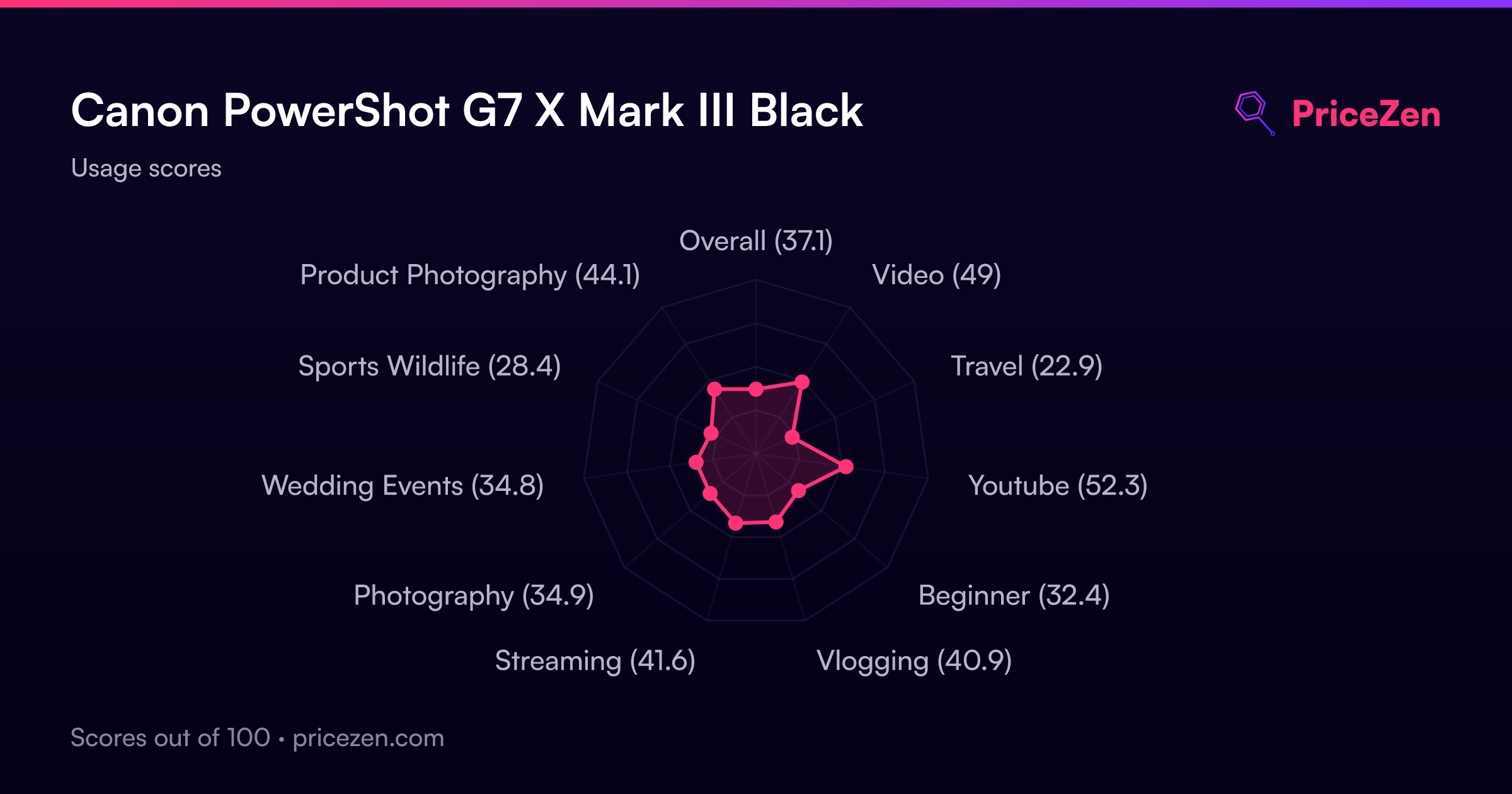
The weak spots are real. Autofocus ranks in the bottom third, which matters if you're relying on the camera to keep a moving subject sharp while you talk to it. Burst shooting is worse still, falling behind most of the field, so action and wildlife are off the menu. Battery ranks slightly below the middle of the pack, which is exactly why the extra battery in this kit isn't just padding. Our category scores tell the same story: beginner 52.3, video 49.9, and travel a rough 25.3 out of 100, the weakest area by far.
Specifications
Full Specifications
Sensor
| Type | CMOS |
| Size | 1-inch" |
| Megapixels | 20.1 MP |
Autofocus
| Eye AF | No |
Video
| Max Resolution | 4K |
| 4K FPS | 120 |
| 10-bit | No |
Display & EVF
| Screen Size | 3" |
| Touchscreen | Yes |
| Articulating | Yes |
Connectivity
| Wi-Fi | Yes |
| USB | USB-C |
vs Competition
Cross-shopping this against the Sony Alpha a7R VI, Fujifilm X-H2 or Nikon Z8 is a bit apples-to-oranges, but it's the comparison shoppers make, so here's the honest framing: those are much bigger, more serious camera systems, and if you want the best possible image quality and autofocus, the G7 X Mark III's mid-pack sensor ranking and bottom-third AF ranking mean it isn't playing in that league. What it offers instead is a body you can actually carry in a jacket pocket.
The Panasonic Lumix G9 II and OM System OM-1 Mark II are the more interesting cross-shops if you're torn between video and stills. Again, argue from this camera's own numbers: its burst and autofocus rankings are weak, so anyone shooting motion should look hard at those alternatives before committing. But if your day is mostly talking to a lens with a flip-out screen and you want stabilised 4K without a rig, the Canon's video and display rankings are the reason to stay here.
| Spec | Canon PowerShot G7 X Mark III | Sony Alpha a7R VI | Fujifilm X-H2 | Nikon Z8 | Panasonic Lumix G9 II | OM System OM-1 Mark II |
|---|---|---|---|---|---|---|
| Type | DSLR | mirrorless | mirrorless | mirrorless | mirrorless | mirrorless |
| Sensor | 20.1MP 1-inch | 66.8MP full-frame | 40.2MP aps-c | 45.7MP full-frame | 25.2MP micro-four-thirds | 20.4MP micro-four-thirds |
| AF Points | - | 759 | 425 | 493 | 779 | 1053 |
| Burst FPS | - | 30 | 15 | 30 | 75 | 120 |
| Video | 4K @120fps | 8K @120fps | 8K @60fps | 8K @120fps | 4K @120fps | 4K @60fps |
| IBIS | true | true | true | true | true | true |
| Weather Sealed | false | true | true | true | true | true |
| Weight (g) | - | 622 | 579 | 820 | 575 | 511 |
| Compare | Compare | Compare | Compare | Compare |
| Product | AF | EVF | Build | Burst | Video | Sensor | Battery | Display | Connectivity | Affordability | Stabilization |
|---|---|---|---|---|---|---|---|---|---|---|---|
| Canon PowerShot G7 X Mark III | 36.9 | 37.2 | 36.9 | 31.5 | 81.9 | 42.9 | 46 | 82 | 70.7 | 42.7 | 74.4 |
| Sony Alpha a7R VI Compare | 96.4 | 98.9 | 94.2 | 87.9 | 98.9 | 80.4 | 96.5 | 97.4 | 95.3 | 13.2 | 99.5 |
| Fujifilm X-H2 Compare | 91.2 | 96.3 | 93.1 | 79 | 94.7 | 98.8 | 97.3 | 94.9 | 95.3 | 28.2 | 95.6 |
| Nikon Z8 Compare | 92.6 | 90.4 | 97.4 | 94.6 | 98.4 | 67 | 88.7 | 97.1 | 95.3 | 17.4 | 87.4 |
| Panasonic Lumix G9 II Compare | 97.6 | 90.2 | 93 | 95.7 | 97.3 | 58.9 | 90.1 | 96.4 | 95.3 | 38.3 | 87.4 |
| OM System OM-1 Mark II Compare | 98.6 | 99.8 | 92.5 | 99.4 | 83.6 | 45.8 | 95.3 | 94.9 | 95.3 | 26.3 | 99.5 |
Price
Value & Pricing
At USD 1,455 for the accessory kit with the extra battery, this sits firmly in premium territory, and our affordability ranking puts it below the category midpoint. We track its price over time, partly through our community browser extension, and right now there's a single US listing at that figure. You're paying for the 4K/120fps video spec, the stabilisation and the flip screen, not for sensor size or autofocus speed. If those three things aren't your priority, the money is better spent elsewhere in this category.
Read more
Overview
The Canon PowerShot G7 X Mark III is a premium point and shoot built around a 20.1MP 1-inch CMOS sensor, with 4K video (including 4K at 120fps), in-body stabilization and a 3-inch articulating touchscreen. The listing we track is the accessory kit with an extra battery, international version, in black at Best Buy, currently USD 1,455. That's a lot of money for a pocket camera, so let's answer the question you probably typed into a search box: what do you actually get for it?
Mostly, you get a small camera that takes video seriously. Our scoring model ranks its display well above average for the category, its video capability near the top of the pack, and its stabilization as strong. The flip side shows up fast: autofocus sits in the bottom third, burst shooting falls behind most rivals, and there's no weather sealing. So is the G7 X Mark III good for YouTube? On paper it's aimed right at that job, with our YouTube score landing at 53.2 out of 100. Solid, not spectacular.
We collect specs, prices and rankings from across stores with our own automated system, then compare every camera against the rest of its category. Nobody pays us to like anything. And on the numbers alone, this one is a specialist rather than an all-rounder.
Common Questions
Q: Is the Canon PowerShot G7 X Mark III good for YouTube and vlogging?
It's clearly built for it: 4K at 120fps, in-body stabilization and a 3-inch articulating touchscreen all rank strongly for the category. Just know the autofocus ranks in the bottom third, so it's better suited to static, sit-down filming than chasing movement.
Q: Does the G7 X Mark III have image stabilization?
Yes, it has in-body stabilization (IBIS), which our ranking places as strong for a premium point and shoot. That helps a lot for handheld 4K video.
Q: Is the Canon G7 X Mark III weather sealed?
No, there's no weather sealing, so rain and dust are a genuine risk. If you shoot outdoors in bad conditions, look at other cameras in this category instead.
Q: How much does the Canon PowerShot G7 X Mark III cost?
The accessory kit with an extra battery, international version in black, is listed at USD 1,455 at Best Buy. That's the only US listing in our price data right now, and it puts the camera below the category average for affordability.
Who Should Skip This
Skip this if you shoot sports, kids or wildlife: the burst ranking falls behind most of the category and autofocus sits in the bottom third, which is a bad combination for anything that moves. Travellers should think twice too, given the travel score of 25.3 out of 100 and the total lack of weather sealing. And if you mainly want stills with the cleanest possible files, the mid-pack 1-inch sensor won't satisfy you at this price. Look at the Panasonic Lumix G9 II, OM System OM-1 Mark II or Fujifilm X-H2 instead.
Verdict
Buy it if you specifically want a pocket-sized camera with stabilised 4K, high frame rate video and a screen that flips around for self-filming. Those are its genuine strengths and they're backed by strong category rankings. Skip it if you need dependable autofocus on moving subjects, fast burst shooting or a camera you can take out in the rain, because the data says it'll disappoint on all three.
At USD 1,455 it's not a casual purchase, and the below-average affordability ranking reflects that. Our verdict: a niche buy for content creators who value size above everything, and a pass for general-purpose photographers.
Usage Scores
- Overall37.4
- Video48.9
- Travel23.3
- Youtube52.2
- Beginner49
- Vlogging40.6
- Streaming41.3
- Photography34
- Wedding Events34.5
- Sports Wildlife28.1
- Product Photography43.3