Panasonic Lumix GH6 Black 2022

80/100 overall score 4.4 average from 188 owner ratings
- Type
- mirrorless
- Sensor
- 25MP micro-four-thirds
- AF points
- 315 pts
- Burst
- 14 fps
- Video
- 6K @120fps
- IBIS
- Yes
- Weather sealed
- Yes
- Weight
- 739 g
Compare prices at 1 store
Cheapest first. New, refurbished and bundled offers are kept apart, so you compare like with like.
| Store | Sold by | Colour and condition | Price | vs lowest | Last checked | Link |
|---|---|---|---|---|---|---|
| New1 offerSingle unit | ||||||
| Out of stock when last checked | ||||||
| Amazon | Not known | Not listed | No price | Out of stock | Oct 31 | Go to store |
 Source: PriceZen, checked Oct 31, 2026
A price counts as current when we checked it in the last 7 days. “Marketplace seller” means a third-party seller on that store, not the store itself.











Snapshot
The 30-Second Version
The Panasonic LUMIX GH6 is a video-focused mirrorless camera with incredible burst speeds, top-tier stabilization, and ProRes support. It's a great value for video shooters at $2,300 USD with the Leica kit lens. But the contrast-detect autofocus and mediocre photography performance make it a poor choice for hybrid shooters or vloggers.
Pros & Cons
Pros
- Insane burst speeds: 60fps mechanical, 120fps electronic 97th
- 7.5 stops of IBIS, among the best stabilization we've seen 97th
- 4K at 120fps and 1080p at 300fps for slow motion 97th
- 10-bit internal recording with Apple ProRes 422 HQ support 96th
- Includes a sharp Leica 12-60mm F2.8-4.0 kit lens
Cons
- Autofocus is contrast-detect only and falls behind rivals
- Micro Four Thirds sensor limits low-light performance
- Photography score of 41.3 is mediocre for the price
- Vlogging score of 23.8 is one of the weakest areas
- International version may have warranty limitations
What owners think
How owner sentiment changed over time
ExclusiveBased on when customers actually wrote their reviews - so you can see whether early praise held up.
13 written reviews, Apr 2022 – Jan 2026: 5 happy, 8 without stars
Across all 188 store ratings: 4.4★. Most owners rate without writing a review. The chart counts the 13 written reviews.
- Jan – Mar 20245 without stars
Buyers praise image quality and ergonomics but report reliability issues like recording failures and focus peaking defects.
- Excellent image quality, colors, and ergonomics; great for run-and-gun filmmaking.
- Cameras fail after light use, recording black with no sound; short lifespan.
- Focus peaking defect required replacement; some quirks resolved with further testing.
- USB-C cable choice critical for external SSD recording; wrong cable causes shutdowns.
- Oct – Dec 20233 without stars
Mixed reviews: one user loves the camera for video, but another reports serious bugs like shutdowns and menu glitches. A third notes a missing 4:3 60fps full sensor mode.
- Camera shuts down mid-recording and has menu/standby glitches.
- No 4:3 60fps full sensor mode; crops to pixel/pixel.
- Excellent for video, great fan for summer heat and continuous use.
- Autofocus is older tech but manageable with practice.
Each dot is one written review, in the month it was written. Happy = 4-5★, mixed = 3★, unhappy = 1-2★. Period summaries are in English.
The proof
Performance
The burst performance is the headline number here. 60fps mechanical and 120fps electronic put the GH6 in the 98th percentile for burst speed among mirrorless cameras in our database. That's genuinely top of the charts. If you're shooting sports or wildlife, you'll get a massive buffer of frames to pick through. The stabilization is also a standout at 7.5 stops, landing in the 97th percentile. Handheld video looks steady, and low-light stills benefit more than you'd expect from a Micro Four Thirds sensor.
But the sensor itself is middle of the pack, sitting around the 60th percentile. The 25MP resolution is fine, but the smaller MFT sensor means dynamic range and high ISO noise can't quite match APS-C or full-frame rivals. Autofocus is a weak spot too, at the 36th percentile. Panasonic stuck with contrast-detect AF here, and while it's improved over older models, it still hunts more than the phase-detect systems in the Fujifilm X-H2S or Sony a1 II. For fast action, the burst speed is there, but the AF might not keep up with the frame rate.
Specifications
Full Specifications
Sensor
| Type | MOS |
| Size | micro-four-thirds |
| Megapixels | 25 MP |
| ISO Range | 100 |
| Processor | Venus Engine |
Autofocus
| AF Points | 315 |
| AF Type | Photo, VideoContrast Detection: 315 |
| Eye AF | Yes |
| Animal AF | Yes |
| Subject Detection | Yes |
Shooting
| Burst (Mechanical) | 14 |
| Burst (Electronic) | 75 |
| Max Shutter | 1/2000 |
| Electronic Shutter | Yes |
Video
| Max Resolution | 6K |
| 4K FPS | 120 |
| 1080p FPS | 300 |
| 10-bit | Yes |
| Log Profile | Yes |
| RAW Video | Yes |
| Codec | H.264, H.265, ProRes 422, ProRes 422 HQ |
Display & EVF
| Screen Size | 3" |
| Touchscreen | Yes |
| Articulating | Yes |
| EVF Resolution | 3.68 M dots |
Build
| Weather Sealed | Yes |
| Weight | 0.7 kg / 1.6 lbs |
| Battery Life | 350 |
Connectivity
| Wi-Fi | Yes |
| Bluetooth | Yes |
| USB | USB-C |
| HDMI | ✓ |
| Hot Shoe | Yes |
vs Competition
The Fujifilm X-H2S is the most direct competitor here. It has a stacked APS-C sensor, phase-detect autofocus that actually works, and 6.2K video. The GH6 beats it on stabilization and slow-motion frame rates, but the X-H2S is the better all-rounder for hybrid shooters. The Canon EOS R6 Mark III brings full-frame image quality and Canon's excellent Dual Pixel AF, though it costs more and can't match the GH6's 300fps 1080p mode.
The Sony a1 II and Nikon Z8 are in a different league price-wise, but they're worth mentioning because people cross-shop them. Both offer stacked full-frame sensors and far better autofocus. The GH6 undercuts them significantly on price while still delivering ProRes and high frame rates. The OM System OM-1 is the other Micro Four Thirds option, and it's actually better for wildlife thanks to its phase-detect AF and weather sealing. The GH6 isn't weather sealed, which is a notable omission for a camera marketed toward outdoor video work.
| Spec | Panasonic Lumix GH6 | Sony Alpha a7R VI | Fujifilm X-H2 | Nikon Z8 | OM System OM-1 Mark II | Canon EOS R6 Mark III |
|---|---|---|---|---|---|---|
| Type | mirrorless | mirrorless | mirrorless | mirrorless | mirrorless | mirrorless |
| Sensor | 25MP micro-four-thirds | 66.8MP full-frame | 40.2MP aps-c | 45.7MP full-frame | 20.4MP micro-four-thirds | 32.5MP full-frame |
| AF Points | 315 | 759 | 425 | 493 | 1053 | 1053 |
| Burst FPS | 14 | 30 | 15 | 30 | 120 | 40 |
| Video | 6K @120fps | 8K @120fps | 8K @60fps | 8K @120fps | 4K @60fps | 6K @120fps |
| IBIS | Yes | Yes | Yes | Yes | Yes | Yes |
| Weather Sealed | Yes | Yes | Yes | Yes | Yes | Yes |
| Weight (g) | 739 | 622 | 579 | 820 | 511 | 609 |
| Compare | Compare | Compare | Compare | Compare |
| Product | AF | EVF | Build | Burst | Video | Sensor | Battery | Display | User Sentiment | Social Proof | Affordability | Stabilization |
|---|---|---|---|---|---|---|---|---|---|---|---|---|
| Panasonic Lumix GH6 | 88.9 | 96.6 | 96.8 | 89 | 94.9 | 59.3 | 88.9 | 96.4 | 5.4 | 76 | 42 | 97.1 |
| Sony Alpha a7R VI Compare | 96.5 | 98.9 | 94.2 | 87.8 | 98.9 | 81.3 | 96.4 | 97.4 | 95.9 | 97.4 | 12.8 | 99.6 |
| Fujifilm X-H2 Compare | 91.5 | 96.2 | 93.2 | 79.1 | 94.6 | 98.8 | 97.1 | 95 | 86 | 92.5 | 24.9 | 95.9 |
| Nikon Z8 Compare | 92.8 | 90.7 | 97.4 | 94.6 | 98.5 | 67.9 | 88.4 | 97.1 | 86 | 97.4 | 16.2 | 87.8 |
| OM System OM-1 Mark II Compare | 98.6 | 99.8 | 92.6 | 99.3 | 83.7 | 47.3 | 95.1 | 95 | 86 | 86.6 | 26.2 | 99.6 |
| Canon EOS R6 Mark III Compare | 98.6 | 89.9 | 93.8 | 90.7 | 89.6 | 62.3 | 96.7 | 95 | 70.7 | 92.5 | 23.3 | 99.6 |
Price
Value & Pricing
At $2,300 USD with the Leica kit lens, the GH6 is priced like a serious hybrid camera but performs like a video specialist. That's not a bad thing if video is your main gig. You're getting ProRes 422 HQ, 4K 120fps, and class-leading stabilization for less than a Sony a1 II or Nikon Z8. But if you want a balanced stills and video camera, the Fujifilm X-H2S and Canon EOS R6 Mark III both offer better autofocus and larger sensors at similar or slightly higher prices. The GH6 makes sense when video features are the priority and you're willing to work around the AF quirks.
Read more
Overview
The Panasonic LUMIX GH6 is a mirrorless Micro Four Thirds camera aimed squarely at video shooters who want serious codec options without stepping up to a cinema body. It packs a 25MP sensor, 7.5 stops of in-body stabilization, and burst speeds that hit 60fps mechanical and 120fps electronic. The kit here includes the Leica 12-60mm F2.8-4.0 lens, which is a solid everyday zoom for both stills and video. At around $2,300 USD, it sits in that prosumer sweet spot where you're paying for video features more than photography chops.
If you're searching for a camera that can shoot 4K at 120fps or 1080p at a frankly ridiculous 300fps, the GH6 answers that question with a yes. It also records 10-bit internally and supports Apple ProRes 422 HQ, which is the kind of thing editors actually care about. But the photography scores tell a different story. Our database puts video at 44 out of 100 and photography at 41.3, so this is not a balanced hybrid. It's a video camera that happens to take photos.
One thing to know up front: this is an international version sold through Newegg. That can mean warranty quirks depending on where you live. We'll get into whether that matters later, but it's worth keeping in mind if you're comparing prices across retailers.
Common Questions
Q: Is the Panasonic LUMIX GH6 good for video?
Yes, the GH6 is excellent for video. It shoots 4K at 120fps, 1080p at 300fps, and records 10-bit internally with Apple ProRes 422 HQ support. The 7.5 stops of IBIS also make handheld footage look remarkably stable.
Q: How does the Panasonic GH6 compare to the Fujifilm X-H2S?
The GH6 has better stabilization and faster slow-motion frame rates, but the X-H2S has phase-detect autofocus that's far more reliable for tracking subjects. The X-H2S is the better hybrid camera, while the GH6 leans harder into video features.
Q: Is the Panasonic GH6 good for photography?
It's serviceable but not great. The 25MP sensor is fine in good light, but the Micro Four Thirds format struggles in low light compared to APS-C or full-frame cameras. Our database scores it 41.3 out of 100 for photography, which is mediocre for the price.
Q: Does the Panasonic LUMIX GH6 have good autofocus?
No, autofocus is the GH6's biggest weakness. It uses contrast-detect AF, which hunts more than the phase-detect systems found in competitors like the Canon EOS R6 Mark III or Sony a1 II. It's workable for static subjects but frustrating for fast action.
Who Should Skip This
Skip the GH6 if you shoot a lot of fast-moving subjects and rely on autofocus. Wildlife and sports photographers will be happier with the OM System OM-1 or Fujifilm X-H2S, both of which have phase-detect AF. Vloggers should also look elsewhere, the flip-out screen and AF performance just don't cut it for self-recording. And if you split your time evenly between photos and video, a full-frame hybrid like the Canon EOS R6 Mark III will serve you better overall.
Verdict
Should you buy the Panasonic LUMIX GH6? If you're a video-first shooter who wants ProRes, 4K 120fps, and best-in-class stabilization without spending $4,000 or more, yes. This camera delivers a lot of video capability for the money. The Leica kit lens is a nice bonus that's genuinely useful for both video and stills.
But if you need reliable autofocus for fast-moving subjects, or you split your time evenly between photos and video, look elsewhere. The GH6's AF is its biggest weakness, and the photography score of 41.3 reflects that. Vloggers should also steer clear, the 23.8 vlogging score is rough. This is a tool for people who know exactly what they want to shoot and are willing to work within its limitations.
Usage Scores
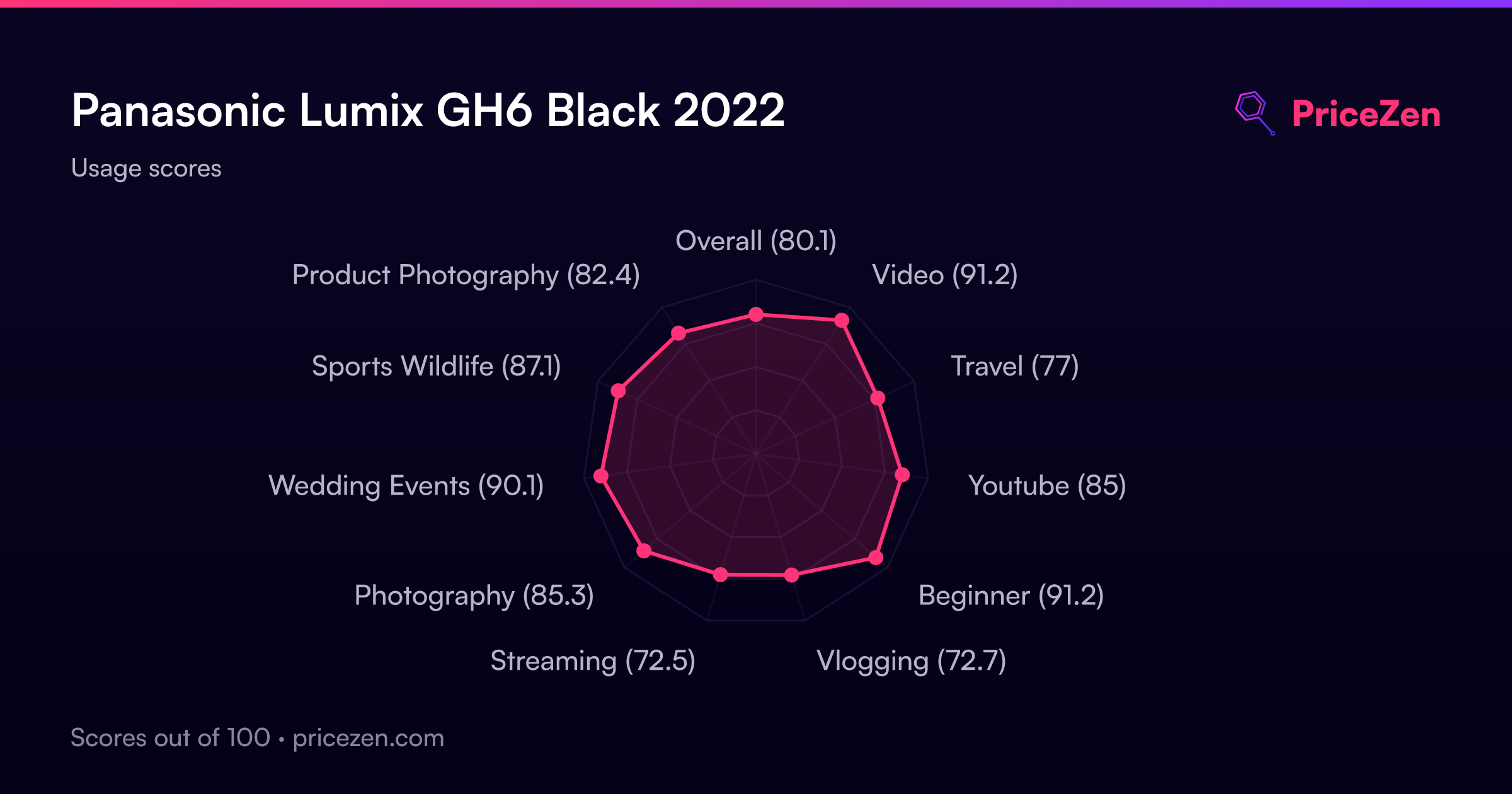
- Overall80.1
- Video91.2
- Travel77
- Youtube85
- Beginner91.2
- Vlogging72.7
- Streaming72.5
- Photography85.3
- Wedding Events90.1
- Sports Wildlife87.1
- Product Photography82.4