ASUS ROG Swift PG32UQXR 32" BLACK 2023
A 576-zone mini LED backlight with 1000 nits peak brightness and DisplayHDR 1000 certification delivers exceptional contrast and HDR impact on this 32-inch 4K Fast IPS panel. Quantum-dot technology achieves 96% DCI-P3 coverage for vivid color, while HDMI 2.1 and DisplayPort 2.1 provide full-bandwidth 4K 160Hz support for current-gen consoles and PCs. This monitor is best for competitive and enthusiast PC gamers who demand high-end HDR visuals without sacrificing the 160Hz refresh rate and 1ms response time.

Sem preço atual de lojas
Onde o vimos antes. Confira o preço de hoje na loja.











Resumo
The 30-Second Version
The ASUS ROG Swift PG32UQXR is a 32-inch 4K mini LED gaming monitor with 160Hz, 1000 nits peak brightness, and 576 local dimming zones. Color performance is elite, ranking in the 99th percentile in our database. The US price has climbed to $1,499, which makes the value case noticeably weaker, while European pricing still varies wildly from EUR 1,174 to EUR 3,094. Just be ready to calibrate it yourself and double-check you got a new unit.
Pros & Cons
Prós
- 1000 nits peak brightness with 576 mini LED zones makes HDR genuinely impressive 95th
- 96% DCI-P3 color coverage ranks in the 99th percentile in our database 95th
- 160Hz refresh rate with 1ms response time keeps 4K gaming smooth 85th
- HDMI 2.1 supports 4K 120Hz on PS5 and Xbox Series X without chroma subsampling 75th
- DisplayPort 2.1 with DSC future-proofs the connection for next-gen GPUs
Contras
- Out-of-box color calibration is inconsistent, multiple owners report needing manual tweaks
- User sentiment sits at just 46th percentile, well below what the specs suggest
- Included HDMI cable reportedly can't handle full 4K at 144Hz
- No USB-C port, which feels stingy at this price
- IPS contrast ratio is a known weak spot, blacks won't match OLED
O que dizem os donos
The Word on the Street
Como a opinião dos donos mudou ao longo do tempo
ExclusivoCom base em quando os clientes realmente escreveram suas avaliações - para ver se os elogios iniciais se mantiveram.
11 avaliações escritas, out. de 2022 – fev. de 2026: 10 satisfeitos, 1 insatisfeito
Em todas as 163 notas das lojas: 4,1★. A maioria dos donos dá nota sem escrever avaliação. O gráfico conta as 11 avaliações escritas.
Cada ponto é uma avaliação escrita, no mês em que foi escrita. Satisfeitos = 4-5★, neutros = 3★, insatisfeitos = 1-2★.
As provas
Performance
The headline numbers are legit. 160Hz at 4K with a 1ms GTG response time means fast-paced games stay sharp even when the action gets chaotic. The Fast IPS panel keeps motion blur in check without the smearing you sometimes see on VA panels. Our database puts overall performance at the 78th percentile, which is solid but not chart-topping. The real star here is brightness and color. At 1000 nits peak with DisplayHDR 1000 certification, HDR scenes have actual impact. Bright highlights in games like Cyberpunk or Horizon look genuinely striking, and the 576 dimming zones keep dark areas from turning into a gray mess.
Color accuracy is where this thing flexes. 96% DCI-P3 coverage and 160% sRGB volume put it in the 99th percentile for color in our rankings. That's the kind of performance that makes games look vivid without feeling oversaturated, assuming you calibrate it properly. And that's the catch. Multiple owners report the out-of-box calibration is off, with colors looking washed or tinted until you spend time tweaking settings. The panel itself is capable of excellent results, but ASUS isn't doing you any favors with the factory setup.
Specifications
Full Specifications
Display
| Size | 32" |
| Resolution | 3840x2160 (4K UHD) |
| Panel Type | IPS |
| Aspect Ratio | 16:9 |
| Curved | No |
| Screen Finish | matte |
Performance
| Refresh Rate | 160 Hz |
| Response Time | 1 |
| Adaptive Sync | FreeSync Premium Pro |
Color & HDR
| Brightness | 400 nits |
| Color Gamut | DCI-P3 96%, sRGB 160% |
| Color Depth | 10-bit |
| HDR | HDR1000 |
| HDR Support | HDR10 |
Connectivity
| HDMI Ports | 2 |
| DisplayPort | 2 |
| USB-C | 0 |
| Speakers | No |
| Headphone Jack | Yes |
Ergonomics
| Height Adjustable | Yes |
| Tilt | Yes |
| Swivel | Yes |
| Pivot | No |
| VESA Mount | 100x100 |
Features
| Webcam | No |
| Touchscreen | No |
| PIP/PBP | Yes |
| Power | 51 |
| Weight | 10.8 kg / 23.8 lbs |
vs Competition
The most direct competition comes from OLED panels like the LG UltraGear 45GX950A-B and the MSI MAG 271QPX QD-OLED E2. OLED gives you perfect blacks and instant response times, which the PG32UQXR can't match. The IPS panel here has a contrast ratio that owners describe as weak, and no amount of local dimming fully fixes that. But OLED has its own issues, mainly brightness and burn-in anxiety. The ASUS hits 1000 nits, which is double what most OLEDs manage. If you play in a bright room or love HDR highlights, the ASUS makes a strong case.
The Samsung Odyssey G60SD and Gigabyte M Series OLED MO27U2 SA are also worth a look. The Samsung is a 1440p panel, so you're trading resolution for speed and OLED contrast. The Gigabyte is 27 inches, which feels small next to this 32-inch display. The Apple Studio Display XDR is a different animal entirely, aimed at creative pros rather than gamers, and it costs significantly more. For pure gaming at 4K with HDR, the PG32UQXR holds its own against all of them, but the OLED options win on contrast and motion clarity.
| Spec | ASUS ROG Swift PG32UQXR 32" | LG UltraGear 45GX950A-B 45" | Dell UltraSharp U4025QW 39.7" | Alienware AW-Series AW3425DW 34" | MSI MAG 271QPX QD-OLED E2 27" | Samsung Odyssey G60SD 27" |
|---|---|---|---|---|---|---|
| Screen Size | 32 | 45 | 39.7 | 34 | 27 | 27 |
| Resolution | 3840 x 2160 | 5120 x 2160 | 5120 x 2160 | 3440 x 1440 | 2560 x 1440 | 2560 x 1440 |
| Panel Type | IPS | OLED | IPS | QD-OLED | QD-OLED | OLED |
| Refresh Rate | 160 | 330 | 120 | 240 | 240 | 360 |
| Response Time Ms | 1 | 0.03 | 5 | 0.03 | 0.03 | 0.03 |
| Adaptive Sync | FreeSync Premium Pro | FreeSync Premium Pro | Adaptive-Sync | FreeSync Premium Pro | FreeSync Premium Pro | FreeSync Premium Pro |
| Hdr | HDR1000 | DisplayHDR True Black 400 | HDR600 | HDR400 | DisplayHDR True Black 400 | HDR10+ |
| Compare | Compare | Compare | Compare | Compare |
| Produto | Color | Portabilidade | Display | Feature | User Sentiment | Ergonomic | Performance | Connectivity | Prova social |
|---|---|---|---|---|---|---|---|---|---|
| ASUS ROG Swift PG32UQXR 32" | 94.8 | 3.7 | 95.1 | 85 | 48.2 | 73.4 | 74.7 | 73.8 | 59.3 |
| LG UltraGear 45GX950A-B 45" Compare | 99.4 | 76.5 | 99.7 | 96.3 | 76.6 | 90.7 | 99.4 | 96.9 | 92 |
| Dell UltraSharp U4025QW 39.7" Compare | 97.9 | 76.5 | 98.6 | 96.3 | 85.4 | 90.7 | 56.1 | 99.3 | 96.8 |
| Alienware AW-Series AW3425DW 34" Compare | 98.9 | 73.9 | 84.1 | 96.3 | 95.7 | 90.7 | 97.9 | 95.3 | 96.8 |
| MSI MAG 271QPX QD-OLED E2 27" Compare | 99.2 | 57.3 | 73.4 | 85 | 95.7 | 90.7 | 97.9 | 81 | 98.9 |
| Samsung Odyssey G60SD 27" Compare | 90.7 | 39.3 | 73.4 | 70.1 | 95.7 | 90.7 | 99.5 | 87.4 | 92 |
Preço
Value & Pricing
Pricing has moved up, and that changes the math here. In the US, we're now tracking $1,499, up from the $1,239 we saw before. That's a meaningful jump for a monitor whose owner feedback was already mixed. In Europe, the spread is still wild, from EUR 1,174 up to EUR 3,094 across three listings in Spain, France, and Italy. That's a EUR 1,920 gap between the cheapest and most expensive vendor, which is frankly absurd. If you're buying in Europe, the EUR 1,174 listing remains the obvious move. Paying anything close to EUR 3,000 for this monitor is a mistake.
At $1,499, the value proposition gets harder to defend. You're still getting 4K, 160Hz, mini LED with 576 zones, and color coverage that sits in the 99th percentile in our rankings, so the hardware itself hasn't gotten worse. But the price premium over OLED alternatives has shrunk, and brightness alone is a thinner argument than it used to be. Add the weak user sentiment at the 46th percentile and the quality control complaints owners keep raising, and you're paying more money for the same gamble. If you get a good unit, the picture quality justifies a lot. If you don't, a return at this price stings considerably more.
Saiba mais
Overview
The ASUS ROG Swift PG32UQXR is a 32-inch 4K mini LED monitor aimed squarely at gamers who want HDR that actually pops. We're talking 576 local dimming zones, 1000 nits peak brightness, and a 160Hz refresh rate. That combination puts it in rare company. Most monitors promise either speed or picture quality, but this one tries to deliver both without making you choose.
ASUS is positioning this as a professional gaming display, and the spec sheet backs that up. You get HDMI 2.1 for console gaming at 4K 120Hz without chroma subsampling, DisplayPort 2.1 with DSC for PC, and FreeSync Premium Pro for tear-free gameplay. The quantum dot layer pushes color coverage to 96% DCI-P3, which is why our database ranks this panel in the 99th percentile for color. That's not just good for a gaming monitor, it's good for any monitor.
But here's the thing. This monitor costs real money, and the user sentiment score sits at just 46th percentile. That gap between elite specs and lukewarm owner feedback tells a story worth digging into. Some of it is about expectations, some of it is about quality control, and some of it is about whether mini LED can really hang with OLED in 2025.
Common Questions
Q: Does this monitor work with PS5 and Xbox Series X at 4K 120Hz?
Yes. The HDMI 2.1 ports support native 4K at 120Hz without chroma subsampling, meaning you get full 4:4:4 color on both consoles. The 160Hz refresh rate is only available over DisplayPort on PC, so console players are capped at 120Hz, which is the console max anyway.
Q: What graphics card do I need to run this monitor properly?
You'll want at least an RTX 3080 or equivalent to push 4K at high refresh rates in demanding games. Owners consistently report that weaker cards struggle to hit frame rates that justify the 160Hz panel. For esports titles like Valorant or Overwatch, a mid-range card can manage, but AAA games at 4K need serious GPU horsepower.
Q: Is the included HDMI cable good enough for 4K 144Hz?
Several owners report the included HDMI cable can't handle full 4K at 144Hz and recommend buying a certified Ultra High Speed HDMI cable. The monitor itself supports the bandwidth, but the bundled cable appears to be a weak link. If you're planning to use HDMI, budget for a better cable.
Q: How does the mini LED local dimming compare to OLED?
The 576 mini LED zones deliver much better HDR brightness than OLED, hitting 1000 nits peak. But OLED still wins on contrast and black levels because each pixel is individually lit. The PG32UQXR can show some blooming around bright objects on dark backgrounds, which is the trade-off for that extra brightness.
Who Should Skip This
If you play competitive shooters and care about every millisecond, look elsewhere. 160Hz is fine, but 240Hz and 360Hz panels exist at lower resolutions and will give you a real edge in fast-paced games. The 32-inch size also means you're scanning more screen real estate, which isn't ideal for twitchy esports play.
If you're sensitive to IPS glow or want perfect blacks, skip this and go OLED. The contrast ratio is a known weak spot, and while the mini LED backlight helps, it can't match the per-pixel control of OLED. The LG UltraGear 45GX950A-B or MSI MAG 271QPX QD-OLED E2 will give you deeper blacks and better motion clarity, just with less brightness. And if you need USB-C connectivity for a laptop setup, this monitor doesn't have it, so you'd need a dongle or a different display.
Verdict
If you're a gamer who wants 4K, high refresh rate, and HDR that actually looks bright, the PG32UQXR still delivers on the spec sheet. The 576-zone mini LED backlight does real work in HDR games, and the color performance is genuinely outstanding once you dial it in. Console players will appreciate the HDMI 2.1 support that runs 4K 120Hz without compromise. Just budget some time for calibration and maybe a better HDMI cable.
The catch is the price. At $1,499, this is no longer the easy pick it was when we tracked it lower, and the case rests almost entirely on how much you value brightness. For competitive esports players, the 160Hz refresh rate is fine but not exceptional, and a higher refresh 1440p panel will serve you better if you're chasing every frame in Valorant or CS2. If you mostly play in a dark room and care about deep blacks above all else, OLED is the better choice, and at this price the gap in cost is much narrower. The PG32UQXR is for people who specifically want mini LED brightness in a 4K gaming panel and are willing to pay for it.
Usage Scores
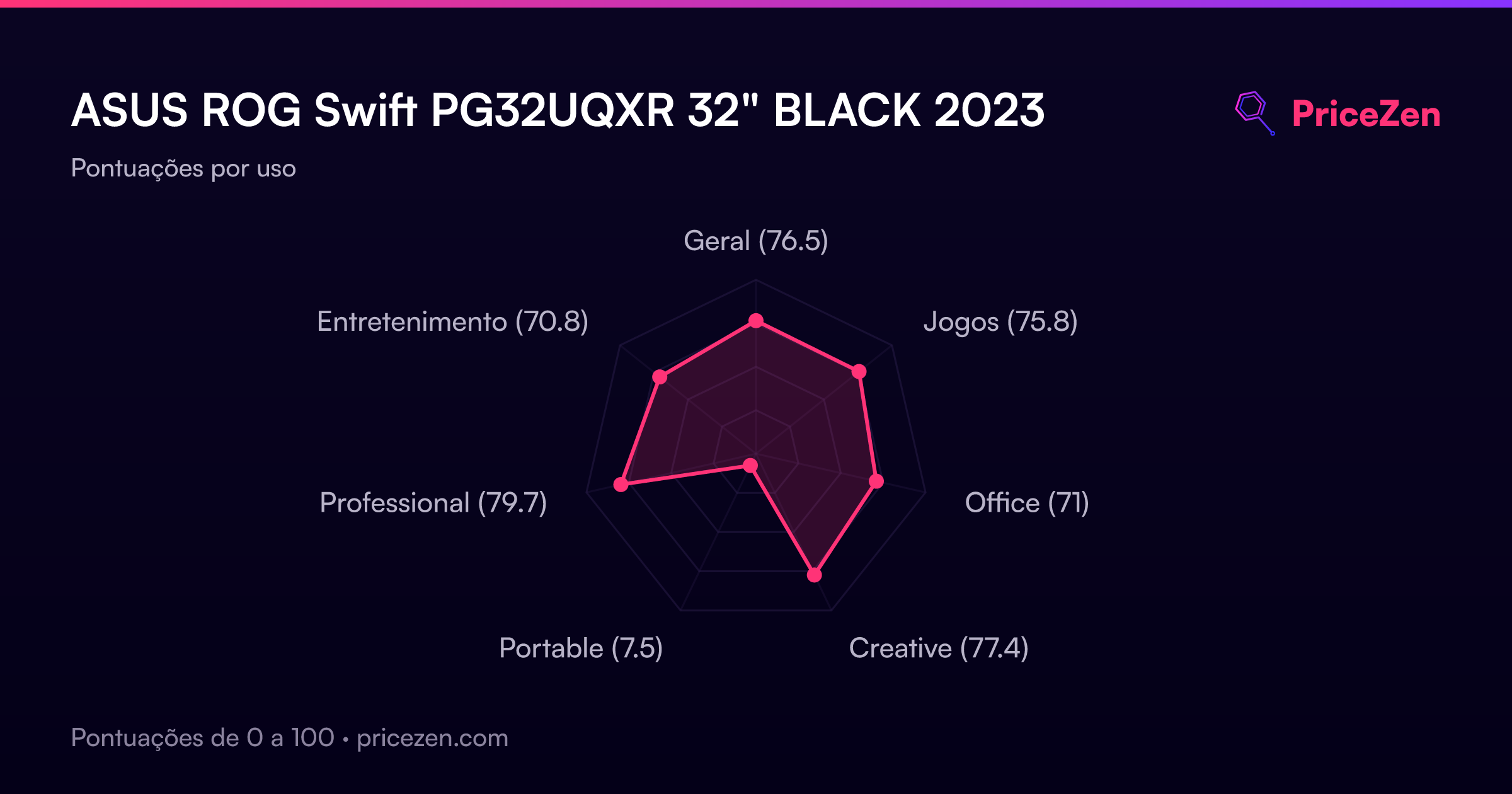
- Geral76.5
- Jogos75.8
- Office71
- Creative77.4
- Portable7.5
- Professional79.7
- Entretenimento70.8