7Artisans 35mm f/2 II
The 35mm f/2 prime pairs a 10-blade diaphragm with a 200g aluminum body, offering smooth bokeh and a compact build for Leica M shooters. Its 700mm minimum focus and f/2 aperture make it a budget-friendly choice for street and travel photography. Best for photographers seeking an affordable, manual-focus lens for everyday documentary shots.

Sem preço atual de lojas
Resumo
The 30-Second Version
A 4 out of 100 macro score is the headline warning here, courtesy of a 700mm minimum focus distance. On the flip side, 200g and CAD 380 make it one of the most portable and affordable ways to get a fast 35mm onto Leica M. The bottom-quarter optical ranking is the price you pay for that.
Pros & Cons
Prós
- 200g aluminum body, one of the most portable options in the category 87th
- CAD 380 puts affordability well above average for rangefinder glass 82nd
- Constant f/2 aperture scores solidly against the field
- 10 aperture blades for smoother out-of-focus rendering
- Crescent focus tab suits fast zone focusing on M bodies
Contras
- Optical score in the bottom quarter of the field, a genuine weak spot
- 700mm minimum focus makes macro one of the worst in the category
- No weather sealing at all
- No stabilization, and video suitability falls behind most rivals
- Build score is underwhelming despite the metal housing
As provas
Performance
The spec sheet reads like a classic reportage lens: 35mm, f/2 wide open down to f/22, 8 elements across 7 groups, and 10 aperture blades for rounder out-of-focus highlights. At 200g with a 55mm filter thread, it's genuinely pocketable by rangefinder standards, and our ranking puts portability among the best on the market. The crescent-style focus tab is a nice touch for zone focusing, which is how most people shoot M bodies anyway. Aperture scores solidly at the 64th percentile, so f/2 is respectable here rather than exceptional, and bokeh comes in about average despite those 10 blades.
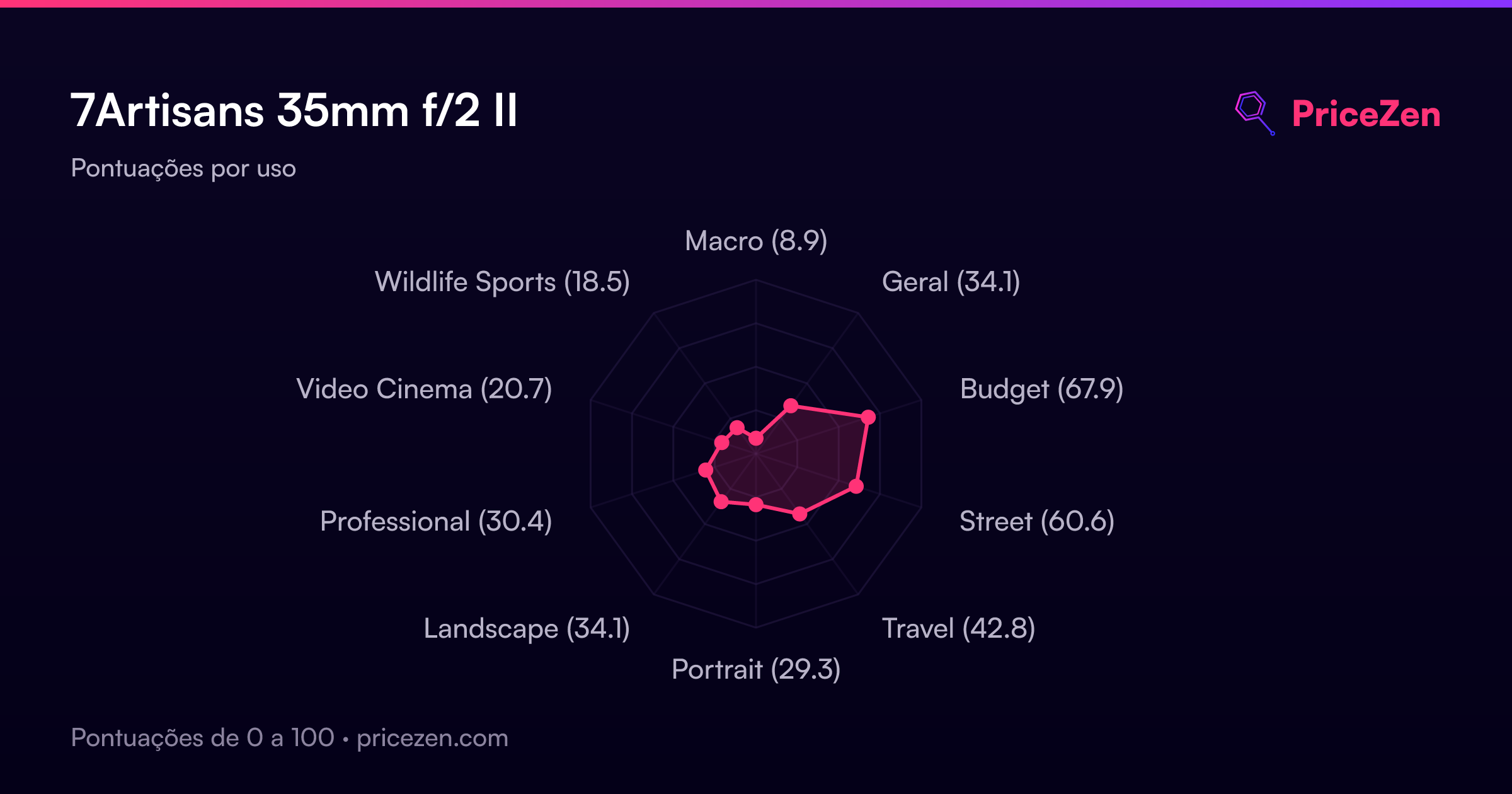
The catch is the optical score in the bottom quarter of the field. That lags behind most of the field, and it's the number we'd weigh hardest if image quality is your priority. There's no stabilization (about a third of the way down the rankings, and M bodies rarely help you there), no weather sealing, and video suitability sits in the bottom third. Reach is mediocre too, which is just physics: 35mm is 35mm. Macro is the real disaster at 4 out of 100, driven by that 700mm close-focus limit. You cannot get near anything with this lens. Best-use scores tell the same story: budget 66.5, street 59.8, travel 36, macro 8.4.
Specifications
Full Specifications
Optics
| Type | Prime |
| Focal Length Min | 35 |
| Focal Length Max | 35 |
| Elements | 8 |
| Groups | 7 |
Aperture
| Max Aperture | f/2 |
| Min Aperture | f/22 |
| Constant | Yes |
| Diaphragm Blades | 10 |
Build
| Mount | Leica M |
| Weight | 0.2 kg / 0.4 lbs |
| Filter Thread | 55 |
Focus
| Min Focus Distance | 700 |
vs Competition
Against the names in our comparison set, this thing plays a very specific game. The Viltrox AF 35mm f/1.2 LAB FE and Canon RF 35mm f/1.4L VCM are the ones to cross-shop if raw image quality and speed matter more than size or spend, because our optical ranking for the 7Artisans sits in the bottom quarter of the field and its f/2 aperture is only solid, not leading. If you want flexibility instead of a fixed view, the Sigma 17-40mm f/1.8 DC Art is the obvious detour, since this lens scores mediocre on versatility and reach. And if you're chasing subject separation or close-up work, the Sony FE 85mm f/1.4 GM and Tamron 70-180mm f/2.8 Di III VC VXD G2 live in a different world entirely, given the 7Artisans' about-average bokeh score and dead-last macro ranking. Where it wins is simple: 200g and CAD 380 on Leica M. None of that comparison changes the fact that this is the small, cheap option, and it should be bought as exactly that.
| Spec | 7Artisans 35mm f/2 II | Sony FE 70-200mm f/2.8 GM OSS II | Canon RF 24-105mm f/2.8L IS USM Z | Sigma 70-200mm f/2.8 DG DN OS Sports | Tamron 70-180mm f/2.8 Di III VC VXD G2 | Viltrox AF 35mm f/1.2 LAB FE |
|---|---|---|---|---|---|---|
| Focal Length | 35mm | 70-200mm | 24-105mm | 70-200mm | 70-180mm | 35mm |
| Max Aperture | f/2 | f/2.8 | f/2.8 | f/2.8 | f/2.8 | f/1.2 |
| Mount | Leica M | Sony E | Canon RF | Sony E | Sony E | Sony E |
| Format Coverage | - | full-frame | full-frame | full-frame | full-frame | full-frame |
| Stabilization | false | true | true | true | true | false |
| Weather Sealed | false | true | true | true | true | true |
| Weight (g) | 200 | 1045 | 1315 | 1345 | 855 | 910 |
| AF Type | - | XD Linear Motors | Nano USM | HLA (High-response Linear Actuator) | VXD | VCM |
| Lens Type | prime | zoom | zoom | zoom | zoom | prime |
| Compare | Compare | Compare | Compare | Compare |
| Produto | Bokeh | Build | Macro | Reach | Video | Optical | Aperture | Wide Angle | Portability | Versatility | Affordability | Stabilization |
|---|---|---|---|---|---|---|---|---|---|---|---|---|
| 7Artisans 35mm f/2 II | 39.8 | 30.3 | 4.2 | 28.9 | 27.3 | 21.3 | 64.5 | 52.8 | 86.6 | 32.5 | 81.8 | 41.4 |
| Sony FE 70-200mm f/2.8 GM OSS II Compare | 88.7 | 99.9 | 77.4 | 83.5 | 85.6 | 89.4 | 43.4 | 28.9 | 18.9 | 78.5 | 12.5 | 97.3 |
| Canon RF 24-105mm f/2.8L IS USM Z Compare | 78.2 | 98.9 | 76.4 | 73.8 | 85.6 | 97.8 | 43.4 | 73.9 | 12.7 | 91.5 | 10.4 | 95.9 |
| Sigma 70-200mm f/2.8 DG DN OS Sports Compare | 88.7 | 98.9 | 55.7 | 83.5 | 85.6 | 99.9 | 43.4 | 28.9 | 11.9 | 78.5 | 23.6 | 99.9 |
| Tamron 70-180mm f/2.8 Di III VC VXD G2 Compare | 85.9 | 90.6 | 82.9 | 81.5 | 81.8 | 95.9 | 43.4 | 28.9 | 24.7 | 76.5 | 30 | 97.3 |
| Viltrox AF 35mm f/1.2 LAB FE Compare | 67.8 | 90.6 | 50 | 28.9 | 69.9 | 91.4 | 96.4 | 52.8 | 23.3 | 32.5 | 33.7 | 41.4 |
Preço
Value & Pricing
CAD 380 at The Camera Store is the only listing we're tracking right now, so there's no store-to-store spread to shop around for. What that buys you is a 200g all-metal 35mm with a constant f/2 and 10 blades on Leica M, which is a lot of lens per dollar in a mount where the alternatives routinely cost multiples of this. Our affordability ranking puts it well above average, and the budget use-case score of 66.5 backs that up. Just go in knowing the savings come out of the optical score, not out of thin air.
Saiba mais
Overview
200 grams, CAD 380, and a portability score in the top 15% of lenses we've tested. That's the whole pitch of the 7Artisans 35mm f2 II in three numbers, and honestly it's a decent pitch. This is a Leica M mount 35mm prime with a constant f/2 aperture, 8 elements in 7 groups, and a 10-blade diaphragm wrapped in an aluminum body light enough that you'll forget it's on the camera. Our scoring model puts its affordability well above average for the category, which tracks: rangefinder glass has a reputation for costing more than your rent.
But the numbers get less friendly once you look past size and price. Optical performance lands in the bottom quarter of the field, a weak spot against the rest of the field, and macro sits at 4 out of 100, one of the worst scores we've seen in this category. The 700mm minimum focus distance explains that one immediately. So what you've got here is a small, cheap, fast-ish street lens that asks you to accept some real optical compromises. Whether that trade works depends entirely on what you shoot.
Common Questions
Q: Can I use this for close-up or product shots?
Not really. The minimum focus distance is 700mm, and our macro ranking puts it at 4 out of 100, one of the worst in the category. The macro use-case score of 8.4 out of 100 says the same thing. For detail work you'll want a different lens.
Q: Is f/2 fast enough, or should I hold out for something wider?
f/2 constant scores at the 64th percentile in our data, which is solid but not leading. Combined with 10 aperture blades you get usable subject separation, though the bokeh score is only about average. If you specifically need more speed, the Viltrox AF 35mm f/1.2 LAB FE and Canon RF 35mm f/1.4L VCM are worth cross-shopping.
Q: How does it hold up for travel and outdoor shooting?
The 200g weight is a big plus, and portability ranks among the best on the market. But there's no weather sealing and no stabilization, and the travel use-case score is only 36 out of 100. Great for a light street kit, less convincing as a do-everything travel lens.
Who Should Skip This
Skip this if image quality is non-negotiable, because a bottom-quarter optical score means it lags behind most of the field. Skip it if you shoot anything close, since 700mm minimum focus and a 4-out-of-100 macro ranking make it near useless for detail work. Skip it for video, where it sits in the bottom third with no stabilization. And skip it if you need one lens to cover everything: versatility and reach both rank mediocre, and the travel score of 36 out of 100 isn't a vote of confidence. This is a specialist budget street prime, not an all-rounder.
Verdict
Buy it if you want a light, inexpensive 35mm on an M body and you're honest with yourself about the trade. The top-15% portability and well-above-average affordability are real strengths, and the street score of 59.8 says it does that job fine. But the bottom-quarter optical score is not something you can ignore, and the 4-out-of-100 macro result means close-up shooting is off the table. As a lightweight everyday carry lens at CAD 380, it earns its spot. As your only lens, or as the one you rely on for critical image quality, we'd point you elsewhere.
Usage Scores
- Macro8.9
- Geral34.1
- Budget67.9
- Street60.6
- Travel42.8
- Portrait29.3
- Landscape34.1
- Professional30.4
- Video Cinema20.7
- Wildlife Sports18.5