Sigma 17-70mm f/2.8-4.5 DC HSM Macro APS-C

Foco macro para os pequenos detalhes verificado em 29 de nov.
51/100 pontuação geral 3,4 média de 78 avaliações de proprietários
- Focal length
- 17-70mm
- Aperture
- f/2.8-4.5
- Mount
- Nikon F
- Format coverage
- APS-C
- Weight
- 454 g
- Af type
- HSM (Hyper-Sonic Motor)
- Lens type
- macro
Compare preços em 1 loja
Da mais barata à mais cara. Ofertas novas, recondicionadas e em kit ficam separadas para você comparar o que é comparável.
| Loja | Vendido por | Cor e condição | Preço | vs. o menor | Última verificação | Link |
|---|---|---|---|---|---|---|
| Novo1 ofertaUnidade única | ||||||
| Esgotado na última verificação | ||||||
| Amazon | Desconhecido | Não informado | Sem preço | Esgotado | Hoje | Ir para a loja |
 Fonte: PriceZen, verificado em 29 de nov. de 2026
Um preço é considerado atual quando o verificamos nos últimos 7 dias. «Vendedor parceiro» significa um vendedor terceiro naquela loja, não a própria loja.











Resumo
The 30-Second Version
The Sigma 17-70mm f/2.8-4.5 DC HSM Macro ranks in the 90th percentile for versatility and 84th for optical quality, making it a solid all-rounder for APS-C shooters. But bokeh sits at 14th percentile and there's no stabilization, so low-light and portrait work suffer. At $499 USD it's a fair deal for the range you get, though the 3.4 out of 5 customer rating suggests some real-world disappointments.
Pros & Cons
Prós
- Versatility in the 90th percentile, this lens covers a huge range of shooting situations 90th
- Optical quality at 84th percentile with 2 aspherical and 1 ED element 85th
- Macro capability at 81st percentile with 1:2.3 max magnification 84th
- HSM autofocus is quiet and smooth in good light 74th
- 454g weight is reasonable for a lens with this much range
Contras
- Bokeh ranks at 14th percentile, the 7-blade diaphragm produces harsh backgrounds
- Aperture performance at 22nd percentile, f/4.5 at the long end is slow
- No stabilization, ranking 34th percentile in that category
- Build quality at 56th percentile, no weather sealing anywhere
- Customer rating of 3.4 out of 5 from 78 reviews is mediocre
As provas
Performance
Optical quality is the headline here, landing in the 84th percentile. That's a strong showing for a lens in this price bracket. The 2 aspherical elements and 1 ED element are doing real work keeping distortion and chromatic aberration in check across the 17-70mm range. The multilayer coating helps with flare, though we'd stop short of calling it exceptional. Sharpness is solid through the middle of the frame, with some softness creeping in at the edges when you're wide open at 17mm.
Autofocus sits at 54th percentile, which is about average. The HSM motor is quiet and reasonably quick in good light, but it can hunt a bit when you're close to the 200mm minimum focus distance. That's annoying for macro work, where precision matters. The lack of stabilization hurts too, ranking at 34th percentile. At 70mm on an APS-C body, you're looking at roughly 105mm equivalent, and without any shake reduction you'll want to keep your shutter speed up. The f/2.8-4.5 variable aperture doesn't help here either, especially at the long end where you're already losing light.
Specifications
Full Specifications
Optics
| Type | Macro |
| Focal Length Min | 17 |
| Focal Length Max | 70 |
| Elements | 15 |
| Groups | 12 |
| Aspherical Elements | 2 |
| ED Elements | 1 |
| Coating | multilayer lens coating |
Aperture
| Max Aperture | f/2.8-4.5 |
| Min Aperture | f/22 |
| Constant | No |
| Diaphragm Blades | 7 |
Build
| Mount | Nikon F |
| Format | APS-C |
| Weight | 0.5 kg / 1.0 lbs |
| Filter Thread | 72 |
AF & Stabilization
| AF Type | HSM (Hyper-Sonic Motor) |
Focus
| Min Focus Distance | 200 |
| Max Magnification | 1:2.3 |
vs Competition
Against the Sony E 18-135mm f/3.5-5.6 OSS, the Sigma gives up stabilization and a bit of reach but fights back with better macro capability and a faster wide end at f/2.8. The Tamron 28-300mm f/4-7.1 Di III VC VXD offers way more telephoto range and includes stabilization, but it's slower throughout and not really a macro contender. The Viltrox AF 13mm f/1.4 Z is a completely different animal, a fast prime that destroys the Sigma on aperture and bokeh but can't touch its versatility. The Nikon NIKKOR 20059 and Panasonic Leica DG Vario-Elmarit H-ES12035 are both more modern designs with better build quality, but they cost more and don't offer the same close-focusing ability. The Sigma's real advantage is that it does a bit of everything without being terrible at any one thing, except bokeh, which is genuinely rough.
| Spec | Sigma 17-70mm f/2.8-4.5 DC HSM Macro | Sony FE 70-200mm f/2.8 GM OSS II | Canon RF 24-105mm f/2.8L IS USM Z | Tamron 70-180mm f/2.8 Di III VC VXD G2 | Viltrox AF 35mm f/1.2 LAB FE | Nikon NIKKOR Z 70-200mm f/2.8 VR S |
|---|---|---|---|---|---|---|
| Focal Length | 17-70mm | 70-200mm | 24-105mm | 70-180mm | 35mm | 70-200mm |
| Max Aperture | f/2.8-4.5 | f/2.8 | f/2.8 | f/2.8 | f/1.2 | f/2.8 |
| Mount | Nikon F | Sony E | Canon RF | Sony E | Sony E | Nikon Z |
| Format Coverage | APS-C | full-frame | full-frame | full-frame | full-frame | full-frame |
| Stabilization | No | Yes | Yes | Yes | No | Yes |
| Weather Sealed | No | Yes | Yes | Yes | Yes | Yes |
| Weight (g) | 454 | 1045 | 1300 | 855 | 910 | 1440 |
| AF Type | HSM (Hyper-Sonic Motor) | XD Linear Motors | Nano USM | VXD | VCM | STM (stepping motor) |
| Lens Type | macro | zoom | zoom | zoom | prime | zoom |
| Compare | Compare | Compare | Compare | Compare |
| Produto | AF | Bokeh | Build | Macro | Reach | Video | Optical | Aperture | Wide Angle | Portability | Versatility | Prova social | Affordability | Stabilization |
|---|---|---|---|---|---|---|---|---|---|---|---|---|---|---|
| Sigma 17-70mm f/2.8-4.5 DC HSM Macro | 83.7 | 33 | 30.4 | 84.7 | 73.8 | 27.3 | 64.6 | 43.1 | 67.9 | 58.6 | 90 | 42.5 | 56.3 | 41.5 |
| Sony FE 70-200mm f/2.8 GM OSS II Compare | 95.4 | 88.6 | 99.9 | 77.3 | 83.6 | 85.2 | 89.3 | 43.1 | 28.9 | 19.2 | 78.5 | 95.8 | 12.7 | 97.2 |
| Canon RF 24-105mm f/2.8L IS USM Z Compare | 90 | 78.1 | 98.9 | 76.2 | 73.8 | 85.2 | 97.8 | 43.1 | 73.9 | 13.3 | 91.5 | 91.4 | 10.7 | 95.9 |
| Tamron 70-180mm f/2.8 Di III VC VXD G2 Compare | 95.4 | 85.9 | 90.8 | 82.9 | 81.6 | 81.4 | 96 | 43.1 | 28.9 | 25.2 | 76.6 | 91.4 | 29.6 | 97.2 |
| Viltrox AF 35mm f/1.2 LAB FE Compare | 95.4 | 67.7 | 90.8 | 50.2 | 28.9 | 69.7 | 91.3 | 96.4 | 52.8 | 23.8 | 32.6 | 85.9 | 34 | 41.5 |
| Nikon NIKKOR Z 70-200mm f/2.8 VR S Compare | 69 | 85.9 | 98.9 | 58.1 | 83.6 | 85.2 | 98 | 43.1 | 28.9 | 10.3 | 78.5 | 95.8 | 14.5 | 98.6 |
Preço
Value & Pricing
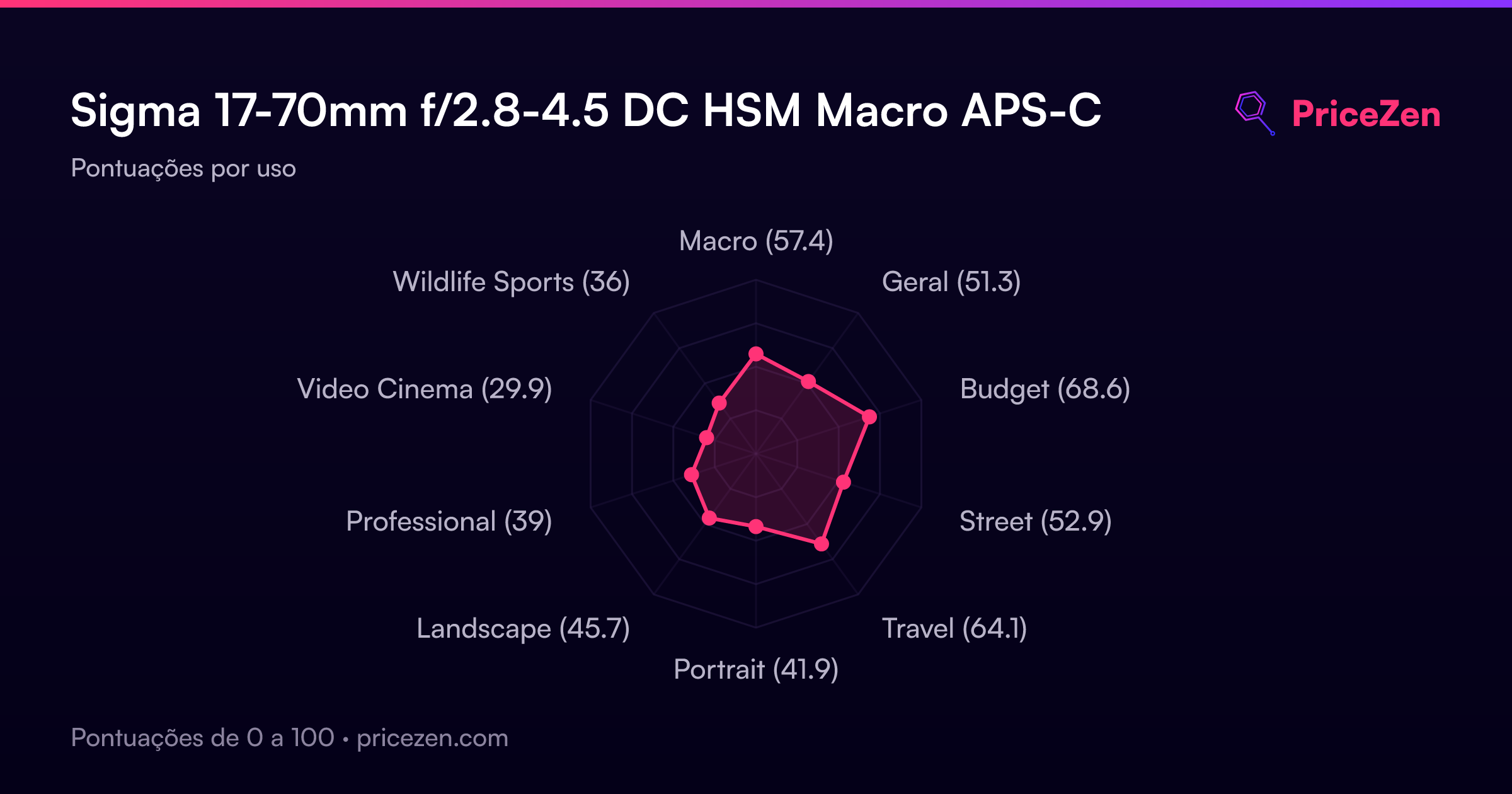
At $499 USD from US listings, this lens is asking a fair but not spectacular price. The CAD 816 listing in Canada is a different story entirely, and we'd have a hard time recommending it at that number. The value proposition really depends on what you need. If you want one lens that can handle landscapes, casual portraits, and close-up work without breaking the bank, the versatility score in the 90th percentile makes a decent argument. But the budget score of 53 out of 100 tells you this isn't a screaming deal. You're paying for range and optical competence, not for build quality or low-light performance.
Saiba mais
Overview
The Sigma 17-70mm f/2.8-4.5 DC HSM Macro sits in a weird but interesting spot. It's a walkaround zoom for APS-C bodies that also tries to be a macro lens, and the numbers tell a mixed story. Versatility lands in the 90th percentile, optical quality at 84th, and macro capability at 81st. Those are genuinely good scores for a lens that costs around $499 USD on the used market. But then you hit the aperture ranking at 22nd percentile and bokeh at 14th, and you start to see where the compromises live.
At 454g with a 72mm filter thread and 15 elements in 12 groups, this is a substantial but not unwieldy piece of glass. The HSM motor handles autofocus, there's no stabilization, and the 7-blade diaphragm is about as basic as it gets. The 1:2.3 max magnification is respectable for a zoom pretending to be a macro lens, but it's not true 1:1. You're getting a lot of range here, just not a lot of polish in the areas that separate good lenses from great ones.
Common Questions
Q: Is this a true macro lens?
No. The max magnification is 1:2.3, which means objects appear at less than half their actual size on the sensor. True macro lenses hit 1:1. That said, the macro score of 81st percentile is strong for a zoom lens, and the 200mm minimum focus distance lets you get reasonably close. It's great for flowers and larger insects, but if you want to fill the frame with a single ant eye, you'll need a dedicated macro prime.
Q: Does the lack of stabilization matter?
It depends on what you shoot. Stabilization ranks at 34th percentile, which means most lenses in this category have it and this one doesn't. At 70mm on an APS-C body, you're effectively shooting at 105mm, and the old rule of thumb says you want 1/105s or faster without stabilization. In good light that's fine. Indoors or at dusk, you'll be cranking ISO or reaching for a tripod. The f/4.5 max aperture at the long end makes this worse.
Q: How does the autofocus perform for macro work?
The HSM motor is quiet and smooth, but autofocus only ranks at 54th percentile overall. For macro shooting, most photographers switch to manual focus anyway because depth of field is razor thin at close distances. The HSM system is fine for general use, but it can hunt when you're working near the 200mm minimum focus distance. If you're serious about macro, plan on using manual focus most of the time.
Who Should Skip This
Portrait shooters should look elsewhere. The portrait score of 37.5 out of 100 is the weakest area for this lens, and the bokeh ranking at 14th percentile confirms it. The 7-blade diaphragm produces busy, harsh backgrounds that will distract from your subject. The f/4.5 max aperture at 70mm doesn't give you enough subject separation either. If you shoot in low light regularly, the lack of stabilization combined with the slow variable aperture will frustrate you. And if you're buying in Canada at CAD 816, the value proposition falls apart completely. For that money you can find better options with stabilization and modern build quality.
Verdict
The Sigma 17-70mm f/2.8-4.5 DC HSM Macro is a lens that makes sense for a specific type of shooter. If you're on an APS-C Nikon F or Canon EF body, want one lens for travel and everyday use, and occasionally like to get close to flowers or small objects, the 90th percentile versatility and 81st percentile macro scores are compelling. The optical quality at 84th percentile means your images will look good in most situations. But the 3.4 out of 5 customer rating suggests real-world experiences don't always match the spec sheet. The lack of stabilization, mediocre build, and genuinely poor bokeh are the trade-offs. At $499 USD it's a reasonable buy. At CAD 816, look elsewhere.
Usage Scores
- Macro57.4
- Geral51.3
- Budget68.6
- Street52.9
- Travel64.1
- Portrait41.9
- Landscape45.7
- Professional39
- Video Cinema29.9
- Wildlife Sports36