PNY GeForce GTX 1080 Ti XLR8 8GB GDDR5
The Pascal-based GTX 1080 Ti runs at a 1670 MHz boost clock with 11GB of GDDR5X memory and a blower-style cooler, delivering 8.87 TFLOPS of FP32 compute for high-refresh 1440p gaming. Its factory overclock requires no software tweaks, and the 267mm dual-slot design fits most mid-tower cases while exhausting heat directly out the rear. This card suits gamers upgrading from older GPUs who prioritize consistent 1440p performance over AI workloads, where its 17.6/100 score trails modern alternatives.

Sem preço atual de lojas











Resumo
The 30-Second Version
The PNY GeForce GTX 1080 Ti XLR8 is a Pascal-era flagship that still handles 1080p and 1440p gaming, but it lacks ray tracing, DLSS, and modern efficiency. At around $370 USD, it's a tough sell when used RTX 3060 Ti and RX 6700 XT cards offer more for similar money. Only worth it if you find one cheap and you don't care about modern features.
Pros & Cons
Prós
- 11GB of VRAM still holds up for 1080p and 1440p gaming
- Strong rasterization performance for its age
- Blower design exhausts heat out of the case, good for small builds
- Factory overclocked to 1670MHz boost, no software needed
- Can be found for around $370 USD on the used market
Contras
- No ray tracing or DLSS support
- 250W TDP is thirsty for the performance you get
- Blower cooler runs loud under load
- Only 2 display outputs, one DP and one HDMI
- PCI Express 3.0 x16 limits bandwidth on newer platforms
As provas
Performance
In our database, this card scores 18,593 in PassMark G3D. That puts it at the 42nd percentile for rasterization, which is about average compared to everything on the market right now. In practice, that means it handles most esports titles and older AAA games without breaking a sweat. You'll get well over 100 FPS in games like CS2, Valorant, and Fortnite at 1080p. At 1440p, you're looking at 60-80 FPS in demanding titles if you're willing to drop settings from ultra to high.
The 11.34 TFLOPS of FP32 compute is respectable for its era, but it lands at the 24th percentile for compute today. That's a polite way of saying modern mid-range cards run circles around it. The 484 GB/s memory bandwidth is still decent, and the 11GB frame buffer means you won't hit VRAM limits in most games. But the lack of RT cores and tensor cores means no DLSS, no ray tracing, and no AI upscaling. If you're wondering whether the GTX 1080 Ti is good for gaming in 2025, the answer is yes for older titles and no for anything that leans on modern features.
Specifications
Full Specifications
Chipset
| GPU Chipset | GeForce GTX 1080 Ti |
| Brand | NVIDIA |
| Architecture | Pascal |
| Class | consumer |
| Process | 16 |
Memory
| VRAM | 8 GB |
| Memory Type | GDDR5 |
| Memory Bus | 352 |
| Bandwidth | 484.4 |
Compute
| Base Clock | 1556 |
| Boost Clock | 1670 |
| FP32 TFLOPS | 11.34 |
Performance
| PassMark G3D | 18593 |
| GPU Compute | 9598 |
Power & Cooling
| TDP | 250 |
| Recommended PSU | 600 |
| Cooler | Blower |
| Fans | 1 |
Connectivity
| Interface | PCI Express 3.0 x16 |
| DisplayPort | 1 |
| HDMI | 1 |
| Max Resolution | 3840x2160 |
Physical
| Length | 267 |
| Slot Width | 2 |
| Form Factor | Full Height |
| Weight | 1.4 kg / 3.0 lbs |
vs Competition
Stacked against the Gigabyte AORUS RTX 5080 or the ASUS TUF RTX 5070 Ti, the 1080 Ti looks like it's from another planet. Those cards are in a completely different price bracket and performance class. The RTX 5070 Ti alone has more than double the compute power, faster memory, and full support for DLSS 4 and ray tracing. Even the MSI Shadow RTX 5070 Ti, which is the budget option in that lineup, makes the 1080 Ti feel like a relic.
A more realistic comparison is against something like a used RTX 3060 Ti or an RX 6700 XT. The 6700 XT has 12GB of VRAM, similar raster performance, and much better efficiency. The 3060 Ti gives you DLSS and ray tracing, even if the ray tracing performance is modest. Both of those cards are easier to live with day to day. The 1080 Ti's only real advantage is that 11GB frame buffer, which is still enough for most games at 1440p. But when you factor in driver support and feature set, the modern cards win almost every time.
| Spec | PNY GeForce GTX 1080 Ti XLR8 | ASUS GeForce RTX 5090 TUF Gaming | Gigabyte GeForce RTX 5080 AERO OC | MSI GeForce RTX 5070 Ti Ventus 3X OC | ZOTAC GeForce RTX 5080 APOCALYPSE | Sapphire Radeon RX 7900 XTX NITRO+ |
|---|---|---|---|---|---|---|
| Chipset | GeForce GTX 1080 Ti | GeForce RTX 5090 | GeForce RTX 5080 | GeForce RTX 5070 Ti | GeForce RTX 5080 | Radeon RX 7900 XTX |
| Vram | 8GB GDDR5 | 32GB GDDR7 | 16GB GDDR7 | 16GB GDDR7 | 16GB GDDR7 | 24GB GDDR6 |
| Boost Clock Mhz | 1670 | 2407 | 2730 | 2482 | 2730 | 2680 |
| Tdp W | 250 | 575 | 360 | 300 | 360 | 339 |
| Memory Bus Bits | 352 | 512 | 256 | 256 | 256 | 384 |
| Ray Tracing | - | true | true | true | true | true |
| GPU Class | consumer | consumer | consumer | consumer | consumer | consumer |
| Compare | Compare | Compare | Compare | Compare |
| Produto | AI | Rt | Vram | Raster | Compute | Feature | Thermal | Efficiency | Connectivity | Prova social | Affordability |
|---|---|---|---|---|---|---|---|---|---|---|---|
| PNY GeForce GTX 1080 Ti XLR8 | 35.8 | 33.1 | 25.8 | 40.9 | 25.4 | 10.8 | 19.7 | 27.3 | 20.5 | 15.1 | 64.4 |
| ASUS GeForce RTX 5090 TUF Gaming Compare | 97.1 | 90.6 | 97.8 | 98.8 | 97.6 | 95.9 | 72.3 | 23.8 | 99.3 | 98.7 | 2.3 |
| Gigabyte GeForce RTX 5080 AERO OC Compare | 85.6 | 95.3 | 89.1 | 94.5 | 93.4 | 95.9 | 91.8 | 56.8 | 94.1 | 83.9 | 13.5 |
| MSI GeForce RTX 5070 Ti Ventus 3X OC Compare | 79.4 | 92.5 | 86 | 89 | 88.1 | 95.9 | 91.8 | 71.8 | 94.1 | 83.9 | 22.2 |
| ZOTAC GeForce RTX 5080 APOCALYPSE Compare | 85.6 | 97.6 | 89.1 | 94.5 | 93.4 | 95.9 | 91.8 | 56.8 | 94.1 | 98.7 | 20.6 |
| Sapphire Radeon RX 7900 XTX NITRO+ Compare | 95.1 | 96.3 | 91.9 | 83.5 | 95.6 | 95.9 | 91.8 | 51.7 | 98.8 | 69.1 | 19 |
Preço
Value & Pricing
At $370 USD, the PNY GTX 1080 Ti sits in a strange value pocket. You can find used RTX 3060 Ti or RTX 3070 cards for similar money, and those give you DLSS, ray tracing, and much better efficiency. The 1080 Ti's 250W TDP means you'll pay more on your power bill over time, and the blower cooler doesn't help with noise. That said, if you're in a market where used RTX cards are overpriced or hard to find, the 1080 Ti still delivers playable frame rates in most games. Just know that you're buying into a dead platform with no driver optimizations for newer titles.
Histórico de preços
Saiba mais
Overview
The PNY GeForce GTX 1080 Ti XLR8 is one of those cards that shows up in 2025 and makes you do a double take. It's a Pascal-era flagship, the kind of GPU that ruled the roost back in 2017, and now it's floating around the used market at around $370 USD. That's a weird spot. You're paying mid-range modern money for a card that's nearly a decade old. But the 1080 Ti has a reputation for a reason, and this PNY blower model still packs 11GB of GDDR5X and a 1670MHz boost clock.
People searching for this card usually want to know one thing: is a GTX 1080 Ti still good in 2025? The short answer is complicated. For 1080p gaming, it's fine. For 1440p, it's starting to show its age. For anything involving ray tracing or AI workloads, it's basically a museum piece. The 8GB of memory listed in the specs is a typo on some retailer pages, this card actually has 11GB, which is one of the few things keeping it relevant.
PNY isn't the flashiest brand, and this blower cooler design is about as exciting as a beige office PC. But it's a functional card that does what it says on the box. No RGB, no fancy backplate, just a single fan pushing hot air out the back of your case. If you're building a budget rig and you find one of these for a good price, it's worth a look. Just don't expect it to keep up with anything from the RTX 40 or 50 series.
Common Questions
Q: Is the PNY GTX 1080 Ti good for gaming in 2025?
It's still decent for 1080p and 1440p gaming in older titles and esports games, but it lacks ray tracing and DLSS support. You'll need to lower settings in newer AAA games to maintain smooth frame rates.
Q: How much VRAM does the PNY GTX 1080 Ti have?
This card has 11GB of GDDR5X memory, despite some retailer listings incorrectly showing 8GB. The 352-bit memory bus gives it 484 GB/s of bandwidth.
Q: Does the GTX 1080 Ti support ray tracing?
No, the GTX 1080 Ti is based on the Pascal architecture and has no RT cores. Ray tracing requires an RTX 20 series card or newer.
Q: What power supply do I need for a GTX 1080 Ti?
PNY recommends a 600W power supply for this card. The GPU itself has a 250W TDP, so make sure your PSU has enough headroom for the rest of your system.
Who Should Skip This
Skip this card if you play newer AAA games with ray tracing or if you want DLSS upscaling. The 1080 Ti simply can't do those things. Also skip it if you're sensitive to fan noise, the blower cooler gets loud under load. If you're building a small form factor PC, the 267mm length and 2-slot design are fine, but the heat output is not. For most people, a used RTX 3060 Ti, RX 6700 XT, or even a new RTX 4060 makes more sense. You'll get better efficiency, quieter operation, and access to modern features that actually matter.
Verdict
Should you buy the PNY GTX 1080 Ti in 2025? Only if you find one for significantly less than $300 USD and you're building a budget rig for older games or esports titles. The card still has enough raw horsepower to push frames at 1080p and 1440p, and the 11GB of VRAM is a nice safety net. But the lack of DLSS, ray tracing, and modern driver optimizations means you're buying into a platform that's already been left behind.
For most people, saving up a bit more for a used RTX 3060 Ti or RX 6700 XT makes way more sense. You'll get better efficiency, quieter cooling, and access to features that actually matter in 2025. The 1080 Ti is a legend, but legends belong in museums, not in your gaming PC.
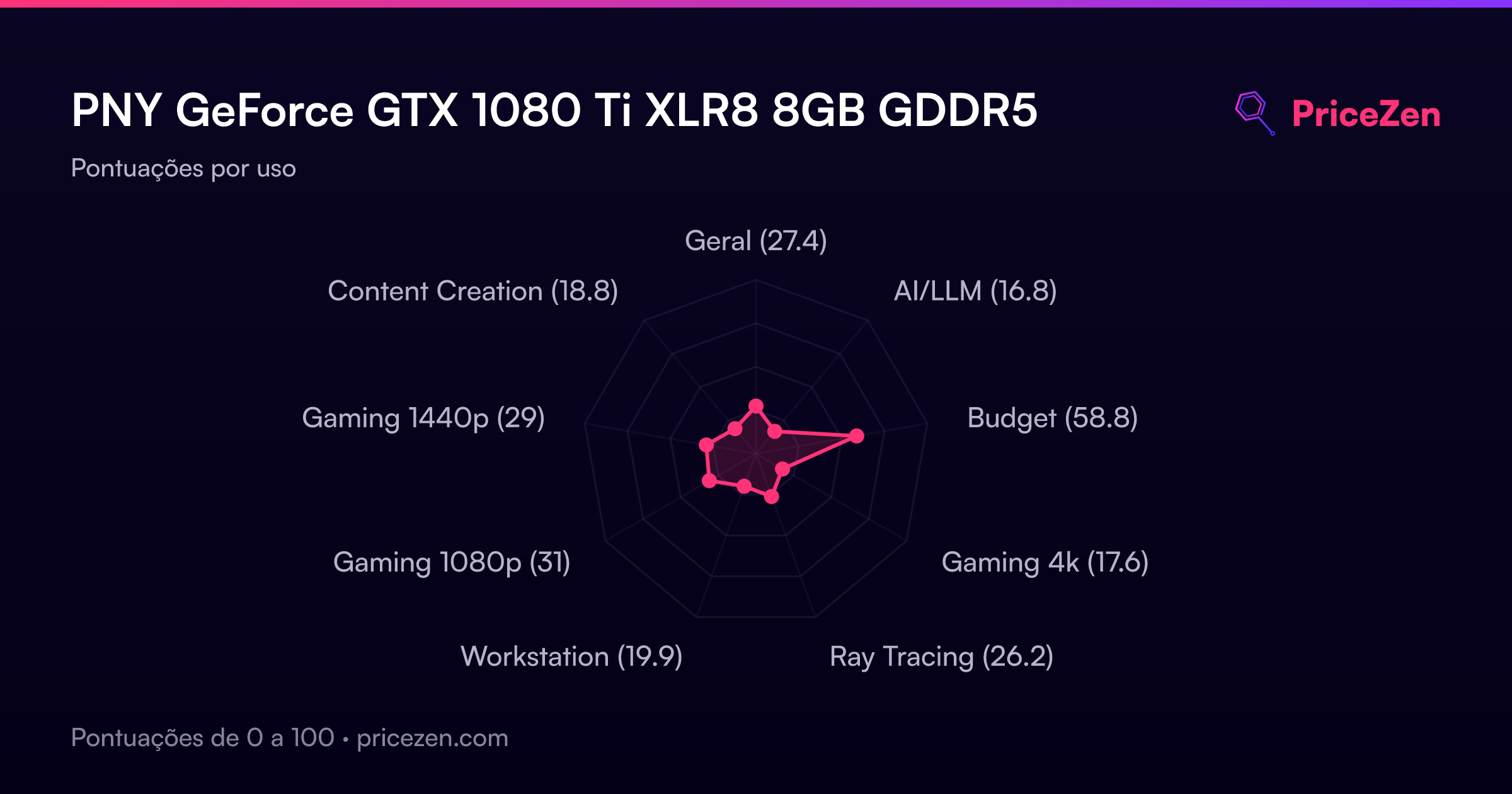
Usage Scores
- Geral27.4
- AI/LLM16.8
- Budget58.8
- Gaming 4k17.6
- Ray Tracing26.2
- Workstation19.9
- Gaming 1080p31
- Gaming 1440p29
- Content Creation18.8