ZOTAC GeForce RTX 3080 TRINITY OC LHR 10GB GDDR6X Gray

912 GB/s de largura de banda de memória verificado em 29 de nov.
66/100 pontuação geral 4,4 média de 433 avaliações de proprietários
- GPU
- GeForce RTX 3080
- VRAM
- 10GB GDDR6X
- Boost clock
- 1725 MHz
- TDP
- 320 W
- Memory bus
- 320 bit
- Ray tracing
- Sim
- Class
- consumer
Compare preços em 1 loja
Da mais barata à mais cara. Ofertas novas, recondicionadas e em kit ficam separadas para você comparar o que é comparável.
| Loja | Vendido por | Cor e condição | Preço | vs. o menor | Última verificação | Link |
|---|---|---|---|---|---|---|
| Novo1 ofertaUnidade única | ||||||
| Esgotado na última verificação | ||||||
| Amazon | Desconhecido | Não informado | Sem preço | Esgotado | 9 de nov. | Ir para a loja |
 Fonte: PriceZen, verificado em 9 de nov. de 2026
Um preço é considerado atual quando o verificamos nos últimos 7 dias. «Vendedor parceiro» significa um vendedor terceiro naquela loja, não a própria loja.











Resumo
The 30-Second Version
The ZOTAC RTX 3080 TRINITY OC LHR is still a beast for 1440p gaming, with a PassMark score of 25003 and excellent thermals that keep it under 70C. The 10GB VRAM is the main limitation for 4K, and the fans get loud under load. Pricing varies wildly from USD 380 to USD 849, so shop carefully. At the low end, it's one of the best used GPU deals available right now.
Pros & Cons
Prós
- Excellent thermal performance, sub-70C temps under gaming load 92nd
- Strong 4K and high-refresh 1440p gaming performance 78th
- Solid build quality with metal frontplate and backplate 75th
- Quiet at idle thanks to FREEZE fan stop 75th
- Great value on the used market, especially near USD 380
Contras
- Fans get loud under heavy load
- 10GB VRAM is limiting for some newer 4K titles
- 320W TDP means high power draw and heat output
- Poor technical support experiences reported by some owners
- Large 318mm length may not fit smaller cases
O que dizem os donos
The Word on the Street
- Owners consistently praise the 4K gaming performance, with many noting the card handles demanding titles without breaking a sweat. The build quality and premium feel of the metal construction also come up frequently.
- Noise levels are a recurring point of contention. Some users find the fans quiet even under load, while others report the card gets noticeably loud during intensive gaming. The FREEZE fan stop at idle is appreciated, but the noise under load seems to vary by unit and case airflow.
- The cooling system gets a lot of love, with multiple owners reporting sub-70C temperatures during gaming. The IceStorm 2.0 cooler appears to do its job well, even if it has to spin the fans fast to do it.
- Technical support is a weak spot. At least one owner with decades of tech support experience detailed a frustrating service interaction, and the overall sentiment around ZOTAC's support quality is notably lower than the card's hardware quality would suggest.
Como a opinião dos donos mudou ao longo do tempo
ExclusivoCom base em quando os clientes realmente escreveram suas avaliações - para ver se os elogios iniciais se mantiveram.
12 avaliações escritas, set. de 2021 – fev. de 2026: 10 satisfeitos, 1 neutro, 1 insatisfeito
Em todas as 433 notas das lojas: 4,4★. A maioria dos donos dá nota sem escrever avaliação. O gráfico conta as 12 avaliações escritas.
Cada ponto é uma avaliação escrita, no mês em que foi escrita. Satisfeitos = 4-5★, neutros = 3★, insatisfeitos = 1-2★.
As provas
Performance
Let's talk raw numbers. The PassMark G3D score of 25003 puts this card in the 66th percentile for raster performance among all GPUs in our database. That's solid, middle-of-the-pack territory when you're comparing against everything from budget cards to RTX 4090s. But context matters. For a card that launched at USD 699 back in 2020, still landing in the top two-thirds of all GPUs tested is respectable. In real terms, you're looking at smooth 1440p gaming at high refresh rates and playable 4K in most titles with settings dialed in sensibly.
The compute numbers tell a similar story. 30.64 FP32 TFLOPS puts it at the 77th percentile for compute, which is well above average. The 48 RT cores and 192 Tensor cores handle ray tracing and DLSS duties, landing at the 74th percentile for ray tracing specifically. That's where this card still shines. DLSS does a lot of heavy lifting here, letting you run ray-traced games at higher resolutions than the raw raster numbers would suggest. The 10GB of VRAM at 912 GB/s bandwidth is the one spec that's starting to show its age. It's at the 56th percentile for VRAM capacity, and some newer titles at 4K with maxed textures will push right up against that 10GB ceiling. For 1440p, it's still plenty.
Thermals are actually a bright spot. The 92nd percentile thermal ranking means this cooler does its job well. Multiple owners report sub-70C temps during gaming, which is excellent for a 320W card. The trade-off is noise. That triple-fan setup has to spin fast to dissipate 320 watts of heat, and several users mention the fans get loud under heavy load. It's the classic air-cooling compromise: great temps, but you'll hear it working. The FREEZE fan stop helps at idle, but once you're in a demanding game, expect audible fan noise.
Specifications
Full Specifications
Chipset
| GPU Chipset | GeForce RTX 3080 |
| Brand | NVIDIA |
| Architecture | Ampere |
| Class | consumer |
| Process | 8 |
Memory
| VRAM | 10 GB |
| Memory Type | GDDR6X |
| Memory Bus | 320 |
| Bandwidth | 912.4 |
| ECC | No |
Compute
| CUDA Cores | 8704 |
| Tensor Cores | 192 |
| RT Cores | 48 |
| Base Clock | 1725 |
| Boost Clock | 1725 |
| FP16 TFLOPS | 30.64 |
| FP32 TFLOPS | 30.64 |
Performance
| PassMark G3D | 25003 |
| GPU Compute | 15059 |
Power & Cooling
| TDP | 320 |
| Recommended PSU | 750 |
| Power Connectors | 2 x 8-Pin |
| Cooler | Triple Fan |
| Fans | 3 |
Connectivity
| Interface | PCI Express 4.0 x16 |
| DisplayPort | 3 |
| HDMI | 1 |
| Max Displays | 4 |
| Max Resolution | 7680 x 4320 |
Physical
| Length | 318 |
| Slot Width | 2.5 |
| Form Factor | Full Height |
| Weight | 1.4 kg / 3.1 lbs |
Features
| Ray Tracing | Yes |
| Upscaling | DLSS |
| AV1 Encode | No |
| VR Ready | Yes |
| DirectX | 12 Ultimate |
| RGB | Yes |
vs Competition
When you stack this against the current competition, the picture gets clearer. The Gigabyte AORUS GV-N5080AORUS M-16GD and MSI Suprim G5080-16SLS are RTX 5080 cards with 16GB of VRAM and significantly higher performance. They also cost dramatically more. If you're building a new system with a current-gen CPU and want max settings at 4K with ray tracing, those are the cards to look at. The RTX 3080 can't keep up with them in raw performance, but it also costs a fraction of the price on the used market.
The ASUS PRIME PRIME-RTX5070TI-O16G and PNY OC VCG5070T16TFXPB1-O are RTX 5070 Ti cards, which are closer in spirit to what the 3080 was at launch: high-end performance without the absolute flagship price. Those cards offer 16GB of VRAM, better efficiency, and newer features like DLSS 4 support. The 3080's 10GB of VRAM is the biggest differentiator here. If you play at 1440p, it's a wash. If you're targeting 4K with high-res textures, the newer cards' extra VRAM matters. The Sapphire PULSE 11322-02-20G is an AMD option, and while it's not directly comparable in features, it shows that the market has moved on. The 3080's ray tracing performance is still competitive, but its efficiency is not. At 320W TDP, it draws more power than newer cards that deliver similar or better performance.
| Spec | ZOTAC GeForce RTX 3080 TRINITY OC LHR | Gigabyte GeForce RTX 5070 Ti Eagle Ice | ASUS GeForce RTX 5080 PRIME EVO OC | MSI GeForce RTX 5070 Ti Ventus 3X OC | PNY GeForce RTX 5080 ARGB OC | Sapphire Radeon RX 7900 XTX NITRO+ |
|---|---|---|---|---|---|---|
| Chipset | GeForce RTX 3080 | GeForce RTX 5070 Ti | GeForce RTX 5080 | GeForce RTX 5070 Ti | GeForce RTX 5080 | Radeon RX 7900 XTX |
| Vram | 10GB GDDR6X | 16GB GDDR7 | 16GB GDDR7 | 16GB GDDR7 | 16GB GDDR7 | 24GB GDDR6 |
| Boost Clock Mhz | 1725 | 2542 | 2685 | 2482 | 2620 | 2680 |
| Tdp W | 320 | 300 | 360 | 300 | 360 | 339 |
| Memory Bus Bits | 320 | 256 | 256 | 256 | 256 | 384 |
| Ray Tracing | Yes | Yes | Yes | Yes | Yes | Yes |
| GPU Class | consumer | consumer | consumer | consumer | consumer | consumer |
| Compare | Compare | Compare | Compare | Compare |
| Produto | AI | Rt | Vram | Raster | Compute | Feature | User Sentiment | Efficiency | Connectivity | Prova social | Affordability |
|---|---|---|---|---|---|---|---|---|---|---|---|
| ZOTAC GeForce RTX 3080 TRINITY OC LHR | 51.7 | 74.6 | 54.7 | 64.8 | 74.7 | 77.7 | 44.7 | 30.7 | 54.7 | 69.5 | 38.5 |
| Gigabyte GeForce RTX 5070 Ti Eagle Ice Compare | 78.9 | 88.6 | 86 | 88.9 | 87.8 | 95.7 | 85 | 71.6 | 94.2 | 93.7 | 23 |
| ASUS GeForce RTX 5080 PRIME EVO OC Compare | 85.5 | 97.7 | 89.1 | 94.5 | 93.3 | 88.4 | 71.1 | 56.6 | 94.2 | 93.7 | 19.3 |
| MSI GeForce RTX 5070 Ti Ventus 3X OC Compare | 78.9 | 92.4 | 86 | 88.9 | 87.8 | 95.7 | 85 | 71.6 | 94.2 | 84.1 | 21.1 |
| PNY GeForce RTX 5080 ARGB OC Compare | 85.5 | 97.7 | 89.1 | 94.5 | 93.3 | 95.7 | 71.1 | 56.6 | 94.2 | 75.1 | 16 |
| Sapphire Radeon RX 7900 XTX NITRO+ Compare | 95.3 | 96.4 | 92 | 83.4 | 95.6 | 95.7 | 85 | 51.3 | 98.8 | 69.5 | 13.6 |
Preço
Value & Pricing
Here's where things get interesting. The price spread on this card is enormous. We're seeing listings from USD 380 to USD 849 across US retailers, with Newegg offering refurbished units at the lower end. At USD 380, this card is an absolute steal. You're getting performance that still competes with cards costing twice as much new. At USD 849, you're overpaying significantly. For that money, you could get a current-generation card with more VRAM and better efficiency.
The affordability percentile sits at 45th, which reflects the fact that this card's original MSRP was never cheap, and the used market pricing is all over the place. The value proposition really depends on which listing you find. If you're patient and can snag one near the low end of that USD 380 to USD 849 range, the price-to-performance ratio is hard to beat. Just don't pay a premium for the LHR version thinking it's special. It's not. It's the same card with a mining limiter, and that actually makes it less desirable for some buyers, not more.
Saiba mais
Overview
The ZOTAC GeForce RTX 3080 TRINITY OC LHR is one of those cards that still makes a strong case for itself in 2025, even with newer generations on the shelf. It's built on NVIDIA's Ampere architecture with 8704 CUDA cores, 10GB of GDDR6X memory on a 320-bit bus, and a boost clock of 1725MHz. That's a serious amount of silicon for pushing pixels at 1440p and 4K, and the LHR designation just means it's the later revision with the mining limiter baked in. For gamers, that's a non-issue. For anyone hoping to recoup costs by mining Ethereum, well, those days are mostly behind us anyway.
Who's this card for? Someone who wants high-refresh 1440p gaming or comfortable 4K performance without paying current-gen flagship prices. The used and refurbished market is where this card lives now, and the pricing reflects that. We're seeing listings from USD 380 to USD 849, which is a wild spread. If you can snag one near the low end, you're getting a lot of GPU for the money. At the high end, you're better off looking at newer options.
The TRINITY OC is ZOTAC's mid-to-upper tier offering with their IceStorm 2.0 cooling solution and SPECTRA 2.0 RGB lighting. It's a triple-fan design that runs 318mm long and takes up 2.5 slots, so it's not a small card. The metal frontplate and lighted backplate give it a more premium feel than some budget options, and the FREEZE fan stop feature means the fans don't spin at idle. That's a nice touch for quiet desktop use, though as we'll get into, the fans can get loud when things heat up.
Common Questions
Q: Is 10GB of VRAM enough for 4K gaming in 2025?
It depends on the game and settings. For most titles at 4K with high settings, 10GB is still workable, especially with DLSS enabled. But some newer games with ultra texture packs will exceed 10GB and cause stuttering or texture pop-in. If you're targeting 4K with maxed settings, a 16GB card from the current generation is the safer bet. For 1440p, 10GB is still plenty.
Q: How loud does this card actually get?
It varies. The triple-fan IceStorm 2.0 cooler keeps temps impressively low, often under 70C, but that requires the fans to spin fast under load. Some owners report the card is quiet even during gaming, while others find it noticeably loud. Your case airflow and ambient temperature play a big role. The FREEZE fan stop means it's silent at idle, which is nice for desktop use.
Q: Will this card fit in my case?
The card is 318mm long and takes up 2.5 slots. That's on the larger side, so you'll need a case with at least 320mm of GPU clearance and three available expansion slots. It also requires two 8-pin power connectors and a 750W power supply. Measure your case before buying, especially if you have a compact or mid-tower build.
Q: Is the LHR version different from the original RTX 3080?
The LHR (Lite Hash Rate) version is functionally identical for gaming. The only difference is a limiter that reduces Ethereum mining performance to around 43 MH/s. For gamers, there's no performance difference. In fact, LHR cards are often cheaper on the used market because miners don't want them, which makes them a better deal for gamers.
Who Should Skip This
If you're building a new system with a current-gen CPU and want to play at 4K with maxed settings and ray tracing, this card will frustrate you. The 10GB VRAM is the bottleneck, and you'll find yourself dialing back texture settings in newer titles. Look at the RTX 5070 Ti or RTX 5080 instead. The extra VRAM and newer features like DLSS 4 are worth the premium if you're already spending on a new build.
Also skip this if you're sensitive to fan noise. The triple-fan cooler does a great job with temps, but it gets audible under load. If you want a quiet gaming experience, look for a card with a larger heatsink or consider an aftermarket cooling solution. And if you have a small form factor case, the 318mm length and 2.5-slot width will likely be a dealbreaker. Measure twice, buy once.
Verdict
If you're building a 1440p gaming rig on a budget and can find this card near the USD 380 mark, buy it without hesitation. The performance is still excellent for that resolution, the thermals are great, and the build quality feels premium. You'll want a case with good airflow and enough clearance for the 318mm length, and you should be prepared for fan noise during intense gaming sessions. But for the money, it's hard to find a better deal.
For 4K gaming, the recommendation gets more nuanced. The 10GB of VRAM is the limiting factor. Some newer titles will require you to drop texture settings to avoid stuttering or crashes. If you're okay with that compromise, the card still delivers playable 4K performance in most games, especially with DLSS enabled. If you want max settings at 4K without worrying about VRAM, save up for a 16GB card from the current generation. The 3080 was a 4K card in 2020. In 2025, it's a fantastic 1440p card that can dabble in 4K.
Usage Scores
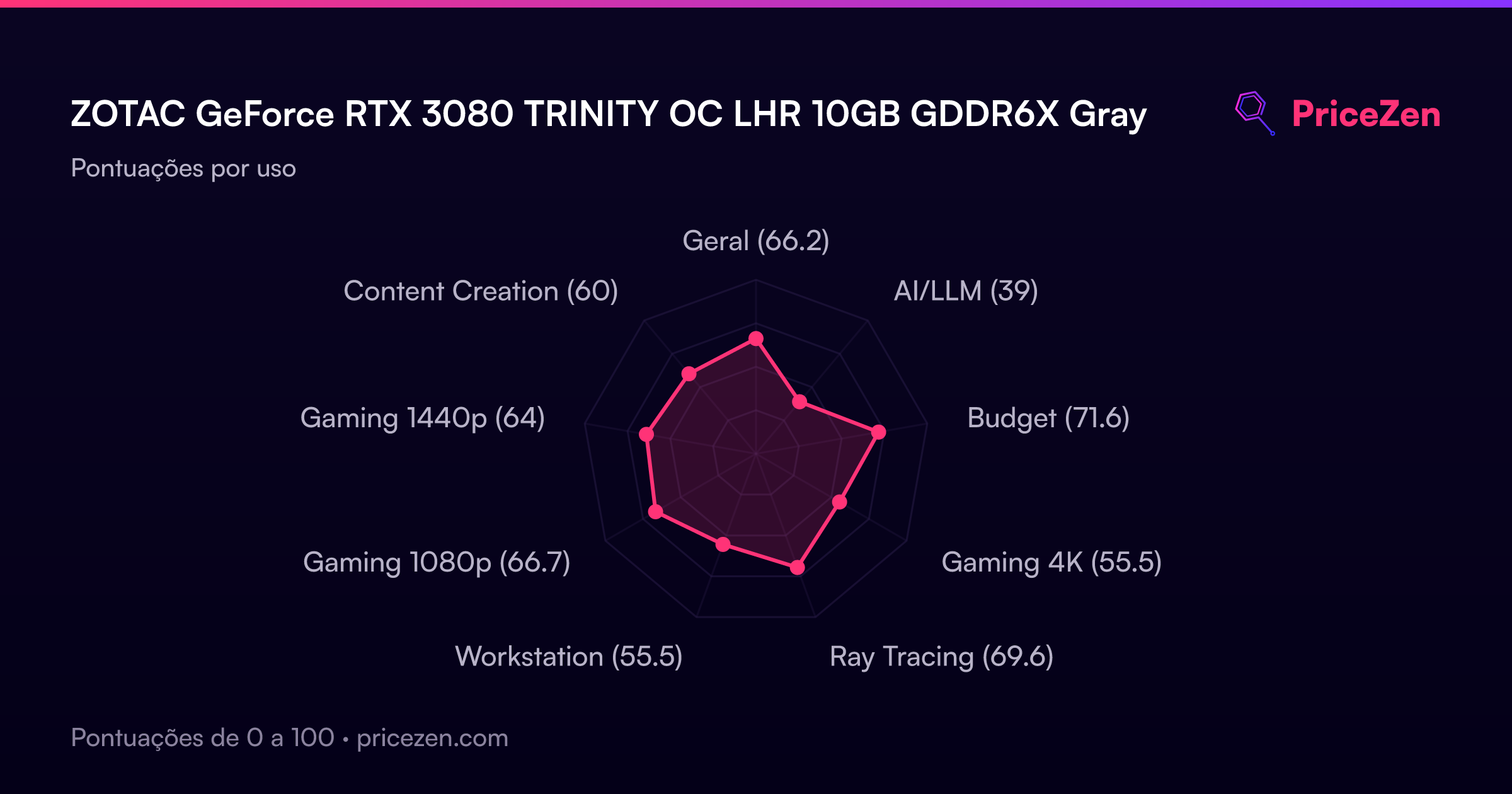
- Geral66.2
- AI/LLM39
- Budget71.6
- Gaming 4K55.5
- Ray Tracing69.6
- Workstation55.5
- Gaming 1080p66.7
- Gaming 1440p64
- Content Creation60