Sapphire Radeon RX 9070 PULSE 16GB GDDR6 Black

Placa PCIe 5.0 para placas-mãe atuais verificado em 28 de nov.
65/100 pontuação geral
- GPU
- Radeon RX 9070
- VRAM
- 16GB GDDR6
- Boost clock
- 2520 MHz
- TDP
- 220 W
- Memory bus
- 256 bit
- Ray tracing
- Sim
- Class
- consumer
Resumo
The 30-Second Version
Great 16GB card, terrible timing. The silicon deserves your attention, the CAD 1,890 sticker does not.
Pros & Cons
Prós
- 16GB on a 256-bit bus at 645 GB/s. Memory headroom is well above average and won't be your bottleneck. 82nd
- 220W and two 8-pins. Efficiency ranks near the top of the category. Your existing 650W PSU is fine. 81st
- Compute and AI scores outrun its gaming rank. 36.13 FP32 TFLOPS is real muscle for the money in shader work. 77th
- Four modern outputs. Two DP 2.1a plus two HDMI 2.1a is more flexibility than most cards give you. 76th
Contras
- Affordability is a weak spot. CAD 1,890 for a 68th-percentile raster card is a hard sell.
- Ray tracing is only about average. 56 RT cores land it mid-pack, so heavy RT titles aren't its home turf.
- Cooling and feature set are unremarkable. Dual fan, 2.5 slots, nothing extra. Both rank near the middle.
- Workstation is its worst score at 58/100. Don't buy this as a pro rendering card.
As provas
Performance
What surprised us most is how far ahead the compute side runs compared to plain raster. 36.13 FP32 TFLOPS and 72.25 FP16 put it near the top for compute and AI, while raster trails at 68 and ray tracing at 70. So this thing punches harder in shader-heavy and AI-assisted work than its raw frame-rate ranking suggests. The PassMark G3D benchmark score of 25398 backs up a strong upper-mid-tier card, not a flagship. Efficiency is the standout: 220W from two 8-pin connectors and a 650W PSU recommendation means no new power supply for most builds. The weak spots are thermal at 42 and feature at 43, both middle of the pack, which tracks with a straightforward dual-fan 2.5-slot cooler rather than anything fancy. At 280mm it'll fit most cases without drama.
Specifications
Full Specifications
Chipset
| GPU Chipset | Radeon RX 9070 |
| Brand | AMD |
| Architecture | RDNA 4 |
| Class | consumer |
| Process | 4 |
Memory
| VRAM | 16 GB |
| Memory Type | GDDR6 |
| Memory Bus | 256 |
| Bandwidth | 644.6 |
Compute
| Stream Processors | 3584 |
| Tensor Cores | 112 |
| RT Cores | 56 |
| Base Clock | 2070 |
| Boost Clock | 2520 |
| FP16 TFLOPS | 72.25 |
| FP32 TFLOPS | 36.13 |
Performance
| PassMark G3D | 25398 |
| GPU Compute | 14794 |
Power & Cooling
| TDP | 220 |
| Recommended PSU | 650 |
| Power Connectors | 2 x 8-Pin |
| Cooler | Dual Fan |
| Fans | 2 |
Connectivity
| Interface | PCI Express 5.0 x16 |
| DisplayPort | 2 |
| HDMI | 2 |
| Max Displays | 4 |
| Max Resolution | 7680 x 4320 |
Physical
| Length | 280 |
| Slot Width | 2.5 |
| Form Factor | ATX |
Features
| Ray Tracing | Yes |
| VR Ready | Yes |
| DirectX | 12 Ultimate |
vs Competition
This is where it gets uncomfortable. The Gigabyte RTX 5070 Ti Eagle Ice and MSI RTX 5070 Ti Ventus 3X OC are the direct cross-shops, and if you care about ray tracing you should look hard at both, because 70th percentile RT and 56 RT cores is the softest part of this card's gaming profile. If your budget stretches further, the ASUS RTX 5080 PRIME EVO OC, ZOTAC RTX 5080 APOCALYPSE and PNY RTX 5080 ARGB OC are the tier above, and the PULSE's 68th-percentile raster score isn't going to close that gap. The PULSE wins its argument on exactly two things: 16GB of well-connected memory and a 220W draw that keeps your PSU and your power bill happy. If those two matter more to you than frames per dollar, it holds up. Otherwise the NVIDIA options are the ones to price-check first.
| Spec | Sapphire Radeon RX 9070 PULSE | ASUS GeForce RTX 5090 TUF Gaming | Gigabyte GeForce RTX 5070 Ti Eagle Ice | MSI GeForce RTX 5070 Ti Ventus 3X OC | ZOTAC GeForce RTX 5080 APOCALYPSE | PNY GeForce RTX 5080 ARGB OC |
|---|---|---|---|---|---|---|
| Chipset | Radeon RX 9070 | GeForce RTX 5090 | GeForce RTX 5070 Ti | GeForce RTX 5070 Ti | GeForce RTX 5080 | GeForce RTX 5080 |
| Vram | 16GB GDDR6 | 32GB GDDR7 | 16GB GDDR7 | 16GB GDDR7 | 16GB GDDR7 | 16GB GDDR7 |
| Boost Clock Mhz | 2520 | 2407 | 2542 | 2482 | 2730 | 2620 |
| Tdp W | 220 | 575 | 300 | 300 | 360 | 360 |
| Memory Bus Bits | 256 | 512 | 256 | 256 | 256 | 256 |
| Ray Tracing | Yes | Yes | Yes | Yes | Yes | Yes |
| GPU Class | consumer | consumer | consumer | consumer | consumer | consumer |
| Compare | Compare | Compare | Compare | Compare |
| Produto | AI | Rt | Vram | Raster | Compute | Feature | Thermal | Efficiency | Connectivity | Affordability |
|---|---|---|---|---|---|---|---|---|---|---|
| Sapphire Radeon RX 9070 PULSE | 81.5 | 69.6 | 75.2 | 67.4 | 77.4 | 43.2 | 41.6 | 80.6 | 76 | 30.1 |
| ASUS GeForce RTX 5090 TUF Gaming Compare | 97.2 | 90.5 | 97.8 | 98.8 | 97.7 | 95.7 | 71.8 | 23.1 | 99.3 | 2.2 |
| Gigabyte GeForce RTX 5070 Ti Eagle Ice Compare | 78.9 | 88.6 | 86 | 88.9 | 87.9 | 95.7 | 91.8 | 71.6 | 94.2 | 23 |
| MSI GeForce RTX 5070 Ti Ventus 3X OC Compare | 78.9 | 92.4 | 86 | 88.9 | 87.9 | 95.7 | 91.8 | 71.6 | 94.2 | 21.1 |
| ZOTAC GeForce RTX 5080 APOCALYPSE Compare | 85.5 | 97.7 | 89.1 | 94.4 | 93.3 | 95.7 | 91.8 | 56.6 | 94.2 | 23.3 |
| PNY GeForce RTX 5080 ARGB OC Compare | 85.5 | 97.7 | 89.1 | 94.4 | 93.3 | 95.7 | 91.8 | 56.6 | 94.2 | 15.9 |
Preço
Value & Pricing
Not at CAD 1,890. The specs justify a strong upper-mid-tier price, and this isn't one. We track prices over time and this card's affordability ranking is one of the worst for a reason. If you find it substantially cheaper, the 16GB and 220W efficiency make it a smart pick. At the current Newegg listing, walk away and cross-shop.
Saiba mais
Overview
The Sapphire PULSE RX 9070 is a genuinely capable 1440p card wearing a price tag that doesn't match its own spec sheet. That's the whole story here. The silicon is good: 16GB of GDDR6 on a 256-bit bus pushing 645 GB/s, 3584 stream processors, and a 2520MHz boost clock on AMD's 4nm RDNA 4. Our scoring model puts its efficiency and AI numbers well above average for the category, and 220W is a refreshingly sane power draw for this much card.
But affordability is one of the worst in our data, and the only listing we're tracking is CAD 1,890 at Newegg. That's a lot of money for a card whose raster score is solid but not leading. Buy this for the memory and the low power draw, not because you think you're getting a bargain.
Common Questions
Q: Will my power supply handle it?
If you've got a decent 650W unit with two free 8-pin PCIe connectors, yes. 220W TDP is modest for this class and efficiency is one of its best rankings.
Q: Is 16GB actually useful or just marketing?
Useful. It's 16GB on a 256-bit bus at 645 GB/s, which puts VRAM well above average in our data. Texture-heavy 1440p and beyond won't hit a memory wall.
Q: Can I use this for Blender or pro rendering work?
You can, but don't buy it for that. Workstation is its lowest score at 58/100. The compute numbers are strong on paper, but this is a gaming card first.
Who Should Skip This
If you want maximum ray tracing performance or the best frames per dollar, this isn't it. Go price the Gigabyte RTX 5070 Ti Eagle Ice or MSI RTX 5070 Ti Ventus 3X OC instead. And if you're building a workstation for rendering, the 58/100 workstation score should end that conversation immediately.
Verdict
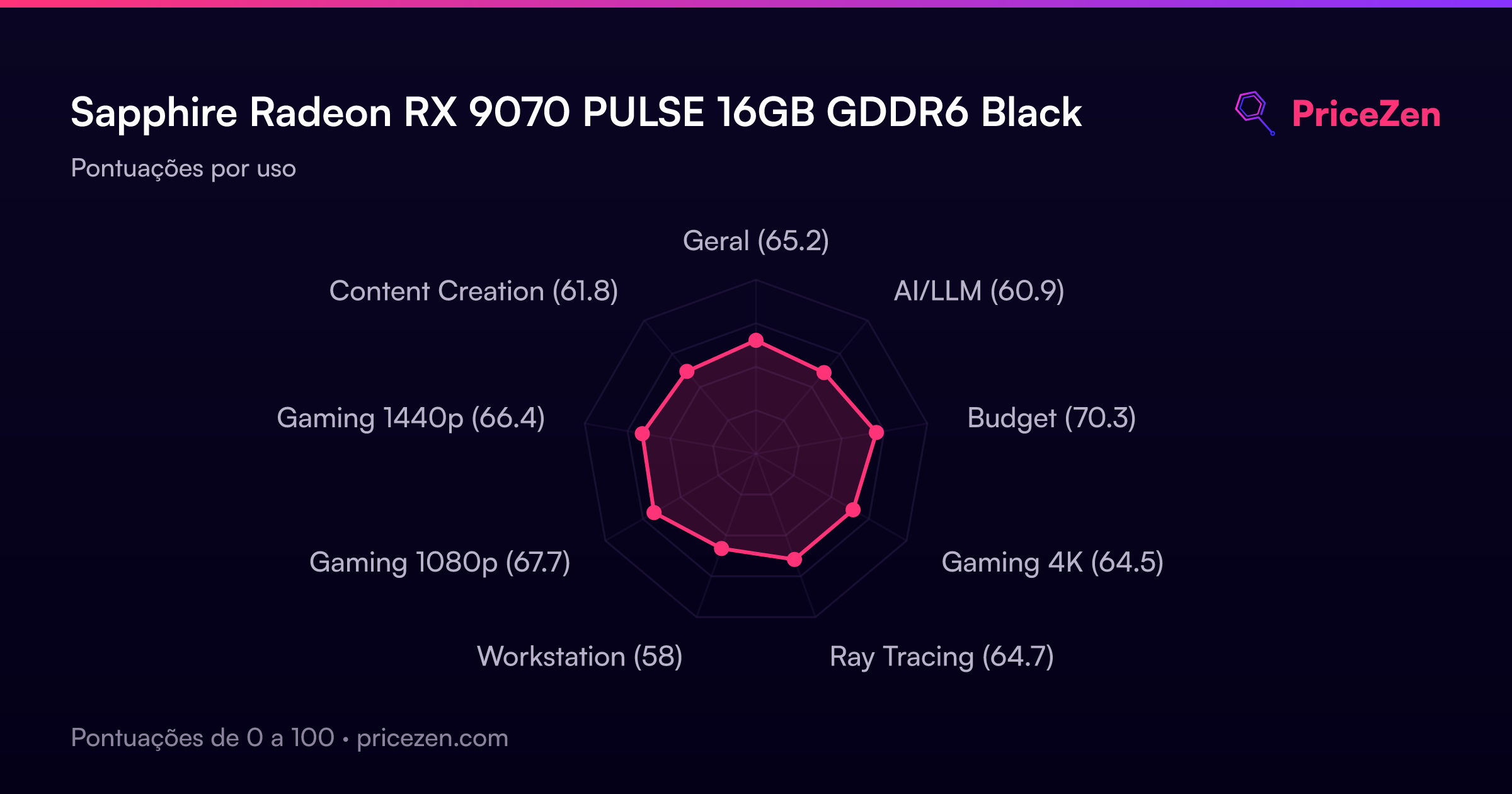
Good card, wrong price. We'd recommend the PULSE RX 9070 without hesitation as an efficient, memory-rich 1440p build if the number on the tag made sense. It doesn't right now. Our budget score of 70.3/100 and 1440p gaming score of 66.4/100 say competent, not compelling, and CAD 1,890 asks flagship-adjacent money for it. Watch the price, and if it drops meaningfully, grab it. Today, put the 5070 Ti cards at the top of your shortlist instead.
Usage Scores
- Geral65.2
- AI/LLM60.9
- Budget70.3
- Gaming 4K64.5
- Ray Tracing64.7
- Workstation58
- Gaming 1080p67.7
- Gaming 1440p66.4
- Content Creation61.8