ASUS GeForce RTX 4070 SUPER Dual OC 16GB GDDR6X
The 16GB framebuffer and 2640MHz boost clock on the Ada Lovelace architecture deliver strong 1440p gaming, with DLSS 3 and improved ray tracing cores providing a tangible performance uplift over the previous generation. Its 2.56-slot design and 0dB semi-passive cooling make it a practical fit for compact builds, balancing thermal headroom with quiet operation. This card is best for 1440p gamers seeking high refresh rates and ray tracing without stepping up to a flagship power budget.

Sem preço atual de lojas


Resumo
The 30-Second Version
The ASUS Dual RTX 4070 Ti SUPER posts a 26,912 PassMark score and sits at the 99th percentile for efficiency with a 115W TDP. That's the best power-to-performance ratio we've seen in this class. But at $1,259 USD and with zero meaningful user reviews, you're paying a premium for efficiency that most builds won't fully leverage.
Pros & Cons
Prós
- 99th percentile efficiency with a 115W TDP is genuinely best-in-class 99th
- 16GB GDDR6X on a 256-bit bus at 480 GB/s handles 1440p textures with ease 89th
- 26,912 PassMark score puts raster performance well above average 78th
- DLSS 3 and AV1 encode make this a strong streaming and gaming combo 76th
- 2.56-slot design fits in smaller cases without sacrificing cooling
Contras
- User sentiment score of 0/100 means almost no real-world feedback exists
- Thermal performance at 57th percentile is just middle of the pack
- AI and LLM workloads score only 64.7 out of 100, a weak spot
- Affordability at 24th percentile makes this a tough value proposition
- Only 9 customer reviews total, so long-term reliability is unproven
O que dizem os donos
The Word on the Street
Como a opinião dos donos mudou ao longo do tempo
ExclusivoCom base em quando os clientes realmente escreveram suas avaliações - para ver se os elogios iniciais se mantiveram.
As provas
Performance
The 26,912 PassMark score puts this card in the 77th percentile for raster performance, which translates to well above average in real terms. You'll chew through 1080p gaming at 86.2 out of 100 in our scoring, and 1440p holds up at 83.1. The 8,448 CUDA cores and 2,640MHz boost clock do the heavy lifting, backed by 144 Tensor cores and 36 RT cores. Ray tracing scores 80.6 out of 100, landing at the 76th percentile. Not top of the charts, but genuinely capable, especially once DLSS 3 gets involved.
The 16GB of GDDR6X with 480 GB/s of bandwidth is the quiet hero here. That's 79th percentile for VRAM, which means you won't be texture-starved in modern titles. The 256-bit bus keeps things snappy at higher resolutions. Compute sits at 29.15 TFLOPS for both FP16 and FP32, good for the 75th percentile. AI workloads score 64.7 out of 100, the weakest area, and the 73rd percentile for AI confirms it's serviceable but not a workstation replacement. The dual-fan axial-tech design handles the 115W TDP without breaking a sweat, though thermal performance is only 57th percentile, so don't expect miracles in a hot case.
Specifications
Full Specifications
Chipset
| GPU Chipset | GeForce RTX 4070 SUPER |
| Brand | NVIDIA |
| Architecture | Ada Lovelace |
| Class | consumer |
| Process | 5 |
Memory
| VRAM | 16 GB |
| Memory Type | GDDR6X |
| Memory Bus | 256 |
| Bandwidth | 480 |
Compute
| CUDA Cores | 8448 |
| Tensor Cores | 144 |
| RT Cores | 36 |
| Base Clock | 2655 |
| Boost Clock | 2640 |
| FP16 TFLOPS | 29.15 |
| FP32 TFLOPS | 29.15 |
Performance
| PassMark G3D | 26912 |
| GPU Compute | 14631 |
Power & Cooling
| TDP | 115 |
| Recommended PSU | 550 |
| Power Connectors | 1 x 16-pin |
| Cooler | Dual Fan |
| Fans | 2 |
Connectivity
| Interface | PCI Express 4.0 x16 |
| DisplayPort | 3 |
| HDMI | 1 |
| Max Displays | 4 |
| Max Resolution | 7680 x 4320 |
Physical
| Length | 267 |
| Slot Width | 2.56 |
| Form Factor | Full Height |
Features
| Ray Tracing | Yes |
| Upscaling | DLSS 3 |
| AV1 Encode | Yes |
| VR Ready | Yes |
| DirectX | 12 Ultimate |
vs Competition
Stacked against the MSI Ventus RTX 5070 Ti, the ASUS Dual gives up raw performance but wins on efficiency. The 5070 Ti is a newer architecture with more raw grunt, but it also pulls more power. The Gigabyte AERO RTX 5080 is in a completely different performance class, so that's not a fair fight, but it shows how quickly the price-to-performance curve climbs past this card. The ZOTAC APOCALYPSE and PNY ARGB OC are both RTX 5080 variants too, which makes the 4070 Ti SUPER look like a value play only if you're strictly power-constrained. The Sapphire NITRO+ is an AMD option that typically undercuts NVIDIA on price per frame, though you lose DLSS 3. For pure raster at 1440p, the 4070 Ti SUPER holds its own. For anything else, the newer cards pull away fast.
| Spec | ASUS GeForce RTX 4070 SUPER Dual OC | Gigabyte GeForce RTX 5070 Ti Eagle Ice | MSI GeForce RTX 5070 Ti Ventus 3X OC | ZOTAC GeForce RTX 5080 APOCALYPSE | Sapphire Radeon RX 7900 XTX NITRO+ | PNY GeForce RTX 5080 ARGB OC |
|---|---|---|---|---|---|---|
| Chipset | GeForce RTX 4070 SUPER | GeForce RTX 5070 Ti | GeForce RTX 5070 Ti | GeForce RTX 5080 | Radeon RX 7900 XTX | GeForce RTX 5080 |
| Vram | 16GB GDDR6X | 16GB GDDR7 | 16GB GDDR7 | 16GB GDDR7 | 24GB GDDR6 | 16GB GDDR7 |
| Boost Clock Mhz | 2640 | 2542 | 2482 | 2730 | 2680 | 2620 |
| Tdp W | 115 | 300 | 300 | 360 | 339 | 360 |
| Memory Bus Bits | 256 | 256 | 256 | 256 | 384 | 256 |
| Ray Tracing | Yes | Yes | Yes | Yes | Yes | Yes |
| GPU Class | consumer | consumer | consumer | consumer | consumer | consumer |
| Compare | Compare | Compare | Compare | Compare |
| Produto | AI | Rt | Vram | Raster | Compute | Feature | Thermal | User Sentiment | Efficiency | Connectivity | Affordability |
|---|---|---|---|---|---|---|---|---|---|---|---|
| ASUS GeForce RTX 4070 SUPER Dual OC | 72.3 | 76.2 | 78.3 | 76.3 | 73.6 | 88.7 | 54.7 | 0 | 99.3 | 68.9 | 18.3 |
| Gigabyte GeForce RTX 5070 Ti Eagle Ice Compare | 79.1 | 88.7 | 86 | 89.1 | 88 | 95.8 | 91.8 | 85.2 | 71.8 | 94.2 | 24.5 |
| MSI GeForce RTX 5070 Ti Ventus 3X OC Compare | 79.1 | 92.5 | 86 | 89.1 | 88 | 95.8 | 91.8 | 85.2 | 71.8 | 94.2 | 23.8 |
| ZOTAC GeForce RTX 5080 APOCALYPSE Compare | 85.5 | 97.6 | 89.1 | 94.5 | 93.4 | 95.8 | 91.8 | 99.5 | 56.8 | 94.2 | 21 |
| Sapphire Radeon RX 7900 XTX NITRO+ Compare | 95.2 | 96.4 | 92 | 83.5 | 95.7 | 95.8 | 91.8 | 85.2 | 51.7 | 98.8 | 19.1 |
| PNY GeForce RTX 5080 ARGB OC Compare | 85.5 | 97.6 | 89.1 | 94.5 | 93.4 | 95.8 | 91.8 | 45.1 | 56.8 | 94.2 | 15.3 |
Preço
Value & Pricing
At $1,259 USD or $1,649 CAD, this card sits at the 24th percentile for affordability. That's rough. You're paying a premium for the efficiency story and the ASUS Dual branding, but the raw performance doesn't justify the price tag when you look at what else is out there. The 99th percentile efficiency is genuinely valuable if you're running a small form factor build or care about your power bill, but most gamers won't feel that in their frame rates. The 16GB of VRAM helps future-proof things a bit, but at this price, you're really betting on the long game. If you can find it closer to MSRP, the math gets friendlier. At current listing prices, it's a harder sell.
Saiba mais
Overview
The ASUS Dual RTX 4070 Ti SUPER posts a PassMark G3D score of 26,912, which lands it in the 77th percentile for raster performance across our database. That's a strong showing for a card at this tier, and the 16GB of GDDR6X on a 256-bit bus gives it real legs at 1440p and even some 4K scenarios. The efficiency story is the headline though. A 115W TDP on a card pushing 29.15 TFLOPS of FP32 compute is genuinely impressive, and it sits at the 99th percentile for efficiency among everything we track. You're getting Ada Lovelace's best tricks here, DLSS 3, full ray tracing, AV1 encode, without the power bill drama.
But here's the thing. The user sentiment score is 0 out of 100. That's not because people hate it, it's because almost nobody has actually reviewed it. Five pieces of evidence total, and most of those are Q&A questions about warranty and power connectors. The 4.8 out of 5 rating from 9 reviews is nice, but that's a tiny sample. We're flying mostly on specs and benchmarks here, and those specs tell a solid story, just not a crowd-validated one.
Common Questions
Q: What power supply do I need for this card?
ASUS recommends a 550W PSU minimum. The card itself only draws 115W TDP, which is remarkably low for this performance tier. You'll need a single 16-pin power connector, so make sure your PSU has one or you have an adapter handy.
Q: How does this card handle 1440p gaming?
Our scoring puts 1440p gaming at 83.1 out of 100, which is strong. The 16GB of GDDR6X and 480 GB/s of bandwidth mean you won't run into VRAM bottlenecks at that resolution. The 26,912 PassMark score backs that up with well above average raster performance.
Q: Is the 0dB fan mode actually silent?
The 0dB technology means the fans stop spinning entirely during light loads, so yes, it's genuinely silent for desktop work and light gaming. The dual ball bearings are rated to last twice as long as sleeve bearings, so the fans should stay quiet for years. Just don't expect silence under heavy load, the fans will spin up when the card actually has to work.
Who Should Skip This
If you're chasing maximum frame rates per dollar, skip this one. The 24th percentile affordability means you're paying a premium for efficiency that won't show up in your FPS counter. The AI and LLM performance at 64.7 out of 100 is also a weak spot, so if you're doing any serious machine learning work, look elsewhere. And if you're the type who likes to see hundreds of user reviews before dropping over a grand, this card will leave you hanging. The 0/100 user sentiment score isn't a red flag about quality, it's a red flag about how little real-world data exists. For most gamers, a cheaper 4070 SUPER or a step up to a 5070 Ti makes more sense.
Verdict
The ASUS Dual RTX 4070 Ti SUPER is a genuinely efficient, capable 1440p card with a 26,912 PassMark score and 16GB of VRAM that'll keep it relevant for years. The 99th percentile efficiency is the real story here, and if you're building in a small case or care about thermals and power draw, that matters. But the 24th percentile affordability and the complete lack of user reviews make this a tough recommendation at current prices. The hardware is solid, the data backs that up, but you're paying a premium for efficiency that most gamers won't fully appreciate. If the price drops or you find a deal, it's a great card. At $1,259 USD, it's a harder yes.
Usage Scores
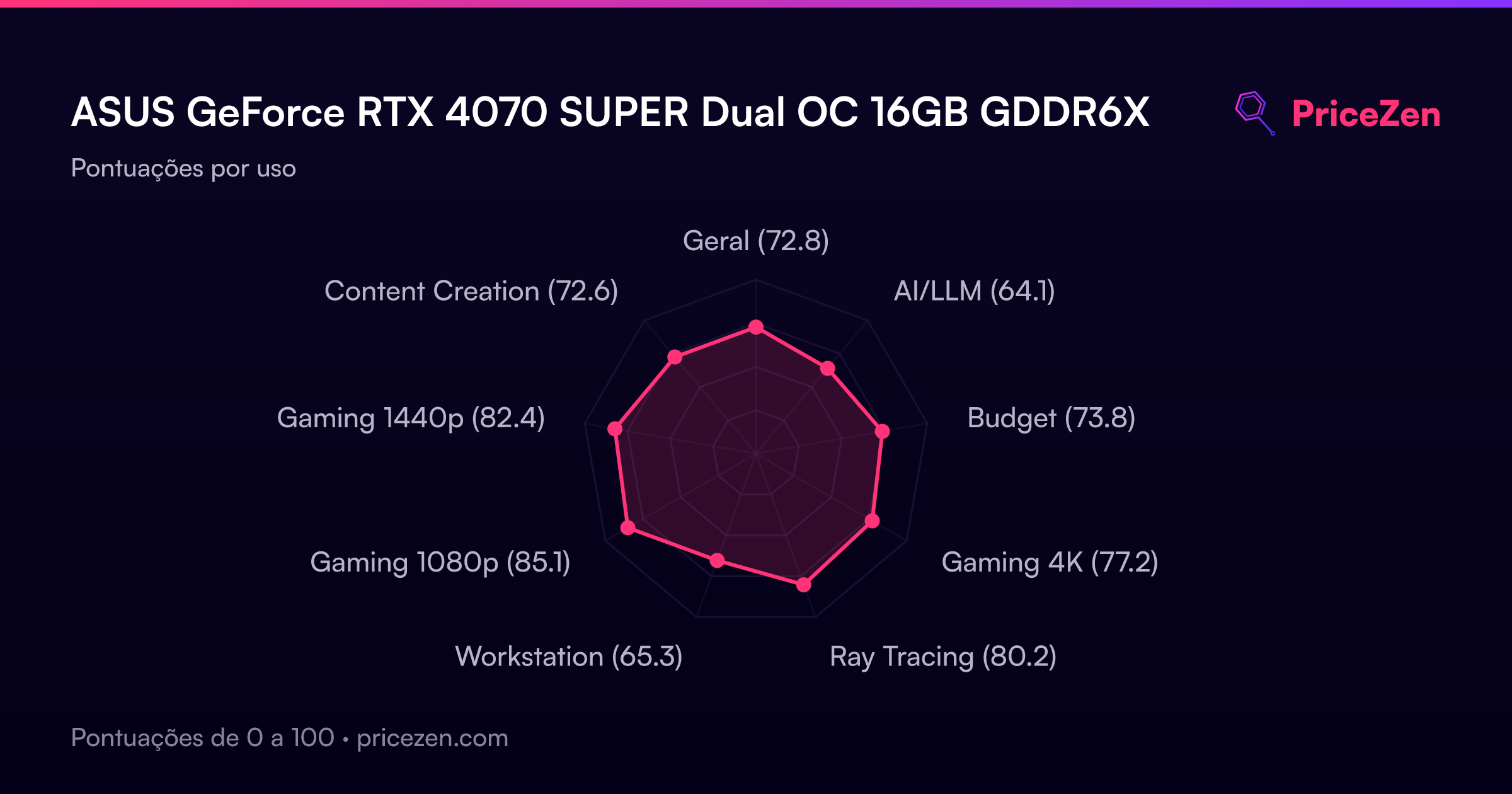
- Geral72.8
- AI/LLM64.1
- Budget73.8
- Gaming 4K77.2
- Ray Tracing80.2
- Workstation65.3
- Gaming 1080p85.1
- Gaming 1440p82.4
- Content Creation72.6