ZOTAC GeForce RTX 3060 Twin Edge 12GB GDDR6

Ventoinhas param em repouso para um PC silencioso verificado em 29 de nov.
51/100 pontuação geral 4,7 média de 4.700 avaliações de proprietários
- GPU
- GeForce RTX 3060
- VRAM
- 12GB GDDR6
- Boost clock
- 1807 MHz
- TDP
- 170 W
- Memory bus
- 192 bit
- Ray tracing
- Sim
- Class
- consumer


Resumo
The 30-Second Version
The ZOTAC RTX 3060 Twin Edge is a compact, low-draw 12GB card that handles 1080p well and visits 1440p with DLSS help. Its 12GB GDDR6 buffer and 224mm dual-slot design are the standouts, while raster performance sits below the middle of our rankings. At USD 495 from Amazon (CAD 430 in Canada), it's priced for its niche rather than its speed. Great for small builds and big upgrades from old hardware, less so if you want maximum frames per dollar.
Pros & Cons
Prós
- 12GB GDDR6 gives real headroom for textures and creative apps 94th
- Compact 224mm, dual-slot design fits small cases 66th
- Single 8-pin connector and 170W draw, easy on older PSUs
- 4.7/5 from 4700 reviews, one of the best-supported cards in our data
- Freeze Fan Stop plus metal backplate at a budget price
Contras
- Raster performance falls behind most current cards (36th percentile)
- 240 GB/s on a 192-bit bus limits what the 12GB can do
- AI/LLM score of 37.7/100 is its weakest area
- Ray tracing ranks slightly below average despite RT cores
- USD 495 asks a lot for a mid-pack performer
O que dizem os donos
The Word on the Street
- A recurring theme is how transformative this card feels for people upgrading from much older GPUs, with multiple owners describing builds around modern CPUs where the 3060 finally removed the bottleneck.
- Long-term owners report solid reliability, including buyers who've run the card for a couple of years without complaints and found recent demanding titles playable at 1440p-class resolutions.
- Several buyers push back on ZOTAC's budget-brand reputation, arguing the on-paper specs hold up against pricier names, while acknowledging this is fundamentally a high-spec 1080p card that needs the right settings for 1440p at 60fps.
- Owners lean on DLSS more than raw power, with reports of certain games running smoothly even at 4K once upscaling is switched on, which matches the card's feature-heavy, throughput-modest profile.
Como a opinião dos donos mudou ao longo do tempo
ExclusivoCom base em quando os clientes realmente escreveram suas avaliações - para ver se os elogios iniciais se mantiveram.
13 avaliações escritas, mar. de 2021 – mar. de 2026: 13 satisfeitos
Em todas as 4.700 notas das lojas: 4,7★. A maioria dos donos dá nota sem escrever avaliação. O gráfico conta as 13 avaliações escritas.
Cada ponto é uma avaliação escrita, no mês em que foi escrita. Satisfeitos = 4-5★, neutros = 3★, insatisfeitos = 1-2★.
As provas
Performance
The external PassMark G3D benchmark score sits at 16890, and our raster ranking places this card below the middle of the pack, around the 36th percentile. Translation: it'll run modern games fine at 1080p with settings dialed sensibly, but it isn't going to brute-force high refresh rates in demanding titles. Compute lands similarly low at the 34th percentile, backed by 12.74 FP32 TFLOPS. Where it claws back ground is features. DLSS and second-gen RT cores give you upscaling and ray tracing options that raw shader counts don't capture, and owners report leaning on DLSS to make 1440p and even some 4K playable. One buyer specifically mentioned smooth 1440p-class performance in a recent Battlefield beta, which lines up with our 51.3/100 1440p score: doable, with compromises.
The trade-off worth naming is bandwidth. 240 GB/s across a 192-bit bus is modest, and that's part of why the 12GB buffer doesn't translate into top-tier frame rates. Big VRAM helps you avoid stutter and load heavy assets; it doesn't make the GPU faster. Efficiency sits about average at the 59th percentile with a 170W draw and a 600W minimum PSU recommendation, so power bills and heat are manageable but not class-leading. Thermals rank mid-pack too, which for a compact dual-fan card is a fair result rather than a win. And if you're eyeing local AI work, our AI/LLM score of 37.7/100 is the weakest thing here despite the generous memory.
Specifications
Full Specifications
Chipset
| GPU Chipset | GeForce RTX 3060 |
| Brand | NVIDIA |
| Architecture | Ampere |
| Class | consumer |
| Process | 8 |
Memory
| VRAM | 12 GB |
| Memory Type | GDDR6 |
| Memory Bus | 192 |
| Bandwidth | 240 |
Compute
| CUDA Cores | 3584 |
| Tensor Cores | 120 |
| RT Cores | 30 |
| Base Clock | 1283 |
| Boost Clock | 1807 |
| FP16 TFLOPS | 12.74 |
| FP32 TFLOPS | 12.74 |
Performance
| PassMark G3D | 16890 |
| GPU Compute | 8110 |
Power & Cooling
| TDP | 170 |
| Recommended PSU | 600 |
| Power Connectors | 8-pin |
| Cooler | Dual Fan |
| Fans | 2 |
Connectivity
| Interface | PCI Express 4.0 |
| DisplayPort | 3 |
| HDMI | 1 |
| Max Displays | 4 |
| Max Resolution | 8K |
Physical
| Length | 224 |
| Slot Width | 2 |
| Form Factor | Full Height |
| Weight | 0.9 kg / 2.0 lbs |
Features
| Ray Tracing | Yes |
| Upscaling | DLSS |
| VR Ready | Yes |
| DirectX | 12 Ultimate |
vs Competition
Cross-shopping this against the Gigabyte GeForce RTX 5070 Ti Eagle Ice, MSI GeForce RTX 5070 Ti GAMING TRIO or ASUS GeForce RTX 5070 Ti TUF Gaming is a bit of a mismatch on paper, and that's the point. Those cards sit in a different performance conversation, and our raster ranking for the 3060 at the 36th percentile makes the gap obvious. If your budget stretches to that tier and your case and PSU can handle it, the 5070 Ti options are where you go for high-refresh 1440p. The 3060's counterargument is physical and electrical: 224mm, two slots, one 8-pin, 170W. Small-form-factor builders and people upgrading prebuilts with modest power supplies genuinely can't always take the bigger option.
The PNY GeForce RTX 5070 Ti OC and Sapphire Radeon RX 9070 XT PULSE round out the competitor set, and again the honest framing is that this ZOTAC gives ground on raw throughput to all of them. Where it holds its own is feature coverage relative to its class: DLSS, second-gen RT cores, HDMI 2.1 plus three DisplayPort 1.4a outputs for four simultaneous displays, and VR Ready certification. Our feature ranking of 66 puts it comfortably above average there. So the decision tree is simple. Want maximum frames per dollar and have room and watts? Look at the competitors. Need a short, low-draw card with lots of VRAM and proven owner satisfaction? This one earns its spot.
| Spec | ZOTAC GeForce RTX 3060 Twin Edge | Gigabyte GeForce RTX 5070 Ti Eagle Ice | ASUS GeForce RTX 5080 PRIME EVO OC | MSI GeForce RTX 5070 Ti Ventus 3X OC | PNY GeForce RTX 5080 ARGB OC | Sapphire Radeon RX 7900 XTX NITRO+ |
|---|---|---|---|---|---|---|
| Chipset | GeForce RTX 3060 | GeForce RTX 5070 Ti | GeForce RTX 5080 | GeForce RTX 5070 Ti | GeForce RTX 5080 | Radeon RX 7900 XTX |
| Vram | 12GB GDDR6 | 16GB GDDR7 | 16GB GDDR7 | 16GB GDDR7 | 16GB GDDR7 | 24GB GDDR6 |
| Boost Clock Mhz | 1807 | 2542 | 2685 | 2482 | 2620 | 2680 |
| Tdp W | 170 | 300 | 360 | 300 | 360 | 339 |
| Memory Bus Bits | 192 | 256 | 256 | 256 | 256 | 384 |
| Ray Tracing | Yes | Yes | Yes | Yes | Yes | Yes |
| GPU Class | consumer | consumer | consumer | consumer | consumer | consumer |
| Compare | Compare | Compare | Compare | Compare |
| Produto | AI | Rt | Vram | Raster | Compute | Feature | Thermal | Efficiency | Connectivity | Prova social | Affordability |
|---|---|---|---|---|---|---|---|---|---|---|---|
| ZOTAC GeForce RTX 3060 Twin Edge | 50.5 | 45.5 | 50.7 | 36.1 | 33.7 | 65.6 | 54.3 | 58.7 | 54.7 | 93.7 | 60.3 |
| Gigabyte GeForce RTX 5070 Ti Eagle Ice Compare | 78.9 | 88.6 | 86 | 88.9 | 87.8 | 95.7 | 91.8 | 71.6 | 94.2 | 93.7 | 22.9 |
| ASUS GeForce RTX 5080 PRIME EVO OC Compare | 85.5 | 97.7 | 89.1 | 94.5 | 93.3 | 88.4 | 91.8 | 56.6 | 94.2 | 93.7 | 19.3 |
| MSI GeForce RTX 5070 Ti Ventus 3X OC Compare | 78.9 | 92.4 | 86 | 88.9 | 87.8 | 95.7 | 91.8 | 71.6 | 94.2 | 84.1 | 21.1 |
| PNY GeForce RTX 5080 ARGB OC Compare | 85.5 | 97.7 | 89.1 | 94.5 | 93.3 | 95.7 | 91.8 | 56.6 | 94.2 | 75.1 | 16.1 |
| Sapphire Radeon RX 7900 XTX NITRO+ Compare | 95.3 | 96.4 | 92 | 83.4 | 95.6 | 95.7 | 91.8 | 51.3 | 98.8 | 69.5 | 13.7 |
Preço
Value & Pricing
Here's where we'd pump the brakes. In our US data the only listing is Amazon at USD 495, and our affordability ranking sits at the 60th percentile, meaning slightly better than average but nothing special. For a card whose raster and compute scores land in the lower third, that price is doing a lot of heavy lifting on the strength of 12GB VRAM and brand familiarity. The budget score of 75.2/100 tells us it's a reasonable pick within its own tier, not that it's a steal against everything else on the shelf.
Canadian buyers see CAD 430 from a single listing, and we'd treat those as separate markets rather than trying to line them up. We track prices over time, partly through our community browser extension, and with one US listing in stock there's no store-to-store arbitrage to chase here. If you're paying USD 495, you should be doing it because the compact size, low power draw and 12GB buffer specifically solve a problem for you.
Saiba mais
Overview
The ZOTAC GeForce RTX 3060 Twin Edge is the kind of card that keeps showing up in build lists because it does a lot of things reasonably well without asking much in return. You get NVIDIA's Ampere silicon on an 8nm process, 3584 CUDA cores boosting to 1807MHz, and 12GB of GDDR6 on a 192-bit bus pushing 240 GB/s. That memory config is the interesting part: plenty of cards in this bracket ship with less VRAM, and 12GB gives you breathing room for texture-heavy games, video timelines and light creative work.
This is aimed at the person building or refreshing a 1080p machine who wants ray tracing and DLSS in the toolbox rather than raw horsepower at any cost. Our scoring puts its budget fit at 75.2 out of 100, which is the strongest number on its sheet. Gaming scores land at 53/100 for 1080p and 51.3/100 for 1440p, so think competent rather than thrilling. It's a sensible card, not a flex.
The physical design helps too. At 224mm long and two slots thick, it fits cases where bigger cards simply won't, and the single 8-pin connector plus 170W max draw means you're not rewiring your whole system. IceStorm 2.0 cooling with Active Fan Control and Freeze Fan Stop means the fans stop spinning at idle, and there's a metal backplate rather than bare PCB. Owners clearly like it: 4.7 out of 5 across 4700 reviews puts its social proof near the top of our graphics card rankings.
Common Questions
Q: Can the RTX 3060 Twin Edge actually game at 1440p?
Yes, with expectations set correctly. Our 1440p gaming score is 51.3/100, and owners report hitting 60fps at that resolution with adjusted settings and DLSS enabled. It's a capable 1440p visitor, not a high-refresh 1440p card.
Q: Will it fit my case and power supply?
Very likely. At 224mm long and two slots wide with a single 8-pin connector, it's one of the easier cards to accommodate. ZOTAC specifies a 600W minimum PSU and 170W max draw, so most decent mid-range supplies handle it without drama.
Q: Is 12GB of VRAM overkill for this GPU?
It's more than the chip can fully exploit, since the 192-bit bus delivers 240 GB/s and our raster ranking sits at the 36th percentile. But the extra memory prevents texture-related stutter and helps in creative apps, so it's headroom rather than waste.
Q: Is USD 495 a fair price right now?
Our affordability ranking puts it at the 60th percentile, so slightly better than average but not a bargain. With Amazon as the only US listing in our data at USD 495, you're paying for the compact design, 12GB buffer and proven reliability rather than class-leading speed.
Who Should Skip This
Skip this if your priority is frames per dollar at 1440p or beyond. The raster and compute rankings both sit in the lower third of our graphics card data, and at USD 495 you're not getting a discount that compensates. Builders with full-size cases and adequate power supplies should look hard at the Gigabyte GeForce RTX 5070 Ti Eagle Ice, PNY GeForce RTX 5070 Ti OC or Sapphire Radeon RX 9070 XT PULSE instead, because those exist in a different performance tier.
Also skip it if local AI or LLM experimentation is the plan. The 12GB looks tempting on paper, but our AI/LLM score of 37.7/100 is this card's weakest metric, and modest bandwidth plus mid-pack compute means you'll hit walls quickly. Same story for heavy ray tracing enthusiasts: RT support exists, but our ray tracing ranking lands just below average, so treat it as a bonus feature rather than a reason to buy.
Verdict
For a 1080p gamer upgrading from something ancient, this is an easy recommendation. Several owners describe exactly that jump, coming from cards generations old and finding everything suddenly playable. The 12GB buffer means you won't be turning textures down just to fit in memory, DLSS gives you a lever to pull when a game gets heavy, and the compact cooler with fan stop keeps things quiet at idle. If you're building a small or budget-conscious machine and want ray tracing available rather than mandatory, it does the job.
For anyone chasing 1440p high refresh or planning to lean on ray tracing hard, we'd point you elsewhere. Our 1440p score of 51.3/100 and below-average RT ranking say this card can visit 1440p, not live there comfortably. And at USD 495 with only one US listing in our data, the value case depends entirely on your constraints. Constrained by size, power or a specific need for 12GB? Buy it. Constrained only by budget? Compare against the newer cards in our competitor list before committing.
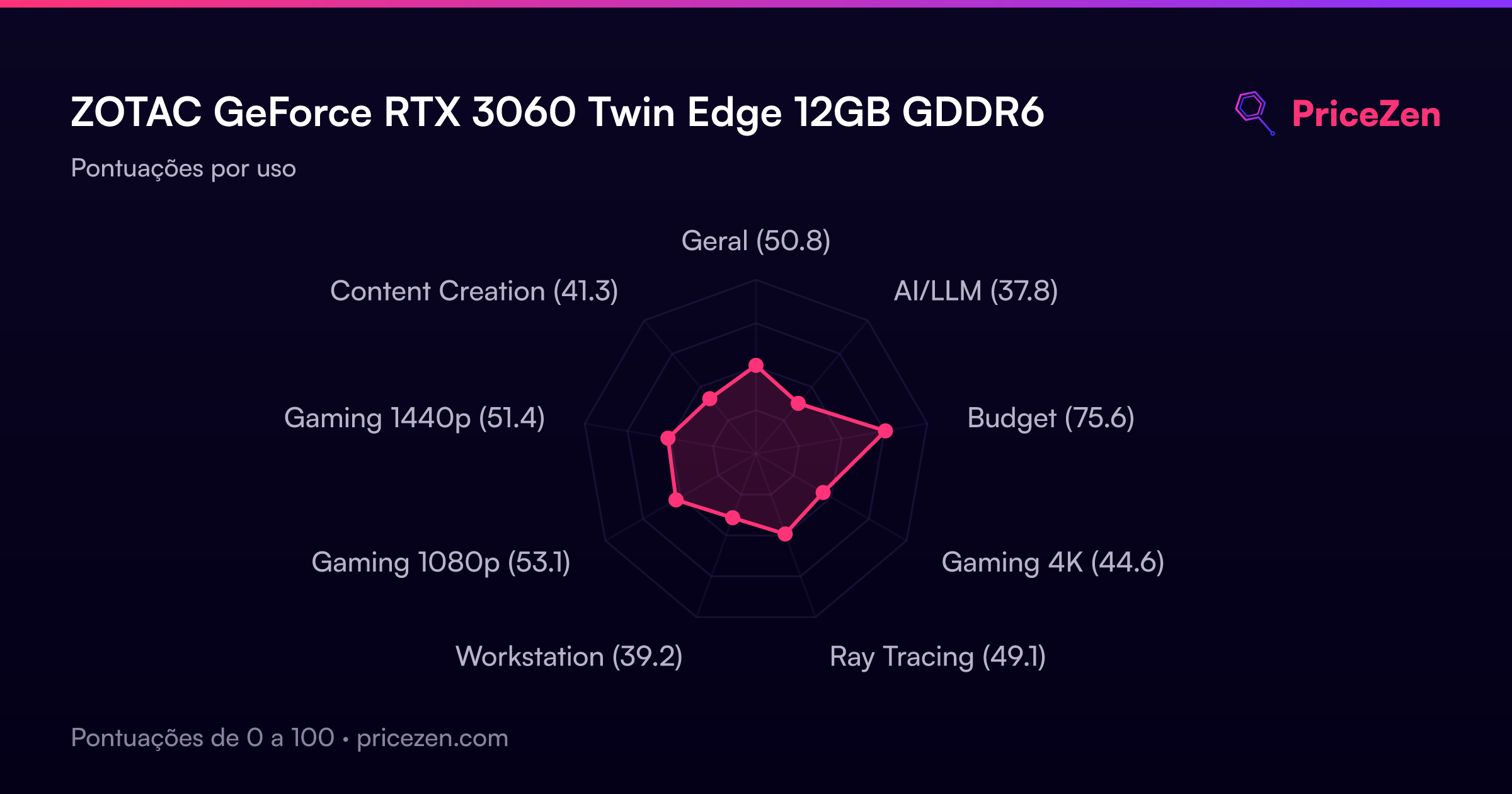
Usage Scores
- Geral50.8
- AI/LLM37.8
- Budget75.6
- Gaming 4K44.6
- Ray Tracing49.1
- Workstation39.2
- Gaming 1080p53.1
- Gaming 1440p51.4
- Content Creation41.3