MSI GeForce RTX 4060 Ventus 2X OC 8GB GDDR6 Black
The Ada Lovelace architecture and DLSS 3 frame generation drive smooth 1080p gaming at a 115W power draw that doesn't demand a large PSU. Its compact 199mm dual-fan design fits easily into small form factor builds while still delivering AV1 encoding for streamers. This card is best for budget-conscious 1080p gamers upgrading from older GTX or RTX 20-series hardware.

Sem preço atual de lojas


Resumo
The 30-Second Version
A tiny, thrifty 1080p card that punches above its weight in efficiency and below it in raw speed. Buy it cheap for a small build, or don't buy it at all.
Pros & Cons
Prós
- Absurdly efficient: 115W and one 8-pin, best-in-class for power draw 99th
- Only 199mm and 2 slots, fits cases other cards won't 98th
- DLSS plus AV1 encode make it a genuinely useful streaming and creator card 89th
- Owners are overwhelmingly happy: 4.8/5 from 1332 reviews 70th
Contras
- 8GB on a 128-bit bus is already tight, and it's only getting tighter
- Raster performance sits below average for the category
- AI and LLM work is a real letdown at 29.7/100
- Pricing is all over the place, and the high end is a bad deal
O que dizem os donos
The Word on the Street
Como a opinião dos donos mudou ao longo do tempo
ExclusivoCom base em quando os clientes realmente escreveram suas avaliações - para ver se os elogios iniciais se mantiveram.
Donos satisfeitos: 100% recentemente, 100% em jul. de 2023 – set. de 2024
Poucas avaliações para falar em mudança.
Em todas as 1.332 notas das lojas: 4,8★. A maioria dos donos dá nota sem escrever avaliação. O gráfico conta as 20 avaliações escritas com estrelas e data própria.
31 avaliações de meses com datas aproximadas (o dia em que as vimos pela primeira vez) ficam fora da tendência.
Ver os números
| Período | Avaliações | Satisfeitos | Neutros | Insatisfeitos | Parcela satisfeitos |
|---|---|---|---|---|---|
| jul. de 2023 – set. de 2024 | 10 | 10 | 0 | 0 | 100% |
| jan. de 2025 – fev. de 2026 | 10 | 10 | 0 | 0 | 100% |
Cada coluna junta trimestres até reunir pelo menos 10 avaliações com estrelas e data própria. Satisfeitos = 4-5★, neutros = 3★, insatisfeitos = 1-2★.
As provas
Performance
What stands out in the data isn't speed, it's restraint. A 115W TDP with a single 8-pin connector puts this card in the 98th percentile for efficiency, and MSI still pushed the boost clock to 2490MHz across 3072 CUDA cores. The PassMark G3D benchmark score of 19495 is respectable for 1080p, but the 272 GB/s memory bandwidth from that 128-bit bus is the ceiling you'll keep bumping into. Ray tracing ranks about average, compute falls behind most of the category, and AI work is a genuine weak spot at 29.7/100. AV1 encoding and DLSS are the real wins here, and they're features you'll actually use.
Specifications
Full Specifications
Chipset
| GPU Chipset | GeForce RTX 4060 |
| Brand | NVIDIA |
| Architecture | Ada Lovelace |
| Class | consumer |
| Process | 5 |
Memory
| VRAM | 8 GB |
| Memory Type | GDDR6 |
| Memory Bus | 128 |
| Bandwidth | 272 |
Compute
| CUDA Cores | 3072 |
| Tensor Cores | 96 |
| RT Cores | 24 |
| Base Clock | 2490 |
| Boost Clock | 2490 |
| FP16 TFLOPS | 15.11 |
| FP32 TFLOPS | 15.11 |
Performance
| PassMark G3D | 19495 |
| GPU Compute | 9195 |
Power & Cooling
| TDP | 115 |
| Recommended PSU | 550 |
| Power Connectors | 8-Pin |
| Cooler | Dual Fan |
| Fans | 2 |
Connectivity
| Interface | PCI Express 4.0 x8 |
| DisplayPort | 3 |
| HDMI | 1 |
| Max Displays | 4 |
| Max Resolution | 7680 x 4320 |
Physical
| Length | 199 |
| Slot Width | 2 |
| Form Factor | ATX |
| Weight | 1.0 kg / 2.2 lbs |
Features
| Ray Tracing | Yes |
| Upscaling | DLSS |
| AV1 Encode | Yes |
| VR Ready | Yes |
| DirectX | 12 Ultimate |
vs Competition
Cross-shop this against the ASUS GeForce RTX 5070 PRIME if you can stretch your budget at all, because the 4060's below-average raster ranking and bottom-third VRAM position are exactly the walls you'll hit first. If you're chasing 1440p or heavy ray tracing, the Sapphire Radeon RX 9070 XT PULSE and XFX Radeon RX 9070 XT Mercury belong on your shortlist instead, and the PowerColor RX 9070 XT Hellhound OC is worth a look for the same reason. The PNY GeForce RTX 5070 Ti OC is the pick if you also care about AI workloads, where this MSI scores a dismal 29.7/100. The Ventus 2X wins on exactly two things: it's 199mm long and it sips 115W. If neither of those matters to you, buy something else from that list.
| Spec | MSI GeForce RTX 4060 Ventus 2X OC | ASUS GeForce RTX 5090 TUF Gaming | Gigabyte GeForce RTX 5070 Ti Eagle Ice | ZOTAC GeForce RTX 5080 APOCALYPSE | PNY GeForce RTX 5080 ARGB OC | Sapphire Radeon RX 9070 XT PULSE |
|---|---|---|---|---|---|---|
| Chipset | GeForce RTX 4060 | GeForce RTX 5090 | GeForce RTX 5070 Ti | GeForce RTX 5080 | GeForce RTX 5080 | Radeon RX 9070 XT |
| Vram | 8GB GDDR6 | 32GB GDDR7 | 16GB GDDR7 | 16GB GDDR7 | 16GB GDDR7 | 16GB GDDR6 |
| Boost Clock Mhz | 2490 | 2407 | 2542 | 2730 | 2620 | 2970 |
| Tdp W | 115 | 575 | 300 | 360 | 360 | 304 |
| Memory Bus Bits | 128 | 512 | 256 | 256 | 256 | 256 |
| Ray Tracing | true | true | true | true | true | true |
| GPU Class | consumer | consumer | consumer | consumer | consumer | consumer |
| Compare | Compare | Compare | Compare | Compare |
| Produto | AI | Rt | Vram | Raster | Compute | Feature | Thermal | Efficiency | Connectivity | Prova social | Affordability |
|---|---|---|---|---|---|---|---|---|---|---|---|
| MSI GeForce RTX 4060 Ventus 2X OC | 32.8 | 51.6 | 32.3 | 43.1 | 37.8 | 88.8 | 55.4 | 97.5 | 69.7 | 98.7 | 50.9 |
| ASUS GeForce RTX 5090 TUF Gaming Compare | 97.1 | 90.5 | 97.7 | 98.7 | 97.7 | 95.9 | 72.3 | 24.1 | 99.3 | 98.7 | 2.3 |
| Gigabyte GeForce RTX 5070 Ti Eagle Ice Compare | 79.5 | 88.6 | 86 | 88.9 | 88.1 | 95.9 | 91.7 | 72.2 | 94.1 | 93.3 | 26.7 |
| ZOTAC GeForce RTX 5080 APOCALYPSE Compare | 85.6 | 97.6 | 89 | 94.5 | 93.5 | 95.9 | 91.7 | 57.1 | 94.1 | 98.7 | 20.3 |
| PNY GeForce RTX 5080 ARGB OC Compare | 85.6 | 97.6 | 89 | 94.5 | 93.5 | 95.9 | 91.7 | 57.1 | 94.1 | 74.7 | 14.5 |
| Sapphire Radeon RX 9070 XT PULSE Compare | 89.3 | 84.7 | 73.8 | 75.3 | 90.2 | 95.9 | 72.3 | 45.6 | 88.9 | 93.3 | 43.3 |
Preço
Value & Pricing
At Newegg's USD 532 this makes sense as a low-power 1080p upgrade. At Amazon's USD 720 it absolutely does not, and that USD 188 spread between the two listings is the whole ballgame. We track prices over time and this card swings hard: Canadian listings run from CAD 300 to CAD 1,593, a CAD 1,293 gap that tells you some sellers are just hoping nobody checks. Buy at the bottom of the range or walk away. Paying near the top for a card with below-average raster and 8GB of VRAM is donating money to a marketplace seller.
Saiba mais
Overview
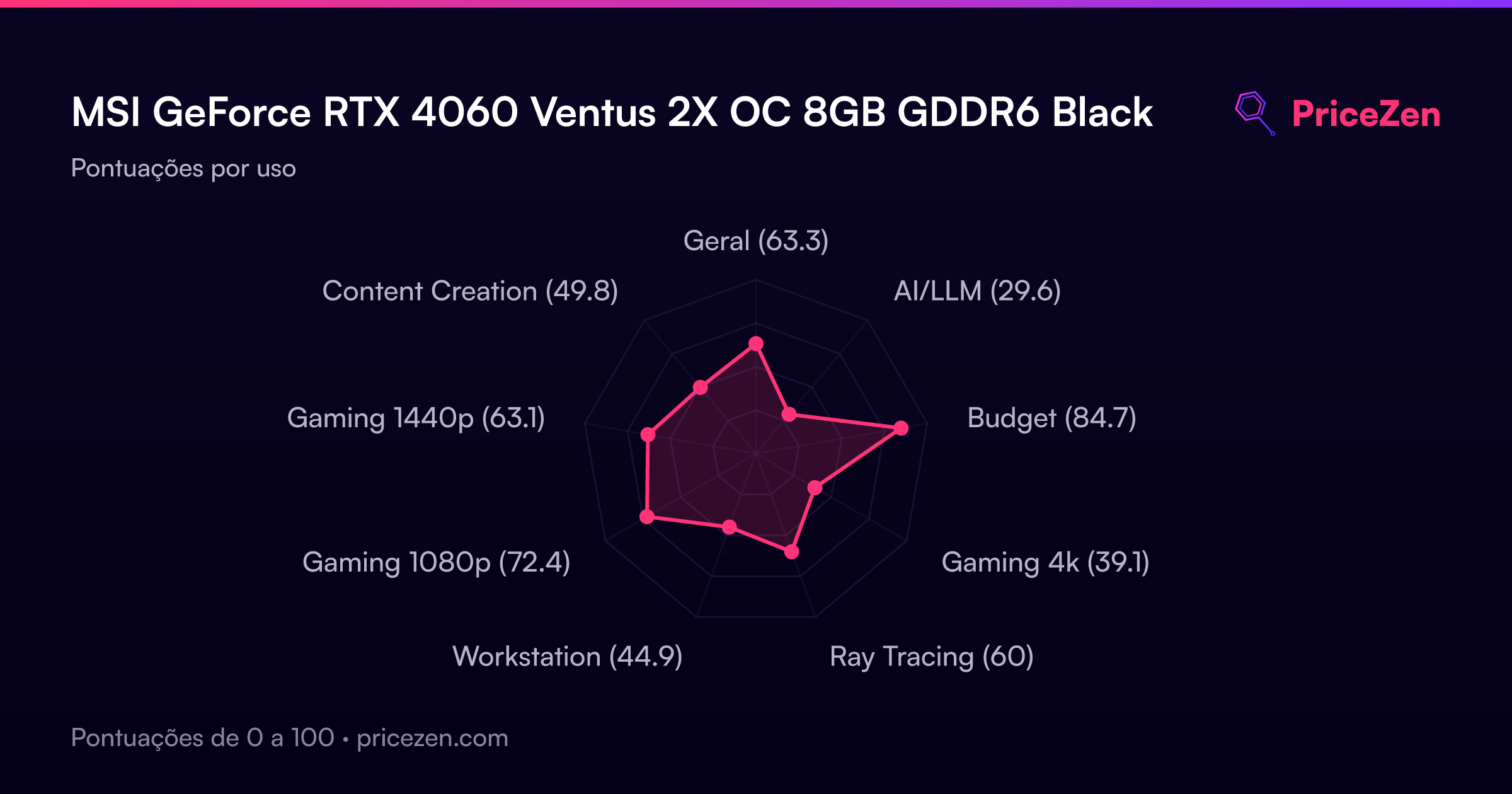
The MSI RTX 4060 Ventus 2X Black is a smart buy for one specific person: someone building or upgrading a compact 1080p rig who doesn't want to think about power supplies. At 199mm long, two slots thick and just 115W, it's the kind of card you drop into an older prebuilt without rewiring your life. Our scoring model gives it 81.6/100 for budget builds and 72.5/100 for 1080p gaming, which lines up exactly with that story.
But here's the thing to know before you click buy: this is not a fast card by current standards. Its raster performance sits below the middle of the pack in our rankings, and 8GB on a 128-bit bus lands it in the bottom third for memory. Owners love it (4.8/5 across 1332 reviews, top of the charts for social proof), and we get why. It's quiet, tiny and efficient. Just don't confuse "people are happy with it" with "it'll handle anything you throw at it."
Common Questions
Q: Will 8GB of VRAM be enough?
For 1080p, yes, mostly. But 8GB on a 128-bit bus ranks in the bottom third of the category in our data, so if you're eyeing 1440p or texture-heavy titles, plan on turning settings down sooner than you'd like.
Q: Do I need a new power supply?
Almost certainly not. It's a 115W card with a single 8-pin connector and a 550W recommended PSU. That's the single best reason to buy this thing.
Q: Can I use it for local AI or LLM stuff?
Don't. AI is its weakest area at 29.7/100 and compute falls behind most of the category. Look at the PNY RTX 5070 Ti OC instead.
Who Should Skip This
If you want 1440p headroom, serious ray tracing or anything resembling local AI work, this isn't it. The 8GB buffer and 128-bit bus will box you in fast. Go get the Sapphire Radeon RX 9070 XT PULSE or the ASUS GeForce RTX 5070 PRIME and stop pretending a 115W card is going to grow with you.
Verdict
Buy it if you're upgrading a small case or an aging prebuilt with a modest PSU and you game at 1080p. In that scenario the 115W draw, single 8-pin and 199mm length solve problems bigger cards create, and DLSS covers a lot of the performance gap. Grab it at Newegg's USD 532 and you'll be happy. Skip it if you have room, wattage and budget for a 5070-class or 9070 XT-class card, because 8GB and a 128-bit bus are the specs you'll regret first.
Usage Scores
- Geral63.3
- AI/LLM29.6
- Budget84.7
- Gaming 4k39.1
- Ray Tracing60
- Workstation44.9
- Gaming 1080p72.4
- Gaming 1440p63.1
- Content Creation49.8