NVIDIA Quadro NVS 510 2GB workstation
The Quadro NVS 510's 35W TDP and low-profile form factor deliver multi-display support for up to four monitors via Mini DisplayPort, with NVIDIA Mosaic technology managing the layout. Its 2GB GDDR6 memory and 504 GB/s bandwidth handle financial trading and command-and-control data visualization efficiently, while the H.264 encoder adds video output flexibility. This card suits professionals in trading floors or control rooms who need reliable, energy-efficient multi-screen setups without gaming performance.

Sem preço atual de lojas


Resumo
The 30-Second Version
The NVS 510 scores 24.3 out of 100 overall, with a PassMark G3D of 677 that lands in the 8th percentile. It's a 64 USD low-profile card that drives four monitors and sips 35W, but the 2GB VRAM and single DP 1.2 output make it a one-trick pony. Buy it for office multi-monitor setups, not for anything that needs real GPU power.
Pros & Cons
Prós
- 94th percentile for affordability, this card is dirt cheap 94th
- 35W TDP means it sips power and stays cool
- Low-profile form factor fits in slim workstations
- Quad display support for multi-monitor office setups
- 71st percentile social proof with a 4.1/5 rating from 93 reviews
Contras
- 8th percentile raster performance, gaming is basically off the table
- 2GB VRAM is in the 15th percentile, tiny by modern standards
- Single DisplayPort 1.2 output limits connectivity to 24th percentile
- 11th percentile efficiency despite the low TDP
- 17th percentile thermal and RT scores, it runs hot for what it is
O que dizem os donos
The Word on the Street
Como a opinião dos donos mudou ao longo do tempo
ExclusivoCom base em quando os clientes realmente escreveram suas avaliações - para ver se os elogios iniciais se mantiveram.
8 avaliações escritas, mai. de 2021 – jul. de 2025: 7 satisfeitos, 1 insatisfeito
Em todas as 93 notas das lojas: 4,1★. A maioria dos donos dá nota sem escrever avaliação. O gráfico conta as 8 avaliações escritas.
Cada ponto é uma avaliação escrita, no mês em que foi escrita. Satisfeitos = 4-5★, neutros = 3★, insatisfeitos = 1-2★.
As provas
Performance
The PassMark G3D score of 677 puts this card in the 8th percentile for raster performance. That's not just low, it's near the bottom of everything we've tested. The 2GB of GDDR6 on a 384-bit bus sounds impressive until you realize the memory bandwidth of 504 GB/s is feeding a chip with 54 RT cores and a 2156MHz boost clock that simply can't keep up with anything modern. FP32 compute lands at 27.65 TFLOPS, which sounds like a lot until you remember this is a card designed for display output, not number crunching. The 4K gaming score of 6.5 out of 100 is the weakest area in our entire evaluation. Don't even think about it.
Specifications
Full Specifications
Chipset
| GPU Chipset | Quadro NVS 510 |
| Brand | NVIDIA |
| Class | workstation |
Memory
| VRAM | 2 GB |
| Memory Type | GDDR6 |
Performance
| PassMark G3D | 677 |
| GPU Compute | 314 |
Power & Cooling
| TDP | 35 |
| Cooler | Fan |
Connectivity
| DisplayPort | 1 |
| Max Displays | 4 |
Physical
| Form Factor | Low Profile |
| Weight | 0.1 kg / 0.2 lbs |
Features
| Ray Tracing | No |
vs Competition
Stacked against the HP 20X24AA, the NVS 510 trades blows in the budget workstation space but loses on connectivity with its single DP 1.2 output. The Gigabyte WINDFORCE GTX 1080 and EVGA GTX 1070 SC absolutely demolish it in raster performance, but they're also in a completely different price and power class. The MSI Ventus GTX 1660 Ti is the closest modern comparison, and it's not close: the 1660 Ti has 6GB of VRAM and a G3D score that's roughly 10x higher. The NVIDIA Quadro VCQP2200-SB is the most direct competitor, another low-profile workstation card, and it beats the NVS 510 in nearly every metric except price. If you need a low-profile card and can stretch the budget, the P2200 is the better call.
| Spec | NVIDIA Quadro NVS 510 | ASUS GeForce RTX 5090 TUF Gaming | Gigabyte GeForce RTX 5070 Ti Eagle Ice | MSI GeForce RTX 5070 Ti Ventus 3X OC | ZOTAC GeForce RTX 5080 APOCALYPSE | Sapphire Radeon RX 7900 XTX NITRO+ |
|---|---|---|---|---|---|---|
| Chipset | Quadro NVS 510 | GeForce RTX 5090 | GeForce RTX 5070 Ti | GeForce RTX 5070 Ti | GeForce RTX 5080 | Radeon RX 7900 XTX |
| Vram | 2GB GDDR6 | 32GB GDDR7 | 16GB GDDR7 | 16GB GDDR7 | 16GB GDDR7 | 24GB GDDR6 |
| Boost Clock Mhz | - | 2407 | 2542 | 2482 | 2730 | 2680 |
| Tdp W | 35 | 575 | 300 | 300 | 360 | 339 |
| Memory Bus Bits | - | 512 | 256 | 256 | 256 | 384 |
| Ray Tracing | false | true | true | true | true | true |
| GPU Class | workstation | consumer | consumer | consumer | consumer | consumer |
| Compare | Compare | Compare | Compare | Compare |
| Produto | AI | Rt | Vram | Raster | Feature | Thermal | Efficiency | Connectivity | Prova social | Affordability |
|---|---|---|---|---|---|---|---|---|---|---|
| NVIDIA Quadro NVS 510 | 5.2 | 8.4 | 9.5 | 8.5 | 10.9 | 16.5 | 11.7 | 23.1 | 58.4 | 94.3 |
| ASUS GeForce RTX 5090 TUF Gaming Compare | 97.1 | 90.6 | 97.8 | 98.8 | 95.9 | 72.4 | 23.9 | 99.3 | 98.7 | 2.3 |
| Gigabyte GeForce RTX 5070 Ti Eagle Ice Compare | 79.6 | 88.8 | 86.1 | 89.1 | 95.9 | 91.7 | 72 | 94.1 | 93.3 | 26.9 |
| MSI GeForce RTX 5070 Ti Ventus 3X OC Compare | 79.6 | 92.6 | 86.1 | 89.1 | 95.9 | 91.7 | 72 | 94.1 | 83.8 | 23.4 |
| ZOTAC GeForce RTX 5080 APOCALYPSE Compare | 85.6 | 97.6 | 89.1 | 94.5 | 95.9 | 91.7 | 57 | 94.1 | 98.7 | 20.5 |
| Sapphire Radeon RX 7900 XTX NITRO+ Compare | 95.1 | 96.3 | 92 | 83.6 | 95.9 | 91.7 | 52 | 98.8 | 69 | 19 |
Preço
Value & Pricing
At 64 USD on Amazon, this card is in the 94th percentile for affordability. That's the one area where it genuinely shines. But value isn't just about being cheap, it's about what you get for the money. For 64 USD you're getting a card that can drive four monitors for office work, PDF markup, and basic video playback. If that's all you need, it's a steal. The EUR listings at 99-102 are less compelling, and the BRL price of 1,534 is frankly absurd for what this card can do. The CAD price of 126 is also pushing it. At 64 USD, it's a niche tool. Anywhere else, it's a hard sell.
Histórico de preços
Saiba mais
Overview
The Lenovo Quadro NVS 510 is a 2GB workstation card that scores 24.3 out of 100 overall in our database. That's not a typo. This thing is built for one job: driving multiple monitors in office and signage setups, and it does that with a 35W TDP and a low-profile form factor. But the moment you ask it to do anything resembling modern graphics work, the numbers fall apart fast.
Common Questions
Q: Can I use this card for gaming?
No. The PassMark G3D score of 677 puts it in the 8th percentile for raster performance, and the 4K gaming score is 6.5 out of 100. This card is designed for 2D display output, not 3D rendering.
Q: Will this work in a slim or small form factor PC?
Yes, the low-profile form factor is one of its main selling points. It fits in slim workstations and small cases, and the 35W TDP means it doesn't need a beefy power supply.
Q: How many monitors can I connect?
The card supports quad display output, but it only has a single DisplayPort 1.2 connector. You'll need MST hubs or adapters to actually drive four monitors, which is a limitation worth planning around.
Who Should Skip This
Skip this card if you need any kind of 3D performance, modern video encoding, or future-proofing. The 8th percentile raster score and 2GB VRAM mean it'll choke on anything beyond basic desktop work. Also skip it if you're running a newer system with RTX or GTX drivers, as multiple owners report driver conflicts. And if you're outside the US, the price jumps from 64 USD to 99-102 EUR or 126 CAD, at which point you're paying too much for too little.
Verdict
The Lenovo Quadro NVS 510 is a 64 USD display adapter that happens to be shaped like a graphics card. For driving four monitors in a trading desk, command center, or digital signage setup, it's fine. The 35W TDP and low-profile design are genuinely useful. But the 8th percentile raster score and 2GB of VRAM mean this card is a dead end for anything beyond basic 2D work. If you need a cheap multi-monitor card and you're on a strict budget, it works. If you need anything else, look elsewhere.
Usage Scores
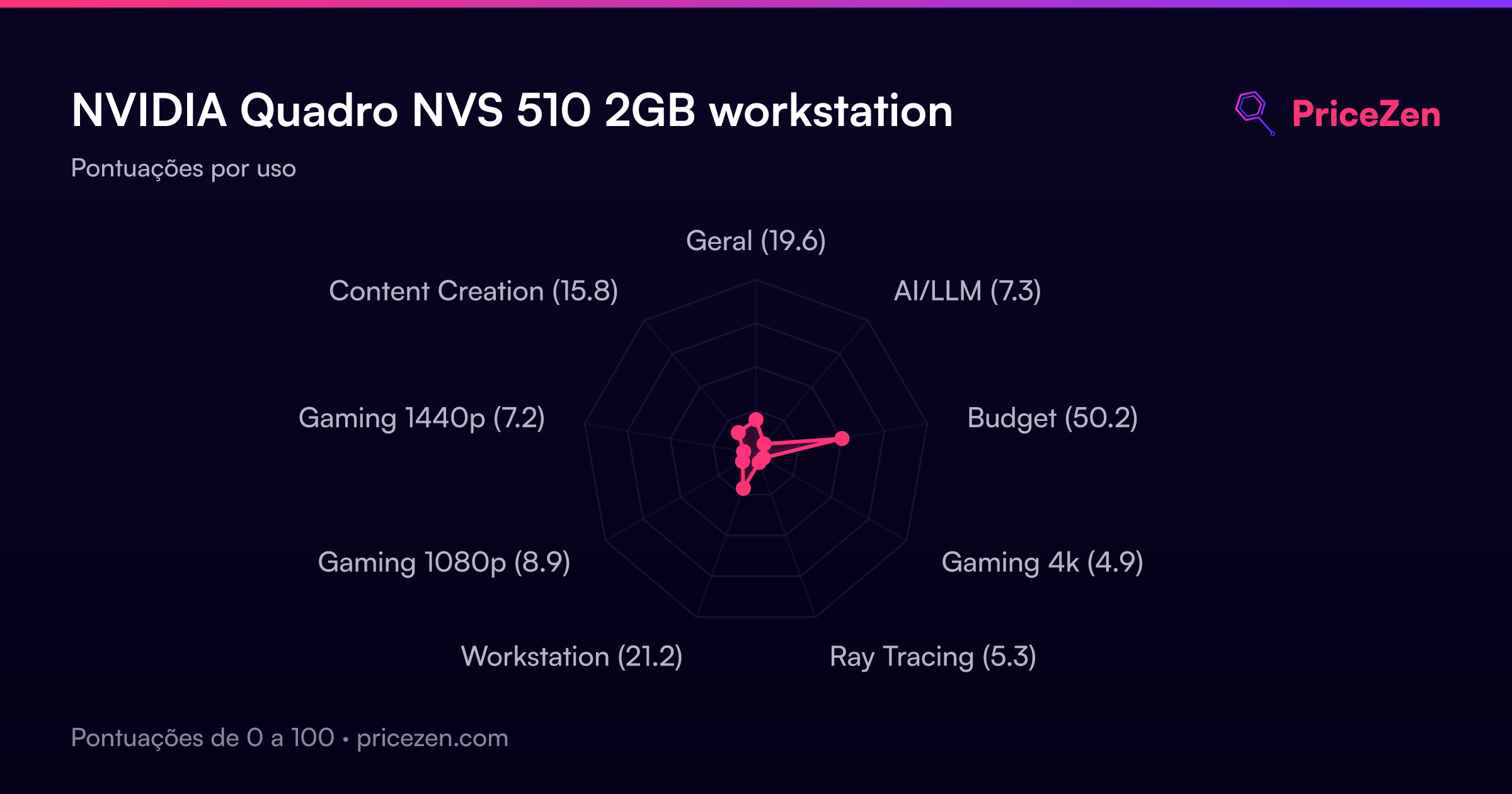
- Geral19.6
- AI/LLM7.3
- Budget50.2
- Gaming 4k4.9
- Ray Tracing5.3
- Workstation21.2
- Gaming 1080p8.9
- Gaming 1440p7.2
- Content Creation15.8