ASUS GeForce GT 730 2GB GDDR5
The 384 CUDA cores at 927MHz boost clock and 2GB GDDR5 memory deliver basic display output, while the passive cooling and single-slot design keep the workspace quiet and free up PCIe slots. Its four HDMI ports support up to four external displays, making it a practical choice for multi-monitor setups without needing a power-hungry card. This is best for office workers or IT admins building low-power productivity stations, not for gaming or AI workloads.

Sem preço atual de lojas


Resumo
The 30-Second Version
The ASUS GeForce GT 730 is a fanless, single-slot graphics card with four HDMI ports, built for multi-monitor office setups and quiet PCs. It scores 825 in PassMark G3D, which puts it near the bottom of our database for gaming and compute performance. Buy it for displays, not for games.
Pros & Cons
Prós
- Four HDMI ports for multi-monitor setups 91st
- Passive cooling means zero fan noise 79th
- Single-slot design fits in tight builds
- Low 49W TDP works with weak power supplies
- Affordable at USD 110 to USD 146
Contras
- PassMark G3D score of 825 is near the bottom of our database
- Drivers haven't been updated since 2018
- Not suitable for gaming, period
- Thermal performance sits in the 20th percentile
- 2GB VRAM is limiting even for basic tasks
O que dizem os donos
The Word on the Street
Como a opinião dos donos mudou ao longo do tempo
ExclusivoCom base em quando os clientes realmente escreveram suas avaliações - para ver se os elogios iniciais se mantiveram.
18 avaliações escritas, mar. de 2023 – fev. de 2026: 11 satisfeitos, 7 insatisfeitos
Em todas as 714 notas das lojas: 4,4★. A maioria dos donos dá nota sem escrever avaliação. O gráfico conta as 18 avaliações escritas.
Cada ponto é uma avaliação escrita, no mês em que foi escrita. Satisfeitos = 4-5★, neutros = 3★, insatisfeitos = 1-2★.
As provas
Performance
Let's talk numbers. The GT 730 packs 384 CUDA cores running at a 927MHz boost clock in OC mode, with 2GB of GDDR5 on a 128-bit bus pushing 26 GB/s of memory bandwidth. On paper, that sounds like a real graphics card. In practice, it scores 825 in PassMark G3D, which puts it near the bottom of our database for raster performance. For context, integrated graphics on a modern Ryzen chip will embarrass this thing in most workloads.
The 49W TDP is low enough that the passive heatsink handles it without breaking a sweat, and ASUS says a 200W power supply is plenty. That's great for older office machines or small form factor builds. The four HDMI ports are the real star here. You can drive up to four displays at once, which is more than most cards twice the price offer. Just don't expect to do anything demanding on those screens. Video playback and web browsing are fine. Anything involving 3D rendering, AI workloads, or modern games will bring this card to its knees. Our AI and compute scores for this thing sit in the 5th to 7th percentile range, which is about as close to "don't bother" as our database gets.
Specifications
Full Specifications
Chipset
| GPU Chipset | GeForce GT 730 |
| Brand | NVIDIA |
| Architecture | Kepler |
| Class | consumer |
| Process | 40 |
Memory
| VRAM | 2 GB |
| Memory Type | GDDR5 |
| Memory Bus | 128 |
| Bandwidth | 25.6 |
Compute
| CUDA Cores | 384 |
| Base Clock | 902 |
| Boost Clock | 927 |
Performance
| PassMark G3D | 825 |
Power & Cooling
| TDP | 49 |
| Recommended PSU | 200 |
| Power Connectors | None |
| Cooler | Passive |
| Fans | 0 |
Connectivity
| Interface | PCI Express 2.0 |
| DisplayPort | 0 |
| HDMI | 4 |
| Max Displays | 4 |
| Max Resolution | 3840x2160 |
Physical
| Slot Width | 1 |
| Form Factor | Full Height |
| Weight | 0.2 kg / 0.5 lbs |
Features
| Ray Tracing | No |
| AV1 Encode | No |
| VR Ready | No |
| RGB | No |
vs Competition
Compared to something like the MSI Gaming X RTX 3050 or the Gigabyte WINDFORCE RTX 3050, the GT 730 is not even in the same conversation. Those cards are built for 1080p gaming with modern features like ray tracing and DLSS. The GT 730 is built for displaying spreadsheets across four screens. The RTX 3050 cards cost significantly more, but they also deliver actual gaming performance. The ASRock Challenger A750 is another competitor that absolutely destroys the GT 730 in every performance metric, though it also costs more and draws more power.
The HP 20X24AA is an interesting comparison because it's also a budget-oriented card, but it's aimed at different use cases. The GT 730's four HDMI ports are genuinely unique at this price point. Most budget cards give you one HDMI and maybe a DisplayPort or two. If you're building a trading rig, a monitoring station, or a home office setup with four screens, the GT 730 is one of the few cards that does it without adapters or dongles. That's the trade-off. You give up all meaningful performance to get that connectivity.
| Spec | ASUS GeForce GT 730 | Gigabyte GeForce RTX 5070 Ti Eagle Ice | MSI GeForce RTX 5070 Ti Ventus 3X OC | ZOTAC GeForce RTX 5080 APOCALYPSE | PNY GeForce RTX 5080 ARGB OC | Sapphire Radeon RX 9070 XT PULSE |
|---|---|---|---|---|---|---|
| Chipset | GeForce GT 730 | GeForce RTX 5070 Ti | GeForce RTX 5070 Ti | GeForce RTX 5080 | GeForce RTX 5080 | Radeon RX 9070 XT |
| Vram | 2GB GDDR5 | 16GB GDDR7 | 16GB GDDR7 | 16GB GDDR7 | 16GB GDDR7 | 16GB GDDR6 |
| Boost Clock Mhz | 927 | 2542 | 2482 | 2730 | 2620 | 2970 |
| Tdp W | 49 | 300 | 300 | 360 | 360 | 304 |
| Memory Bus Bits | 128 | 256 | 256 | 256 | 256 | 256 |
| Ray Tracing | false | true | true | true | true | true |
| GPU Class | consumer | consumer | consumer | consumer | consumer | consumer |
| Compare | Compare | Compare | Compare | Compare |
| Produto | AI | Rt | Vram | Raster | Compute | Feature | Thermal | User Sentiment | Efficiency | Connectivity | Prova social | Affordability |
|---|---|---|---|---|---|---|---|---|---|---|---|---|
| ASUS GeForce GT 730 | 7.7 | 9.5 | 7.5 | 9.5 | 5.8 | 11 | 20 | 13.8 | 11 | 37.7 | 78.7 | 90.9 |
| Gigabyte GeForce RTX 5070 Ti Eagle Ice Compare | 79.6 | 88.6 | 85.9 | 89 | 88.2 | 96 | 91.6 | 85.5 | 72.3 | 94 | 95.4 | 26.9 |
| MSI GeForce RTX 5070 Ti Ventus 3X OC Compare | 79.6 | 92.4 | 85.9 | 89 | 88.2 | 96 | 91.6 | 85.5 | 72.3 | 94 | 88.9 | 23.4 |
| ZOTAC GeForce RTX 5080 APOCALYPSE Compare | 85.6 | 97.5 | 89 | 94.5 | 93.5 | 96 | 91.6 | 99.5 | 57.3 | 94 | 99.1 | 20.4 |
| PNY GeForce RTX 5080 ARGB OC Compare | 85.6 | 97.5 | 89 | 94.5 | 93.5 | 96 | 91.6 | 45.2 | 57.3 | 94 | 82.8 | 14.5 |
| Sapphire Radeon RX 9070 XT PULSE Compare | 89.3 | 84.7 | 73.8 | 75.3 | 90.2 | 96 | 72.2 | 96 | 45.8 | 88.8 | 95.4 | 43.3 |
Preço
Value & Pricing
Value is where this card gets weird. At USD 110 to USD 146 across three US listings, you're paying a premium for the four HDMI ports and the fanless design, not for raw performance. The cheapest US listing comes in at USD 110, while the most expensive hits USD 146, so it's worth shopping around before you click buy. In Europe, prices range from EUR 76 to EUR 89 across four listings, which is a tighter spread but still worth checking. For the same money, you could grab a used GTX 1050 Ti or even a GTX 1650 if you're patient, and either of those would run circles around the GT 730 in any workload. But neither of those has four HDMI ports out of the box, and neither is passively cooled. If your priority is quiet multi-monitor productivity, this card earns its keep. If you want any kind of graphical horsepower, your money is better spent elsewhere.
Histórico de preços
Saiba mais
Overview
The ASUS GeForce GT 730 is a budget graphics card aimed squarely at office workers, home theater tinkerers, and anyone who needs to run a pile of monitors without a jet engine under their desk. It's a single-slot, passively cooled card with 2GB of GDDR5 and four HDMI ports, which is honestly the whole pitch. You're not buying this for frame rates. You're buying it because your motherboard only has one video output and you want four screens for spreadsheets, dashboards, or a wall of browser tabs.
At around USD 110 to USD 146 depending on where you shop, it sits in that awkward price zone where you could almost grab a used gaming card instead. But used gaming cards don't come with four HDMI ports and a fanless design. This thing is dead silent because there's no fan at all, just a chunk of metal doing the cooling. For a file server or a quiet office PC, that's a real selling point.
Is the ASUS GT730 good for gaming? No. Not even a little. With a PassMark G3D score of 825, it lands in the 9th percentile for raster performance in our database. That's not a typo. This card is for pixels on screens, not polygons in motion. If you need a cheap way to get four displays running, it does that job. If you want to play anything made after 2015, keep scrolling.
Common Questions
Q: Is the ASUS GT 730 good for gaming?
No. With a PassMark G3D score of 825, it ranks in the 9th percentile for raster performance in our database. It can handle basic video playback and web browsing, but modern games will struggle or fail to run.
Q: Can the ASUS GT 730 run 4 monitors?
Yes. This card has four HDMI ports and supports up to four external displays simultaneously. That's its main selling point and the reason most people buy it.
Q: Does the ASUS GT 730 need a power connector?
No. It draws all its power from the PCIe slot with a 49W TDP. ASUS recommends a 200W power supply, which most office PCs already have.
Q: Is the ASUS GT 730 good for a home theater PC?
It works well for basic HTPC duties like streaming video and browsing. The passive cooling means zero fan noise, which is ideal for a living room setup. Just don't expect it to handle 4K gaming or heavy video transcoding.
Who Should Skip This
Skip this card if you want to play games, edit video, run AI models, or do any kind of 3D work. The GT 730's 825 PassMark score and 2GB of VRAM make it a poor fit for anything beyond basic display output. If you need a budget gaming card, look at a used GTX 1050 Ti or GTX 1650 instead. If you need modern features like ray tracing or DLSS, the RTX 3050 cards from MSI, Gigabyte, or ZOTAC are better options, though they cost more. Also skip it if you're running a system with only one display output and no need for multi-monitor support. You'd be paying for four HDMI ports you'll never use.
Verdict
Should you buy the ASUS GeForce GT 730? If you need four monitors running off a single-slot, fanless card and you don't care about gaming or GPU compute, yes. This is one of the few cards that does exactly that without costing a fortune or sounding like a leaf blower. Owners consistently praise it for multi-monitor productivity, and the 4.4-star rating across 714 reviews backs that up.
But if you have any interest in gaming, video editing, 3D work, or anything that actually stresses a GPU, this card is a bad purchase. The 825 PassMark score is a real letdown, and the outdated drivers from 2018 mean you're not getting any future improvements. The user sentiment score of 65/100 reflects that split. People who bought it for displays are happy. People who expected more are not. Know what you're getting into before you spend the money.
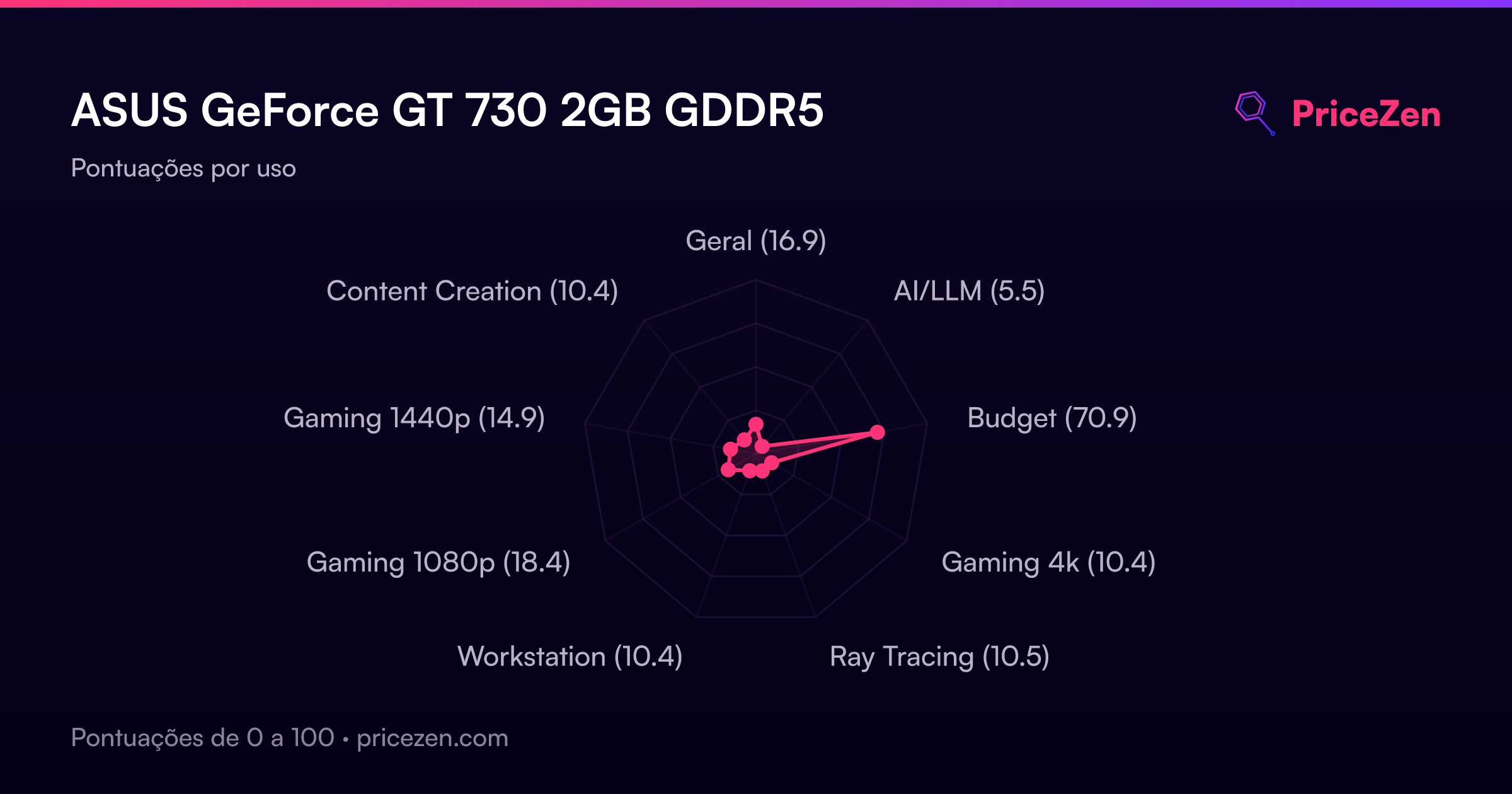
Usage Scores
- Geral16.9
- AI/LLM5.5
- Budget70.9
- Gaming 4k10.4
- Ray Tracing10.5
- Workstation10.4
- Gaming 1080p18.4
- Gaming 1440p14.9
- Content Creation10.4