MSI GeForce RTX 5060 Ti Ventus 3X OC 8GB GDDR7 Silver

DLSS 4 para mais quadros por segundo verificado em 29 de nov.
71/100 pontuação geral 4,6 média de 163 avaliações de proprietários
- GPU
- GeForce RTX 5060 Ti
- VRAM
- 8GB GDDR7
- Boost clock
- 2602 MHz
- TDP
- 180 W
- Memory bus
- 128 bit
- Ray tracing
- Sim
- Class
- consumer
Compare preços em 1 loja
Da mais barata à mais cara. Ofertas novas, recondicionadas e em kit ficam separadas para você comparar o que é comparável.
| Loja | Vendido por | Cor e condição | Preço | vs. o menor | Última verificação | Link |
|---|---|---|---|---|---|---|
| Novo1 ofertaUnidade única | ||||||
| Esgotado na última verificação | ||||||
| Amazon | Desconhecido | Não informado | Sem preço | Esgotado | 9 de nov. | Ir para a loja |
 Fonte: PriceZen, verificado em 9 de nov. de 2026
Um preço é considerado atual quando o verificamos nos últimos 7 dias. «Vendedor parceiro» significa um vendedor terceiro naquela loja, não a própria loja.
Histórico de preços
Verificado nesse diaNão verificado nesse dia, ainda em oferta
Fonte: PriceZen, checked 6 de set. de 2026











Resumo
The 30-Second Version
The RTX 5060 Ti Ventus 3X OC scores 20,798 on PassMark and runs cool thanks to a 92nd percentile thermal rating. The 8GB of GDDR7 is the weak link, capping this card's longevity at 1080p. At USD 398 it's a decent deal, but at USD 600 you're overpaying.
Pros & Cons
Prós
- Thermals at the 92nd percentile thanks to the triple-fan cooler 94th
- Connectivity is top-tier at the 94th percentile with 3x DP 2.1b and HDMI 2.1b 92nd
- 19.18 TFLOPS of FP32 compute handles 1080p gaming easily 84th
- 180W TDP is efficient, landing at the 82nd percentile for power draw 82nd
- DLSS 4 and AV1 encode support add real value for streamers
Contras
- 8GB VRAM is already limiting at 1440p with high textures
- AI and LLM performance is weak at 38.3 out of 100
- 128-bit memory bus caps bandwidth at 448 GB/s
- PCIe 5.0 x16 slot actually runs at x8
- Price varies wildly, from USD 398 to USD 600 across vendors
O que dizem os donos
The Word on the Street
- Owners upgrading from older 20-series cards report a massive generational leap in performance, with most newer games running above 60 fps at 1440p.
- A recurring complaint is the price, with multiple buyers noting they paid well above MSRP and feeling the value proposition is questionable.
- Some users appreciate the low power draw, quiet operation, and small size, but express disappointment with gaming performance expectations.
Como a opinião dos donos mudou ao longo do tempo
ExclusivoCom base em quando os clientes realmente escreveram suas avaliações - para ver se os elogios iniciais se mantiveram.
49 avaliações escritas, mai. de 2025 – jun. de 2026: 33 satisfeitos, 1 neutro, 15 sem estrelas
Em todas as 163 notas das lojas: 4,6★. A maioria dos donos dá nota sem escrever avaliação. O gráfico conta as 49 avaliações escritas.
- abr. – jun. de 202625 de 26 satisfeitos · 15 sem estrelas
Buyers praised the RTX 5060 Ti for its quiet operation, cool temperatures, and strong 1440p performance, often upgrading from older cards. The 16GB VRAM and low power draw were highlights, though some noted moderate gains over last gen and one expected better gaming performance.
- Quiet and cool under load, with many noting dead silent operation and temps around 54-70°C.
- Strong 1440p performance, often exceeding 100 fps in demanding games, with DLSS and frame generation boosting 4K.
- 16GB VRAM valued for future-proofing and handling modern titles smoothly.
- Performance gains over previous generation described as moderate; one reviewer expected better gaming performance.
- jan. – mar. de 20263 de 3 satisfeitos
Buyers praised the 5060 Ti 16 GB as a strong upgrade from the 3060 Ti, with great performance and value, especially at MSRP or on sale.
- Performance boost from 3060 Ti is fantastic, making it a solid upgrade.
- Great value at MSRP or sale price, saving money on other upgrades.
- MSI brand reliability and quality, with consistent satisfaction.
- Price considered a bit high, but acceptable when discounted.
- abr. – jun. de 20253 de 3 satisfeitos
Buyers upgrading from older GPUs (20-series or 3070) report solid performance gains, especially at 1080p/1440p. The card is praised for build quality, quiet operation, and cool temperatures, though one reviewer advises against upgrading from 30/40-series.
- Great for 1080p/1440p gaming with new features; noticeable upgrade from 20-series and 3070.
- Top quality build, quiet, and cool under load.
- Not worth upgrading from 30/40-series; performance boost from 4060 Ti is minimal.
Cada ponto é uma avaliação escrita, no mês em que foi escrita. Satisfeitos = 4-5★, neutros = 3★, insatisfeitos = 1-2★. Os resumos por período estão em inglês.
As provas
Performance
The 19.18 TFLOPS of FP32 compute is solid for this class of card, and the 2602MHz boost clock keeps things snappy in rasterization workloads. Our raster score puts this at the 53rd percentile, which translates to about average for current GPUs. Ray tracing sits at the 60th percentile, so you'll get playable RT performance in most titles, especially with DLSS 4 doing the heavy lifting. The 8GB of GDDR7 is fast, but that 128-bit memory bus is the bottleneck. At 448 GB/s, you're getting decent bandwidth, but games are already pushing past 8GB at 1440p with high textures.
The triple-fan Ventus cooler is doing real work here. Thermal performance lands at the 92nd percentile, which is genuinely impressive for a card with a 180W TDP. The 306mm length means it'll fit in most mid-tower cases, though the 2.3-slot design might crowd smaller builds. One thing to note: the PCIe 5.0 x16 slot actually runs at x8, which is fine for gaming but worth knowing if you're planning to use this in a workstation setup.
Specifications
Full Specifications
Chipset
| GPU Chipset | GeForce RTX 5060 Ti |
| Brand | NVIDIA |
| Architecture | Blackwell |
| Class | consumer |
| Process | 5 |
Memory
| VRAM | 8 GB |
| Memory Type | GDDR7 |
| Memory Bus | 128 |
| Bandwidth | 448 |
Compute
| CUDA Cores | 4608 |
| Tensor Cores | 120 |
| RT Cores | 30 |
| Base Clock | 2400 |
| Boost Clock | 2602 |
| FP16 TFLOPS | 19.18 |
| FP32 TFLOPS | 19.18 |
Performance
| PassMark G3D | 20798 |
| GPU Compute | 10484 |
Power & Cooling
| TDP | 180 |
| Recommended PSU | 600 |
| Power Connectors | 1 x 8-Pin |
| Cooler | Triple Fan |
| Fans | 3 |
Connectivity
| Interface | PCI Express® Gen 5 x16 (uses x8) |
| DisplayPort | 3 |
| HDMI | 1 |
| Max Displays | 4 |
| Max Resolution | 7680 x 4320 |
Physical
| Length | 306 |
| Slot Width | 2.3 |
| Form Factor | Full Height |
| Weight | 0.8 kg / 1.8 lbs |
Features
| Ray Tracing | Yes |
| Upscaling | DLSS 4 |
| AV1 Encode | Yes |
| DirectX | 12 Ultimate |
| RGB | No |
vs Competition
Against the competition, this card occupies an awkward middle ground. The Gigabyte AORUS RTX 5080 and ASUS TUF RTX 5070 Ti both blow it out of the water on raw performance, but they're also in a completely different price bracket. The ZOTAC SOLID SFF OC and PNY OC RTX 5070 Ti are closer in spirit, but they pack 16GB of VRAM compared to this card's 8GB. That's the real differentiator here. The Sapphire PULSE is an AMD option that trades blows on rasterization but falls behind on ray tracing. For pure 1080p gaming on a budget, this MSI card holds its own. But the moment you start thinking about 1440p or future-proofing, the 8GB frame buffer becomes a genuine liability that the 16GB competitors simply don't have.
| Spec | MSI GeForce RTX 5060 Ti Ventus 3X OC | Gigabyte GeForce RTX 5070 Ti Eagle Ice | ASUS GeForce RTX 5080 PRIME EVO OC | ZOTAC GeForce RTX 5080 APOCALYPSE | PNY GeForce RTX 5080 ARGB OC | Sapphire Radeon RX 7900 XTX NITRO+ |
|---|---|---|---|---|---|---|
| Chipset | GeForce RTX 5060 Ti | GeForce RTX 5070 Ti | GeForce RTX 5080 | GeForce RTX 5080 | GeForce RTX 5080 | Radeon RX 7900 XTX |
| Vram | 8GB GDDR7 | 16GB GDDR7 | 16GB GDDR7 | 16GB GDDR7 | 16GB GDDR7 | 24GB GDDR6 |
| Boost Clock Mhz | 2602 | 2542 | 2685 | 2730 | 2620 | 2680 |
| Tdp W | 180 | 300 | 360 | 360 | 360 | 339 |
| Memory Bus Bits | 128 | 256 | 256 | 256 | 256 | 384 |
| Ray Tracing | Yes | Yes | Yes | Yes | Yes | Yes |
| GPU Class | consumer | consumer | consumer | consumer | consumer | consumer |
| Compare | Compare | Compare | Compare | Compare |
| Produto | AI | Rt | Vram | Raster | Compute | Feature | Efficiency | Connectivity | Prova social | Affordability |
|---|---|---|---|---|---|---|---|---|---|---|
| MSI GeForce RTX 5060 Ti Ventus 3X OC | 39.1 | 59.6 | 46.1 | 51.1 | 49.6 | 71.4 | 81.5 | 94.2 | 84.1 | 57.2 |
| Gigabyte GeForce RTX 5070 Ti Eagle Ice Compare | 78.9 | 88.6 | 85.9 | 88.9 | 87.8 | 95.7 | 71.6 | 94.2 | 93.7 | 23 |
| ASUS GeForce RTX 5080 PRIME EVO OC Compare | 85.5 | 97.7 | 89.1 | 94.5 | 93.3 | 88.4 | 56.6 | 94.2 | 93.7 | 19.3 |
| ZOTAC GeForce RTX 5080 APOCALYPSE Compare | 85.5 | 97.7 | 89.1 | 94.5 | 93.3 | 95.7 | 56.6 | 94.2 | 98.8 | 23.6 |
| PNY GeForce RTX 5080 ARGB OC Compare | 85.5 | 97.7 | 89.1 | 94.5 | 93.3 | 95.7 | 56.6 | 94.2 | 75.1 | 16.1 |
| Sapphire Radeon RX 7900 XTX NITRO+ Compare | 95.3 | 96.4 | 92 | 83.4 | 95.6 | 95.7 | 51.3 | 98.8 | 69.5 | 13.6 |
Preço
Value & Pricing
The price spread on this card is genuinely wild. In the US, you're looking at anywhere from USD 398 to USD 600 depending on where you shop. That's a USD 202 gap for the exact same GPU. Newegg has the best deal at the low end, and honestly, at USD 398 this card makes a lot of sense for a budget 1080p build. At USD 600, you're dangerously close to better options. The CAD market is even messier, with prices ranging from CAD 555 to CAD 1,512 across just three listings. If you're in Canada, do your homework before clicking buy. The affordability score sits at the 52nd percentile, which means you're paying about average for what you get. Not a steal, not a ripoff, just depends entirely on which listing you find.
Saiba mais
Overview
The MSI RTX 5060 Ti Ventus 3X OC lands with a PassMark G3D score of 20,798, which puts it right around the middle of the pack for current GPUs. That's not a knock, it's just reality. This is a card built for 1080p gaming first, with 8GB of GDDR7 on a 128-bit bus pushing 448 GB/s of bandwidth. The 4608 CUDA cores and 2602MHz boost clock give it enough muscle to handle most modern titles at high settings without breaking a sweat, but the 8GB frame buffer is going to be the thing that ages this card fastest.
Our database shows this card scoring 84.1 out of 100 for budget builds and 76.7 for 1080p gaming. The connectivity is genuinely impressive at the 94th percentile, and thermals sit at the 92nd percentile thanks to that triple-fan cooler. But the AI and LLM performance is rough, landing at just 38.3 out of 100. If you're buying this for gaming, you're in decent shape. If you're buying it for AI workloads, keep looking.
Common Questions
Q: How much VRAM does this card have and is it enough?
This card has 8GB of GDDR7 on a 128-bit bus. For 1080p gaming at high settings, it's adequate today. But our database shows VRAM performance at the 48th percentile, and several newer titles already push past 8GB at 1440p with high textures. If you plan to game at 1440p or keep the card for 3+ years, the 8GB will become a bottleneck.
Q: What kind of warranty does MSI offer on this card?
MSI includes a 3-year manufacturer warranty on the Ventus GeForce RTX 5060 Ti. That's standard for the industry and gives you decent coverage if anything goes wrong with the cooler or PCB.
Q: Can this card handle 4K gaming?
Technically yes, with DLSS 4 and Multi-Frame Generation you can hit playable frame rates in some 4K titles. But the 8GB frame buffer and 128-bit memory bus are real constraints. Our ray tracing score puts this at the 60th percentile, so you'll need DLSS doing heavy lifting. For native 4K without upscaling, this card will struggle in demanding games.
Who Should Skip This
If you're planning to game at 1440p or higher, or you want a card that'll still feel capable in three years, skip this one. The 8GB of VRAM is already a limiting factor in newer titles, and our AI score of 38.3 out of 100 means this is a poor choice for any kind of machine learning or LLM work. The 128-bit memory bus is the real culprit, capping bandwidth at 448 GB/s. If you're spending USD 500 or more on this card, you're making a mistake. Save up for a 16GB option or look at the used market for something with more headroom.
Verdict
The MSI RTX 5060 Ti Ventus 3X OC is a solid 1080p card that's held back by its 8GB of VRAM. The thermals are excellent, the connectivity is best-in-class, and the 19.18 TFLOPS of compute is plenty for most games at 1080p. But that 128-bit memory bus and 8GB frame buffer are going to feel cramped within a couple of years. If you can find this at the USD 398 end of the price range, it's a reasonable buy for a budget build. If you're looking at USD 500 or more, you should seriously consider saving a bit longer for a 16GB card. The 4.6-star rating from 293 reviews tells us owners are generally happy, but the recurring complaint about price and VRAM limitations is hard to ignore.
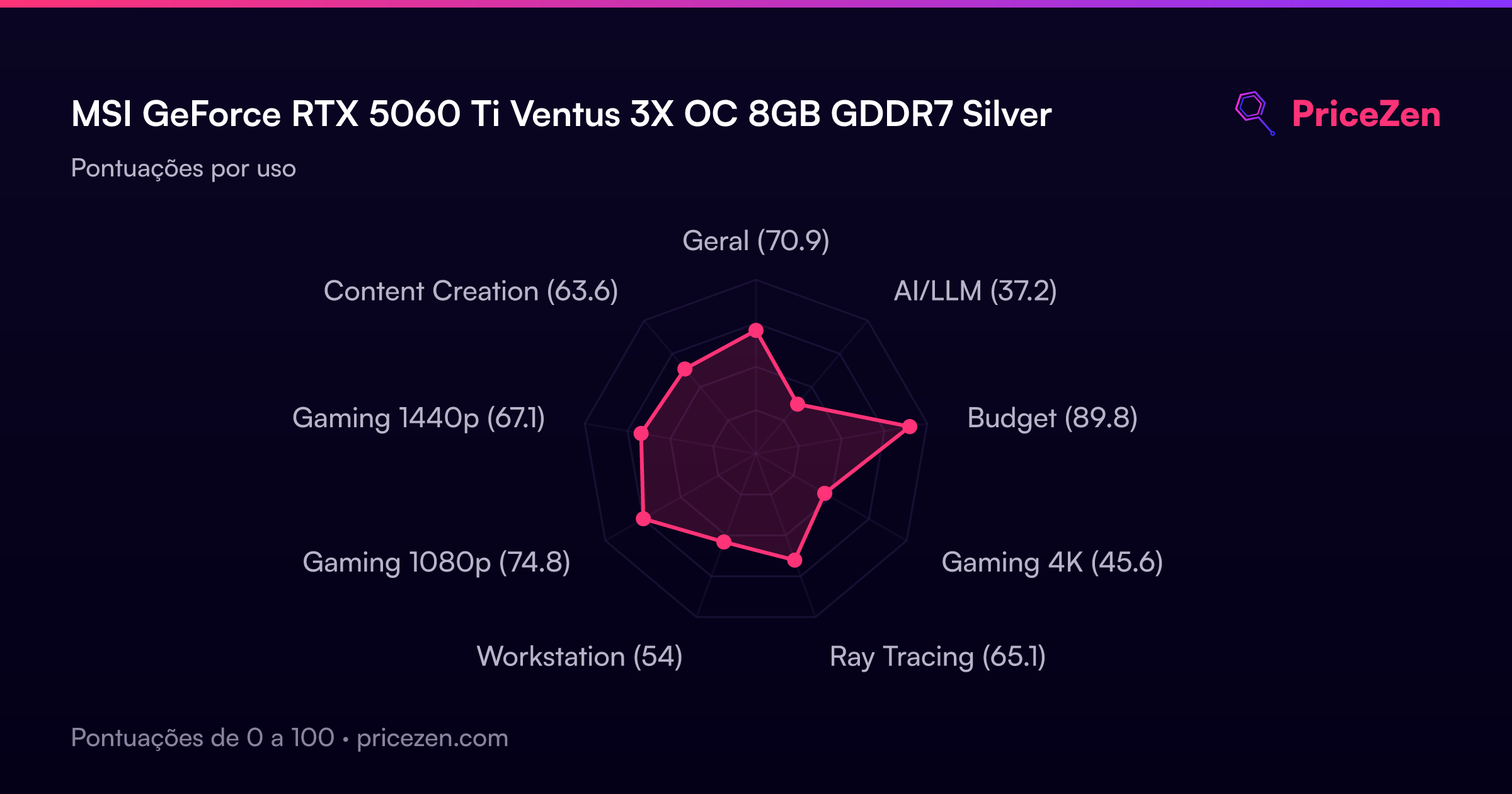
Usage Scores
- Geral70.9
- AI/LLM37.2
- Budget89.8
- Gaming 4K45.6
- Ray Tracing65.1
- Workstation54
- Gaming 1080p74.8
- Gaming 1440p67.1
- Content Creation63.6