Canon EOS C300 EF Mark III
The 9.6MP Super 35mm Dual Gain Output sensor delivers over 16 stops of dynamic range, paired with the DIGIC DV 7 processor for internal Cinema RAW Light and 4K 120p recording. Its modular design with three expansion units and user-changeable lens mounts makes it adaptable for cinema or broadcast workflows, while Dual Pixel Autofocus with Eye AF adds precision. Best for professional cinematographers and documentary crews needing high dynamic range, high frame rates, and flexible rig configurations in a lightweight body.

Sem preço atual de lojas


Resumo
The 30-Second Version
The C300 Mark III is a dedicated cinema camera with a 16+ stop DGO sensor, internal Cinema RAW Light and 4K at 120fps, and our rankings put its video capability among the best in the category. At USD 5,425 body only from Amazon, affordability is its worst score by far. No weather sealing, a weak EVF and a 9.6MP sensor rule it out as a do-everything camera. Buy it for graded cinema work, skip it for hybrids and travel.
Pros & Cons
Prós
- 16+ stops of dynamic range at ISO 800 from the DGO sensor 93rd
- Internal Cinema RAW Light and XF-AVC H.264, no external recorder needed 90th
- 4K at 120fps and 1080p at 180fps for real slow motion 82nd
- Dual Pixel AF with Eye AF and subject detection, well above average in our rankings 77th
- Modular design with three expansion units and user-changeable lens mounts
Contras
- Affordability ranks 9th percentile, one of the priciest options we track
- No weather sealing, so rain and dust are your problem
- Battery scores below the midpoint in our data
- EVF falls behind most of the category
- 9.6MP sensor limits stills work, reflected in a mid-pack sensor score
As provas
Performance
Start with the sensor, because everything else follows from it. The DGO design gives you 16+ stops at ISO 800, and in practice that means windows stay recoverable and faces don't turn to mush in the same shot. Our sensor score sits solidly mid-pack overall, which sounds underwhelming until you remember the resolution: 9.6MP on an APS-C sized Super 35 sensor. That's a video-first pixel count. Stills-oriented bodies in this category are chasing far more megapixels, so the C300 Mark III loses points there while winning on the thing it was actually designed for. Sensitivity runs ISO 100 to 102,400, so low-light interiors are within reach without immediately reaching for a light kit.
The video numbers are where it pulls ahead. A 90th percentile video ranking puts it among the best we track, backed by 4K (4096x2160) at 60p, 4K at 120fps and 1080p at 180fps. That 120fps 4K figure matters more than it looks on paper: you can pull genuinely usable slow motion at delivery resolution instead of dropping to HD and hoping the client doesn't notice. Internal Cinema RAW Light means the grade has real latitude without an external recorder in the rig. Autofocus ranks well above average thanks to Dual Pixel AF with Eye AF and subject detection, and IBIS lands in strong territory too, though neither replaces a proper operator or a gimbal on a moving shot. Burst sits near the top of the charts at 92, which is a nice side effect of the readout speed even if nobody buys this for stills.
Specifications
Full Specifications
Sensor
| Type | CMOS |
| Size | aps-c |
| Megapixels | 9.6 MP |
| ISO Range | 100 |
| Processor | DIGIC DV 7 |
Autofocus
| Eye AF | Yes |
| Subject Detection | Yes |
Shooting
| Burst (Electronic) | 120 |
| Electronic Shutter | Yes |
Video
| Max Resolution | 4K |
| 4K FPS | 120 |
| 1080p FPS | 180 |
| 10-bit | Yes |
| Log Profile | Yes |
| RAW Video | Yes |
| Codec | Cinema RAW Light, XF-AVC H.264 |
Display & EVF
| Screen Size | 4.3" |
| Touchscreen | Yes |
| Articulating | Yes |
Connectivity
| Wi-Fi | Yes |
vs Competition
The names sitting next to this in our competitor set tell you something: Sony Alpha a7R VI, Fujifilm X-H2, Nikon Z8, OM System OM-1 Mark II and Panasonic LUMIX GH7. Those are hybrid cameras, and the C300 Mark III beats them on the specific things a cinema production cares about. Its video ranking is in the top tier of the category, its burst score sits near the top of the charts, and internal Cinema RAW Light plus 4K 120p is a combination built for grading suites rather than social feeds. If your deliverable is a commercial or a short film, this is the tool shaped for that job.
But it gives ground everywhere else, and you should know where. The Nikon Z8 and Sony Alpha a7R VI are the ones to cross-shop if you need stills alongside video, because our sensor score for the Canon is only mid-pack and 9.6MP won't satisfy anyone printing large or cropping hard. The Panasonic LUMIX GH7 and Fujifilm X-H2 are worth a look if budget is the deciding factor, since affordability is this camera's worst ranking by a wide margin. And the OM System OM-1 Mark II is the direction to head if you shoot outdoors in bad weather, because the C300 Mark III has no weather sealing at all. Our build score lands well below average too, which for a camera at this price is a fair thing to be annoyed about.
| Spec | Canon EOS C300 EF Mark III | Sony Alpha a7R VI | Fujifilm X-H2 | Nikon Z8 | Panasonic Lumix G9 II | OM System OM-1 Mark II |
|---|---|---|---|---|---|---|
| Type | cinema | mirrorless | mirrorless | mirrorless | mirrorless | mirrorless |
| Sensor | 9.6MP aps-c | 66.8MP full-frame | 40.2MP aps-c | 45.7MP full-frame | 25.2MP micro-four-thirds | 20.4MP micro-four-thirds |
| AF Points | - | 759 | 425 | 493 | 779 | 1053 |
| Burst FPS | - | 30 | 15 | 30 | 75 | 120 |
| Video | 4K @120fps | 8K @120fps | 8K @60fps | 8K @120fps | 4K @120fps | 4K @60fps |
| IBIS | Yes | Yes | Yes | Yes | Yes | Yes |
| Weather Sealed | No | Yes | Yes | Yes | Yes | Yes |
| Weight (g) | - | 622 | 579 | 820 | 575 | 511 |
| Compare | Compare | Compare | Compare | Compare |
| Produto | AF | EVF | Build | Burst | Video | Sensor | Battery | Display | Connectivity | Affordability | Stabilization |
|---|---|---|---|---|---|---|---|---|---|---|---|
| Canon EOS C300 EF Mark III | 76.7 | 37.4 | 36.7 | 92.5 | 89.5 | 63.9 | 45.9 | 82.3 | 60.8 | 10.8 | 74.9 |
| Sony Alpha a7R VI Compare | 96.5 | 98.9 | 94.2 | 88 | 98.9 | 81 | 96.4 | 97.3 | 95.5 | 12.6 | 99.6 |
| Fujifilm X-H2 Compare | 91.4 | 96.2 | 93.2 | 79.2 | 94.6 | 98.8 | 97.1 | 94.9 | 95.5 | 24.6 | 95.8 |
| Nikon Z8 Compare | 92.7 | 90.6 | 97.4 | 94.7 | 98.5 | 67.5 | 88.4 | 97.1 | 95.5 | 16 | 87.8 |
| Panasonic Lumix G9 II Compare | 97.6 | 90.4 | 93.1 | 95.8 | 97.3 | 59.4 | 89.8 | 96.4 | 95.5 | 38 | 87.8 |
| OM System OM-1 Mark II Compare | 98.6 | 99.8 | 92.6 | 99.3 | 83.5 | 46.7 | 95.1 | 94.9 | 95.5 | 25.8 | 99.6 |
Preço
Value & Pricing
At USD 5,425 from Amazon (body only), this is not an impulse purchase, and our affordability ranking of 9 says so bluntly. But price-to-performance depends entirely on what you're comparing it to. If you need internal RAW, 16+ stops and 4K 120p in one box, you're paying for capabilities that most hybrid bodies simply don't offer at any price. The cost per useful feature is reasonable for a working cinematographer billing day rates. For a hobbyist or a solo YouTube creator, it's a lot of money for features you'll never open.
We track pricing across stores, and right now the US listing sits at USD 5,425 with Amazon as the only in-stock source in our data. Canadian buyers are looking at CAD 12,000 from a single listing. Those are separate markets with separate currencies, so don't try to line them up against each other. With only one listing per region, there's no cross-store bargain hunting to be done here. If the price moves, our community browser extension will catch it, but don't expect the discount-bin treatment on a cinema body.
Saiba mais
Overview
The Canon EOS C300 EF Mark III is a proper cinema camera, not a mirrorless body that happens to shoot good video. It's built around a Super 35mm Dual Gain Output sensor that reads each pixel twice with different gains, then merges the bright-area and shadow-area reads into one image. That's how Canon gets to 16+ stops of dynamic range at ISO 800, and it's the single most important thing about this camera. Our scoring model puts its video capability in the top tier of everything we track in this category, which is exactly where you'd hope a dedicated cinema body would land.
Who's it for? Small crews, documentary shooters, commercial directors and owner-operators who need internal RAW and high frame rates without renting a whole camera department. You get Cinema RAW Light and XF-AVC H.264 recording internally, 4K at up to 120fps, 1080p at 180fps, 10-bit and Log. The DIGIC DV 7 processor is what makes all that possible inside the body rather than on an external recorder hanging off the side. Add Dual Pixel autofocus with Eye AF and subject detection, plus IBIS, and you've got a cinema camera that can actually be operated by one person when the job demands it.
The interesting part is the modularity. Three expansion units and user-changeable lens mounts mean you build the camera around the job instead of adapting your job to the camera. The trade-off is obvious once you look at our rankings: this thing scores near the bottom on affordability and lands well below average on build and battery in our data. It's a specialist tool priced like one, sold here as body only at USD 5,425. If you're shooting narrative or commercial work where dynamic range and codec options decide the grade, that math works. If you want one camera for everything, keep reading, because the weaknesses are real.
Common Questions
Q: Do I need an external recorder to shoot RAW with this camera?
No, and that's one of its biggest practical advantages. The DIGIC DV 7 processor handles Cinema RAW Light internally, alongside XF-AVC H.264, so you get gradable RAW files straight to the camera's own media. That keeps the rig smaller and removes a cable, a battery and a point of failure from your setup.
Q: Can I use it for photography as well as video?
You can, but you shouldn't buy it for that. The sensor is 9.6MP on a Super 35 format, which is a video-first design, and our sensor score sits mid-pack while product photography lands at 58.4. Burst ranks near the top of the charts, so action stills are technically fine, but the low resolution limits cropping and large prints compared to the hybrid bodies in its competitor set.
Q: Is it suitable for outdoor or run-and-gun shooting?
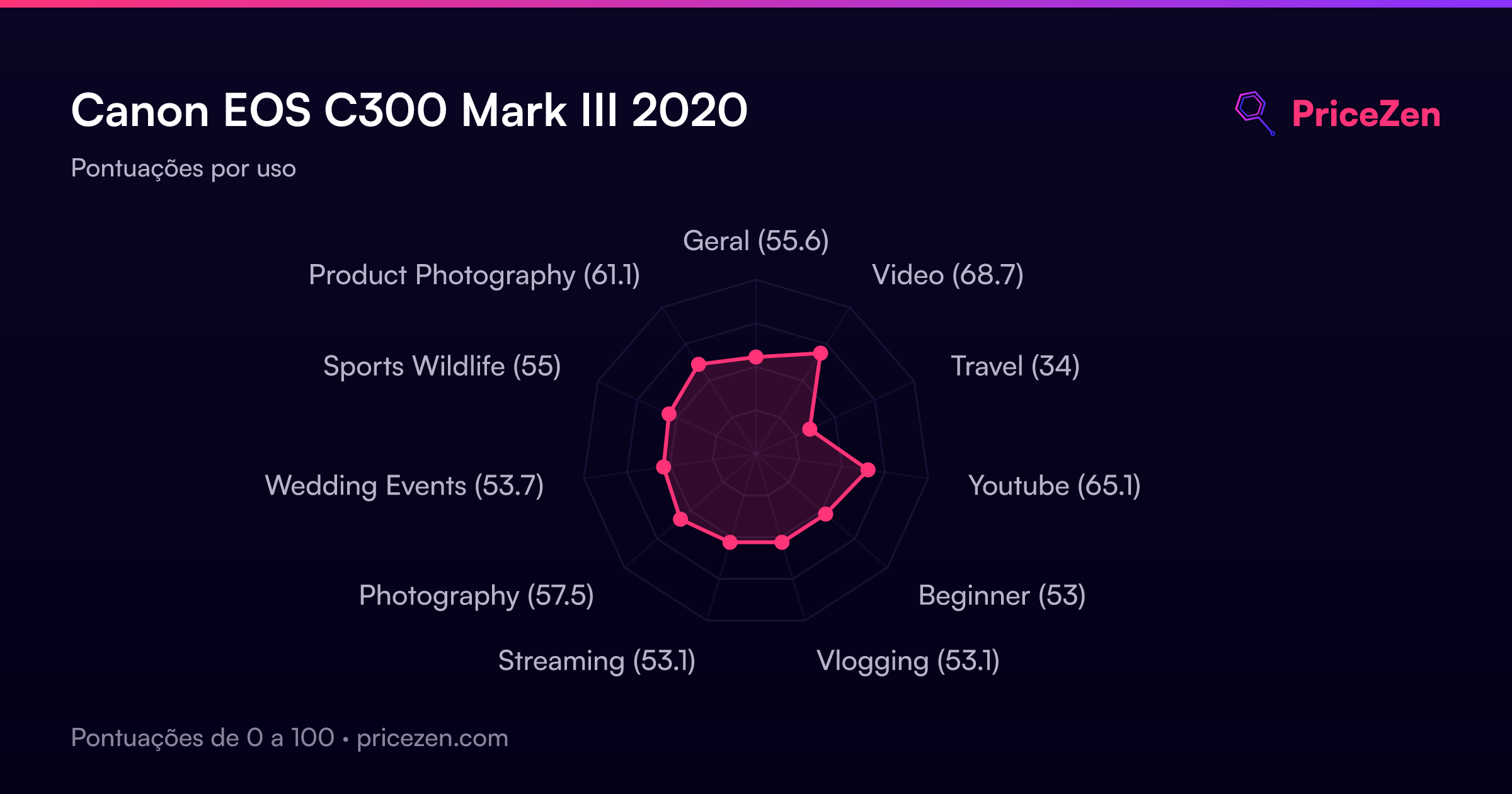
Partly. IBIS ranks in strong territory and Dual Pixel AF with Eye AF and subject detection is well above average, so handheld work is realistic. But there's no weather sealing, our build score falls below average and battery sits under the midpoint, so rain, dust and long unpowered days are genuine risks. Travel is its weakest area at 33.1.
Q: What does 16+ stops of dynamic range actually get me?
It means the sensor holds detail in bright highlights and deep shadows in the same frame, measured here at ISO 800. In real terms, an interior scene with a bright window behind your subject stays recoverable in the grade instead of blowing out or going noisy. The DGO sensor achieves this by reading each pixel at two different gains and combining the results.
Who Should Skip This
Skip this if you need one camera for photo and video. At 9.6MP, the sensor is tuned for motion, and our product photography score of 58.4 plus a mid-pack sensor ranking confirm it. The Nikon Z8, Sony Alpha a7R VI and Fujifilm X-H2 are the names to cross-shop for hybrid work. Also skip it if you shoot outdoors in unpredictable conditions: no weather sealing and a below-average build score make it a poor companion for rain, dust or travel, and our travel score of 33.1 is the lowest on the sheet. The OM System OM-1 Mark II is the more sensible direction there.
And skip it if budget is the deciding factor. Affordability ranks 9th percentile, which is close to the bottom of everything we track in this category, and USD 5,425 buys body only. Solo creators chasing YouTube output should look hard at the Panasonic LUMIX GH7 before committing, because our YouTube score for the Canon is a middling 63.5. You'd be paying cinema money for features a smaller production never touches.
Verdict
If you shoot narrative, documentary or commercial video and you grade your footage, buy it. The 16+ stop DGO sensor, internal Cinema RAW Light and 4K 120p are the reasons this camera exists, and our video ranking backs that up. The modular mount system and expansion units mean it grows with your productions instead of getting replaced. For a small crew that needs cinema-grade files without an external recorder cluttering the rig, this is a genuinely strong pick and we'd recommend it without hesitation.
If you're a hybrid shooter, a solo content creator or someone who needs one camera to do everything, look elsewhere. Our YouTube score of 63.5 and product photography score of 58.4 are middling, and the travel score of 33.1 is the weakest area on the whole sheet. Pair that with no weather sealing, a below-average battery score and a weak EVF, and the picture is clear: this is a specialist that excels inside its lane and struggles outside it. Buy it for the lane, not for the versatility.
Usage Scores
- Geral53.4
- Video67.5
- Travel32.6
- Youtube63.3
- Beginner50.3
- Vlogging52
- Streaming50.3
- Photography56.2
- Wedding Events52.5
- Sports Wildlife54.4
- Product Photography58.4