DJI Ronin 4D
The full-frame 8K sensor records 8K/75fps internal RAW and 4K/120fps, paired with 4-axis active stabilization and LiDAR focusing for steady, precise shots. Its integrated carbon fiber and aluminum magnesium body combines imaging, stabilization, and wireless transmission, reducing setup time for solo operators. Best for cinematographers needing a self-contained gimbal camera for run-and-gun narrative or documentary work.

Sem preço atual de lojas
Resumo
The 30-Second Version
The DJI Ronin 4D is a full-frame 8K cinema camera with a built-in 4-axis gimbal, LiDAR focusing, and internal RAW recording. It's expensive at CAD 13,129, but it replaces a gimbal, follow focus, wireless transmitter, and RAW recorder in one integrated body. The stabilization and wireless workflow are genuinely best-in-class, while the sensor and battery life are just okay. Buy it if you shoot movement-heavy work solo or with a tiny crew. Skip it if you're mostly on a tripod or already own a full gimbal rig.
Pros & Cons
Prós
- Integrated 4-axis gimbal eliminates separate stabilizer setup 87th
- Internal 8K/75fps RAW recording with no external recorder needed 87th
- LiDAR focusing works with manual cinema lenses 83rd
- Modular design accepts E-mount and L-mount adapters 76th
- Wireless transmission and control built in
Contras
- CAD 13,129 price puts it in the 7th percentile for affordability
- Battery life is mediocre at 46th percentile
- No weather sealing despite the rugged build
- EVF performance is underwhelming at 39th percentile
- Sensor quality is middle of the pack at 34th percentile
As provas
Performance
The benchmark story here is interesting because the Ronin 4D doesn't dominate any single category but does a lot of things well enough to be dangerous. Connectivity is at the 89th percentile, which makes sense given the built-in wireless transmission and control system. You can hand a director a tablet and they can pull focus or adjust settings from across the room. That's a feature that usually requires a Teradek and a separate control system. The burst score is also 89th percentile, which is a bit of an odd metric for a cinema camera but speaks to the processing power under the hood. The display is at the 86th percentile, and the articulating touchscreen is genuinely useful when you're operating the gimbal from odd angles.
The weak spots are worth being honest about. The EVF at the 39th percentile is disappointing for a camera at this price. If you're shooting in bright sunlight and relying on the viewfinder, you might find yourself squinting. The sensor at the 34th percentile is also a bit of a letdown for a full-frame 8K camera. It's not bad, but it's not the kind of sensor that makes Sony or Canon shooters jealous. The dynamic range and low light performance are fine, but they're not the reason you buy this camera. You buy it for the integration and the stabilization.
Specifications
Full Specifications
Sensor
| Size | full-frame |
| ISO Range | 800 |
| Processor | CineCore 3.0 |
Autofocus
| Subject Detection | Yes |
Shooting
| Burst (Electronic) | 75 |
| Electronic Shutter | Yes |
Video
| Max Resolution | 8K |
| 4K FPS | 120 |
| 10-bit | Yes |
| Log Profile | Yes |
| RAW Video | Yes |
| Codec | Apple ProRes RAW, ProRes 422 HQ, H.264 |
Display & EVF
| Touchscreen | Yes |
| Articulating | Yes |
Connectivity
| Wi-Fi | Yes |
| Bluetooth | Yes |
| USB | USB 3.1 Type-C |
| HDMI | HDMI Type-A |
vs Competition
The Sony FX30 is the obvious budget alternative. It's an APS-C camera, not full-frame, and it doesn't have a built-in gimbal. But it costs a fraction of the price and Sony's autofocus is genuinely better. If you're shooting interviews, corporate work, or anything where the camera sits on sticks most of the day, the FX30 makes way more sense. The Nikon Z9 is the other interesting comparison. It's a full-frame 8K camera with incredible autofocus and build quality, and it's actually cheaper than the Ronin 4D. But it's a traditional mirrorless body. No gimbal, no LiDAR, no integrated wireless control. You'd need to build out a whole rig to match what the Ronin 4D does out of the box.
The Fujifilm X-H2 and Panasonic Lumix G9 II are both excellent hybrid cameras that cost way less, but they're in a completely different league for cinema work. The OM System OM-1 Mark II is a great travel camera but it's not even playing the same sport. The real question is whether you value the integrated gimbal and wireless workflow enough to pay the premium over a Z9 or an FX30 with a separate gimbal. For solo shooters who move fast, the answer is often yes. For everyone else, probably not.
| Spec | DJI Ronin 4D | Sony Alpha a7R VI | Fujifilm X-H2 | Nikon Z8 | Panasonic Lumix G9 II | OM System OM-1 Mark II |
|---|---|---|---|---|---|---|
| Type | cinema | mirrorless | mirrorless | mirrorless | mirrorless | mirrorless |
| Sensor | - | 66.8MP full-frame | 40.2MP aps-c | 45.7MP full-frame | 25.2MP micro-four-thirds | 20.4MP micro-four-thirds |
| AF Points | - | 759 | 425 | 493 | 779 | 1053 |
| Burst FPS | - | 30 | 15 | 30 | 75 | 120 |
| Video | 8K @120fps | 8K @120fps | 8K @60fps | 8K @120fps | 4K @120fps | 4K @60fps |
| IBIS | true | true | true | true | true | true |
| Weather Sealed | false | false | true | true | true | true |
| Weight (g) | - | 621 | 579 | 820 | 575 | 511 |
| Compare | Compare | Compare | Compare | Compare |
| Produto | AF | EVF | Build | Burst | Video | Sensor | Battery | Display | Connectivity | Affordability | Stabilization |
|---|---|---|---|---|---|---|---|---|---|---|---|
| DJI Ronin 4D | 69.3 | 37.7 | 73.9 | 87.3 | 75.8 | 31.5 | 46.1 | 83.3 | 87.2 | 8.1 | 75.8 |
| Sony Alpha a7R VI Compare | 96.5 | 98.9 | 75.9 | 88.2 | 98.8 | 80.8 | 96.6 | 97.7 | 95.4 | 13.1 | 99.5 |
| Fujifilm X-H2 Compare | 91.6 | 96.4 | 93.4 | 79.4 | 94.7 | 98.9 | 97.4 | 83.3 | 95.4 | 29.6 | 95.6 |
| Nikon Z8 Compare | 92.8 | 90.4 | 97.4 | 94.8 | 99 | 67.4 | 89 | 97.5 | 95.4 | 14.8 | 87.5 |
| Panasonic Lumix G9 II Compare | 97.6 | 90.2 | 93.3 | 96 | 97.3 | 59.6 | 90.4 | 96.9 | 95.4 | 30.1 | 87.5 |
| OM System OM-1 Mark II Compare | 98.7 | 99.8 | 90.1 | 99.4 | 83.8 | 46.7 | 95.4 | 95.7 | 95.4 | 28.2 | 99.5 |
Preço
Value & Pricing
Here's where things get complicated. At CAD 13,129, the Ronin 4D is one of the most expensive products in our entire database. The affordability percentile of 7th means 93% of cinema cameras cost less. But that's a slightly unfair comparison because most of those cheaper cameras don't include a gimbal, a follow focus system, a wireless video transmitter, and a RAW recorder. When you add up what a Sony FX30 plus a decent gimbal plus a wireless follow focus plus a monitor plus cables and batteries would cost, you're not that far off. And you'd still have a frankenrig that takes 20 minutes to set up.
That said, the value proposition really depends on how much you shoot handheld or on the move. If you're mostly on a tripod doing interviews or locked-off product shots, you're paying a huge premium for stabilization you won't use. If you're running and gunning on music videos, documentaries, or commercial work where movement is part of the visual language, the integrated design genuinely saves time and money on every shoot. The battery life being at the 46th percentile is a real consideration though. You'll want extra batteries, and DJI batteries are never cheap.
Saiba mais
Overview
The DJI Ronin 4D is one of those rare pieces of gear that makes you stop and rethink what a camera can be. It's a full-frame cinema camera with a built-in 4-axis gimbal, LiDAR focusing, and internal 8K RAW recording, all wrapped up in a carbon fiber and aluminum magnesium body. DJI basically took their drone and gimbal expertise and crammed it into a handheld cinema rig. The result is something that feels less like a traditional camera and more like a filmmaking robot that happens to shoot 8K.
Who's this for? Solo cinematographers and small crews who want gimbal-smooth footage without spending 45 minutes balancing a separate stabilizer. The integrated design means you pull it out of the case and you're rolling. That's a big deal when you're a one-person band shooting a music video or a commercial and the client is watching the clock. It's also interesting for directors who want to move fast on set without a dedicated gimbal operator.
The catch is that this thing is expensive. Like, really expensive. The CAD 13,129 price tag puts it in the 7th percentile for affordability, which is our polite way of saying almost nothing in this category costs more. But if you're already budgeting for a cinema body, a gimbal, a follow focus system, and a wireless video transmitter, the Ronin 4D starts to look like it might actually save you money. And setup time. And back pain.
Common Questions
Q: Does the Ronin 4D work with lenses I already own?
The Ronin 4D uses DJI's DL-mount natively, but it accepts E-mount and L-mount lens adapters. That means Sony E-mount glass and L-mount lenses from Panasonic, Sigma, and Leica can be adapted. The LiDAR focusing system works with manual cinema lenses too, which is a big deal if you have a set of vintage primes or cine lenses without autofocus motors. Just keep in mind that adapters add cost and the lenses themselves are sold separately.
Q: How long does the battery last on a shoot?
Battery life is one of the weaker points of this camera. It ranks at the 46th percentile in our database, which puts it below average for cinema cameras. You'll want at least two or three batteries for a full day of shooting, especially if you're using the wireless transmission system heavily. The gimbal motors and wireless video both draw power constantly, so expect to swap batteries more often than you would on a traditional cinema body.
Q: Is the 4-axis stabilization really better than a regular gimbal?
The fourth axis adds vertical stabilization, which specifically targets the up-and-down bounce you get when walking or running with a camera. A standard 3-axis gimbal handles tilt, roll, and pan, but vertical movement still shows up in the footage. The Ronin 4D's active vertical axis smooths that out, which is why footage from this camera often looks like it came off a much larger stabilization rig. It's a meaningful difference if you shoot while moving.
Q: Can I use this camera in the rain or dusty conditions?
No, the Ronin 4D is not weather sealed. That's a notable omission for a camera at this price point, especially since the build quality is otherwise solid at the 72nd percentile. If you shoot in harsh environments regularly, you'll need to protect the camera with rain covers or consider something like the Nikon Z9, which has much better environmental sealing. The exposed gimbal motors and LiDAR module are particularly vulnerable to dust and moisture.
Who Should Skip This
If you shoot mostly on a tripod, this camera is overkill. The entire value proposition is the integrated gimbal and the speed of setup. Locked-off interviews, product shots, or studio work don't benefit from 4-axis stabilization, and you're paying a massive premium for it. A Sony FX30 or even a used full-frame mirrorless body will give you better sensor performance and autofocus for a fraction of the price. Put the savings into lenses and lighting.
Also skip it if you already own a solid gimbal setup. If you've got a Ronin RS3 Pro, a wireless follow focus, and a monitor that you're happy with, the Ronin 4D doesn't add much beyond integration. You'd be paying CAD 13,129 to consolidate gear you already own. The sensor isn't a meaningful upgrade over what's in a good mirrorless body, and the battery life is worse than most. The Nikon Z9 is a better choice if you want a flagship full-frame 8K camera without the gimbal tax.
Verdict
If you're a solo cinematographer or a small crew that shoots a lot of movement-heavy work, the Ronin 4D is hard to beat. The integrated gimbal means you're rolling in minutes instead of an hour, and the footage looks like it came off a much more expensive setup. The LiDAR focusing with manual lenses is a genuinely useful feature that no one else offers in this form factor. The 8K RAW internal recording means you're not juggling external recorders and cables. For music videos, documentaries, and commercial work where you need to move fast and look good doing it, this camera earns its keep.
But if you're mostly locked off on a tripod, or you already own a gimbal and a wireless follow focus system, the value proposition gets shaky. The sensor isn't class-leading, the battery life is mediocre, and the lack of weather sealing is annoying at this price. You could buy a Sony FX30, a nice gimbal, and a wireless follow focus for less money and get better autofocus and a better sensor. You'd just spend more time setting up and tearing down. The Ronin 4D is a specialized tool that does one thing incredibly well: getting smooth, cinematic footage quickly with minimal crew. If that's your job, it's worth every penny. If it's not, you're paying for capability you won't use.
Usage Scores
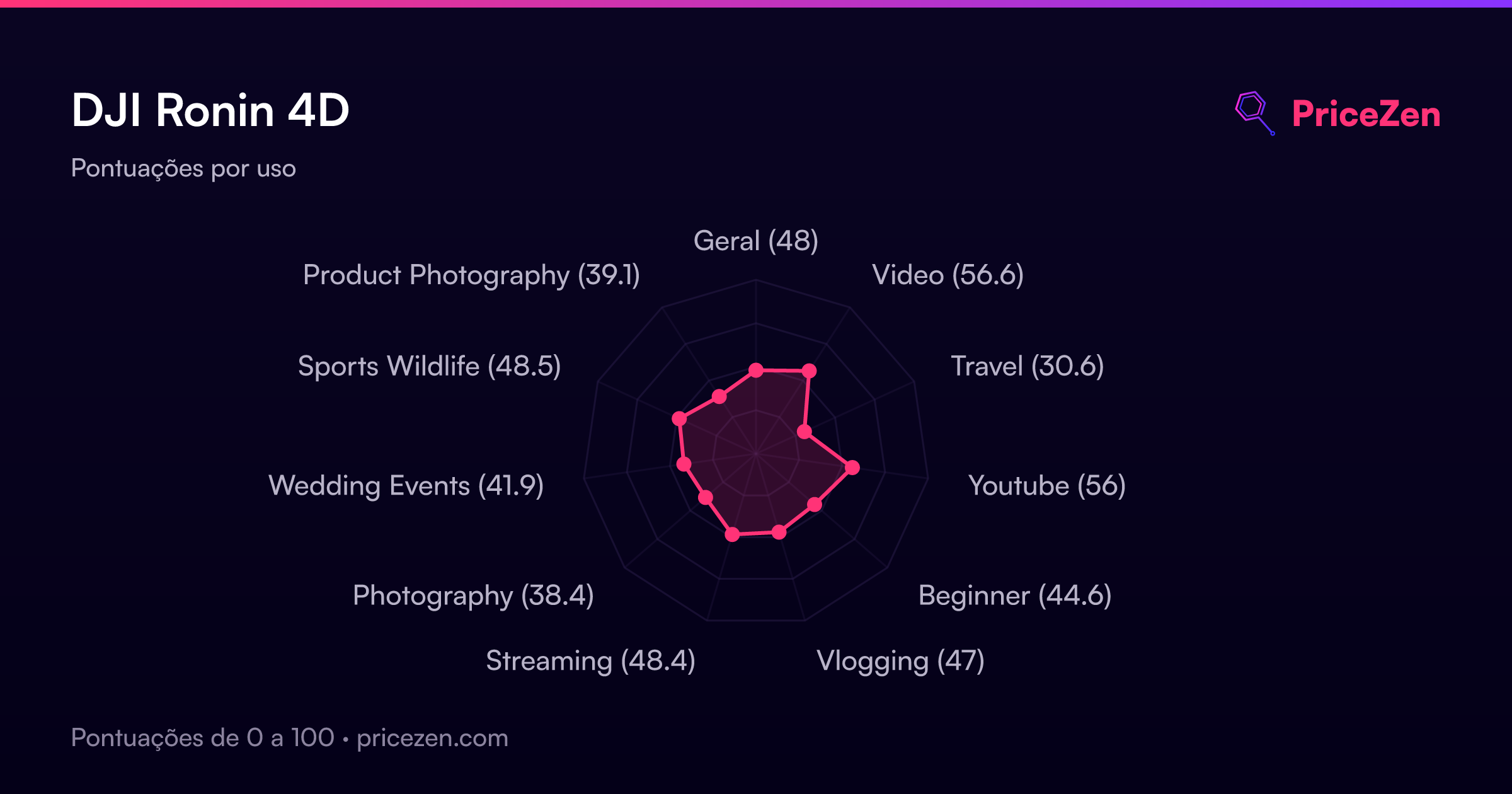
- Geral53.9
- Video61.5
- Travel35
- Youtube59.5
- Beginner49.5
- Vlogging49.5
- Streaming51.5
- Photography46.8
- Wedding Events47.2
- Sports Wildlife51.2
- Product Photography49.9