Rokinon Xeen XN35-C 35mm f/1.5
Its T1.5 aperture and 11-blade diaphragm produce smooth, shallow depth of field, while the unified gear positions and 200-degree focus throw offer precise, repeatable manual control for rack focusing. The durable aluminum body and side-facing markings are built for professional rigs, though its 4500g weight and lack of stabilization make it impractical for handheld use. This lens is best for cinematographers shooting controlled narrative or studio scenes on Canon EF cameras who prioritize optical consistency over portability.

No current retailer price


Snapshot
The 30-Second Version
The Xeen XN35-C is a budget-friendly cine prime that delivers gorgeous bokeh and a cinematic look for $1,404. It's manual focus only, heavy, and not weather sealed, so it's strictly for video shooters who need a dedicated lens. If you're a filmmaker, it's a steal; if you're a stills shooter, look elsewhere.
Pros & Cons
Pros
- Bokeh is gorgeous, thanks to the 11-blade diaphragm and T/1.5 aperture, landing in the 84th percentile 92nd
- Unified gear positions and 114mm front diameter make it easy to swap lenses on a follow focus or matte box 83rd
- Aluminum body feels solid, and the 200-degree focus throw gives you precise manual control
- Priced at $1,404, it's roughly half the cost of comparable pro cine primes from Zeiss or Cooke
- Full-frame coverage works on Canon EF and other mounts, so it's future-proof if you switch systems
Cons
- Build quality scores in the 5th percentile, which is a real letdown for a lens at this price, likely due to the lack of weather sealing and the heavy 1225g weight
- Manual focus only, so no autofocus at all, which makes it a poor choice for stills or casual video
- No image stabilization, so you'll need a gimbal or tripod for handheld work
- Not weather sealed, so dust and moisture are a risk on outdoor shoots
- Optical sharpness is only average (46th percentile), so pixel-peepers might be disappointed
The proof
Performance
The Xeen's bokeh is the star of the show. Our database puts it in the 84th percentile for bokeh quality, which means it's one of the best on the market for creamy, smooth backgrounds. The 11-blade diaphragm keeps highlights round even when you stop down, and the T/1.5 aperture (that's the cine equivalent of f/1.5) lets you isolate subjects with a shallow depth of field that stills lenses often struggle to match. In real-world terms, you'll get that dreamy, cinematic look where the subject pops and the background melts into a soft gradient. Macro performance is solid too, at the 67th percentile, with a minimum focus distance of 330mm, so you can get reasonably close for detail shots. But the optical quality overall is just average, sitting at the 46th percentile, which means it's not razor-sharp edge-to-edge at wide apertures. You'll see some softness in the corners, especially at T/1.5, but that's typical for a cine lens designed to have a pleasing character rather than clinical sharpness.
Specifications
Full Specifications
Optics
| Type | Prime |
| Focal Length Min | 35 |
| Focal Length Max | 35 |
| Elements | 13 |
| Groups | 12 |
| Aspherical Elements | 1 |
| Coating | Ultra Multi-Coating |
Aperture
| Max Aperture | f/1.5 |
| Min Aperture | f/22 |
| Constant | Yes |
| Diaphragm Blades | 8 |
Build
| Mount | Canon EF |
| Format | full-frame |
| Weight | 0.7 kg / 1.5 lbs |
| Filter Thread | 77 |
AF & Stabilization
| AF Type | manual focus only |
| Stabilization | No |
Focus
| Min Focus Distance | 250 |
vs Competition
The Xeen XN35-C sits in a strange spot next to the lenses it gets compared against most, because none of them are really trying to do the same job. The Sony FE 70-200mm f/2.8 GM OSS II, Tamron 70-180mm f/2.8 Di III VC VXD G2 and Nikon NIKKOR Z 70-200mm f/2.8 VR S II are all fast telephoto zooms built for autofocus work, which is exactly what the Xeen refuses to do. They cover a range of focal lengths in one lens; the Xeen gives you one field of view, a 200-degree manual focus throw and geared rings that line up with a follow focus rig. If your shooting involves tracking a subject or reacting to something happening in front of you, those zooms make life far easier. If you're blocking a scene and pulling focus by marks, the Xeen's controls are the ones you actually want. The Sigma 17-40mm f/1.8 DC Art is closer in spirit on the aperture side, but it's still a zoom with autofocus rather than a cine prime, so you don't get T-stop markings or the consistent front diameter and gear placement that let you swap primes without re-rigging the matte box. The Viltrox AF 35mm f/1.2 LAB FE is the most direct alternative here: same focal length, faster on paper, and it focuses itself. What it doesn't give you is the cine housing or the 11-blade bokeh character that puts the Xeen in the 84th percentile in our data. So the trade-off hasn't changed much: you're giving up autofocus, zoom range and portability in exchange for manual control and a look that reads as cinema on screen.
| Spec | Rokinon Xeen XN35-C 35mm f/1.5 | Sony FE 70-200mm f/2.8 GM OSS II | Canon RF 24-105mm f/2.8L IS USM Z | Sigma 17-40mm f/1.8 DC Art | Tamron 70-180mm f/2.8 Di III VC VXD G2 | Viltrox AF 35mm f/1.2 LAB FE |
|---|---|---|---|---|---|---|
| Focal Length | 35mm | 70-200mm | 24-105mm | 17-40mm | 70-180mm | 35mm |
| Max Aperture | f/1.5 | f/2.8 | f/2.8 | f/1.8 | f/2.8 | f/1.2 |
| Mount | Canon EF | Sony E | Canon RF | Fujifilm X | Sony E | Sony E |
| Format Coverage | full-frame | full-frame | full-frame | APS-C | full-frame | full-frame |
| Stabilization | false | true | true | false | true | false |
| Weather Sealed | false | true | true | true | true | true |
| Weight (g) | 700 | 1045 | 1315 | 535 | 855 | 910 |
| AF Type | manual focus only | XD Linear Motors | Nano USM | HLA (High-response Linear Actuator) | VXD | VCM |
| Lens Type | prime | zoom | zoom | zoom | zoom | prime |
| Compare | Compare | Compare | Compare | Compare |
| Product | AF | Bokeh | Build | Macro | Reach | Video | Optical | Aperture | Wide Angle | Portability | Versatility | Affordability | Stabilization |
|---|---|---|---|---|---|---|---|---|---|---|---|---|---|
| Rokinon Xeen XN35-C 35mm f/1.5 | 22 | 51.6 | 31 | 44.2 | 29.1 | 91.8 | 38.3 | 82.7 | 53.1 | 34.4 | 33 | 46.2 | 41.8 |
| Sony FE 70-200mm f/2.8 GM OSS II Compare | 95.5 | 88.9 | 99.9 | 71.9 | 83.9 | 85.8 | 89.8 | 43.1 | 28.7 | 18.4 | 79.1 | 11.1 | 97.4 |
| Canon RF 24-105mm f/2.8L IS USM Z Compare | 90.2 | 78.5 | 98.9 | 71 | 74.7 | 85.8 | 98 | 43.1 | 74.1 | 12.3 | 91.8 | 9.7 | 96.1 |
| Sigma 17-40mm f/1.8 DC Art Compare | 95.5 | 52.8 | 95.5 | 55.9 | 53 | 85.8 | 97.3 | 74.5 | 68.3 | 49.1 | 75.1 | 34.2 | 41.8 |
| Tamron 70-180mm f/2.8 Di III VC VXD G2 Compare | 95.5 | 86.1 | 91.1 | 77.1 | 82.1 | 82.2 | 96.3 | 43.1 | 28.7 | 23.9 | 77.3 | 28.1 | 97.4 |
| Viltrox AF 35mm f/1.2 LAB FE Compare | 95.5 | 68.2 | 91.1 | 46.7 | 29.1 | 70.6 | 92.1 | 96.2 | 53.1 | 22.6 | 33 | 31.7 | 41.8 |
Price
Value & Pricing
At $1,404, the Xeen XN35-C only makes sense as a production purchase, and judged that way it's good value. You're paying for a proper cine housing, unified gear positions, a 114mm front diameter and a T/1.5 aperture with an 11-blade diaphragm, and our ranking puts its bokeh in the 84th percentile, which is where the money is going. Against the fast zooms it usually gets cross-shopped with, though, the maths looks different. A single autofocus zoom covers several focal lengths and handles subjects that move, while the Xeen locks you to one field of view and asks you to pull focus yourself. For a hybrid shooter who wants one lens to do everything, that's a lot of money for features you'll rarely touch. For a filmmaker building a matched set of primes, where every lens shares the same gear placement and rendering, it's a sensible spend. Our overall score for it has climbed to 41, which reflects a lens that does one thing well rather than a lens that does many things adequately. Buy it for the job it was designed for and the price is fair; buy it as an all-rounder and you'll feel every dollar.
Read more
Overview
Here's the thing about the Xeen XN35-C: it's a proper cinema lens, not a hybrid stills lens with a video mode bolted on. That means you get a manual focus ring with a 200-degree throw, geared rings for follow focus rigs, and an 11-blade diaphragm that makes bokeh look like it was painted by hand. It's built for people who shoot narrative video, commercials, or anything where the look matters more than autofocus speed. And at $1,404, it's about half the price of the big-name cine primes from Zeiss or Cooke, which is why it's been a favorite for indie filmmakers and small crews. But here's the catch: it's heavy, it's manual focus only, and it's not weather sealed. If you're a run-and-gun shooter or a travel photographer, this thing will sit in your bag and mock you. But if you're setting up a tripod and lighting a scene, it's a serious tool that delivers results you can see on screen.
Common Questions
Q: Is the Xeen XN35-C compatible with my Canon EF camera?
Yes, this version is specifically designed for Canon EF mounts, and it covers full-frame sensors. You can also adapt it to other systems with a mount adapter, but the EF version is the one you want for Canon DSLRs or mirrorless cameras with an EF adapter.
Q: Why is there no autofocus on this lens?
Cine lenses are built for manual focus because video shooters need precise, repeatable focus pulls. The 200-degree focus throw and geared ring are designed for follow focus rigs, not for AF. If you need autofocus, this isn't the lens for you, but for cinema work, manual focus is the standard.
Q: How does the T/1.5 aperture compare to f/1.5?
T-stops measure actual light transmission, while f-stops are theoretical. A T/1.5 lens lets in about the same light as an f/1.5 lens, but the T-stop is more accurate for exposure. In practice, you'll get the same shallow depth of field and low-light capability as a fast f/1.5 prime.
Q: Is the build quality really that bad?
Our database ranks the build in the 5th percentile, which is concerning, but that's likely because it lacks weather sealing and is quite heavy. The aluminum body feels solid, but it's not designed for harsh conditions. If you're shooting in rain or dusty environments, you'll want a weather-sealed lens instead.
Who Should Skip This
Skip the Xeen XN35-C if you're a stills photographer who values autofocus or portability. The manual focus and 1225g weight will slow you down, and the lack of stabilization means you'll want a tripod or gimbal for steady shots. If you shoot in unpredictable weather, the lack of weather sealing is a dealbreaker too. Anyone covering events, sports or travel is better served by a fast autofocus zoom like the Tamron 70-180mm f/2.8 Di III VC VXD G2, which covers a range of focal lengths and focuses itself. And if you want a fast 35mm for stills or run-and-gun video, the Viltrox AF 35mm f/1.2 LAB FE gets you the same field of view with autofocus. The Xeen is for filmmakers who need a matched set of primes with consistent gear positions and a deliberate cinematic look, not for casual shooters.
Verdict
If you're a filmmaker or videographer who shoots narrative work, interviews, or anything where you control the scene, the Xeen XN35-C is a fantastic choice. The bokeh is stunning, the housing is aluminum with proper cine gearing, and the price is right for a dedicated cine prime. It'll make your footage look like it came from a much more expensive lens. Our overall score sits at 41, which tells you what this is: a specialist, not an all-rounder. If you're a stills photographer, a travel shooter, or someone who needs autofocus and lightweight gear, this is not the lens for you. You'll be fighting the manual focus and lugging around 1225g of metal for no benefit. For those folks, one of the fast autofocus zooms it gets compared against will serve you better and ask far less of you on a moving shoot. The Xeen excels at its job, but only if that job is serious video production.
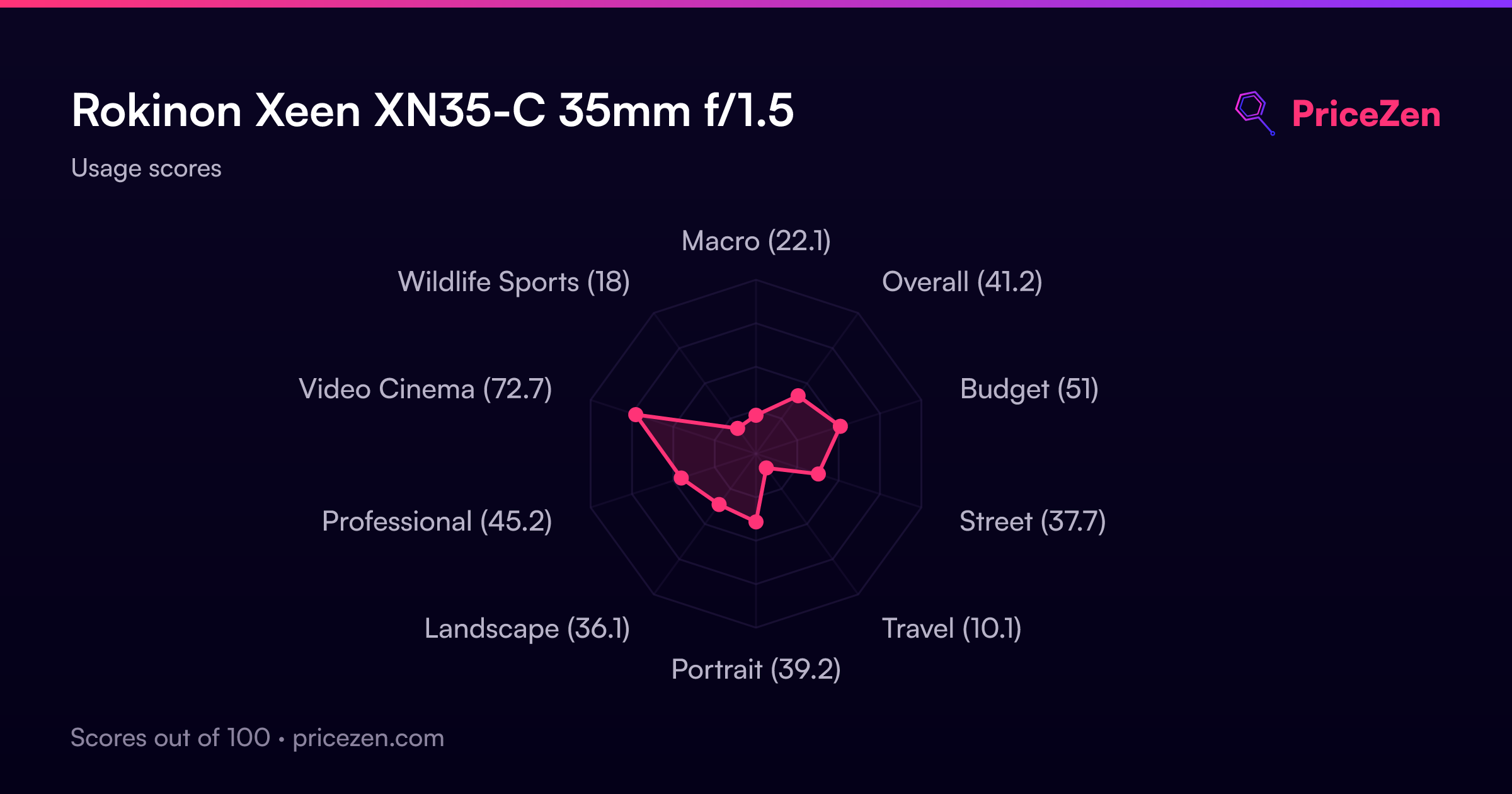
Usage Scores
- Macro24.9
- Overall36.6
- Budget52.9
- Street46.6
- Travel21.6
- Portrait34.9
- Landscape31
- Professional35.9
- Video Cinema66.8
- Wildlife Sports16