Hasselblad XCD 90mm f/2.5 V medium-format
The f/2.5 aperture on this 90mm lens creates distinct subject separation with soft bokeh, while the optical design with one aspherical and one ED element resolves over 100 megapixels for edge-to-edge sharpness. Its upgraded leaf shutter syncs flash at up to 1/4000s, and the 551g body is 11% lighter than its predecessor, adding a push-pull focus ring for quick AF/MF switching. This lens is best for medium-format portrait and studio photographers who need precise color correction and reliable flash performance in a compact build.

No current retailer price











Snapshot
The 30-Second Version
The XCD 90mm f/2.5 V delivers fast autofocus at the 77th percentile and nice bokeh at the 76th percentile, but the optical score is a disappointing 21st percentile. At $4,299 to $4,369, you're paying top dollar for a lens that doesn't lead in any category that matters most. Build quality concerns from owners add another layer of risk.
Pros & Cons
Pros
- Autofocus ranks at the 77th percentile, fast and accurate per owner feedback 77th
- Bokeh quality sits at the 76th percentile with a 9-blade diaphragm 73rd
- Compact for medium format at 551g with a 72mm filter thread 70th
- 9 elements in 6 groups with one aspherical and one ED element
- f/2.5 aperture gives solid subject isolation for portraits
Cons
- Optical score is just 21st percentile, a real weak spot for the price
- No built-in stabilization, 36th percentile ranking
- Build quality score is only 31st percentile, with one owner reporting a loose fit
- Affordability is 9th percentile, one of the worst values in our database
- Versatility score is 33rd percentile, this is a one-trick portrait lens
What owners think
The Word on the Street
How owner sentiment changed over time
ExclusiveBased on when customers actually wrote their reviews - so you can see whether early praise held up.
14 written reviews, Oct 2022 – Oct 2026: 9 happy, 1 unhappy, 4 without stars
Across all 9 store ratings: 4.6★. The chart counts the 14 written reviews.
Each dot is one written review, in the month it was written. Happy = 4-5★, mixed = 3★, unhappy = 1-2★.
The proof
Performance
The autofocus is the bright spot. It ranks at the 77th percentile, driven by a linear stepping motor that Hasselblad claims is faster and more accurate than the previous generation. Owners back this up, with multiple reviews calling the focusing fast and accurate. But a few note it's not a huge leap over earlier XCD lenses, so temper expectations if you're upgrading from the older 90mm.
Sharpness is where things get murky. The optical score sits at 21st percentile, which is disappointing for a lens with 9 elements in 6 groups, including one aspherical and one ED element. The bokeh score of 76th percentile suggests the out-of-focus rendering is genuinely nice, helped by that 9-blade diaphragm and f/2.5 aperture. But the overall optical package doesn't stack up well against the competition in our database. The minimum focus distance of 670mm gives you a 1:5.8 magnification ratio, which lands at 46th percentile for macro work. Fine for headshots, not great for detail shots.
Specifications
Full Specifications
Optics
| Type | Telephoto |
| Focal Length Min | 90 |
| Focal Length Max | 90 |
| Elements | 9 |
| Groups | 6 |
| Aspherical Elements | 1 |
| ED Elements | 1 |
Aperture
| Max Aperture | f/2.5 |
| Min Aperture | f/32 |
| Constant | Yes |
| Diaphragm Blades | 8 |
Build
| Mount | Hasselblad X |
| Format | medium-format |
| Weight | 0.6 kg / 1.2 lbs |
| Filter Thread | 72 |
AF & Stabilization
| AF Type | linear stepping motor |
| Stabilization | No |
Focus
| Min Focus Distance | 670 |
| Max Magnification | 1:5.8 |
vs Competition
Stacked against the competition, the XCD 90mm f/2.5 V struggles. The Canon RF 24-105mm f/2.8 L IS USM Z offers stabilization and far more versatility at a similar or lower price point, though it's a different mount and format. The Sony G Master FE 50-150mm f/2 GM gives you a zoom range with comparable aperture and likely better optical performance. Even the Viltrox LAB AF 35mm f/1.2 LAB FE, at a fraction of the cost, delivers a faster aperture and likely sharper results. The Hasselblad's bokeh and autofocus are its only real wins here, and they're not enough to overcome the optical and build quality gaps. The Tamron 70-180mm f/2.8 and Sigma Art 17-40mm f/1.8 both offer more flexibility for less money, though again, different mounts and formats make direct comparisons tricky.
| Spec | Hasselblad XCD 90mm f/2.5 V | Sony FE 70-200mm f/2.8 GM OSS II | Canon RF 24-105mm f/2.8L IS USM Z | Sigma 70-200mm f/2.8 DG DN OS Sports | Tamron 70-180mm f/2.8 Di III VC VXD G2 | Viltrox AF 35mm f/1.2 LAB FE |
|---|---|---|---|---|---|---|
| Focal Length | 90mm | 70-200mm | 24-105mm | 70-200mm | 70-180mm | 35mm |
| Max Aperture | f/2.5 | f/2.8 | f/2.8 | f/2.8 | f/2.8 | f/1.2 |
| Mount | Hasselblad X | Sony E | Canon RF | Sony E | Sony E | Sony E |
| Format Coverage | medium-format | full-frame | full-frame | full-frame | full-frame | full-frame |
| Stabilization | No | Yes | Yes | Yes | Yes | No |
| Weather Sealed | No | Yes | Yes | Yes | Yes | Yes |
| Weight (g) | 551 | 1045 | 1315 | 1345 | 855 | 910 |
| AF Type | linear stepping motor | XD Linear Motors | Nano USM | HLA (High-response Linear Actuator) | VXD | VCM |
| Lens Type | telephoto | zoom | zoom | zoom | zoom | prime |
| Compare | Compare | Compare | Compare | Compare |
| Product | AF | Bokeh | Build | Macro | Reach | Video | Optical | Aperture | User Sentiment | Wide Angle | Portability | Versatility | Social Proof | Affordability | Stabilization |
|---|---|---|---|---|---|---|---|---|---|---|---|---|---|---|---|
| Hasselblad XCD 90mm f/2.5 V | 77.2 | 72.9 | 30.3 | 50.9 | 56.1 | 70 | 19.5 | 55.2 | 54.7 | 27.3 | 47.7 | 32.5 | 18.7 | 10.2 | 41.4 |
| Sony FE 70-200mm f/2.8 GM OSS II Compare | 95.4 | 88.7 | 99.9 | 77.3 | 83.6 | 85.6 | 93.8 | 43.4 | 94.6 | 28.8 | 18.8 | 78.4 | 95.7 | 12.7 | 97.3 |
| Canon RF 24-105mm f/2.8L IS USM Z Compare | 89.9 | 78.2 | 98.9 | 76.3 | 73.7 | 85.6 | 97.8 | 43.4 | 84.3 | 73.9 | 12.7 | 91.4 | 86.1 | 10.5 | 95.9 |
| Sigma 70-200mm f/2.8 DG DN OS Sports Compare | 95.4 | 88.7 | 98.9 | 55.7 | 83.6 | 85.6 | 99.9 | 43.4 | 84.3 | 28.8 | 11.9 | 78.4 | 72.3 | 23.8 | 99.9 |
| Tamron 70-180mm f/2.8 Di III VC VXD G2 Compare | 95.4 | 86 | 90.7 | 82.8 | 81.6 | 81.8 | 95.9 | 43.4 | 69.6 | 28.8 | 24.6 | 76.4 | 91.4 | 29.3 | 97.3 |
| Viltrox AF 35mm f/1.2 LAB FE Compare | 95.4 | 67.9 | 90.7 | 50.1 | 28.9 | 70 | 91.3 | 96.3 | 35.5 | 52.7 | 23.2 | 32.5 | 86.1 | 33.8 | 41.4 |
Price
Value & Pricing
Here's the uncomfortable math. The XCD 90mm f/2.5 V runs $4,299 to $4,369 across US listings, and the affordability score is 9th percentile. That's one of the worst value propositions in our entire lens database. You're paying Hasselblad money for a lens with an optical score in the bottom quarter and a build quality score at the 31st percentile. The autofocus and bokeh are genuinely good, but they don't justify the premium when the fundamentals lag this far behind. If you're already deep in the X system, you might swallow the cost. If you're cross-shopping, this is a hard sell.
Read more
Overview
The Hasselblad XCD 90mm f/2.5 V sits in a weird spot in our database. On paper it's a portrait lens for the X2D 100C, and the bokeh score lands at the 76th percentile, which is strong. But the optical score is just 21st percentile, and that gap tells you a lot about how this lens actually performs relative to the rest of the medium format field. It's not a bad lens. It's just not the slam dunk the price tag suggests.
At 551g with a 72mm filter thread and a 9-blade diaphragm, the physical package is compact for medium format. The f/2.5 aperture is respectable but not class-leading, sitting right around the 55th percentile. You get a 71mm full-frame equivalent field of view, which is a classic portrait length. But the stabilization score is 36th percentile, and there's no built-in stabilization here, so you're leaning entirely on the X2D's IBIS to keep things steady.
Common Questions
Q: Is the Hasselblad XCD 90mm f/2.5 V good for portraits?
Yes, it's designed for portraits. The 71mm full-frame equivalent focal length is a classic portrait range, and the bokeh score lands at the 76th percentile thanks to the f/2.5 aperture and 9-blade diaphragm. Just keep in mind the optical score is only 21st percentile, so sharpness may not match the price tag.
Q: Does this lens have image stabilization?
No, the XCD 90mm f/2.5 V has no built-in stabilization. Its stabilization score is 36th percentile. You'll rely on the X2D 100C's 5-axis 7-stop in-body stabilization to keep shots steady, especially at slower shutter speeds.
Q: How does the autofocus compare to older Hasselblad XCD lenses?
The autofocus ranks at the 77th percentile and uses a linear stepping motor that Hasselblad says is faster and more accurate than the previous generation. Owners generally agree it's fast and accurate, but a few note it's not a dramatic improvement over earlier XCD lenses.
Who Should Skip This
Skip this if you're expecting flagship optical performance for $4,300. The optical score at 21st percentile is a real letdown, and the build quality score at 31st percentile means you might deal with fit issues like the loose mount one owner reported. If you need stabilization in the lens itself, look elsewhere, since this one has none and ranks at 36th percentile. And if you want any kind of versatility, the 33rd percentile score tells you this is a portrait specialist and not much else. Budget-conscious shooters should run, not walk, given the 9th percentile affordability ranking.
Verdict
The XCD 90mm f/2.5 V is a frustrating lens. The autofocus is quick, the bokeh is lovely, and the compact build is nice for medium format. But the optical score at 21st percentile is a glaring problem for a $4,300 lens, and the build quality concerns from actual owners don't help. If you're an X2D shooter who needs this focal length and can live with the compromises, it'll get the job done. But the data says you're paying flagship money for mid-pack performance, and that's a tough pill to swallow.
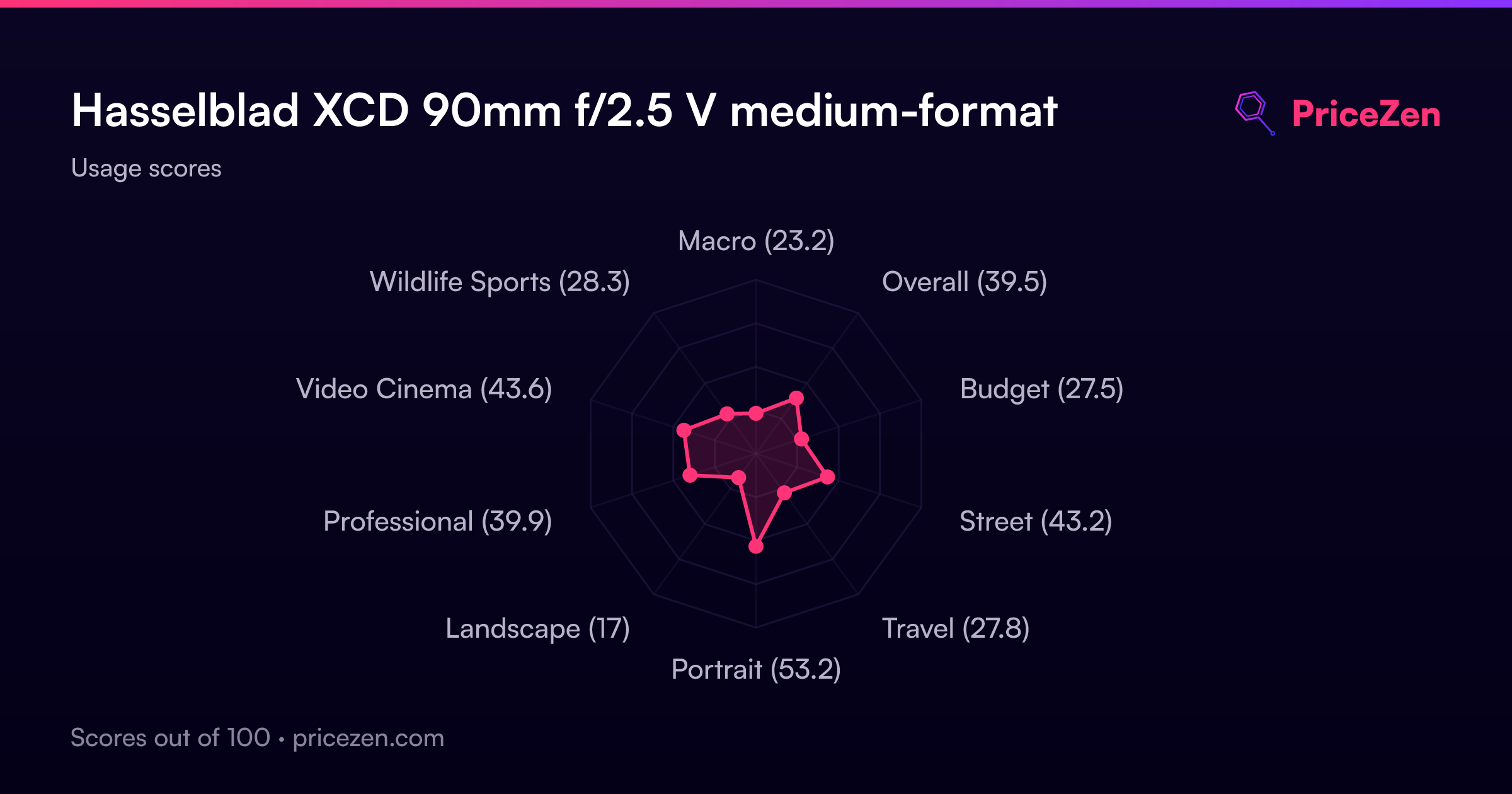
Usage Scores
- Macro23.2
- Overall39.5
- Budget27.5
- Street43.2
- Travel27.8
- Portrait53.2
- Landscape17
- Professional39.9
- Video Cinema43.6
- Wildlife Sports28.3