HP 15.6 2025, Core Ultra 5 225U, 8GB, 512GB SSD, Natural Silver
The Intel Core Ultra 5 225U processor with built-in AI acceleration and integrated Intel Graphics handles everyday multitasking and light creative work, while the 15.6-inch FHD IPS anti-glare display offers comfortable viewing from wide angles. With 8GB DDR5 RAM, a 512GB NVMe SSD, Wi-Fi 6, and up to 9 hours 45 minutes of battery life with fast charging, it balances portability and productivity for daily use. Best for students who need a reliable, affordable laptop for note-taking, streaming, and office tasks, though its integrated GPU limits gaming performance.

No current retailer price
Snapshot
The 30-Second Version
The HP 15.6 15-fd2015st packs a current-gen Intel Core Ultra 5 225U and a 512GB NVMe SSD into a $450 package, which is genuinely impressive. The 8GB of RAM and weak integrated graphics are the main compromises, and gaming is basically off the table. Battery life is a highlight at nearly 10 hours claimed. For students and everyday users, this is one of the better value picks we've seen.
Pros & Cons
Pros
- Core Ultra 5 225U is a genuinely capable 12-core chip for this price 91st
- 512GB NVMe SSD beats the old hard drives still common in budget laptops 78th
- Claimed 9h45m battery life with fast charging (0-50% in 45 min)
- Anti-glare IPS display with wide viewing angles
- 4.5-star rating from 1,023 buyers, 96th percentile for social proof
Cons
- 8GB RAM is tight and sits in the 24th percentile
- Gaming score of 13.7/100 means integrated graphics are a real limitation
- Port selection is sparse, 27th percentile
- 2.29kg weight makes it less portable than many competitors
- Screen quality is below average at the 39th percentile
The proof
Performance
The Core Ultra 5 225U is the star here. It's a 12-core chip with a 4.8GHz max clock, and in our database it lands in the 61st percentile for CPU performance. That's solidly above average, and honestly better than you'd expect from a laptop in this class. For everyday tasks like web browsing, document editing, and video calls, it's going to feel snappy. The 8GB of DDR5-5600 helps too, though that's where things get tight. 8GB is fine for basic multitasking, but it sits in the 24th percentile for RAM, which means you'll feel the squeeze if you're the type who keeps 30 browser tabs open while editing photos.
The integrated Intel Graphics is a mixed bag. It lands in the 57th percentile for GPU performance, which is fine for streaming video and light photo editing, but gaming is a non-starter. Our gaming score for this machine is 13.7 out of 100, which is about as low as it gets. You can play older titles or indie games at low settings, but anything modern will struggle. The 512GB NVMe SSD is right in the middle of the pack at the 51st percentile, and it's a genuine upgrade over the spinning hard drives you still see in budget laptops. Boot times and app launches will feel quick.
Specifications
Full Specifications
Processor
| CPU | Intel Core Ultra 5 225U |
| Cores | 12 |
| Frequency | 4.8 GHz |
| L3 Cache | 12 MB |
Graphics
| GPU | Intel Graphics |
| Type | Integrated |
Memory & Storage
| RAM | 8 GB |
| RAM Generation | DDR5 |
| Storage | 512 GB |
| Storage Type | NVMe SSD |
Display
| Size | 15.6" |
| Resolution | 1920x1080 (Full HD) |
| Panel | IPS |
Connectivity
| USB Ports | 2 |
| HDMI | 1x HDMI |
| Wi-Fi | Wi-Fi 6 |
| Bluetooth | Bluetooth 5.4 |
Physical
| Weight | 2.3 kg / 5.0 lbs |
| OS | Windows 11 Home |
vs Competition
The Apple MacBook Air M4 is the obvious elephant in the room. It's lighter, has a better screen, and the M4 chip runs circles around the Core Ultra 5 in most tasks. But it costs a lot more, and if you're on a student budget, that gap matters. The Lenovo ThinkPad T14 Gen 6 is another strong alternative, especially if you value build quality and keyboard feel. ThinkPads are tanks, and the T14 has a better port selection, but again, you're paying for it.
The ASUS Vivobook Pro 15 N6506CU is probably the closest competitor in spirit. It's a 15-inch laptop with a focus on value, and ASUS tends to offer better displays at similar price points. The Samsung Galaxy Book5 Pro is thinner and lighter with a gorgeous OLED screen, but it's aimed at a different buyer. If you want something that feels premium, the Surface Laptop 7th Edition is lovely, but it's also in a completely different price bracket. The HP's real advantage is that it delivers current-gen performance at a price none of these others can touch.
| Spec | HP 15.6 15-fd2015st | Apple MacBook Pro 14.2" M4 Max | ASUS ROG Zephyrus 14" GA403WW-G14.R95080 | Lenovo Legion Pro 7i Gen 10 16" | Samsung Galaxy Book5 Pro 14" NP944XHA-KG3US | Dell Premium 14.5" LDA14250-7667SLV-PUS |
|---|---|---|---|---|---|---|
| CPU | Intel Core Ultra 5 225U | Apple M4 Max | AMD Ryzen AI 9 HX 370 | Intel Core Ultra 9 275HX | Intel Core Ultra 7 258V | Intel Core Ultra 7 255H |
| RAM (GB) | 8 | 64 | 32 | 32 | 32 | 32 |
| Storage (GB) | 512 | 4096 | 2048 | 1024 | 1024 | 1024 |
| Screen | 15.6" 1920x1080 | 14.2" 3024x1964 | 14" 2880x1800 | 16" 2560x1600 | 14" 2880x1800 | 14.5" 3200x2000 |
| GPU | Intel Graphics | Apple (40-Core) | NVIDIA GeForce RTX 5080 | NVIDIA GeForce RTX 5070 Ti | Intel Arc Graphics 140V | Intel Arc Graphics |
| OS | Windows 11 Home | macOS | Windows 11 Home | Windows 11 Home | Windows 11 Pro | Windows 11 Home |
| Weight (kg) | 2.3 | 1.6 | 1.6 | 2.7 | 1.2 | 1.7 |
| Battery (Wh) | - | 72 | - | 99 | 63 | 62 |
| Compare | Compare | Compare | Compare | Compare |
| Product | CPU | GPU | RAM | Ports | Screen | Portability | Storage | Reliability | Social Proof | Affordability |
|---|---|---|---|---|---|---|---|---|---|---|
| HP 15.6 15-fd2015st | 60.1 | 56.9 | 23.5 | 26.2 | 38.7 | 31.3 | 50.8 | 33.6 | 91.4 | 78.2 |
| Apple MacBook Pro 14.2" M4 Max Compare | 93.7 | 91.6 | 95.7 | 73.1 | 99.3 | 68.8 | 98.4 | 98.3 | 73.3 | 1.7 |
| ASUS ROG Zephyrus 14" GA403WW-G14.R95080 Compare | 91.2 | 98.3 | 90.9 | 89.2 | 96.5 | 73.7 | 89.7 | 60.7 | 96.5 | 5.8 |
| Lenovo Legion Pro 7i Gen 10 16" Compare | 97.2 | 96.6 | 89 | 97.2 | 95.6 | 9.6 | 79.2 | 82.1 | 99.7 | 5.6 |
| Samsung Galaxy Book5 Pro 14" NP944XHA-KG3US Compare | 65.7 | 69.6 | 79.4 | 83 | 91.6 | 89.5 | 79.2 | 82.1 | 96.5 | 20.6 |
| Dell Premium 14.5" LDA14250-7667SLV-PUS Compare | 87 | 69.6 | 89 | 65.8 | 97.2 | 61.2 | 65.1 | 33.6 | 96.5 | 14 |
Price
Value & Pricing
At $450 USD, this laptop is punching above its weight. The affordability score lands in the 78th percentile, which means it's cheaper than most of what's out there. And you're getting a current-generation Intel chip with an NPU, a fast SSD, and a decent battery. That's a strong value proposition for students or anyone who needs a dependable machine without spending MacBook money.
Compare that to the Apple MacBook Air M4 or the Microsoft Surface Laptop 7th Edition, both of which will run you significantly more. You're giving up build quality, screen quality, and portability, but you're also keeping a lot of cash in your pocket. For the price, the compromises feel reasonable. The 8GB RAM is the one that stings, since it's not user-upgradeable on most modern thin laptops, and it's the spec most likely to make this machine feel dated in a few years.
Read more
Overview
The HP 15.6 15-fd2015st is one of those laptops that sneaks up on you. On paper it's a budget machine, but HP stuffed a brand new Intel Core Ultra 5 225U in there, which is a 12-core chip with a 4.8GHz boost clock. That's not the kind of silicon you usually find at this price point. The rest of the spec sheet is more modest: 8GB of DDR5, a 512GB NVMe SSD, and a 15.6-inch 1080p IPS display. It's clearly aimed at students and everyday users who want something reliable for schoolwork, streaming, and light productivity.
What makes this interesting is the AI angle. HP is pushing the Copilot key hard, and the Core Ultra 5 has a dedicated NPU for on-device AI tasks. Whether that matters to you right now is debatable, but it does mean this laptop is built for where Windows is heading. The 4.5-star rating from over a thousand buyers suggests HP got the fundamentals right here, even if the spec sheet has some obvious compromises.
At 2.29kg, it's not exactly a featherweight, and the port selection is pretty bare. But for someone who needs a dependable daily driver that won't break the bank, this thing checks a lot of boxes. The 9 hour 45 minute claimed battery life is a big deal for students hauling it between classes, and the anti-glare display means you can actually use it near a window without fighting reflections.
Common Questions
Q: Can this laptop handle gaming?
Not really. The integrated Intel Graphics scores 13.7 out of 100 in our gaming benchmarks, which puts it near the bottom. You can play older titles, indie games, or browser-based games at low settings, but anything modern will struggle. If gaming matters, look for a laptop with a dedicated GPU like the ASUS Vivobook Pro 15.
Q: Is 8GB of RAM enough for everyday use?
For basic tasks like web browsing, document editing, and video calls, 8GB is workable. But it sits in the 24th percentile for RAM, which means it's below average. If you keep lots of tabs open, edit photos, or run heavier applications, you'll notice slowdowns. There's no indication this RAM is user-upgradeable, so what you buy is what you get.
Q: How good is the battery life?
HP claims up to 9 hours and 45 minutes of battery life, with fast charging that takes the battery from 0 to 50% in about 45 minutes. Real-world usage typically lands lower than manufacturer claims, but even at 7-8 hours, that's a full day of classes or work without hunting for an outlet.
Q: Does the Copilot key actually do anything useful?
The dedicated Copilot key launches Microsoft's AI assistant, which can help with summarizing text, drafting emails, and answering questions. The Core Ultra 5 has a dedicated NPU for on-device AI tasks, so some features work without an internet connection. It's a nice-to-have, not a reason to buy the laptop on its own.
Who Should Skip This
If you're a developer, content creator, or anyone who needs serious multitasking headroom, this laptop will frustrate you. The 8GB of RAM is the bottleneck, and our developer score of 44.9 reflects that. Running virtual machines, Docker, or heavy IDEs will push this machine to its limits. Look at the Lenovo ThinkPad T14 Gen 6 instead, which offers better build quality and more memory options.
Gamers should also steer clear. The 13.7 gaming score is a clear signal that this isn't the machine for you. Even casual gaming at 1080p will be a struggle on modern titles. If you want a 15-inch laptop that can game, the ASUS Vivobook Pro 15 with its dedicated GPU is a much better fit. And if portability matters, the 2.29kg weight and 31st percentile compactness score mean this isn't the laptop to toss in a bag and forget about.
Verdict
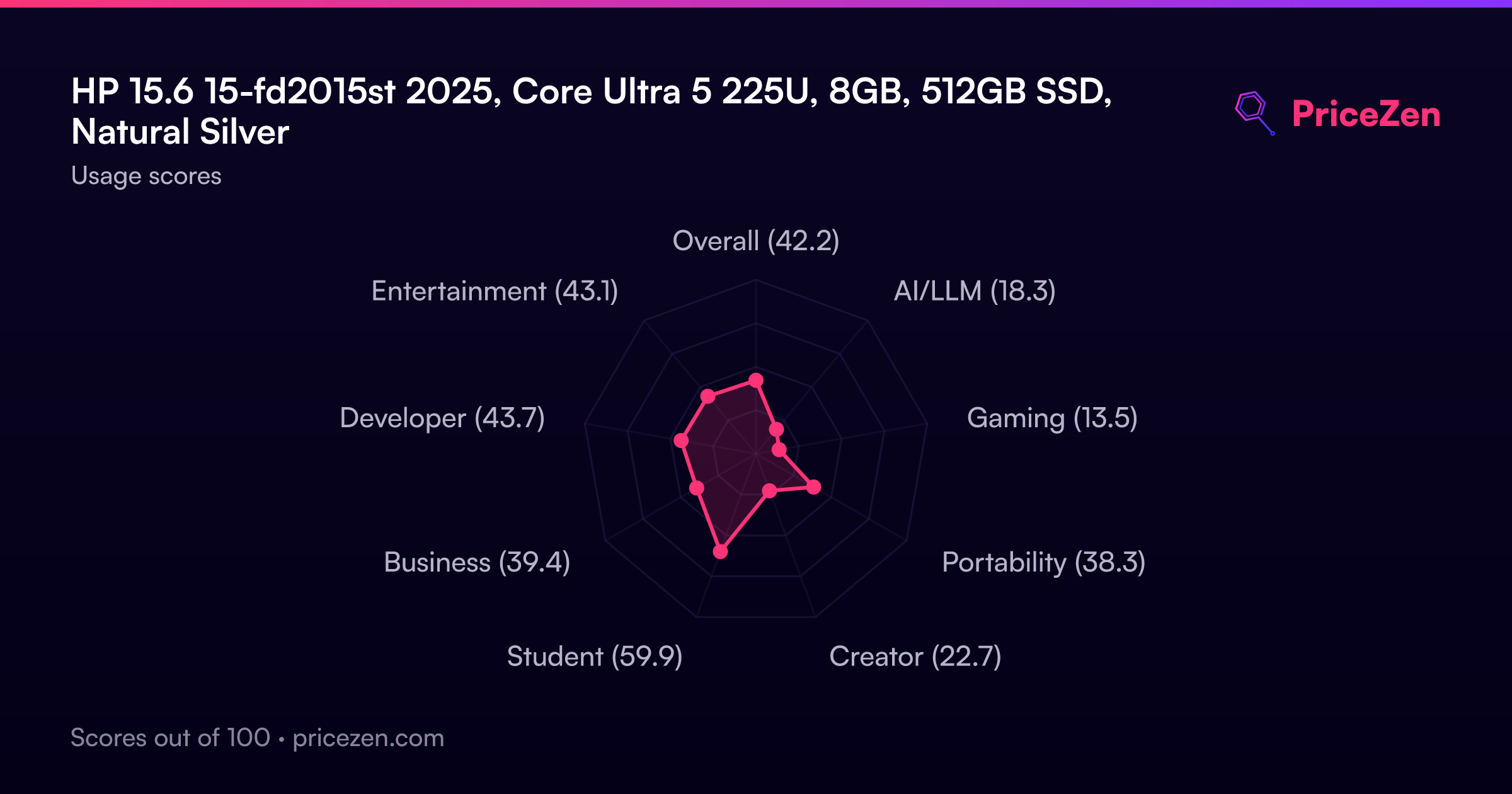
For students, this HP is a no-brainer. Our student score of 60.2 out of 100 reflects that it handles the basics well: note-taking, research, streaming, and video calls. The battery life claim of nearly 10 hours means you can leave the charger at home, and the anti-glare screen is genuinely useful in bright lecture halls or libraries. The Copilot key is a nice bonus if you're curious about AI assistance for summarizing notes or drafting emails.
For developers, the score drops to 44.9, and that's mostly about the 8GB of RAM. If you're running Docker containers, virtual machines, or heavy IDEs, you'll hit the ceiling fast. The CPU is capable, but the memory constraint is real. For entertainment, the 44 out of 100 score reflects the mediocre screen and weak speakers. It's fine for casual Netflix, but it's not a media machine. If you're a developer or someone who needs more headroom, look for a model with 16GB of RAM or consider a ThinkPad with upgradeable memory.
Usage Scores
- Overall42.2
- AI/LLM18.3
- Gaming13.5
- Portability38.3
- Creator22.7
- Student59.9
- Business39.4
- Developer43.7
- Entertainment43.1