MSI Raider 16" GE68 HX 14VFG-297US 2024, Core i7-14700HX, 16GB, 1TB SSD + 512GB SSD, RTX 4060, Black
Intel’s 20-core i7-14700HX and GeForce RTX 4060 drive its 2560x1600 240Hz panel for smooth gameplay and creative tasks. 1.5TB of PCIe 4.0 storage and Killer Wi-Fi 7 cut load times while delivering next-gen wireless connectivity. Best suited for gamers and 4K video editors who prioritize screen real estate and connectivity over portability.

No current retailer price


Snapshot
The 30-Second Version
A 98th-percentile port selection and 92nd-percentile CPU make this a connectivity and processing monster. But at $2,250 USD and 2.75kg, it's one of the least portable and least affordable options we track. Desktop replacement energy, literally.
Pros & Cons
Pros
- CPU ranks among the best on the market (92nd percentile) with 20 cores and 5.5 GHz boost 98th
- Port selection is top of the charts: Thunderbolt, 4x USB-C, 2x USB-A, HDMI 2.1 with 8K output 92nd
- Dual NVMe Gen4x4 drives totaling 1.5TB, well above average for storage 91st
- GPU in the 91st percentile, a standout for mobile graphics 88th
- 240Hz QHD+ 16-inch display, strong for both gaming and creative work
Cons
- Affordability is a weak spot at $2,250 USD, lagging behind most competitors
- 2.75kg makes it one of the heaviest in its class, dead last territory for portability
- 16GB RAM is only middle of the pack when many rivals ship more at this price
- Reliability ranking sits at about average (61st percentile), nothing reassuring there
- Only one store listing currently tracked, limiting price competition
What owners think
The Word on the Street
The proof
Performance
Let's talk numbers. The i7-14700HX sits in the 92nd percentile for CPU performance in our rankings, meaning it outpaces the vast majority of laptops we track. Twenty cores with a 5.5 GHz boost clock is serious silicon for rendering, compiling, or running virtual machines. The RTX 4060 lands in the 91st percentile for GPU, which puts it among the leading mobile graphics options right now. Pair that with a 240Hz QHD+ display (84th percentile for screen quality) and you've got a machine that can push high frame rates at a resolution that actually looks sharp.
Storage is another strong suit: 1TB plus 512GB, both NVMe Gen4x4, earns an 88th-percentile ranking. That's one of the better setups on the market for load times and project file access. The port situation is genuinely exceptional, sitting in the 98th percentile with Thunderbolt, four USB-C ports, two USB-A ports, HDMI 2.1 capable of 8K at 60Hz or 4K at 120Hz, and Wi-Fi 7 via the Killer BE1750. You will never need a dongle with this thing. RAM at 16GB DDR5 is solid but middle of the pack (60th percentile), and the chipset supports up to 64GB if you want to upgrade later.
Specifications
Full Specifications
Processor
| CPU | Intel Core i7 14700HX |
| Cores | 20 |
| Frequency | 2.1 GHz |
| L3 Cache | 33 MB |
Graphics
| GPU | NVIDIA GeForce RTX 4060 |
| Type | Discrete |
| VRAM | 8 GB |
| VRAM Type | GDDR6 |
Memory & Storage
| RAM | 16 GB |
| RAM Generation | DDR5 |
| Storage 1 | 1 TB |
| Storage 1 Type | NVMe SSD |
| Storage 2 | 512 GB |
| Storage 2 Type | NVMe SSD |
Display
| Size | 16" |
| Resolution | 2560x1600 (QHD) |
| Refresh Rate | 240 Hz |
Connectivity
| USB-C Ports | 4 |
| USB Ports | 2 |
| Thunderbolt | Thunderbolt 4 |
| HDMI | HDMI 2.1 |
| Wi-Fi | Wi-Fi 7 |
| Bluetooth | BT 5.4 |
Physical
| Weight | 2.7 kg / 6.1 lbs |
| Battery | 100 Wh |
| OS | Windows 11 Pro |
vs Competition
Stack this against the Lenovo Legion Pro 7i Gen 10 16" and you're looking at two heavy hitters in the same size class, but the Raider's 98th-percentile port score and 92nd-percentile CPU give it a clear connectivity and processing edge in our data. The ASUS ROG Zephyrus 14" GA403WW targets a completely different buyer: someone who wants power in a smaller chassis, which is exactly where the Raider flops (9th percentile for compactness). Cross-shop the HP OMEN Transcend 14 if weight matters to you. The Apple MacBook Pro 14.2" M4 Pro appeals to creators who prioritize efficiency and battery life over raw port count and Windows compatibility. And the Samsung Galaxy Book5 Pro 14" is for people who want thin-and-light productivity, not a 2.75kg desktop replacement. The Raider wins on brute force and I/O; it loses on price, weight, and portability against basically all of them.
| Spec | MSI Raider 16" GE68 HX 14VFG-297US | Apple MacBook Pro 14.2" M4 Pro | ASUS ROG Zephyrus 14" GA403WW-G14.R95080 | Lenovo Legion Pro 7i Gen 10 16" | HP OMEN Transcend | Samsung Galaxy Book5 Pro 14" NP944XHA-KG3US |
|---|---|---|---|---|---|---|
| CPU | Intel Core i7 14700HX | Apple M4 Pro | AMD Ryzen AI 9 HX 370 | Intel Core Ultra 9 275HX | Intel Core Ultra 9 285H | Intel Core Ultra 7 258V |
| RAM (GB) | 16 | 48 | 32 | 32 | 32 | 32 |
| Storage (GB) | 1024 | 4096 | 2048 | 1024 | 1024 | 1024 |
| Screen | 16" 2560x1600 | 14.2" 3024x1964 | 14" 2880x1800 | 16" 2560x1600 | 14" 2880x1800 | 14" 2880x1800 |
| GPU | NVIDIA GeForce RTX 4060 | Apple (16-Core) | NVIDIA GeForce RTX 5080 | NVIDIA GeForce RTX 5070 Ti | NVIDIA GeForce RTX 5070 | Intel Arc Graphics 140V |
| OS | Windows 11 Pro | macOS | Windows 11 Home | Windows 11 Home | Windows 11 Home | Windows 11 Pro |
| Weight (kg) | 2.7 | 1.6 | 1.6 | 2.7 | 1.6 | 1.2 |
| Battery (Wh) | 100 | 72 | - | 99 | 71 | 63 |
| Compare | Compare | Compare | Compare | Compare |
| Product | CPU | GPU | RAM | Ports | Screen | Portability | Storage | Reliability | Affordability |
|---|---|---|---|---|---|---|---|---|---|
| MSI Raider 16" GE68 HX 14VFG-297US | 91.7 | 90.9 | 59.9 | 98 | 83.8 | 9.3 | 88.4 | 60.6 | 13.3 |
| Apple MacBook Pro 14.2" M4 Pro Compare | 92.4 | 78.9 | 90.6 | 73.8 | 99.1 | 68.9 | 98.4 | 98.2 | 4.7 |
| ASUS ROG Zephyrus 14" GA403WW-G14.R95080 Compare | 91.2 | 98.3 | 90.8 | 89.4 | 96 | 73.6 | 89.7 | 60.6 | 6.1 |
| Lenovo Legion Pro 7i Gen 10 16" Compare | 97.2 | 96.7 | 89 | 97.3 | 95 | 9.5 | 79.3 | 81.9 | 5.9 |
| HP OMEN Transcend Compare | 90.1 | 93.5 | 89.7 | 89.4 | 96 | 72.2 | 65.4 | 33.7 | 9 |
| Samsung Galaxy Book5 Pro 14" NP944XHA-KG3US Compare | 65.8 | 69.7 | 79.5 | 83.5 | 90.3 | 89.4 | 79.3 | 81.9 | 21.4 |
Price
Value & Pricing
At $2,250 USD from Newegg (the only listing we're tracking right now), you're paying a premium for that CPU, GPU, and port combo. The dual-drive 1.5TB storage setup and Wi-Fi 7 are nice bonuses that justify some of the cost. But our affordability ranking puts this in the bottom 13 percent of gaming laptops we compare, so you're definitely not getting a bargain. If raw power per dollar is your priority, there are better deals out there. If you specifically need that port array and creator-grade CPU alongside a fast GPU, the price starts making more sense.
Read more
Overview
The MSI Raider GE68 HX 14VFG-297US is a spec-heavy gaming laptop that our ranking puts near the top for CPU and GPU power, with a port selection that's basically best-in-class. The catch? It costs $2,250 USD and weighs 2.75kg, landing it in the bottom tier for both affordability and compactness. This thing is built to sit on a desk and crush workloads, not to slip into a backpack unnoticed.
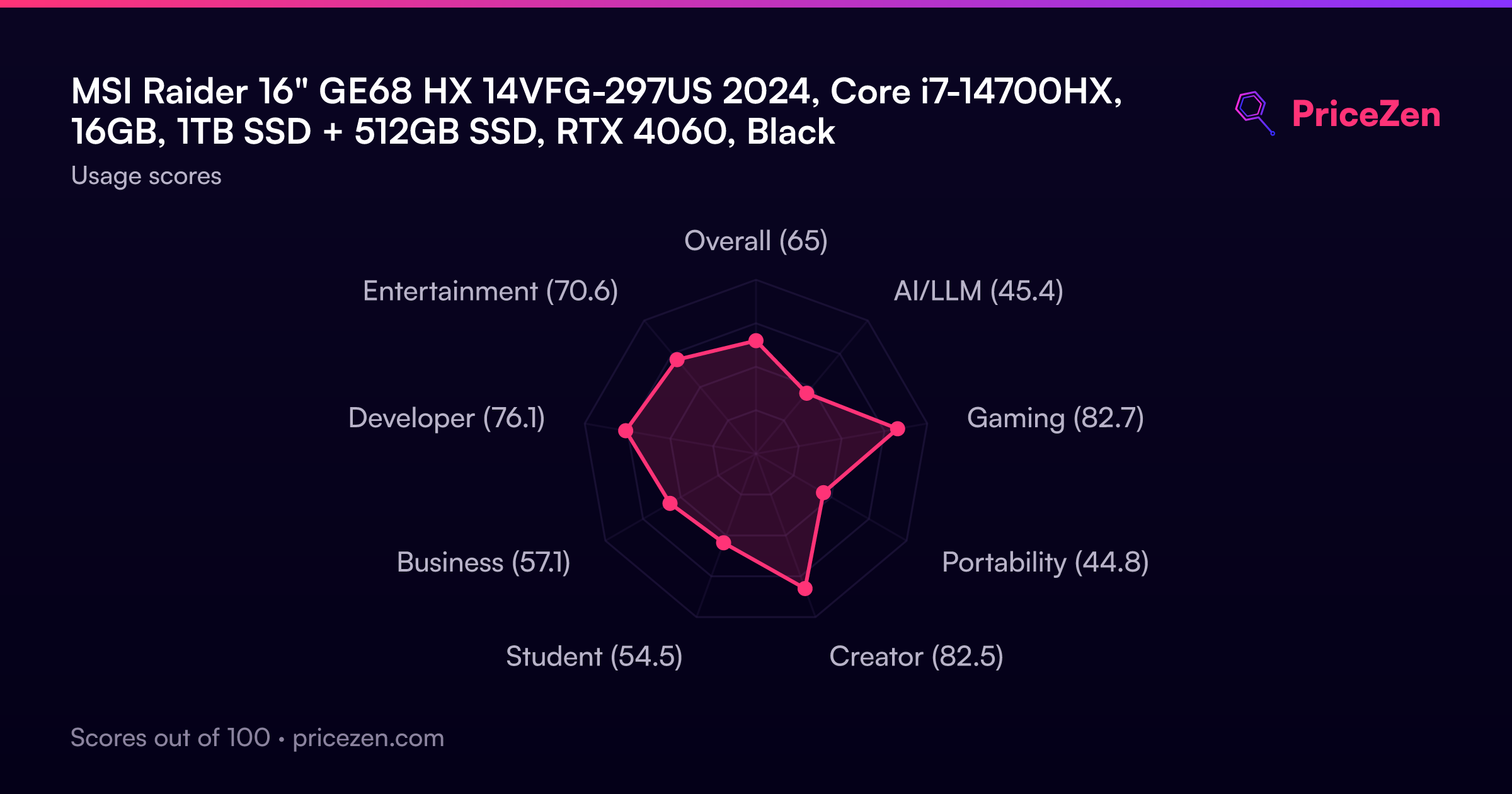
Under the hood you're getting an Intel Core i7-14700HX with 20 cores boosting up to 5.5 GHz, an RTX 4060 with 8GB of GDDR6, 16GB of DDR5 at 5600MHz, and a combined 1.5TB of NVMe Gen4x4 storage across two drives. The 16-inch QHD+ panel runs at 240Hz, which is well above average for this category. Our scoring model gives it 82.7/100 for gaming and 82.5/100 for creators, so it pulls double duty nicely. But that 13th-percentile affordability score stings, and the compact rating of 44.8/100 (our weakest-area flag) tells you everything about its travel-friendliness.
Common Questions
Q: How heavy is this laptop for daily carrying?
It weighs 2.75kg (about 9.25 lbs according to owner Q&A). Our compactness ranking puts it in the 9th percentile, meaning it's one of the bulkiest gaming laptops we compare. This is a stay-at-home machine unless you enjoy shoulder workouts.
Q: Can I upgrade the RAM later?
Yes. It ships with 16GB DDR5 at 5600MHz in a dual-channel config (8GB x 2), and the chipset supports up to 64GB (32GB x 2). Given that 16GB only ranks in the 60th percentile for this category, upgrading is worth considering for heavy multitasking or large creative projects.
Q: What external displays can I run through HDMI?
The HDMI 2.1 port supports up to 8K at 60Hz or 4K at 120Hz. Combined with Thunderbolt and four USB-C ports, the overall port selection ranks in the 98th percentile, so multi-monitor setups are absolutely not a problem here.
Who Should Skip This
If you commute, travel, or even move between rooms regularly, the 2.75kg weight and 9th-percentile compactness score should stop you cold. Budget-conscious buyers should also look elsewhere: the $2,250 USD price tag lands in the 13th percentile for affordability, meaning almost everything else in our database costs less. And if 16GB of RAM isn't enough for your workflow out of the box, you're paying extra to upgrade on a machine that already stretches the wallet. The 61st-percentile reliability score doesn't exactly inspire confidence for a long-term investment either.
Verdict
If you need a Windows laptop that handles gaming at 82.7/100 and creative work at 82.5/100 in our scoring, with enough ports to connect a small studio's worth of peripherals, the Raider GE68 HX delivers. The 20-core CPU and RTX 4060 are genuinely among the best in their respective categories. But at $2,250 USD and 2.75kg, this is a desk-bound investment. Buy it if you want power and connectivity above all else. Skip it if you care about your wallet or your spine.
Usage Scores
- Overall65
- AI/LLM45.4
- Gaming82.7
- Portability44.8
- Creator82.5
- Student54.8
- Business57.1
- Developer76.1
- Entertainment70.6