Peladn GeForce RTX 3070 Ti 8GB GDDR6X White
The Ampere-based RTX 3070 Ti with 8GB of GDDR6X memory and 6144 CUDA cores delivers strong 1440p gaming, backed by a solid metal backplate that enhances both rigidity and thermal conductivity. Its triple-fan cooler and precision-machined circular heat pipes ensure sustained performance under the 290W TDP during long sessions. This card is best for competitive 1080p and 1440p gamers who need high frame rates in titles like PUBG and CSGO, provided their case accommodates the 314mm length.

No current retailer price
Snapshot
The 30-Second Version
Cheap Ampere muscle with an 8GB expiration date. Great stopgap, terrible foundation.
Pros & Cons
Pros
- Genuinely cheap for the silicon. Affordability ranks well above average at the 75th percentile. 75th
- Cooling is a real strength. Triple fans plus a metal back push thermals to the 72nd percentile. 72nd
- Raster performance still holds up. 23203 in PassMark G3D and 448 GB/s of bandwidth is nothing to sneeze at.
- Four outputs, no adapters needed. 3x DisplayPort and 1x HDMI covers most multi-monitor setups.
Cons
- 8GB of VRAM is the ceiling. Below-average VRAM ranking, and it shows in modern titles.
- Power hungry for what you get. 290W TDP and a 750W PSU ask, with efficiency in the bottom third.
- AI work is a non-starter. Our AI/LLM score of 27.1/100 is the weakest thing about this card.
- It's long. 314mm will not fit every case, so measure first.
What owners think
The Word on the Street
The proof
Performance
The PassMark G3D benchmark score of 23203 is respectable, and 6144 CUDA cores with 448 GB/s of memory bandwidth still moves pixels fine. What surprised us in the data is how lopsided this card is. Raster performance is one of the best, but ray tracing drops to about average and AI lands at the 42nd, with our AI/LLM score bottoming out at 27.1/100. That 8GB buffer is the culprit, and it's also why VRAM ranks below the midpoint. Efficiency is a weak spot too, sitting at the 34th percentile, because 290W and a 750W PSU recommendation is a lot of appetite for middle-of-the-pack frame rates. The triple-fan cooler and metal backplate do help thermals land at a solid 72nd percentile, so at least it isn't cooking itself while it works.
Specifications
Full Specifications
Chipset
| GPU Chipset | GeForce RTX 3070 Ti |
| Brand | NVIDIA |
| Architecture | Ampere |
| Class | consumer |
| Process | 8 |
Memory
| VRAM | 8 GB |
| Memory Type | GDDR6X |
| Memory Bus | 256 |
| Bandwidth | 448 |
Compute
| CUDA Cores | 6144 |
| Tensor Cores | 184 |
| RT Cores | 46 |
| Base Clock | 1575 |
| Boost Clock | 1485 |
| FP16 TFLOPS | 16.6 |
| FP32 TFLOPS | 16.6 |
Performance
| PassMark G3D | 23203 |
| GPU Compute | 11474 |
Power & Cooling
| TDP | 290 |
| Recommended PSU | 750 |
| Power Connectors | 2 x 8-Pin |
| Cooler | Triple Fan |
| Fans | 3 |
Connectivity
| Interface | PCI Express 4.0 x16 |
| DisplayPort | 3 |
| HDMI | 1 |
Physical
| Length | 314 |
Features
| Ray Tracing | Yes |
| RGB | Yes |
vs Competition
This is where the Peladn gets uncomfortable. The Sapphire Radeon RX 9070 XT PULSE, XFX Radeon RX 9070 XT Mercury and PowerColor Radeon RX 9070 XT Hellhound OC are all sitting in the same competitor set, and our rankings put this card's VRAM, efficiency and feature scores below the midpoint against that field. If you care about 1440p headroom or ray tracing, cross-shop those first. The MSI GeForce RTX 5070 Gaming Trio is the Nvidia-side alternative worth a look, and the ASUS GeForce RTX 5070 Ti PRIME is the one to aim at if you want to stop upgrading for a while. The Peladn only wins on price, and it wins there clearly.
| Spec | Peladn GeForce RTX 3070 Ti | ASUS GeForce RTX 5090 TUF Gaming | Gigabyte GeForce RTX 5070 Ti Eagle Ice | MSI GeForce RTX 5070 Ti Ventus 3X OC | ZOTAC GeForce RTX 5080 APOCALYPSE | Sapphire Radeon RX 7900 XTX NITRO+ |
|---|---|---|---|---|---|---|
| Chipset | GeForce RTX 3070 Ti | GeForce RTX 5090 | GeForce RTX 5070 Ti | GeForce RTX 5070 Ti | GeForce RTX 5080 | Radeon RX 7900 XTX |
| Vram | 8GB GDDR6X | 32GB GDDR7 | 16GB GDDR7 | 16GB GDDR7 | 16GB GDDR7 | 24GB GDDR6 |
| Boost Clock Mhz | 1485 | 2407 | 2542 | 2482 | 2730 | 2680 |
| Tdp W | 290 | 575 | 300 | 300 | 360 | 339 |
| Memory Bus Bits | 256 | 512 | 256 | 256 | 256 | 384 |
| Ray Tracing | Yes | Yes | Yes | Yes | Yes | Yes |
| GPU Class | consumer | consumer | consumer | consumer | consumer | consumer |
| Compare | Compare | Compare | Compare | Compare |
| Product | AI | Rt | Vram | Raster | Compute | Feature | Thermal | Efficiency | Connectivity | Affordability |
|---|---|---|---|---|---|---|---|---|---|---|
| Peladn GeForce RTX 3070 Ti | 41.8 | 52.9 | 42.2 | 61.6 | 48.3 | 38 | 72.1 | 33.2 | 33.5 | 75.1 |
| ASUS GeForce RTX 5090 TUF Gaming Compare | 97.2 | 90.5 | 97.8 | 98.8 | 97.7 | 95.8 | 72.1 | 23.5 | 99.3 | 2.1 |
| Gigabyte GeForce RTX 5070 Ti Eagle Ice Compare | 79.1 | 88.7 | 86 | 89 | 88 | 95.8 | 91.8 | 71.8 | 94.2 | 22.7 |
| MSI GeForce RTX 5070 Ti Ventus 3X OC Compare | 79.1 | 92.4 | 86 | 89 | 88 | 95.8 | 91.8 | 71.8 | 94.2 | 22.2 |
| ZOTAC GeForce RTX 5080 APOCALYPSE Compare | 85.4 | 97.6 | 89.1 | 94.5 | 93.4 | 95.8 | 91.8 | 56.8 | 94.2 | 22.5 |
| Sapphire Radeon RX 7900 XTX NITRO+ Compare | 95.2 | 96.4 | 92 | 83.4 | 95.7 | 95.8 | 91.8 | 51.6 | 98.8 | 13.5 |
Price
Value & Pricing
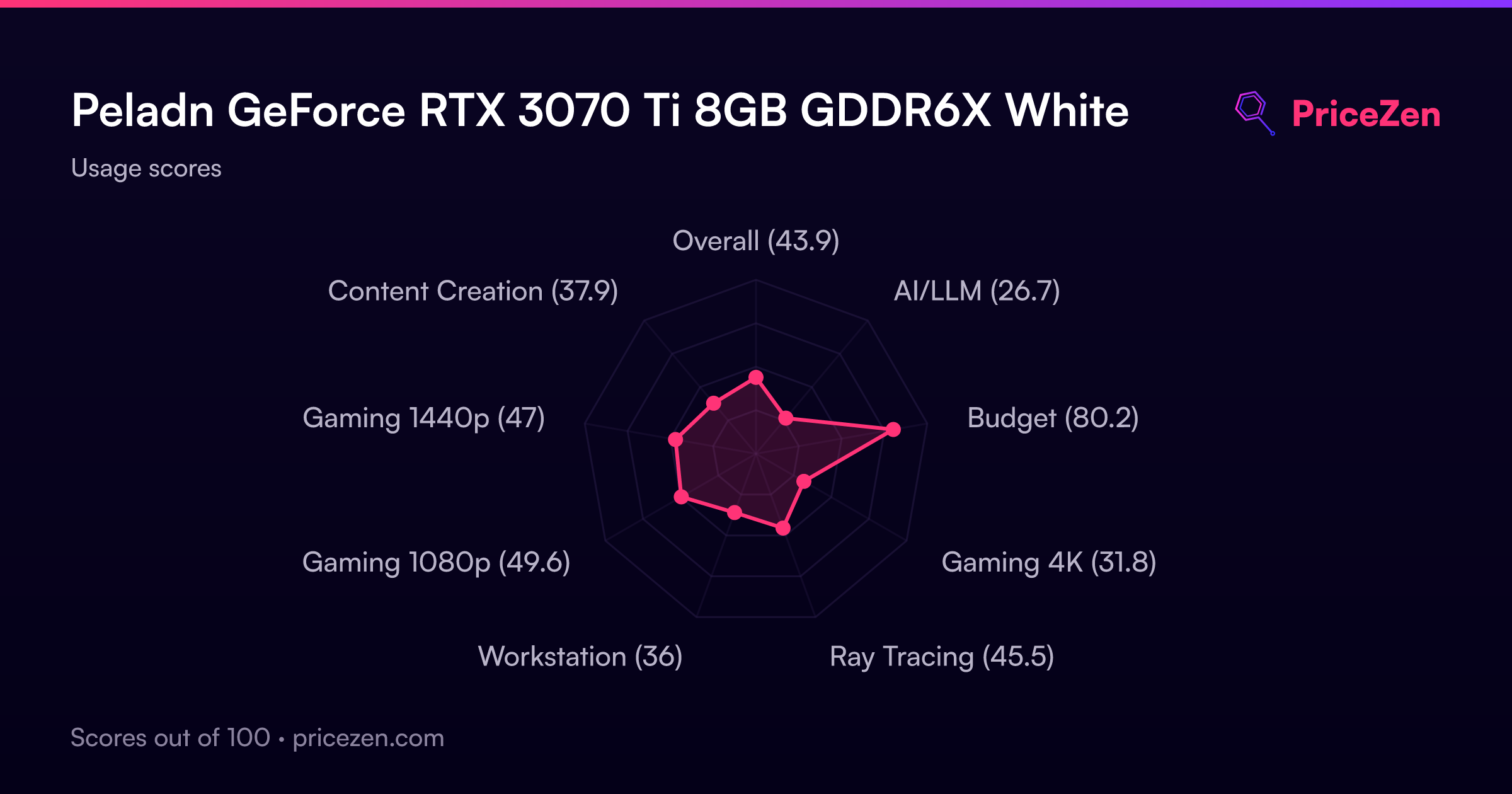
At USD 325 it's worth it if your budget stops there and you mostly play at 1080p. Our budget score of 79/100 backs that up. But don't pretend you're getting a bargain on a card that needs a 750W PSU and taps out at 8GB. If you can stretch your budget, stretch it.
Read more
Overview
The Peladn GeForce RTX 3070 Ti is a budget play, and it knows it. At USD 325 from Newegg, our scoring model puts its affordability at the 75th percentile, which is well above average for this category. That's the whole pitch: you're buying Ampere muscle cheap, not buying the future.
And here's the thing to know before you click buy. This is a 290W card with 8GB of GDDR6X on a 256-bit bus, and both of those numbers are starting to show their age. Our gaming scores land at 50.1/100 for 1080p and 47.5/100 for 1440p, dead middle of the pack. It'll run your games. It won't impress anyone.
Common Questions
Q: Will this fit in my case?
Maybe not. It's 314mm long and roughly 2 inches thick, so grab a ruler before you order. Peladn themselves flag this in the listing, which is a hint.
Q: Is 8GB enough for 1440p gaming?
Not comfortably. Our 1440p gaming score is 47.5/100 and VRAM ranks below average. You'll be dialing textures down in newer titles.
Q: What power supply do I need?
A 750W unit with two 8-pin connectors. Don't try to squeeze this onto a tired 550W box, because 290W of GPU draw plus the rest of your system won't leave room.
Who Should Skip This
If you're building a PC you want to keep for years, this isn't it. The 8GB buffer and bottom-third efficiency ranking mean you'll be shopping again sooner than you'd like. Go look at the Sapphire Radeon RX 9070 XT PULSE or the PowerColor Radeon RX 9070 XT Hellhound OC instead. And if you're planning to run local LLMs, don't even consider this one.
Verdict
Buy it if USD 325 is your hard ceiling and 1080p is your resolution. Skip it if you're building for 1440p, ray tracing, or anything involving local AI models, because 8GB and a 27.1/100 AI score will frustrate you within a year. As a stopgap card in an existing build with a decent PSU, it does the job. As the foundation of a new build, we'd point you at one of the RX 9070 XT options instead.
Usage Scores
- Overall44
- AI/LLM26.8
- Budget80.2
- Gaming 4K31.9
- Ray Tracing45.6
- Workstation36.1
- Gaming 1080p49.7
- Gaming 1440p47.1
- Content Creation38