Nikon Z6III Black 2023
The 26.8MP partially stacked CMOS sensor and EXPEED 7 processor deliver 20fps mechanical and 120fps electronic burst rates, plus 8-stop IBIS for sharp handheld shots. It records 6K video at 60p and 4K at 120fps with N-RAW and ProRes RAW HQ, and the 5.8M-dot EVF and weather-sealed body suit demanding conditions. Best for sports and wildlife photographers who need fast autofocus, high burst speeds, and robust video capabilities in a portable 670g body.

No current retailer price
Snapshot
The 30-Second Version
The Nikon Z6III is a full-frame mirrorless camera with 8-stop IBIS, a 5.8M-dot EVF, 20fps mechanical burst and internal 6K RAW video, priced from USD 3,172 to USD 3,997. It's one of the best hybrid sports, wildlife and event cameras in our rankings, though battery life and travel-friendliness are only average.
Pros & Cons
Pros
- 8-stop IBIS, top of the charts for stabilization 98th
- 5.8M-dot EVF, among the best viewfinders available 98th
- Internal 6K, 4K/120p, N-RAW and ProRes RAW HQ 96th
- 20fps mechanical and 120fps electronic burst 96th
- Weather-sealed body with excellent build quality
Cons
- Expensive, affordability ranks in the bottom fifth
- Battery life is only about average for the class
- Sensor resolution score is mid-pack, not class-leading
- Weakest category is travel at 65.6/100
- Price swings by hundreds between listings
The proof
Performance
The headline numbers here aren't marketing filler. Burst speed is among the best we've seen for mirrorless cameras, with 20fps mechanical and 120fps electronic putting it near the front of the pack for action work. Autofocus is also a standout, the 299-point system with subject detection ranks well above average rather than just adequate. Stabilization is basically best-in-class thanks to that 8-stop IBIS rating, and the 5.8M-dot EVF matches it. If you're handholding long lenses or shooting dim reception halls, those two scores matter more than any megapixel count.
Video is the other place this camera flexes: it's one of the best we've tracked, driven by 6K capture, 4K at 120fps, 1080p at 240fps, 10-bit Log, and internal N-RAW and ProRes RAW HQ. That's a genuinely rare combination in a stills-first body. The less exciting news is the sensor score, which is solid but middle of the pack, and battery life is dead average. Build quality, on the other hand, is top-tier, so the weather-sealed 670g chassis is one of the better-built bodies in the category.
Specifications
Full Specifications
Sensor
| Type | CMOS |
| Size | full-frame |
| Megapixels | 26.79 MP |
| ISO Range | 100 |
| Processor | EXPEED 7 |
Autofocus
| AF Points | 299 |
| Eye AF | Yes |
| Animal AF | Yes |
| Subject Detection | Yes |
Shooting
| Burst (Mechanical) | 20 |
| Burst (Electronic) | 120 |
| Electronic Shutter | Yes |
Video
| Max Resolution | 6K |
| 4K FPS | 120 |
| 1080p FPS | 240 |
| 10-bit | Yes |
| Log Profile | Yes |
| RAW Video | Yes |
| Codec | N-RAW, Apple ProRes RAW HQ |
Display & EVF
| Screen Size | 3.2" |
| Touchscreen | Yes |
| Articulating | Yes |
| EVF Resolution | 5.76 M dots |
Build
| Weather Sealed | Yes |
| Weight | 0.7 kg / 1.5 lbs |
Connectivity
| Wi-Fi | Yes |
| Bluetooth | Yes |
| USB | USB Power Delivery |
| Hot Shoe | Yes |
vs Competition
Against the Canon EOS R6 Mark III, the Z6III's argument is its video stack and viewfinder: 6K with internal N-RAW and ProRes RAW HQ, plus a 5.8M-dot EVF that is among the best we've seen. If you're a hybrid shooter who grades footage, that's the pitch. Sports and event shooters comparing the two should weigh the 20fps mechanical and 120fps electronic burst against whatever workflow they already own lenses for.
The Sony Alpha a7R VI is the resolution-first alternative, and it's worth noting the Z6III's sensor score is only mid-pack, so if maximum detail is your priority, cross-shop it. The OM System OM-1 Mark II and Panasonic Lumix G9 II are the ones to look at if travel is your main use case, since travel is the Z6III's weakest score at 65.6/100 and its 670g body plus full-frame glass adds up fast. And the Fujifilm X-H2 is the natural pick if you want to spend less and don't need internal RAW video.
| Spec | Nikon Z6III | Sony Alpha a7R VI | Fujifilm X-H2 | Panasonic Lumix G9 II | OM System OM-1 Mark II | Canon EOS R6 Mark III |
|---|---|---|---|---|---|---|
| Type | mirrorless | mirrorless | mirrorless | mirrorless | mirrorless | mirrorless |
| Sensor | 26.8MP full-frame | 66.8MP full-frame | 40.2MP aps-c | 25.2MP micro-four-thirds | 20.4MP micro-four-thirds | 32.5MP full-frame |
| AF Points | 299 | 759 | 425 | 779 | 1053 | 1053 |
| Burst FPS | 20 | 30 | 15 | 75 | 120 | 40 |
| Video | 6K @120fps | 8K @120fps | 8K @60fps | 4K @120fps | 4K @60fps | 6K @120fps |
| IBIS | Yes | Yes | Yes | Yes | Yes | Yes |
| Weather Sealed | Yes | Yes | Yes | Yes | Yes | Yes |
| Weight (g) | 670 | 622 | 579 | 575 | 511 | 609 |
| Compare | Compare | Compare | Compare | Compare |
| Product | AF | EVF | Build | Burst | Video | Sensor | Battery | Display | Connectivity | Affordability | Stabilization |
|---|---|---|---|---|---|---|---|---|---|---|---|
| Nikon Z6III | 88.5 | 97.7 | 95.7 | 94 | 96.2 | 60.7 | 45.9 | 82.3 | 79.5 | 20.5 | 98.4 |
| Sony Alpha a7R VI Compare | 96.5 | 98.9 | 94.2 | 87.9 | 98.9 | 81 | 96.4 | 97.3 | 95.5 | 12.6 | 99.6 |
| Fujifilm X-H2 Compare | 91.4 | 96.2 | 93.2 | 79.2 | 94.6 | 98.8 | 97.1 | 94.9 | 95.5 | 24.6 | 95.8 |
| Panasonic Lumix G9 II Compare | 97.6 | 90.4 | 93.1 | 95.8 | 97.3 | 59.4 | 89.9 | 96.4 | 95.5 | 38 | 87.8 |
| OM System OM-1 Mark II Compare | 98.6 | 99.8 | 92.6 | 99.3 | 83.5 | 46.6 | 95.1 | 94.9 | 95.5 | 25.9 | 99.6 |
| Canon EOS R6 Mark III Compare | 98.6 | 89.8 | 93.8 | 90.8 | 89.5 | 61.9 | 96.7 | 94.9 | 95.5 | 23 | 99.6 |
Price
Value & Pricing
Here's the honest part: this is not a value pick. Affordability is low, meaning most mirrorless cameras we track cost less. And the spread is wild, USD 3,172 to USD 3,997 across four US listings, an USD 825 gap for what is essentially the same camera family depending on bundle. We track prices over time, partly through our community browser extension, and a gap that size means shopping around pays for itself. If you're cross-shopping the Fujifilm X-H2 or Panasonic Lumix G9 II purely on budget, they're worth a look before you commit. But if you need 8-stop stabilization, a 5.8M-dot EVF and internal RAW video in one weather-sealed body, the Z6III earns its price rather than just charging it.
Read more
Overview
The Nikon Z6III is a full-frame mirrorless camera built around a partially stacked CMOS sensor and the EXPEED 7 processor, and it sits firmly in enthusiast/pro territory: USD 3,172 to USD 3,997 across the four US listings we track. That's real money for a camera, and Nikon clearly knows it, because this thing is aimed at people who shoot fast-moving subjects and also need serious video from the same body.
The spec sheet backs that up. You get 20fps with the mechanical shutter and 120fps electronic, 299 AF points with eye, animal and subject detection, 8 stops of in-body stabilization, and internal 6K plus 4K at 120fps with N-RAW and Apple ProRes RAW HQ. Add a 5.8M-dot EVF, a 3.2" articulating touchscreen, weather sealing and a 670g body, and you've got one of the most complete hybrid shooters in our mirrorless rankings right now.
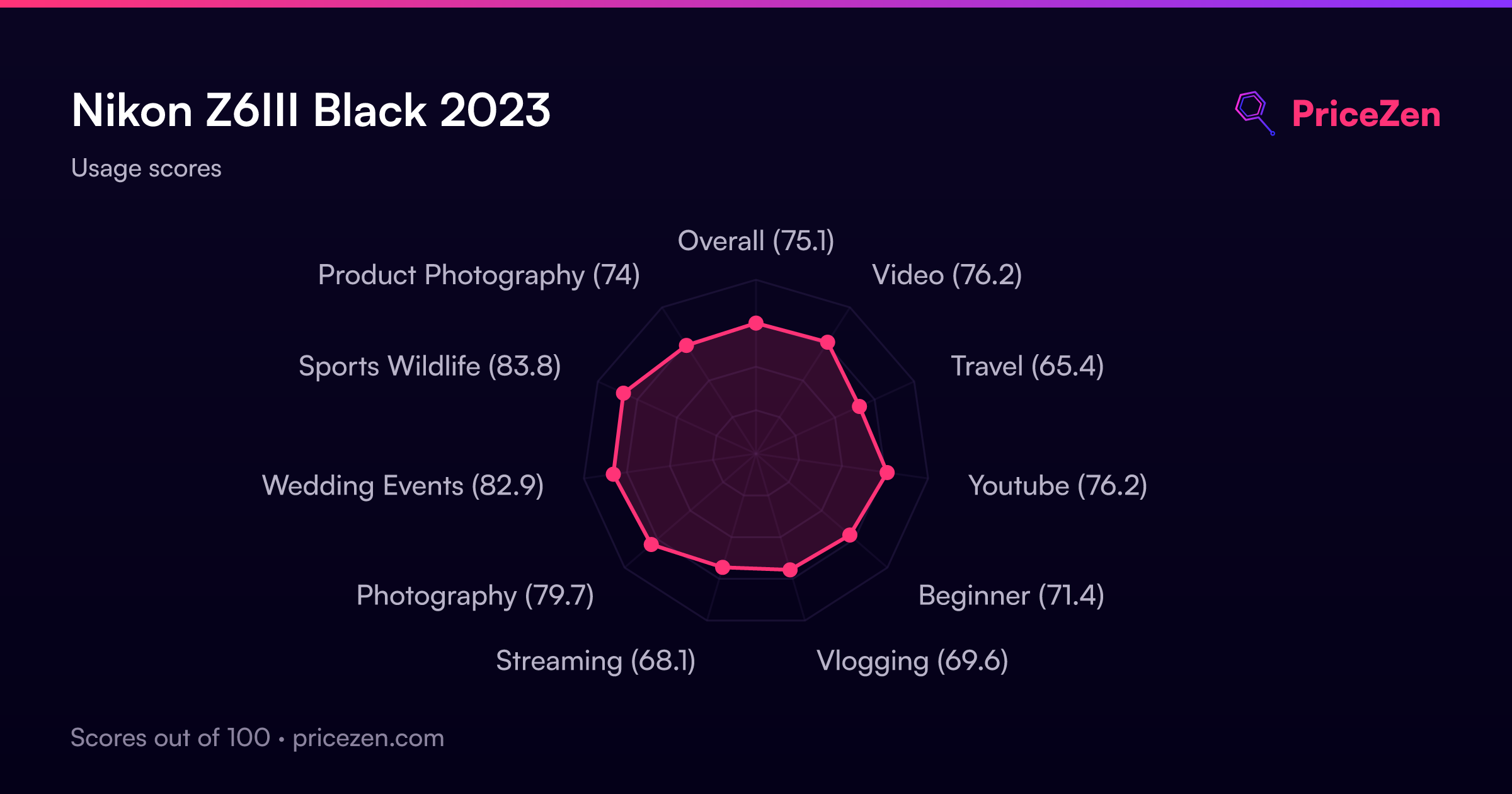
So is the Nikon Z6III good for sports and wildlife? Our scoring model says yes, emphatically: 83.7/100 for sports and wildlife and 82.7/100 for weddings and events are its two strongest categories. General photography lands at 79.3/100. Travel is where it slips, at 65.6/100, and we'll get into why.
Common Questions
Q: Is the Nikon Z6III good for wildlife and sports photography?
Yes, it's one of its strongest suits. Our model scores it 83.7/100 for sports and wildlife, backed by 20fps mechanical and 120fps electronic burst, 299 AF points with animal and subject detection, and 8 stops of stabilization.
Q: Does the Nikon Z6III shoot 6K RAW video internally?
It does. The Z6III records 6K internally along with 4K at 120fps and 1080p at 240fps, with 10-bit Log, N-RAW and Apple ProRes RAW HQ, which puts its video score among the best mirrorless cameras.
Q: How much does the Nikon Z6III cost?
In our tracked US listings it runs USD 3,172 to USD 3,997 depending on the bundle, so it's worth comparing kits before buying. That's an USD 825 spread for essentially the same camera.
Q: Is the Nikon Z6III weather sealed and good for outdoor shooting?
Yes, the body is weather sealed and its build quality is top-tier against other mirrorless cameras. At 670g it's manageable, though travel is its weakest scoring category at 65.6/100.
Who Should Skip This
Skip this if you're a travel shooter counting grams, a landscape photographer chasing maximum resolution, or someone who just wants a great everyday camera without spending enthusiast money. Travel is its lowest score at 65.6/100, the sensor ranking is mid-pack, and battery life is only average, so none of its headline strengths help you much. Look at the OM System OM-1 Mark II or Panasonic Lumix G9 II for lighter travel kits, the Sony Alpha a7R VI if detail is the priority, or the Fujifilm X-H2 if you'd rather keep the budget sane.
Verdict
Should you buy the Nikon Z6III? If you shoot sports, wildlife, weddings or events and also want proper cinema-grade video from the same body, yes. It's one of the strongest all-rounders in our mirrorless rankings, with best-in-class stabilization and EVF, near-top burst speed, leading autofocus and a video feature set most rivals can't match internally.
If you mostly shoot landscapes, static subjects or casual travel, you're paying a premium for speed you won't use, and the mid-pack sensor score plus average battery life make that a harder sell. Buy it for what it's exceptional at, not as a general-purpose default.
Usage Scores
- Overall75
- Video76.1
- Travel65.3
- Youtube76.1
- Beginner70.7
- Vlogging69.6
- Streaming68
- Photography79.4
- Wedding Events82.8
- Sports Wildlife83.7
- Product Photography73.7