Tamron 28-300mm f/3.5-6.3 Di III VC VXD

Estabilización integrada para fotos nítidas a pulso verificado el 29 nov
74/100 puntuación global 3,8 media de 78 valoraciones de propietarios
Cerca del precio habitual de 599,00 US$.
Mínimo de 90 días 14,46 US$Habitual y máximo 599,00 US$
Precio en los últimos 90 días: mínimo 14,46 US$ el 25 oct, máximo 599,00 US$. Precio habitual 599,00 US$. Hoy 599,00 US$.
- Focal length
- 28-300mm
- Aperture
- f/3.5-6.3
- Mount
- Sony E
- Format coverage
- full-frame
- Stabilization
- Sí
- Weather sealed
- Sí
- Weight
- 539 g
- Af type
- VXD
Compara precios en 2 tiendas
De la más barata a la más cara. Las ofertas nuevas, reacondicionadas y en pack se mantienen separadas para que compares lo comparable.
| Tienda | Vendido por | Color y estado | Precio | vs. el más bajo | Última comprobación | Enlace |
|---|---|---|---|---|---|---|
| Nuevo4 ofertasUnidad individual | ||||||
| Amazon | Vendedor externo | No indicado | 599,00 US$ | Precio más bajo | Anteayer | Ir a la tienda |
| Amazon | Vendedor externo | No indicado | 649,00 US$ | +50,00 US$ | Anteayer | Ir a la tienda |
| Agotado en la última comprobación | ||||||
| Amazon | Desconocido | No indicado | Sin precio | Agotado | Ayer | Ir a la tienda |
| Amazon | Desconocido | Black | Sin precio | Agotado | Hace 3 días | Ir a la tienda |
| Reacondicionado y renovado1 ofertaNo es nuevo: el estado y la garantía varían según el vendedor | ||||||
| Procam | Procam | Usado | 299,91 US$ | −299,09 US$ | Hoy | Ir a la tienda |
 Fuente: PriceZen, comprobado el 29 nov 2026
9 anuncios; 4 de ellos repiten otra oferta exactamente (misma tienda, vendedor, estado, color y precio), por lo que se muestran una sola vez. Un precio se considera vigente si lo comprobamos en los últimos 7 días. «Vendedor externo» significa un vendedor de terceros en esa tienda, no la propia tienda.
Historial de precios
El precio habitual en tiendas es 599,00 US$ y el más bajo de los últimos 90 días fue 14,46 US$.
Comprobado ese díaNo comprobado ese día, sigue en oferta
Fuente: PriceZen, checked 29 nov 2026











Resumen
The 30-Second Version
The Tamron 28-300mm f/3.5-6.3 Di III VC VXD is a lightweight all-in-one travel zoom for Sony E-mount that delivers impressive optical performance in our database but suffers from inconsistent real-world quality. Autofocus reliability issues and lens creep are common complaints from owners. It's a solid value on paper at $599-649, but the 3.2/5 customer rating suggests you're rolling the dice on getting a good copy.
Pros & Cons
Ventajas
- Massive 28-300mm zoom range in one lens 98th
- Lightweight at 540g for a superzoom 98th
- Weather sealed for outdoor shooting 95th
- VXD autofocus is fast when it works 90th
- Strong optical performance in our database
Desventajas
- Autofocus reliability issues reported by multiple owners
- Lens creep is a common complaint
- f/6.3 at 300mm makes low-light shooting rough
- Soft image quality at times according to users
- Bokeh quality is mediocre at best
Opinión de los propietarios
The Word on the Street
- Buyers consistently praise the versatility and lightweight design, especially for travel where carrying multiple lenses isn't practical.
- A recurring complaint is autofocus reliability, with multiple owners reporting focus chatter, noisy operation, and even complete AF failures.
- Image quality opinions are split, with some users finding it sharp enough for casual use while others report soft results, particularly at longer focal lengths.
Cómo cambió la opinión de los propietarios con el tiempo
ExclusivaSegún cuándo escribieron realmente sus opiniones los clientes, para ver si los elogios iniciales se mantuvieron.
18 opiniones escritas, mar 2005 – abr 2024: 10 satisfechos, 3 neutrales, 5 insatisfechos
En las 78 valoraciones de tiendas: 3,8★. La mayoría de los propietarios valora sin escribir una opinión. El gráfico cuenta las 18 opiniones escritas.
Cada punto es una opinión escrita, en el mes en que se escribió. Satisfechos = 4-5★, neutrales = 3★, insatisfechos = 1-2★.
Las pruebas
Performance
The optical performance is where this lens shines on paper. Our database puts it at the 99th percentile for optics, which means it's among the absolute best in its class for sharpness and image quality. The 19 elements in 15 groups include 4 aspherical and 4 ED glass elements, plus XR glass to keep the size down. That's a serious optical formula for a superzoom, and it shows in the results.
Autofocus uses Tamron's VXD linear motor, which ranks at the 96th percentile in our database. That's a standout performer on paper. But here's where the real-world feedback gets messy. Multiple owners report focus chatter at short distances, noisy AF operation, and in some cases outright autofocus failures after a short period. The stabilization system ranks at the 79th percentile, which is well above average and should help at the 300mm end, but the f/6.3 max aperture at telephoto means you'll be fighting for light in anything but bright conditions. The aperture performance sits at the 35th percentile, which is mediocre for this category, and that's the trade-off you make for the compact size.
Specifications
Full Specifications
Optics
| Type | Zoom |
| Focal Length Min | 28 |
| Focal Length Max | 300 |
| Elements | 19 |
| Groups | 15 |
| Aspherical Elements | 4 |
| ED Elements | 4 |
| Coating | XR (Extra Refractive Index) glass |
Aperture
| Max Aperture | f/3.5-6.3 |
| Min Aperture | f/22-40 |
| Constant | No |
| Diaphragm Blades | 7 |
Build
| Mount | Sony E |
| Format | full-frame |
| Weather Sealed | Yes |
| Weight | 0.5 kg / 1.2 lbs |
| Filter Thread | 67 |
AF & Stabilization
| AF Type | VXD |
| Stabilization | Yes |
Focus
| Min Focus Distance | 490 |
| Max Magnification | 1:3.5 |
vs Competition
Compared to the Sony G Master SEL24F14GM, this Tamron is a completely different animal. The Sony is a prime lens with a bright f/1.4 aperture and exceptional bokeh, but it costs significantly more and covers exactly one focal length. The Tamron trades that optical purity for versatility. Against the Canon RF RF28-70mm F2.8 IS STM, the Tamron has a much longer reach at 300mm versus 70mm, but the Canon maintains a constant f/2.8 aperture throughout its range, which is a huge advantage for low-light and subject separation. The Canon also has a better reputation for build quality and autofocus consistency.
The Sigma Art 17-40mm f/1.8 DC is a wide-angle specialist that doesn't compete directly on focal range, but it shows what you give up with the Tamron: the Sigma's f/1.8 aperture is dramatically brighter, and its bokeh quality is in a different league. The Viltrox LAB AF 35mm f/1.2 LAB FE is another prime that outclasses the Tamron on aperture and bokeh but obviously can't match the zoom range. If you shoot portraits or anything where background blur matters, the Tamron's 31st percentile bokeh ranking means you'll be disappointed compared to any of these alternatives.
| Spec | Tamron 28-300mm f/3.5-6.3 Di III VC VXD | Sigma 70-200mm f/2.8 DG DN OS Sports | Sony FE 85mm f/1.4 GM II | Viltrox AF 35mm f/1.2 LAB FE | Canon RF 35mm f/1.4L VCM | Nikon NIKKOR Z 50mm f/1.2 S |
|---|---|---|---|---|---|---|
| Focal Length | 28-300mm | 70-200mm | 85mm | 35mm | 35mm | 50mm |
| Max Aperture | f/3.5-6.3 | f/2.8 | f/1.4 | f/1.2 | f/1.4 | f/1.2 |
| Mount | Sony E | Sony E | Sony E | Sony E | Canon RF | Nikon Z |
| Format Coverage | full-frame | full-frame | full-frame | full-frame | full-frame | full-frame |
| Stabilization | Yes | Yes | No | No | Yes | No |
| Weather Sealed | Yes | Yes | Yes | Yes | Yes | Yes |
| Weight (g) | 539 | 1345 | 642 | 910 | 555 | 1090 |
| AF Type | VXD | HLA (High-response Linear Actuator) | XD Linear Motor | VCM | Nano USM | Multi-Focus Stepping Motor AF System |
| Lens Type | zoom | zoom | prime | prime | prime | prime |
| Compare | Compare | Compare | Compare | Compare |
| Producto | AF | Bokeh | Build | Macro | Reach | Video | Optical | Aperture | User Sentiment | Wide Angle | Portability | Versatility | Valoración social | Affordability | Stabilization |
|---|---|---|---|---|---|---|---|---|---|---|---|---|---|---|---|
| Tamron 28-300mm f/3.5-6.3 Di III VC VXD | 95.4 | 63 | 77.2 | 75.8 | 88.1 | 69.7 | 98.3 | 25 | 2.4 | 61.9 | 50.3 | 97.5 | 49.6 | 53.1 | 89.9 |
| Sigma 70-200mm f/2.8 DG DN OS Sports Compare | 95.4 | 88.6 | 98.9 | 55.8 | 83.6 | 85.2 | 99.9 | 43.1 | 83.9 | 28.9 | 12.1 | 78.5 | 72.5 | 24.2 | 99.9 |
| Sony FE 85mm f/1.4 GM II Compare | 95.4 | 94.1 | 90.8 | 21.2 | 65.4 | 69.7 | 70.2 | 89.3 | 94.7 | 19.2 | 40.2 | 32.6 | 91.4 | 21.6 | 41.5 |
| Viltrox AF 35mm f/1.2 LAB FE Compare | 95.4 | 67.7 | 90.8 | 50.2 | 28.9 | 69.7 | 91.3 | 96.4 | 35.3 | 52.8 | 23.8 | 32.6 | 85.9 | 34 | 41.5 |
| Canon RF 35mm f/1.4L VCM Compare | 90 | 59 | 77.2 | 52.5 | 28.9 | 69.7 | 70.2 | 89.3 | 94.7 | 52.8 | 47.8 | 32.6 | 72.5 | 21.7 | 92.5 |
| Nikon NIKKOR Z 50mm f/1.2 S Compare | 69 | 79.9 | 77.2 | 42.4 | 43.2 | 69.7 | 86.4 | 96.4 | 94.7 | 39.5 | 18.1 | 32.6 | 95.8 | 21.9 | 41.5 |
Precio
Value & Pricing
At $599-649 in the US, the Tamron 28-300mm undercuts most premium superzooms by a wide margin. The Sony 24-240mm f/3.5-6.3 typically runs higher, and the Canon RF 28-70mm F2.8 is in a completely different price bracket. For budget-conscious travelers who want one lens to do it all, the value proposition is strong on paper. But the 3.2/5 customer rating and recurring quality control complaints complicate that math. A lens that fails or hunts for focus isn't a bargain at any price. If you're willing to gamble on getting a good copy, the value is there. If you need reliability for a once-in-a-lifetime trip, you might want to spend more elsewhere.
Leer más
Overview
The Tamron 28-300mm f/3.5-6.3 Di III VC VXD is an all-in-one travel zoom for Sony E-mount full-frame cameras. It's the kind of lens you buy when you want one piece of glass to cover everything from wide landscapes to distant wildlife without swapping lenses every five minutes. At 540g, it's remarkably light for a 10.7x zoom range, and the 67mm filter thread means you won't need a whole new set of filters if you're coming from another Tamron or Sony lens.
We've seen this lens listed around $599-649 in the US and roughly 367 EUR in Europe, which puts it in the budget-friendly end of the superzoom category. The optical performance in our database ranks at the 99th percentile for this type of lens, which is genuinely impressive for a 28-300mm. But the user sentiment tells a different story, with a 3.2/5 rating across 72 reviews and a sentiment score of just 45/100. That gap between lab performance and real-world satisfaction is the big story here.
Is the Tamron 28-300mm good for travel? On paper, absolutely. It's light, weather sealed, and covers a massive focal range. But the recurring complaints about autofocus reliability and lens creep suggest quality control is a real concern. We'll dig into what that means for you below.
Common Questions
Q: Is the Tamron 28-300mm good for travel photography?
Yes, the Tamron 28-300mm is designed for travel, with a 540g weight and weather sealing that make it easy to carry all day. The 10.7x zoom range means you can shoot landscapes at 28mm and distant subjects at 300mm without changing lenses.
Q: Does the Tamron 28-300mm have image stabilization?
Yes, it includes Tamron's VC (Vibration Compensation) stabilization, which ranks at the 79th percentile in our database. It helps reduce camera shake, especially at the 300mm end where stabilization matters most.
Q: Is the Tamron 28-300mm good in low light?
Not particularly. The f/3.5-6.3 variable aperture means you're at f/6.3 by the time you reach 300mm, which forces higher ISOs or slower shutter speeds in dim conditions. The stabilization helps, but this lens performs best in daylight.
Q: How does the Tamron 28-300mm compare to the Sony 24-240mm?
The Tamron offers a longer 300mm reach and is lighter at 540g, while the Sony 24-240mm starts wider at 24mm. The Tamron's optical performance ranks at the 99th percentile in our database, but the Sony generally has a better reputation for autofocus consistency and build quality.
Who Should Skip This
Skip this lens if you shoot portraits or anything where background blur matters. The bokeh ranks at the 31st percentile, and the f/6.3 max aperture at 300mm won't give you the subject separation you'd get from a prime like the Sony G Master SEL24F14GM or the Viltrox LAB AF 35mm f/1.2. Also skip it if you need reliable autofocus for fast-moving subjects like sports or wildlife, where the reported AF issues would be a dealbreaker. If you're a professional who can't afford a lens failure mid-shoot, spend more on something with better quality control. And if you already own a decent mid-range zoom, the added reach probably isn't worth the reliability gamble.
Verdict
Should you buy the Tamron 28-300mm f/3.5-6.3 Di III VC VXD? If you're a travel photographer who wants one lightweight lens that covers everything from wide shots to distant wildlife, and you're willing to accept some compromises, this could work. The optical performance in our database is genuinely impressive, and the 540g weight is a real achievement for this zoom range. The weather sealing is a nice bonus for outdoor shooters.
But the user feedback gives us serious pause. A 3.2/5 rating with multiple reports of autofocus failures, lens creep, and soft images suggests Tamron's quality control on this lens is inconsistent. Some owners love it and report no issues. Others have had lenses fail after a short period. That's a gamble, and for a lens you'd likely take on important trips, it's a risky one. We'd recommend testing your copy thoroughly within the return window if you decide to go this route.
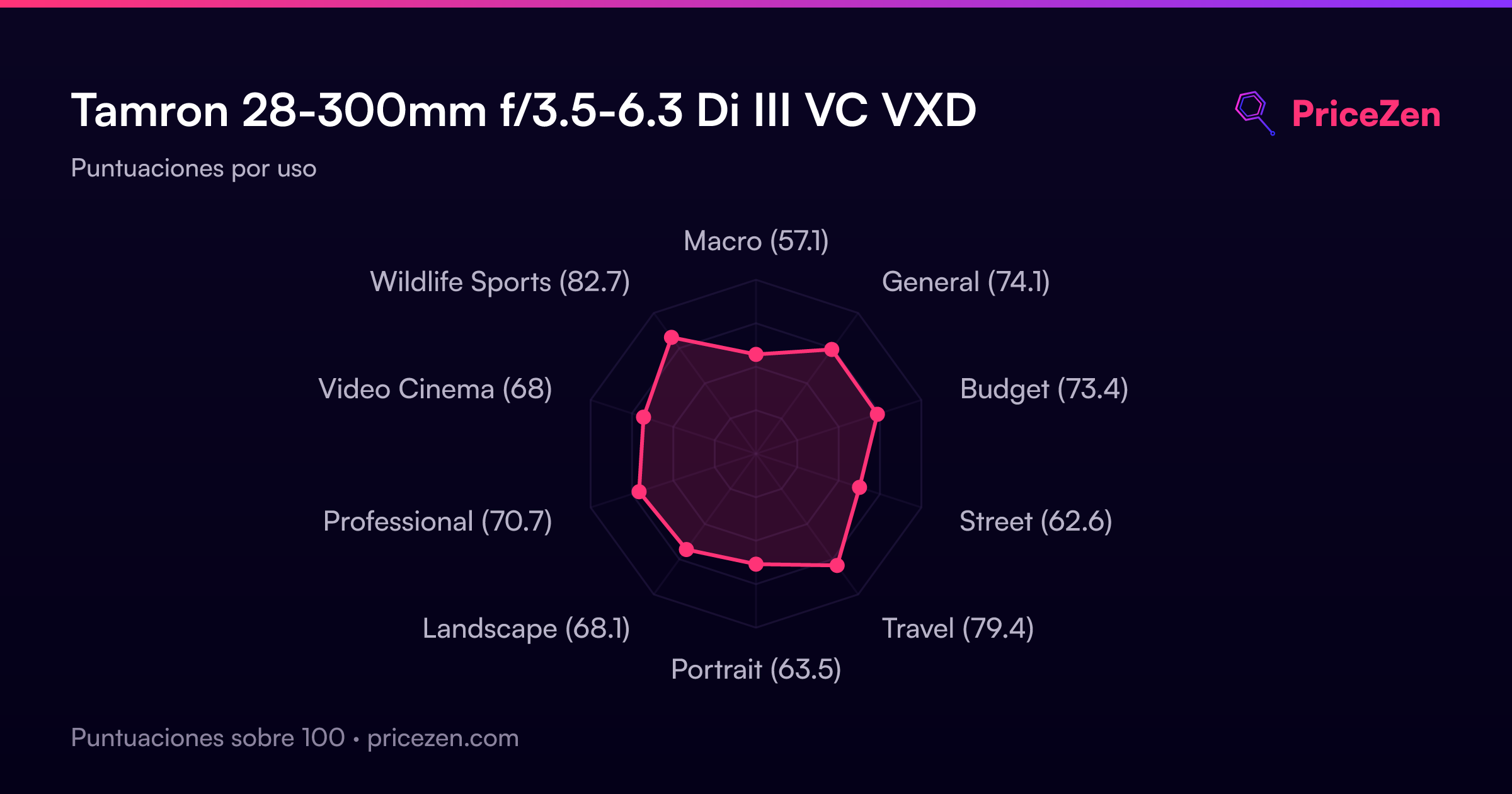
Usage Scores
- Macro57.1
- General74.1
- Budget73.4
- Street62.6
- Travel79.4
- Portrait63.5
- Landscape68.1
- Professional70.7
- Video Cinema68
- Wildlife Sports82.7