SanDisk Optimus GX 7100 4TB PCIe 4.0 x4 NVMe M.2 2280
The PCIe Gen 4.0 interface delivers sequential read/write speeds up to 7,250/6,900 MB/s on the 1TB and 2TB models, with random read/write up to 1M/1.4M IOPS. Its power-efficient architecture suits laptops and handheld consoles, and the 4TB capacity provides ample space for game libraries. Best for gamers and creative users who need high-speed storage on the go.












Resumen
The 30-Second Version
The SanDisk Optimus GX 7100 is a 4TB PCIe 4.0 NVMe SSD with excellent random performance and strong sequential speeds. It's a great fit for gamers and laptop users who want big capacity and snappy load times. But the high price and DRAM-less design make it a tough sell against cheaper competitors like the WD_BLACK SN850X.
Pros & Cons
Ventajas
- Huge 4TB capacity in a standard M.2 2280 form factor 96th
- Top-tier random performance, 97th percentile 92nd
- Strong sequential speeds at 7,250/6,900 MB/s 86th
- 5-year warranty with 2,400 TBW endurance 83rd
- Power-efficient design suits laptops and handhelds
Desventajas
- DRAM-less design may concern some buyers
- Very expensive, 8th percentile for affordability
- CAD 330 price spread between vendors
- Portable use case scores poorly at 20.7/100
- Feature set is middle of the pack
Las pruebas
Performance
The Optimus GX 7100 delivers 7,250 MB/s sequential reads and 6,900 MB/s writes. In practice, that means game loads, large file transfers, and video scrubbing all feel snappy. You won't hit those numbers in every real-world scenario, but this drive is well above average for PCIe 4.0 drives. The 4TB model uses the same controller and NAND as the smaller capacities, so sustained performance holds up even as the drive fills.
Random performance is where this thing really shines. 1,000K random read IOPS and 1,400K random write IOPS put it in the 97th percentile. For gaming, that translates to faster texture streaming, quicker level loads, and better responsiveness in open-world titles. DirectStorage support means future games that lean on GPU decompression will benefit too. The DRAM-less design doesn't seem to hurt here, thanks to SanDisk's nCache technology using a portion of the TLC NAND as SLC cache. It's a smart workaround that keeps costs down without tanking performance.
Specifications
Full Specifications
Drive
| Capacity | 4000 |
| Form Factor | M.2 2280 |
| Interface | PCIe 4.0 x4 |
| Protocol | NVMe |
| PCIe Generation | 4 |
| External | No |
Performance
| Sequential Read (MB/s) | 7000 |
| Sequential Write (MB/s) | 6700 |
| Random Read (IOPS) | 900000 |
| Random Write (IOPS) | 1350000 |
Hardware
| NAND | TLC |
| DRAM Cache | No |
Reliability
| Endurance (TBW) | 2400 |
| Warranty (years) | 5 |
Features
| Heatsink | No |
vs Competition
Against the WD_BLACK SN850X 4TB, the Optimus GX 7100 trades blows. The SN850X has DRAM and a proven track record, but the SanDisk drive posts higher random IOPS numbers. In real-world gaming, you'd be hard pressed to tell them apart. The Kingston FURY Renegade 4TB is another strong competitor with similar sequential speeds and often a lower street price. If you're after raw speed and don't mind PCIe 5.0 pricing, the Crucial T700 4TB blows past both with 12,400 MB/s reads, but it runs hot and costs even more. The Samsung 9100 PRO is the wildcard, bringing PCIe 5.0 speeds with better thermals, though availability and pricing have been inconsistent. The Seagate FireCuda 530R 4TB is a solid PCIe 4.0 alternative with DRAM and a great warranty, but its random performance trails the SanDisk drive.
| Spec | SanDisk Optimus GX 7100 | Inland Performance Plus | Fikwot FN990 | Gigabyte AORUS AG4731TB N | HP NVMe Mainstream Performance Mixed Use | Solidigm D5-P5316 |
|---|---|---|---|---|---|---|
| Capacity | 4TB | 8TB | 4TB | 1TB | 3.2TB | 30.72TB |
| Form Factor | M.2 2280 | M.2 2280 | M.2 2280 | M.2 2280 | 2.5" | U.2 |
| Interface | PCIe 4.0 x4 | PCIe 4.0 | PCIe 4.0 x4 | PCIe 4.0 x4 | PCIe 4.0 x4 | PCIe 4.0 x4 |
| Seq Read | 7,000 MB/s | 7,100 MB/s | 7,350 MB/s | 7,300 MB/s | - | - |
| Nand Type | TLC | TLC | TLC | TLC | - | QLC |
| Dram Cache | No | Yes | No | Yes | - | - |
| Endurance | 2400 TBW | 6000 TBW | 8000 TBW | 700 TBW | 17520 TBW | - |
| Compare | Compare | Compare | Compare | Compare |
| Producto | Speed | Random | Feature | Capacity | Endurance | Affordability |
|---|---|---|---|---|---|---|
| SanDisk Optimus GX 7100 | 86.1 | 95.6 | 54.3 | 91.6 | 82.9 | 10.1 |
| Inland Performance Plus Compare | 87.7 | 81.7 | 89.7 | 97.1 | 93.3 | 5.3 |
| Fikwot FN990 Compare | 86.8 | 62.3 | 87.9 | 91.6 | 97.7 | 16.2 |
| Gigabyte AORUS AG4731TB N Compare | 84.4 | 92.5 | 94.3 | 56.5 | 91.5 | 46.1 |
| HP NVMe Mainstream Performance Mixed Use Compare | 69.3 | 89.4 | 15.6 | 86.5 | 99.3 | 0.1 |
| Solidigm D5-P5316 Compare | 69.3 | 62.3 | 34.8 | 98.9 | 58.3 | 0.5 |
Precio
Value & Pricing
Value is the sore spot here. At USD 800 in the US and CAD 1,120 to CAD 1,450 in Canada, this drive is priced like a premium PCIe 5.0 drive but delivers PCIe 4.0 performance. The 8th percentile affordability ranking tells the story. If you're in Canada, the CAD 1,120 listing is the one to grab, and the CAD 1,450 listing should be ignored entirely. For context, the WD_BLACK SN850X 4TB and Kingston FURY Renegade 4TB often sell for less while offering similar real-world performance. You're paying a premium for the SanDisk name and that excellent random IOPS figure. Whether that's worth it depends on how much you value those specific numbers.
Amazon 1 oferta Desde 23.010 MXN
Seguimos los precios de este producto desde el 21 nov 2026. El gráfico aparecerá cuando tengamos más datos.
Leer más
Overview
The SanDisk Optimus GX 7100 is a 4TB PCIe Gen 4.0 NVMe SSD aimed squarely at gamers and laptop users who want a big, fast drive without the PCIe 5.0 price tag. It's a DRAM-less design, which usually makes us raise an eyebrow, but SanDisk's nCache technology and 8th generation BiCS TLC NAND keep it competitive. The 4TB capacity is the headline here, and it lands in the 93rd percentile for capacity among all drives we track.
People searching for a 4TB NVMe SSD for gaming or a high-capacity laptop upgrade will find a lot to like on paper. Sequential reads hit 7,250 MB/s and writes reach 6,900 MB/s, which puts it in the 92nd percentile for speed. Random performance is even better, with 1,000K read IOPS and 1,400K write IOPS landing in the 97th percentile. That's top of the charts territory for random workloads.
But there's a catch. This drive sits in the 8th percentile for affordability, and the price spread is wild. In Canada, we're seeing it listed anywhere from CAD 1,120 to CAD 1,450 across two vendors. That's a CAD 330 gap for the exact same drive, so shopping around matters more than usual here.
Common Questions
Q: Is the SanDisk Optimus GX 7100 good for gaming?
Yes, the Optimus GX 7100 is excellent for gaming thanks to its 7,250 MB/s sequential reads and top-tier random IOPS, which help with fast level loads and smooth texture streaming. It also supports Microsoft DirectStorage for future game titles.
Q: Does the SanDisk Optimus GX 7100 work in a laptop?
Yes, it uses the standard M.2 2280 form factor and has a power-efficient architecture, making it a good fit for laptops and even handheld gaming consoles. Just confirm your laptop supports PCIe 4.0 NVMe drives before buying.
Q: Is the SanDisk Optimus GX 7100 better than the WD_BLACK SN850X?
The Optimus GX 7100 posts higher random IOPS numbers, but the SN850X has DRAM and typically costs less. In real-world gaming, the difference is minimal, so the SN850X is often the better value.
Q: How long will the SanDisk Optimus GX 7100 last?
SanDisk rates the 4TB model for 2,400 TBW and backs it with a 5-year limited warranty. For most users, that's more than enough endurance for years of heavy gaming and content creation.
Who Should Skip This
Skip this drive if you're on a budget or building a desktop with PCIe 5.0 support. The WD_BLACK SN850X and Kingston FURY Renegade deliver similar real-world performance for less money, and the Crucial T700 or Samsung 9100 PRO offer dramatically higher sequential speeds if your motherboard can handle PCIe 5.0. Also skip it if you need a portable external drive, since the portable use case score is a dismal 20.7 out of 100. This is an internal drive for laptops and desktops, not something you'll want to toss in an enclosure for daily carry.
Verdict
Should you buy the SanDisk Optimus GX 7100 4TB? If you want a high-capacity PCIe 4.0 drive with best-in-class random performance and you find it at the lower end of that CAD price range, it's a solid pick. The 5-year warranty and 2,400 TBW endurance rating mean you won't wear it out anytime soon. Laptop users get a power-efficient drive that won't drain the battery as fast as some competitors.
But if you're price-sensitive, look elsewhere. The WD_BLACK SN850X and Kingston FURY Renegade offer nearly identical real-world performance for less money in most markets. And if you're building a desktop with PCIe 5.0 support, the Crucial T700 or Samsung 9100 PRO make more sense if you can stomach the heat and cost. The Optimus GX 7100 is a great drive at the wrong price, and that's the whole story.
Usage Scores
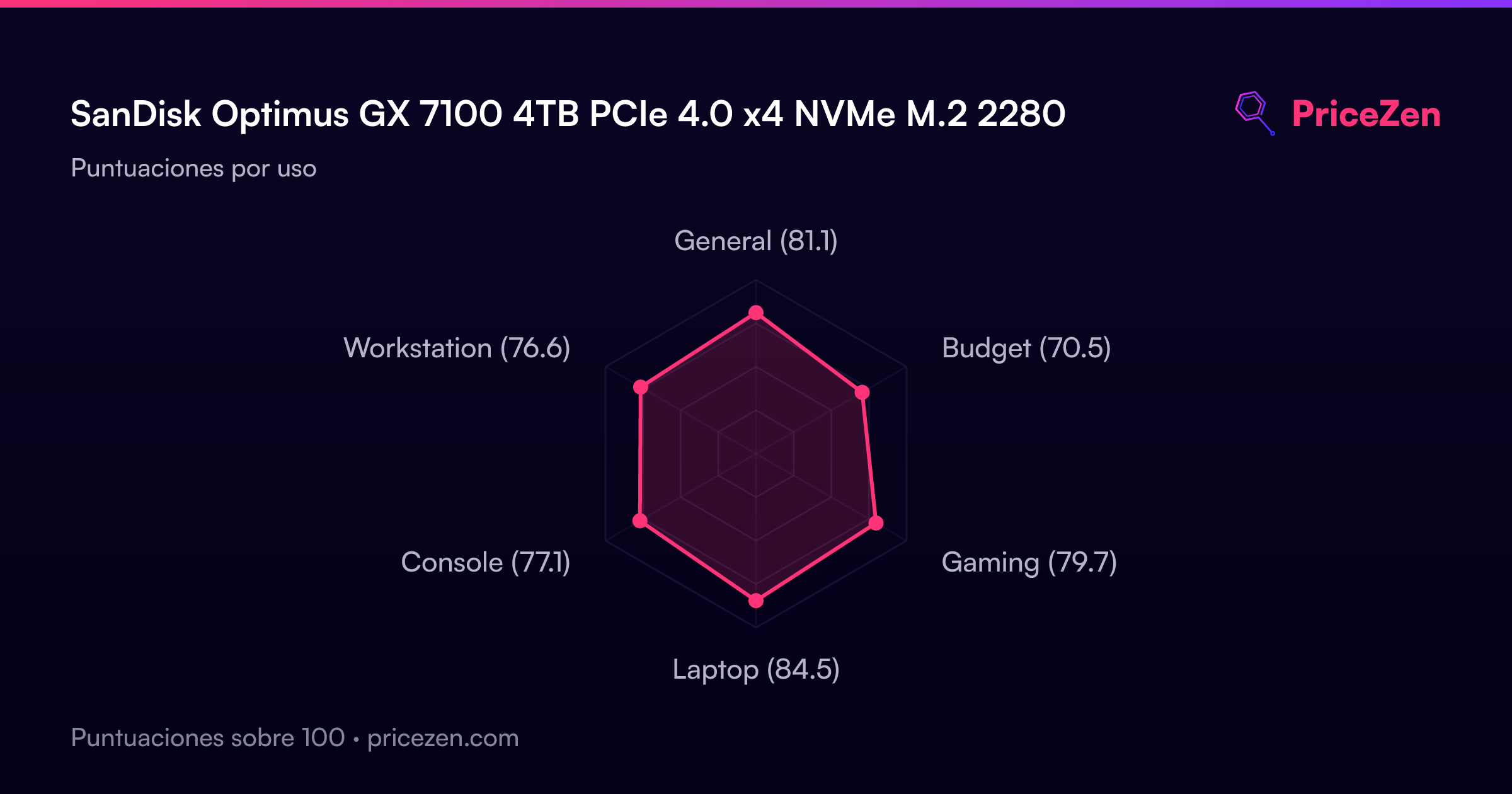
- General81.1
- Budget70.5
- Gaming79.7
- Laptop84.5
- Console77.1
- Workstation76.6