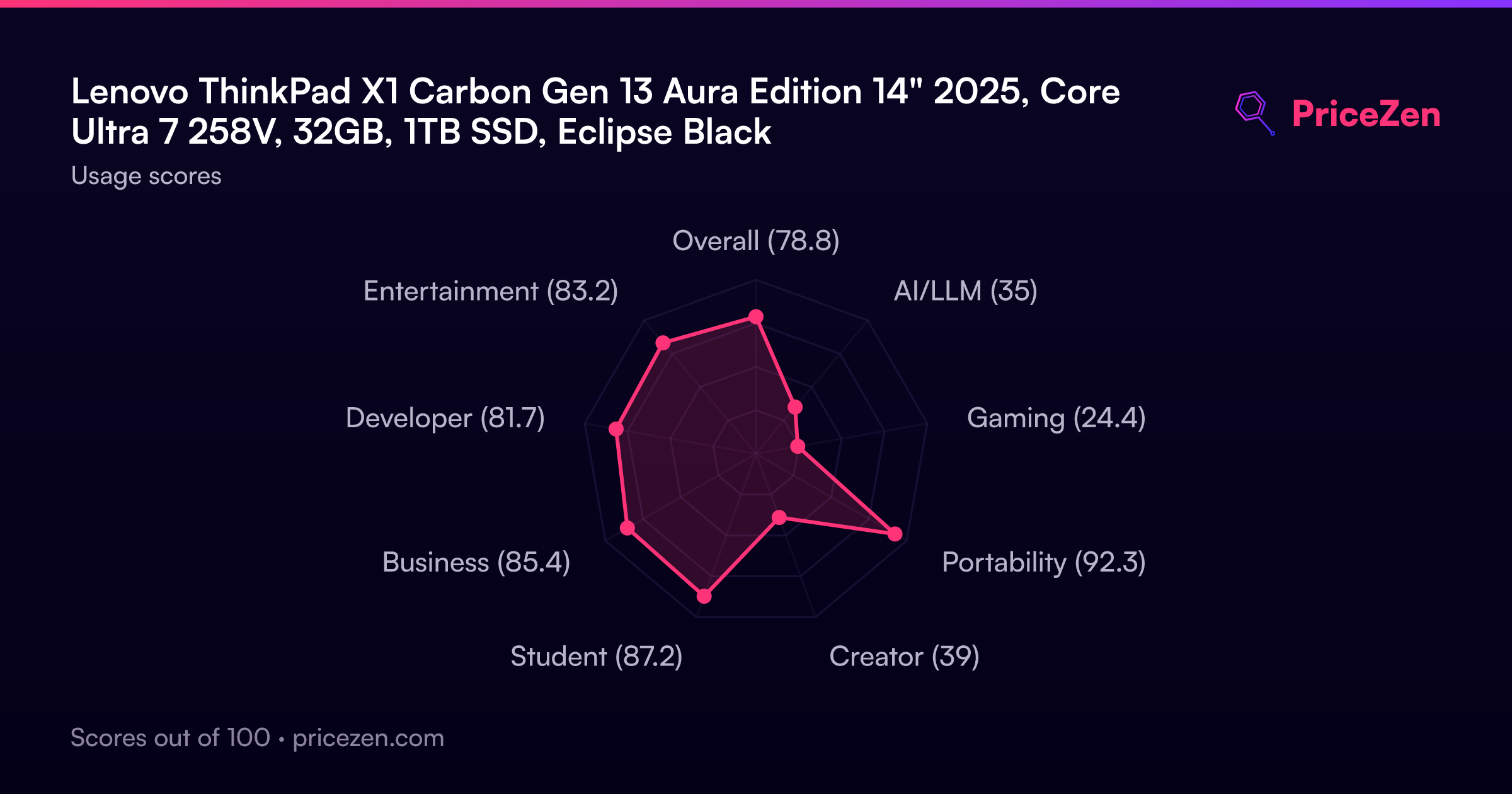
Lenovo ThinkPad X1 Carbon Gen 13 Aura Edition 14" 2025, Core Ultra 7 258V, 32GB, 1TB SSD, Eclipse Black
The Intel Core Ultra 7 258V processor and integrated Intel Arc Graphics with 16GB VRAM deliver solid everyday performance in a 0.99kg chassis, paired with a 14-inch OLED 120Hz display at 400 nits and 100% DCI-P3 coverage. The 57Wh battery, Wi-Fi 7, and full port selection including Thunderbolt and Ethernet make it a practical travel companion. Best for business professionals who prioritize portability and display quality over gaming, where its 23/100 score shows clear limits.

No current retailer price
Snapshot
The 30-Second Version
The ThinkPad X1 Carbon Gen 13 Aura Edition is a 0.99kg ultraportable with 32GB of RAM, a 120Hz OLED display, and excellent port selection. It's one of the lightest and most portable 14-inch laptops we've seen, with a compact score of 87.9 out of 100. At $2,021 USD, you're paying a premium for portability and build quality, not raw performance. Buy it for business travel and productivity, skip it for gaming or creative work.
Pros & Cons
Pros
- 0.99kg weight makes it one of the lightest 14-inch laptops available 96th
- 32GB LPDDR5X RAM at the 92nd percentile, double what most ultraportables offer 92nd
- OLED display with 120Hz refresh rate and 100% DCI-P3 color coverage 92nd
- Port selection includes HDMI 2.1, Ethernet, USB-A, and USB-C, rare for this weight class 90th
- Wi-Fi 7 support means future-proof connectivity
Cons
- Gaming score of 23.5 out of 100, integrated graphics can't handle modern games
- CPU at the 64th percentile, not a performance leader for heavy compute tasks
- 57Wh battery is smaller than some competitors in this class
- Social proof at the 58th percentile, limited real-world feedback so far
- No dedicated GPU option, which limits creative and gaming workloads
What owners think
How owner sentiment changed over time
ExclusiveBased on when customers actually wrote their reviews - so you can see whether early praise held up.
70 written reviews, Feb – Nov 2026: 59 happy, 3 mixed, 8 unhappy
Across all 779 store ratings: 4.5★. Most owners rate without writing a review. The chart counts the 70 written reviews.
Each dot is one written review, in the month it was written. Happy = 4-5★, mixed = 3★, unhappy = 1-2★.
The proof
Performance
The Core Ultra 7 258V is an 8-core chip running at 3.5GHz, and it lands at the 64th percentile for CPUs in our database. That's solid but not earth-shattering. For everyday productivity, coding, and multitasking, you won't feel held back. The 32GB of RAM is the real star here, sitting at the 92nd percentile. That's enough headroom to run multiple virtual machines, dozens of browser tabs, and heavy IDEs without breaking a sweat. Most ultraportables top out at 16GB, so this is a meaningful advantage for power users.
The integrated Arc graphics are a mixed bag. The GPU score lands at the 66th percentile, which is actually pretty good for integrated graphics. You can handle light photo editing, casual gaming at lower settings, and GPU-accelerated tasks without issue. But don't expect to play modern AAA titles at anything beyond low settings. The gaming score of 23.5 out of 100 tells the story clearly. This is not a gaming laptop, and the 120Hz OLED display is more about smooth scrolling and fluid UI than frame rates in Cyberpunk. The 57Wh battery paired with this efficient chip should get you through a full workday, though we'd want to test real-world endurance before making promises.
Specifications
Full Specifications
Processor
| CPU | Intel Core Ultra 7 258V |
| Cores | 8 |
| Frequency | 2.2 GHz |
| L3 Cache | 12 MB |
Graphics
| GPU | Intel Arc Graphics |
| Type | Integrated |
| VRAM Type | Shared |
Memory & Storage
| RAM | 32 GB |
| RAM Generation | LPDDR5X |
| Storage | 1 TB |
| Storage Type | NVMe SSD |
Display
| Size | 14" |
| Resolution | 2880x1800 |
| Panel | OLED |
| Refresh Rate | 120 Hz |
| Brightness | 500 nits |
| Color Gamut | 100%DCI-P3 |
Connectivity
| USB-C Ports | 2 |
| USB Ports | 2 |
| Thunderbolt | Thunderbolt 4 |
| HDMI | HDMI 2.1 |
| Wi-Fi | Wi-Fi 7 |
| Bluetooth | Bluetooth 5.4 |
| Ethernet | HDMI 2.1 (supports resolution up to 4K@60Hz) |
Physical
| Weight | 1.0 kg / 2.2 lbs |
| Battery | 57 Wh |
| OS | Windows 11 Pro |
vs Competition
The Apple MacBook Pro M4 Max is the elephant in the room. It absolutely demolishes the X1 Carbon in CPU and GPU performance, but it's also heavier, more expensive, and locked into macOS. If you're doing video editing, 3D rendering, or heavy creative work, the MacBook is the obvious choice. But if you need Windows, a lighter bag, and ports that don't require dongles, the ThinkPad makes a strong case.
The Microsoft Surface Laptop 7th Edition is probably the most direct competitor. Both are premium Windows ultraportables with excellent build quality. The Surface typically has a better display and more modern design, but the X1 Carbon counters with more RAM, better port selection, and that legendary ThinkPad keyboard. The ASUS ROG Zephyrus G14 and HP OMEN Transcend 14 are gaming-focused machines that offer dramatically better GPU performance but sacrifice portability and battery life. The MSI Raider is in a completely different category, a desktop replacement that weighs nearly three times as much. For business travelers, none of those gaming machines make sense as alternatives.
| Spec | Lenovo ThinkPad X1 Carbon Gen 13 Aura Edition 14" | Apple MacBook Pro 14.2" M4 Pro | ASUS ROG Zephyrus 14" GA403WW-G14.R95080 | HP OMEN Transcend | Samsung Galaxy Book5 Pro 14" NP944XHA-KG3US | Dell Premium 14.5" LDA14250-7667SLV-PUS |
|---|---|---|---|---|---|---|
| CPU | Intel Core Ultra 7 258V | Apple M4 Pro | AMD Ryzen AI 9 HX 370 | Intel Core Ultra 9 285H | Intel Core Ultra 7 258V | Intel Core Ultra 7 255H |
| RAM (GB) | 32 | 48 | 32 | 32 | 32 | 32 |
| Storage (GB) | 1024 | 4096 | 2048 | 1024 | 1024 | 1024 |
| Screen | 14" 2880x1800 | 14.2" 3024x1964 | 14" 2880x1800 | 14" 2880x1800 | 14" 2880x1800 | 14.5" 3200x2000 |
| GPU | Intel Arc Graphics | Apple (16-Core) | NVIDIA GeForce RTX 5080 | NVIDIA GeForce RTX 5070 | Intel Arc Graphics 140V | Intel Arc Graphics |
| OS | Windows 11 Pro | macOS | Windows 11 Home | Windows 11 Home | Windows 11 Pro | Windows 11 Home |
| Weight (kg) | 1 | 1.6 | 1.6 | 1.6 | 1.2 | 1.7 |
| Battery (Wh) | 57 | 72 | - | 71 | 63 | 62 |
| Compare | Compare | Compare | Compare | Compare |
| Product | CPU | GPU | RAM | Ports | Screen | Portability | Storage | Reliability | Social Proof | Affordability |
|---|---|---|---|---|---|---|---|---|---|---|
| Lenovo ThinkPad X1 Carbon Gen 13 Aura Edition 14" | 65.9 | 69.6 | 92 | 89.4 | 96 | 92.1 | 79.3 | 81.8 | 90.3 | 10.8 |
| Apple MacBook Pro 14.2" M4 Pro Compare | 92.4 | 78.8 | 90.6 | 73.9 | 99.1 | 68.8 | 98.4 | 98.1 | 99.7 | 4.4 |
| ASUS ROG Zephyrus 14" GA403WW-G14.R95080 Compare | 91.2 | 98.3 | 90.8 | 89.4 | 96 | 73.6 | 89.7 | 60.5 | 95.5 | 6 |
| HP OMEN Transcend Compare | 90.1 | 93.5 | 89.6 | 89.4 | 96 | 72.2 | 65.3 | 33.6 | 93 | 8.9 |
| Samsung Galaxy Book5 Pro 14" NP944XHA-KG3US Compare | 65.9 | 69.6 | 79.5 | 83.5 | 90.4 | 89.4 | 79.3 | 81.8 | 95.5 | 21 |
| Dell Premium 14.5" LDA14250-7667SLV-PUS Compare | 87 | 69.6 | 89 | 66.8 | 96.8 | 61.2 | 65.3 | 33.6 | 95.5 | 14.6 |
Price
Value & Pricing
At $2,021 USD, this is a premium machine with a premium price tag. You're paying for the engineering that goes into a sub-1kg chassis with this level of build quality and port selection. The reliability score sits at the 81st percentile, which is reassuring for a business machine. ThinkPads have a reputation for surviving years of abuse, and that longevity helps justify the upfront cost.
Compared to the competition, the value proposition depends entirely on what you need. The MacBook Pro M4 Max will crush this in raw performance but weighs significantly more and costs more. The Surface Laptop 7th Edition is a closer competitor in the ultraportable space, but you'll typically get less RAM and fewer ports. If portability and durability are your top priorities, the X1 Carbon earns its price. If you need maximum performance per dollar, look elsewhere.
Read more
Overview
The ThinkPad X1 Carbon has been the default answer for 'I need a serious work laptop that won't break my back' for over a decade now. The Gen 13 Aura Edition keeps that formula intact but adds some genuinely interesting twists. You're looking at a 14-inch machine that weighs just 0.99kg, packs a Core Ultra 7 258V with integrated Arc graphics, and throws in an OLED display with a 120Hz refresh rate. That's not the usual ThinkPad spec sheet, and it signals Lenovo is trying to make this more than just a spreadsheet machine.
Who's this for? Business travelers, consultants, developers, and students who want something light enough to forget it's in the bag but powerful enough to handle real work. The compact score of 87.9 out of 100 is the headline here, and it's backed up by a 92nd percentile ranking for portability. If you've ever lugged a 2kg laptop through three airports in a day, you know exactly why that matters.
What makes this interesting is the balance. You're getting 32GB of LPDDR5X RAM, a 1TB NVMe SSD, Wi-Fi 7, and a port selection that includes HDMI 2.1, Ethernet, and both USB-C and USB-A. That's a lot of capability in a sub-1kg chassis. The Aura Edition branding is Lenovo's way of saying this is their AI-focused premium tier, and while the AI features are more marketing than magic right now, the underlying hardware is legitimately impressive for an ultraportable.
Common Questions
Q: Can this laptop handle gaming?
Not really. The integrated Intel Arc graphics score lands at the 66th percentile, which is decent for integrated graphics but nowhere near a dedicated GPU. The gaming score of 23.5 out of 100 confirms this is not a gaming machine. You can play older titles and indie games at lower settings, but modern AAA games will struggle. If gaming matters, look at the ASUS ROG Zephyrus G14 or HP OMEN Transcend 14 instead.
Q: How does the battery life compare to other ultraportables?
The 57Wh battery is on the smaller side for this class. The Core Ultra 7 258V is an efficient chip, which helps, but we'd expect real-world battery life to be good rather than exceptional. The MacBook Pro M4 Max has a larger battery and Apple's efficiency advantage, so it will likely last longer. For a full workday of typical use, the X1 Carbon should hold up, but heavy multitasking or video calls will drain it faster.
Q: Is the OLED display worth it over a standard IPS panel?
The 1920x1200 OLED panel with 120Hz refresh rate and 100% DCI-P3 coverage is a significant upgrade over typical IPS displays. Colors will be more vibrant, blacks will be truly black, and the higher refresh rate makes everything feel smoother. The 400 nits brightness is adequate for indoor use but might struggle in direct sunlight. For content consumption and general use, the OLED is a clear win. For pure productivity work, an IPS panel would be fine, but the OLED makes the experience noticeably more pleasant.
Q: How does the X1 Carbon Gen 13 compare to the MacBook Pro M4 Max?
They're fundamentally different machines. The MacBook Pro M4 Max is a performance monster with dramatically better CPU and GPU scores, but it's heavier, more expensive, and runs macOS. The X1 Carbon is about portability first, with a 0.99kg weight and excellent port selection that the MacBook can't match. If you need maximum performance for creative work, get the MacBook. If you need a light Windows machine for business travel, the ThinkPad is the better choice.
Who Should Skip This
Gamers and creative professionals should look elsewhere. The integrated Arc graphics simply can't handle modern games or heavy GPU workloads, and the gaming score of 23.5 out of 100 makes that clear. If you're editing 4K video, rendering 3D models, or want to play recent titles, the ASUS ROG Zephyrus G14 or a MacBook Pro M4 Max will serve you far better.
Budget-conscious buyers should also think twice. At $2,021 USD, you're paying a significant premium for the lightweight chassis and ThinkPad durability. If you don't need the absolute lightest machine and can live with a bit more weight, there are plenty of laptops with similar specs for hundreds less. The Surface Laptop 7th Edition offers comparable build quality at a lower price point, though you'll sacrifice some RAM and ports.
Verdict
If you're a business traveler, consultant, or developer who values portability above all else, the X1 Carbon Gen 13 Aura Edition is one of the best options on the market. The 0.99kg weight, 32GB of RAM, and excellent port selection make it a productivity powerhouse that disappears into your bag. The OLED display is a nice bonus that makes everything look better, from spreadsheets to Netflix on a flight.
For students, the 81.6 out of 100 score reflects a solid but not perfect fit. The price is steep for a student budget, and the lack of gaming capability might be a dealbreaker for some. But if you can afford it and don't care about gaming, the durability and battery life will carry you through four years of classes. For anyone who needs GPU performance, creative work, or gaming, this is the wrong tool. Look at the Zephyrus G14 or a MacBook Pro instead.
Usage Scores
- Overall79.1
- AI/LLM35
- Gaming24.4
- Portability92.5
- Creator39.1
- Student81.5
- Business85.9
- Developer81.9
- Entertainment83.5