Gigabyte GeForce RTX 5050 WINDFORCE OC 8GB GDDR6 Black
The 2587 MHz boost clock and 2560 CUDA cores on Blackwell architecture deliver strong 1080p gaming performance, paired with 8GB GDDR6 VRAM and a 130W TDP that keeps power demands modest. Its 199mm dual-fan design fits compact builds, and the 2x DP 2.1b and 2x HDMI 2.1b outputs support modern displays. Best for budget-conscious gamers upgrading from older GPUs who want ray tracing and DLSS at 1080p without overspending.

No current retailer price











Snapshot
The 30-Second Version
A fine 1080p card at the right price, but the 8GB VRAM and a top 5 full of 16GB cards make it a tough sell. Shop hard, and don't overpay.
Pros & Cons
Pros
- Sips power at just 130W TDP 93rd
- DLSS 4 and ray tracing on a budget 89th
- Compact 199mm dual-fan design fits small cases 89th
- Great connectivity with 2x DP 2.1b and 2x HDMI 2.1b 88th
Cons
- 8GB VRAM is already limiting in 2025
- Ray tracing performance is mediocre at best
- Thermals are nothing special, 44th percentile
- Price swings wildly between vendors
What owners think
The Word on the Street
How owner sentiment changed over time
ExclusiveBased on when customers actually wrote their reviews - so you can see whether early praise held up.
21 written reviews, Sep 2025 – Oct 2026: 19 happy, 2 unhappy
Across all 159 store ratings: 4.7★. Most owners rate without writing a review. The chart counts the 21 written reviews.
Each dot is one written review, in the month it was written. Happy = 4-5★, mixed = 3★, unhappy = 1-2★.
The proof
Performance
The 2587MHz boost clock and 2560 CUDA cores push this thing to a PassMark G3D score of 16985. That's about average for modern GPUs, landing in the 40th percentile for raster performance. What surprised us is the efficiency. At 130W TDP, it sips power while still delivering playable frame rates in competitive titles. But the 8GB VRAM is already a bottleneck in newer AAA games, and the AI and compute scores are weak, 30th and 32nd percentile respectively. This card is built for gaming, not for running local LLMs or heavy compute workloads.
Specifications
Full Specifications
Chipset
| GPU Chipset | GeForce RTX 5050 |
| Brand | NVIDIA |
| Architecture | Blackwell |
| Class | consumer |
| Process | 5 |
Memory
| VRAM | 8 GB |
| Memory Type | GDDR6 |
| Memory Bus | 128 |
| Bandwidth | 320 |
Compute
| CUDA Cores | 2560 |
| Tensor Cores | 80 |
| RT Cores | 20 |
| Base Clock | 2572 |
| Boost Clock | 2587 |
| FP16 TFLOPS | 13.17 |
| FP32 TFLOPS | 13.17 |
Performance
| PassMark G3D | 16985 |
| GPU Compute | 8543 |
Power & Cooling
| TDP | 130 |
| Recommended PSU | 550 |
| Power Connectors | 8-Pin |
| Cooler | Dual Fan |
| Fans | 2 |
Connectivity
| Interface | PCI Express 5.0 x8 |
| DisplayPort | 2 |
| HDMI | 2 |
| Max Displays | 4 |
| Max Resolution | 7680 x 4320 |
Physical
| Length | 199 |
| Slot Width | 2 |
| Form Factor | Full Height |
| Weight | 0.5 kg / 1.1 lbs |
Features
| Ray Tracing | Yes |
| Upscaling | DLSS 4 |
| AV1 Encode | Yes |
| VR Ready | Yes |
| DirectX | 12 |
| RGB | No |
vs Competition
The RTX 5050 sits in a weird spot, and the competitive field just got more crowded. The ASUS TUF RTX 5090 is in a completely different universe, 32GB of VRAM and a price tag that makes this whole conversation feel silly. More relevant are the Gigabyte Eagle RTX 5070 Ti and MSI Ventus RTX 5070 Ti, both with 16GB of VRAM. They make the 5050's 8GB look like a rounding error. The ZOTAC APOCALYPSE RTX 5080 is another step up, and the Sapphire NITRO+ RX 9070 XT brings serious AMD firepower. If you're dead set on Nvidia and DLSS 4, the 5050 is fine. But with 16GB cards now dominating the top 5, the 5050 only makes sense if you find it at the very bottom of that price range.
| Spec | Gigabyte GeForce RTX 5050 WINDFORCE OC | ASUS GeForce RTX 5090 ROG Astral | NVIDIA RTX PRO 6000 Blackwell | ZOTAC GeForce RTX 4070 Ti SUPER GAMING | PNY GeForce RTX 3090 XLR8 | MSI GeForce RTX 4070 Ti SUPER Gaming Slim |
|---|---|---|---|---|---|---|
| Chipset | GeForce RTX 5050 | GeForce RTX 5090 | NVIDIA RTX PRO 6000 Blackwell | GeForce RTX 4070 Ti SUPER | GeForce RTX 3090 | GeForce RTX 4070 Ti SUPER |
| Vram | 8GB GDDR6 | 32GB GDDR7 | 96GB GDDR7 | 16GB GDDR6X | 24GB GDDR6X | 16GB GDDR6X |
| Boost Clock Mhz | 2587 | 2580 | 2617 | 2640 | 2000 | 2625 |
| Tdp W | 130 | 575 | 600 | 295 | 350 | 285 |
| Memory Bus Bits | 128 | 512 | 512 | 256 | 384 | 256 |
| Ray Tracing | true | true | true | true | true | true |
| GPU Class | consumer | consumer | workstation | consumer | consumer | consumer |
| Compare | Compare | Compare | Compare | Compare |
| Product | AI | Rt | Vram | Raster | Compute | Feature | Thermal | Efficiency | Connectivity | Social Proof | Affordability |
|---|---|---|---|---|---|---|---|---|---|---|---|
| Gigabyte GeForce RTX 5050 WINDFORCE OC | 29.5 | 37.8 | 34.7 | 37.7 | 31.8 | 88.7 | 42 | 87.9 | 88.9 | 93.3 | 63.3 |
| ASUS GeForce RTX 5090 ROG Astral Compare | 97.9 | 84.1 | 97.8 | 98.8 | 98.9 | 65.8 | 72 | 23.4 | 88.9 | 0 | 0.2 |
| NVIDIA RTX PRO 6000 Blackwell Compare | 99.8 | 99.9 | 99.8 | 99.9 | 99.9 | 85.3 | 30.3 | 21.1 | 73.5 | 0 | 0.5 |
| ZOTAC GeForce RTX 4070 Ti SUPER GAMING Compare | 76.9 | 91.5 | 79.1 | 86.3 | 85.7 | 77.9 | 49.9 | 73.1 | 55.1 | 0 | 26.3 |
| PNY GeForce RTX 3090 XLR8 Compare | 94 | 87.8 | 94.6 | 68.9 | 82.6 | 59.8 | 72 | 28.1 | 5.1 | 41.2 | 11 |
| MSI GeForce RTX 4070 Ti SUPER Gaming Slim Compare | 76.9 | 91.5 | 79.1 | 86.3 | 85.7 | 52.3 | 30.3 | 76.2 | 43.6 | 21 | 5.1 |
Price
Value & Pricing
Here's the thing: the price is all over the place. In the US, we're seeing listings from USD 290 to USD 657. That's a USD 367 spread for the same card. At USD 290, this is a decent budget pick. At USD 657, you're getting robbed. The best US deal we found is at the lower end of that range, so shop around before you buy. In Canada, the spread is even worse, CAD 400 to CAD 1,000. If you're paying anywhere near the top of that range, stop. Get an RTX 5070 instead.
Price history
Read more
Overview
The Gigabyte RTX 5050 WINDFORCE OC is a weird little card. It's got the Blackwell name and DLSS 4 support, but only 8GB of VRAM and a 128-bit bus. For 1080p gaming on a budget, it's a solid step up from older GTX cards, but it's not the value king some hoped for. The one thing to know: this is a 1080p card, full stop. Don't expect 1440p miracles.
Common Questions
Q: Is the RTX 5050 good for 1440p gaming?
Not really. The 8GB VRAM and 128-bit bus hold it back. You'll be turning settings down in newer games. Stick to 1080p.
Q: Can this card handle ray tracing?
It can, but don't expect much. Ray tracing performance is in the 40th percentile. You'll need DLSS to keep frame rates playable.
Q: What power supply do I need?
Gigabyte recommends a 550W PSU. The card itself only draws 130W, so most mid-range power supplies will handle it fine.
Who Should Skip This
If you're looking for a card that will last you three or four years of new AAA games, this isn't it. The 8GB VRAM is already a problem. Go get an RTX 5070 with 12GB or an AMD RX 9070 instead. If you're into AI workloads or local LLMs, skip this entirely. The AI performance is bottom-tier.
Verdict
The Gigabyte RTX 5050 WINDFORCE OC is a decent 1080p card if you can snag it for under USD 300. It's efficient, compact, and has modern features like DLSS 4 and AV1 encoding. But the 8GB VRAM is a ticking time bomb, and with 16GB cards like the RTX 5070 Ti and RX 9070 XT now crowding the top of the market, the 5050 feels more like a stopgap than a long-term buy. If you're paying more than USD 350, you're making a mistake. This card is for budget builders who play esports titles and older games, not for anyone chasing high refresh rates in new AAA releases.
Usage Scores
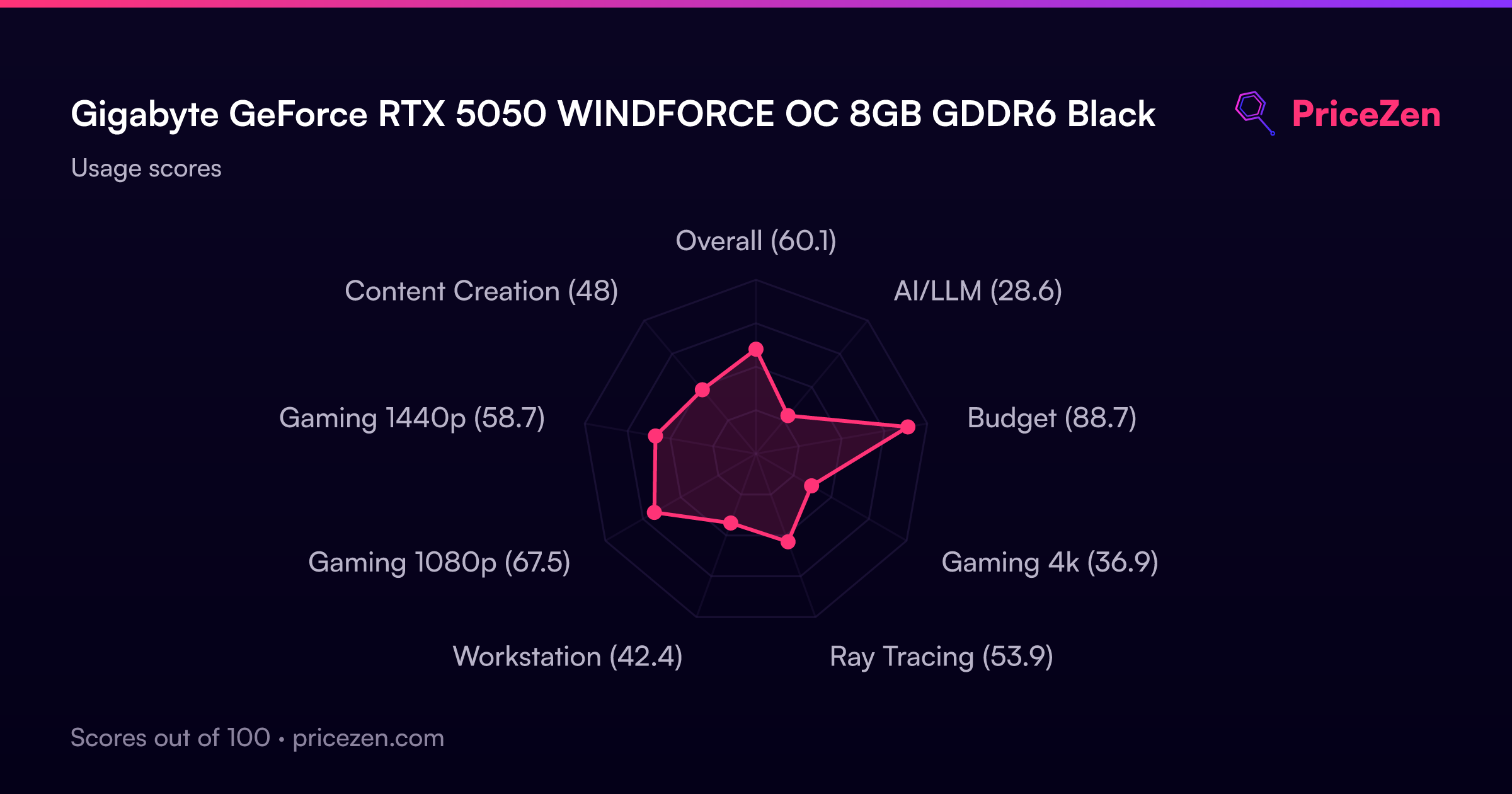
- Overall60.1
- AI/LLM28.6
- Budget88.7
- Gaming 4k36.9
- Ray Tracing53.9
- Workstation42.4
- Gaming 1080p67.5
- Gaming 1440p58.7
- Content Creation48