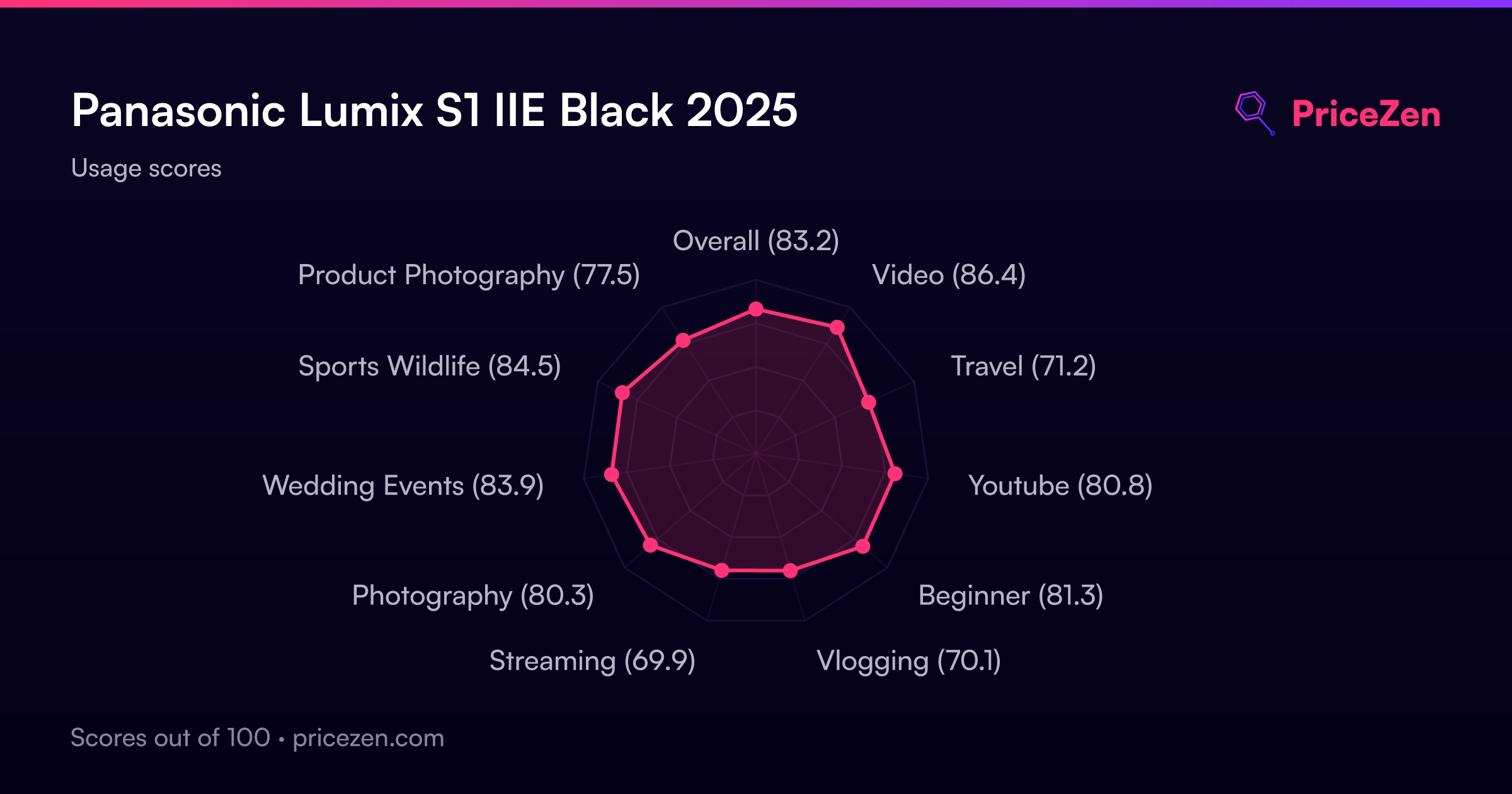
Panasonic Lumix S1 IIE Black 2025
The 24.1MP BSI CMOS sensor pairs with 6K open gate video and internal 4:2:2 10-bit recording, while the 8-stop IBIS and 30fps burst keep it steady and fast. The blackout-free 5.8M-dot OLED viewfinder and dual CFx Type B and SD slots add pro-level flexibility without flagship weight or cost. Best for hybrid shooters who need strong video and photo performance in a lighter, more affordable body.

No current retailer price


Snapshot
The 30-Second Version
The S1 IIE is a video beast with best-in-class stabilization at a price that makes flagship cameras nervous. Skip it if you need battery life or weather sealing, but for everyone else, this is the hybrid camera to beat.
Pros & Cons
Pros
- Best-in-class 8-stop IBIS 98th
- 6K open gate video with 10-bit internal recording 98th
- Autofocus that actually keeps up with fast subjects 97th
- Blackout-free EVF with 5.8M dots 97th
- Compact body without sacrificing pro features
Cons
- Battery life is mediocre at best
- No weather sealing at this price is annoying
- Smaller body than the original S1, some shooters will hate it
- Steep learning curve for the feature set
What owners think
The Word on the Street
How owner sentiment changed over time
ExclusiveBased on when customers actually wrote their reviews - so you can see whether early praise held up.
7 written reviews, Jul 2025 – Sep 2026: 7 happy
Across all 15 store ratings: 4.7★. Most owners rate without writing a review. The chart counts the 7 written reviews.
Each dot is one written review, in the month it was written. Happy = 4-5★, mixed = 3★, unhappy = 1-2★.
The proof
Performance
The stabilization is the real story here. Eight stops of IBIS puts this in the absolute best tier of any camera we've tracked, and it shows when you're shooting handheld video or grabbing shots in garbage light. Autofocus is right up there too, with 779 points and subject detection that actually keeps up. The 24.1MP sensor is solid but not spectacular, sitting right around average for full-frame. Burst shooting at 30fps is impressive on paper, though the buffer will make you wait if you lean on it hard. What surprised us most is how much camera Panasonic packed into 712 grams. It feels dense in a good way, like they stripped the fat but kept the muscle.
Specifications
Full Specifications
Sensor
| Type | BSI CMOS |
| Size | full-frame |
| Megapixels | 24.1 MP |
| ISO Range | 100 |
| Processor | LUMIX color science |
Autofocus
| AF Points | 779 |
| AF Type | Photo, VideoContrast Detection, Phase Detection: 779 |
| Eye AF | Yes |
| Animal AF | Yes |
| Subject Detection | Yes |
Shooting
| Burst (Mechanical) | 30 |
| Burst (Electronic) | 30 |
| Max Shutter | 1/2000 |
| Electronic Shutter | Yes |
Video
| Max Resolution | 6K |
| 4K FPS | 60 |
| 1080p FPS | 120 |
| 10-bit | Yes |
| Log Profile | Yes |
| RAW Video | Yes |
| Codec | H.265, H.264, ProRes RAW, ProRes RAW HQ |
Display & EVF
| Screen Size | 3" |
| Touchscreen | Yes |
| Articulating | Yes |
| EVF Resolution | 5.76 M dots |
Build
| Weather Sealed | Yes |
| Weight | 0.7 kg / 1.6 lbs |
Connectivity
| Wi-Fi | Yes |
| Bluetooth | Yes |
| USB | USB-C |
| HDMI | ✓ |
| Hot Shoe | Yes |
vs Competition
The Sony Alpha a1 II and Nikon Z9 are the obvious heavyweights here, but they cost dramatically more and weigh significantly more too. The Canon EOS R6 Mark III is the closest direct competitor, and it's a genuine toss-up depending on whether you prefer Canon's color science or Panasonic's video features. The Fujifilm X-H2 is cheaper and has more megapixels, but it's APS-C, so you're giving up that full-frame look. If video is your priority, the S1 IIE beats everything in its price class. If you need weather sealing and battery life for outdoor work, the Canon or Nikon are safer bets.
| Spec | Panasonic Lumix S1 IIE | Sony Alpha a7R VI | Fujifilm X-H2 | Nikon Z8 | OM System OM-1 Mark II | Canon EOS R6 Mark III |
|---|---|---|---|---|---|---|
| Type | mirrorless | mirrorless | mirrorless | mirrorless | mirrorless | mirrorless |
| Sensor | 24.1MP full-frame | 66.8MP full-frame | 40.2MP aps-c | 45.7MP full-frame | 20.4MP micro-four-thirds | 32.5MP full-frame |
| AF Points | 779 | 759 | 425 | 493 | 1053 | 1053 |
| Burst FPS | 30 | 30 | 15 | 30 | 120 | 40 |
| Video | 6K @60fps | 8K @120fps | 8K @60fps | 8K @120fps | 4K @60fps | 8K @120fps |
| IBIS | true | true | true | true | true | true |
| Weather Sealed | true | false | true | true | true | true |
| Weight (g) | 712 | 621 | 579 | 820 | 511 | 608 |
| Compare | Compare | Compare | Compare | Compare |
| Product | AF | EVF | Build | Burst | Video | Sensor | Battery | Display | User Sentiment | Social Proof | Affordability | Stabilization |
|---|---|---|---|---|---|---|---|---|---|---|---|---|
| Panasonic Lumix S1 IIE | 97.7 | 96 | 96.5 | 88.1 | 92.8 | 50.3 | 46.1 | 97 | 85.3 | 51.5 | 28.5 | 98.4 |
| Sony Alpha a7R VI Compare | 96.6 | 98.9 | 76 | 88.1 | 98.8 | 80.7 | 96.6 | 97.9 | 95.4 | 97.7 | 13 | 99.5 |
| Fujifilm X-H2 Compare | 91.6 | 96.4 | 93.4 | 79.4 | 94.6 | 98.9 | 97.4 | 83.4 | 85.3 | 88.5 | 29.7 | 95.6 |
| Nikon Z8 Compare | 92.8 | 90.6 | 97.5 | 94.9 | 99 | 67.2 | 89 | 97.6 | 85.3 | 97.7 | 16.8 | 87.7 |
| OM System OM-1 Mark II Compare | 98.7 | 99.8 | 90.2 | 99.4 | 83.8 | 46.6 | 95.4 | 95.8 | 85.3 | 88.5 | 28.3 | 99.5 |
| Canon EOS R6 Mark III Compare | 98.7 | 89.9 | 94 | 90.9 | 89.6 | 61.9 | 97 | 95.8 | 69.4 | 93.5 | 18.4 | 99.5 |
Price
Value & Pricing
Here's where it gets interesting. US prices swing from $2,098 to $2,875 depending on where you shop, and that's a $777 spread you should absolutely pay attention to. The best deal we're seeing is at the lower end of that range, and at $2,098 this thing is a steal for what you get. Canadian buyers face an even wilder spread, from CAD 2,698 to CAD 5,791, so shop around before you commit. At the low end, this is one of the best hybrid values on the market. At the high end, you're paying flagship money for a camera that isn't quite flagship.
Read more
Overview
The Panasonic Lumix S1 IIE is the camera for people who want flagship video chops without the flagship price tag. You get 6K open gate recording, 10-bit internal capture, and one of the best stabilization systems we've ever tested, all in a body that won't break your back or your bank account. The one thing to know? This is a video-first camera that happens to take great photos, not the other way around.
Common Questions
Q: Is the S1 IIE good for video?
Yes, it's one of the best video cameras at this price. You get 6K open gate, 10-bit internal recording, and RAW output. The stabilization alone makes it worth it for handheld shooters.
Q: Does it have weather sealing?
No, and that's a real miss at this price. If you shoot in rain, dust, or harsh conditions, look at the Canon R6 Mark III or Nikon Z9 instead.
Q: Is the autofocus reliable?
It's a massive improvement over older Panasonic bodies. The 779-point phase hybrid system with subject detection is among the best we've tested, though it's not quite Sony-level in low light.
Who Should Skip This
If you're a travel photographer or someone who shoots outdoors in rough conditions, this isn't your camera. No weather sealing and mediocre battery life will drive you nuts. Go grab a Canon EOS R6 Mark III or Nikon Z9 instead. And if you're a stills-only shooter who never touches video, you're paying for features you won't use, so save your money and get something like the Fujifilm X-H2.
Verdict
Buy it if video is your main game and you want pro-level features without selling a kidney. The S1 IIE delivers image quality and stabilization that punch way above its price point, and the autofocus improvements over older Panasonic bodies are real. Just know what you're getting into: battery life is rough, there's no weather sealing, and the smaller body won't please everyone. For hybrid shooters who can live with those trade-offs, this is one of the best values in full-frame right now.
Usage Scores
- Overall85.7
- Video87.7
- Travel71.7
- Youtube81.5
- Beginner82.8
- Vlogging70.3
- Streaming70.3
- Photography80.7
- Wedding Events84.7
- Sports Wildlife84.8
- Product Photography78.4